
Why Are the Catholic Ten Commandments Numbered Differently from the Protestant Ones?
Did Catholics delete the commandment against images? No. Both lists come from the same Bible verses, divided differently. Here is why, with the history and both lists side by side.
If you were raised Protestant, you may have been told that Catholics deleted the second commandment, the one against graven images, to hide their idolatry, and then split the last commandment in two so there would still be ten. If you are Catholic, you may have been puzzled when a Protestant friend recited a list that did not match yours, or when “the fourth commandment” meant something different to each of you. The truth is much less dramatic. Catholics and Protestants have exactly the same commandments, taken from exactly the same Bible passages. The only difference is how the text is divided into ten. This article explains the two ways of counting, where each comes from, why the Catholic way has a good biblical basis, why the charge of deletion is false, the honest history of conflict over images, and how Christians have always used the commandments.
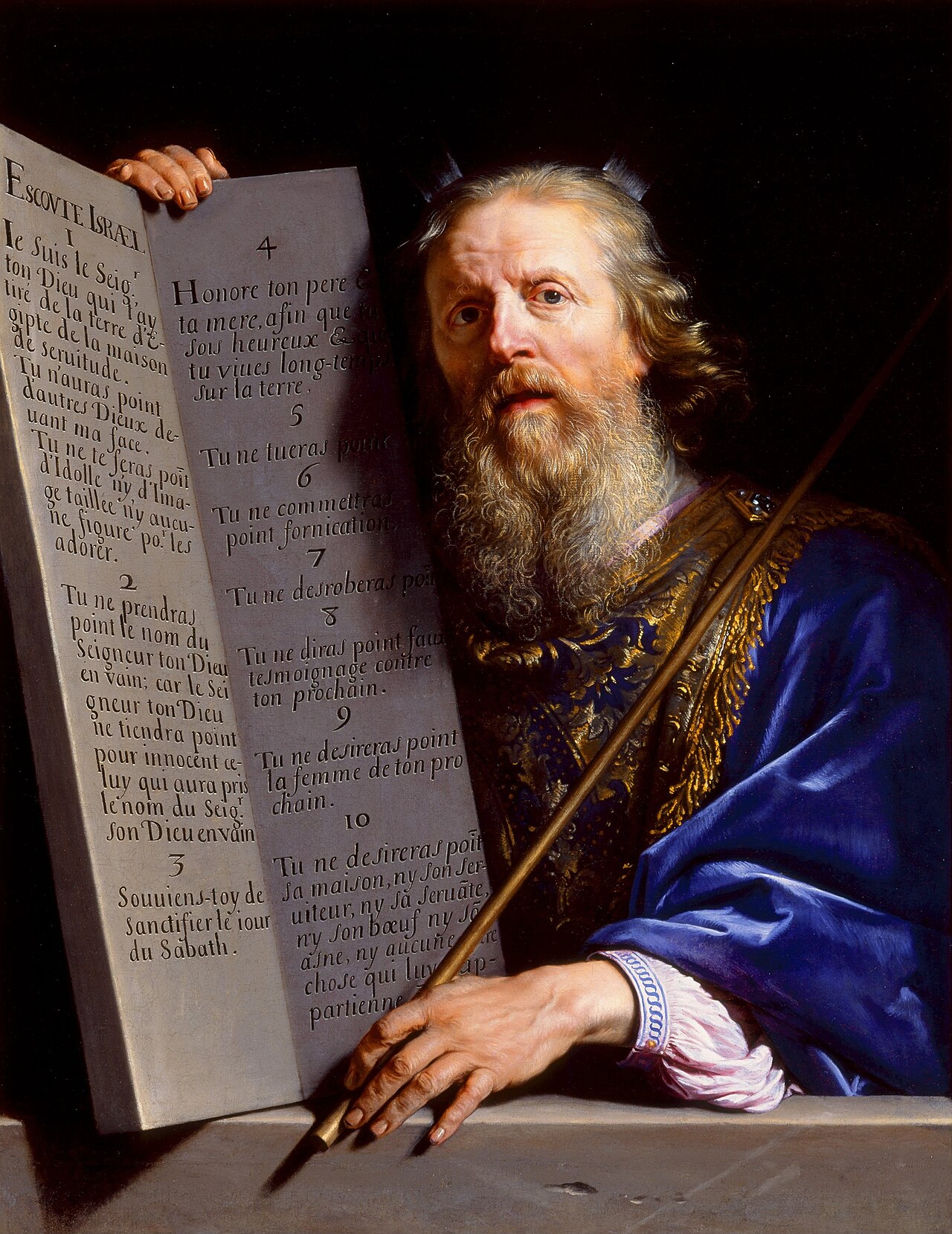
1. Same commandments, different division
The Ten Commandments appear twice in the Bible: in Exodus 20:1-17, when God speaks them from Mount Sinai, and in Deuteronomy 5:6-21, when Moses repeats them to the people before they enter the promised land. In both places, the text runs for more than a dozen verses without any numbers. The Bible never says “first commandment”, “second commandment” and so on.
What the Bible does say is that there were ten. Moses told Israel that God “declared to you his covenant, which he commanded you to do, and the ten words that he wrote in two tables of stone” (Deuteronomy 4:13). The phrase “ten words” (in Greek, deka logoi, hence “Decalogue”) tells us the total, but not where each one begins and ends.
Because the passage contains more than ten separate statements, Jews and Christians have divided it in different ways. Around 419, St Augustine of Hippo weighed up the possibilities carefully in his Questions on Exodus (71). He chose the division that Catholics, and also Lutherans, still use today.
Here are the two common Christian lists, in short form:
Catholic and Lutheran: 1. I am the Lord your God; you shall have no other gods before me (including the ban on idols). 2. You shall not take the name of the Lord your God in vain. 3. Remember to keep holy the Lord’s Day. 4. Honour your father and mother. 5. You shall not kill. 6. You shall not commit adultery. 7. You shall not steal. 8. You shall not bear false witness. 9. You shall not covet your neighbour’s wife. 10. You shall not covet your neighbour’s goods.
Reformed, Anglican and most other Protestant (and Orthodox): 1. No other gods. 2. No graven images. 3. Name of the Lord. 4. Sabbath. 5. Parents. 6. Killing. 7. Adultery. 8. Stealing. 9. False witness. 10. Coveting (wife and goods together).
2. Who counts which way
The two lists differ in only two places. Catholics and Lutherans treat the ban on making idols as part of the first commandment (against false gods), and they count two commandments about coveting: one against coveting a neighbour’s wife and one against coveting his goods. Most other Protestants reverse this: they count the ban on images as a separate second commandment, and join the two coveting clauses into one tenth commandment. Everything in between is shifted by one.
This was never simply a Catholic-against-Protestant difference. Martin Luther’s Small Catechism of 1529, which millions of Lutherans have learned by heart, uses exactly the Catholic numbering. A Lutheran child and a Catholic child recite the same list.
The other numbering was adopted by the Reformed (Calvinist) churches. The Heidelberg Catechism of 1563, the most widely used Reformed catechism, counts the ban on images as a separate second commandment and teaches on it at length (questions 96-98). The Church of England and most later Protestant traditions followed this pattern.
Jewish tradition, interestingly, counts in a third way. Most Jews treat the opening words, “I am the Lord thy God, who brought thee out of the land of Egypt” (Exodus 20:2), as the first of the ten “words”, even though it is a statement rather than a command. They then combine the ban on other gods and on idols into the second. This tradition is recorded in ancient rabbinic writings such as the Mekhilta and the Babylonian Talmud (Makkot 24a).
3. Both systems are ancient
Neither system is a late invention. Both have roots in the first centuries of the Christian era.
The division that separates the ban on images as the second commandment goes back to Greek-speaking Jews. Philo of Alexandria, a Jewish philosopher who lived at the same time as Jesus, wrote a treatise On the Decalogue around AD 40, in which he treated the ban on images as the second commandment.
Early Greek Christian writers followed Philo’s pattern. Origen of Alexandria, the great third-century biblical scholar, used it when he preached on the Ten Commandments around 240 (Homilies on Exodus 8). The Orthodox churches still number the commandments this way.
St Augustine’s division became standard in the Latin West. Around 1150 the theologian Peter Lombard, a teacher at Paris who later became its bishop, adopted Augustine’s division in his Sentences (Book 3, distinction 37), the standard theology textbook of the Middle Ages. Every university student for four centuries learned it, including Martin Luther, which explains why he kept it.
4. Augustine’s division has a biblical basis
Augustine had good reasons for his division, and they come from the text itself.
In Exodus, the final commandment reads: “Thou shalt not covet thy neighbour’s house: neither shalt thou desire his wife, nor his servant, nor his handmaid, nor his ox, nor his ass, nor any thing that is his” (Exodus 20:17). Here the house comes first, and the wife is listed with other possessions.
But in Deuteronomy, the order and wording change. “Thou shalt not covet thy neighbour’s wife: nor his house, nor his field, nor his manservant…” (Deuteronomy 5:21). The neighbour’s wife is named first and on her own. And in the Hebrew, a different verb is used for desiring the wife (tachmod) and for desiring the house and goods (titaweh). Augustine argued from the separate naming of the wife that the two are distinct commandments, and later commentators have pointed to the two Hebrew verbs as well.
They are also distinct sins, with different roots. The Bible’s most famous story of coveting a neighbour’s wife is King David’s desire for Bathsheba, wife of his loyal soldier Uriah. David’s lust led him to adultery and then to arranging Uriah’s death in battle (2 Samuel 11). The Bible’s most famous story of coveting a neighbour’s goods is King Ahab’s desire for Naboth’s vineyard, next to his palace. When Naboth refused to sell his family inheritance, Ahab sulked on his bed and refused to eat, until his wife Jezebel had Naboth falsely accused of blasphemy and stoned to death (1 Kings 21:1-16). Lust and greed are different temptations, and the Catholic numbering keeps them apart.
5. Catholics did not delete anything
The charge that Catholics removed the second commandment to hide idolatry is simply false. The words about images are printed in full in every Catholic Bible and explained in every major Catholic catechism.
The Douay-Rheims Bible, translated by English Catholic exiles and published in 1609, prints Exodus 20:4 in full: “Thou shalt not make to thyself a graven thing, nor the likeness of any thing that is in heaven above, or in the earth beneath, nor of those things that are in the waters under the earth.” Any Catholic reading the Bible has always been able to read it.
The Roman Catechism, issued in 1566 after the Council of Trent for the instruction of parish priests, explains the ban on images at length under the first commandment, carefully distinguishing idolatry from the legitimate use of sacred images.
The modern Catechism of the Catholic Church (1992) sets out the complete texts of the commandments from both Exodus and Deuteronomy, in parallel columns, at the beginning of its section on the commandments, beside the short “traditional catechetical formula” that children memorise. The short formula abbreviates every commandment, not only the first; for example, the Sabbath commandment is shortened from four verses to a single line.
6. What the commandment forbids
Since the Catholic Church teaches the commandment against graven images in full, how does it justify statues, crucifixes and stained glass? The answer is that the commandment forbids making idols to worship as gods; it does not forbid religious art, which God himself commanded.
Only five chapters after the Ten Commandments were given at Sinai, God ordered Moses to make two cherubim of beaten gold for the cover of the Ark of the Covenant, their wings spread out over it, facing each other (Exodus 25:18-22). The holiest object in Israel’s worship was decorated with images of heavenly beings.
Later, when the Israelites in the desert were bitten by poisonous snakes, God told Moses to make a bronze serpent and set it on a pole, so that anyone who looked at it would live (Numbers 21:8-9). Centuries later, when the people of Judah began burning incense to that same bronze serpent as if it were a god, King Hezekiah broke it in pieces (2 Kings 18:4). The same object could be a sign of God’s mercy or an idol, depending on how it was used.
In 787, the Second Council of Nicaea, accepted by Catholics and Orthodox alike, explained the principle: the honour shown to an image passes to the person it represents, while true adoration (latreia) belongs to God alone. For more, see our article Why Do Catholics Have Statues? Is It Idolatry?
7. Protestant caution has real grounds
Catholics should recognise that Protestant caution about images has real grounds. Popular devotion has sometimes slid into superstition, and the Catholic Church itself has admitted it.
In December 1563, the Council of Trent ordered bishops to root out every superstition connected with images, to remove anything that might suggest that divinity or power resides in the images themselves, and to forbid anything that might mislead the uneducated. The council would not have issued such orders if the problem had not been real.
Protestant reformers acted on their convictions in dramatic ways. In Zurich, following the preaching of Huldrych Zwingli, the city council decided in June 1524 to remove all images from the city’s churches. Teams of councillors, clergy and craftsmen went from church to church, locking the doors behind them. According to the reformer Heinrich Bullinger, within thirteen days every church in the city had been cleared of statues and paintings, and the walls whitewashed.
Elsewhere the removal was violent. In August 1566, in what the Dutch call the Beeldenstorm (“statue storm”), crowds swept through hundreds of churches and monasteries across the Low Countries in a few weeks, smashing statues, altars, stained glass and organs. Those who took part believed they were obeying the second commandment as they numbered it.
8. Say which list you are using
Because of the different numbering, Christians can talk past each other. “Breaking the fourth commandment” means dishonouring your parents to a Catholic, but breaking the Sabbath to a Presbyterian. The difference has even caused real conflict, so it is wise to say which list you are using.
In the nineteenth century, many American public schools required pupils to recite the Ten Commandments in the Protestant form from the King James Bible. On 14 March 1859, at the Eliot School in Boston, an eleven-year-old Catholic boy named Thomas Whall refused, on his priest’s instructions, to recite the Protestant version. His teacher beat his hands with a rattan cane for about half an hour until they bled. Hundreds of Catholic pupils walked out in protest, and the “Eliot School Rebellion” helped spur the growth of Catholic schools in the city.
The question still arises today. In 2005, in Van Orden v. Perry, the US Supreme Court allowed a monument to the Ten Commandments to remain in the grounds of the Texas State Capitol. The text on the monument had been drafted decades earlier with input from Jewish, Protestant and Catholic advisers, to avoid favouring any one tradition’s wording or numbering.
On 19 June 2024 the Governor of Louisiana signed House Bill 71, requiring a prescribed version of the Ten Commandments to be displayed in every public school classroom in the state. Among the objections raised by opponents was that different faiths number and word the commandments differently, so that any single version favours one tradition. The law was immediately challenged in the courts.
9. Jesus and the commandments
Whatever the numbering, Jesus confirmed the commandments, summed them up in love of God and neighbour, and the Church has always taught them to ordinary people.
When a rich young man asked Jesus what he must do to gain eternal life, Jesus told him to keep the commandments, and listed several: “Thou shalt do no murder, Thou shalt not commit adultery, Thou shalt not steal, Thou shalt not bear false witness, Honour thy father and thy mother” (Matthew 19:18-19). He listed them in an order of his own, which shows that the point is the commandments themselves, not their numbers.
When a lawyer asked which commandment was the greatest, Jesus replied: love God with all your heart, soul and mind, and love your neighbour as yourself. “On these two commandments dependeth the whole law and the prophets” (Matthew 22:37-40). Both the Catholic and Protestant lists divide naturally into two parts: duties to God and duties to neighbour, traditionally said to correspond to the two stone tablets.
The Church has always worked to teach the commandments to ordinary people. In 1281, Archbishop John Pecham of Canterbury held a council at Lambeth, which ordered every parish priest in England to explain the Ten Commandments, along with the Creed, the works of mercy, the seven deadly sins and the sacraments, to his people in their own language four times a year.
10. Use them as Christians always have
The best thing to do is to read both Bible passages, Exodus 20 and Deuteronomy 5, for yourself. Then use the commandments as Christians always have: not as a list to argue about, but as a mirror for examining your conscience and a path back to God.
The Bible itself shows the power of the commandments heard afresh. In the reign of King Josiah, workers repairing the Temple in Jerusalem found a forgotten “book of the law”. When it was read aloud to the king, he tore his clothes in grief at how far the nation had strayed. He gathered all the people, read the whole book to them, and led them in renewing the covenant with God (2 Kings 22-23).
In the last Lent of his life, in 1273, St Thomas Aquinas, the greatest theologian of the Middle Ages, preached a series of sermons on the Ten Commandments to ordinary people in Naples, speaking not in scholarly Latin but in his native Italian dialect. The theologian who wrote the Summa thought nothing more important than helping ordinary people live God’s law.
On 26 February 2000, during his Jubilee pilgrimage in the footsteps of Moses, Pope John Paul II prayed at the foot of Mount Sinai, at the ancient St Catherine’s Monastery. In his homily he presented the Ten Commandments not as the arbitrary demands of a tyrant but as God’s gift, which protects human freedom from the slavery of sin and points the way to true life.
In practice, Catholics most often meet the commandments before confession. Many prayer books and parish leaflets set out an “examination of conscience” built on the ten: Have I put anything, money, success, a relationship, in God’s place? Have I used God’s name carelessly or in anger? Have I kept Sunday as a day for God and for rest? Have I honoured and cared for my parents? Have I harmed anyone by violence, cruelty or harsh words? Have I been faithful in thought and deed? Have I taken what is not mine, or been dishonest at work? Have I lied, gossiped or damaged someone’s good name? Have I let envy or lust take root in my heart? A Protestant using the other numbering would ask exactly the same questions, in a slightly different order. That, in the end, is the best answer to the whole question: the numbers differ, but the commandments, and the God who gave them, are the same.
Frequently asked questions
Did the Catholic Church remove the second commandment? No. The words about images are in every Catholic Bible and explained in Catholic catechisms. Catholics count them as part of the first commandment.
Why do Catholics have two commandments about coveting? Following Deuteronomy 5:21, St Augustine distinguished coveting a neighbour’s wife from coveting his goods. Lutherans count the same way.
Is “keep holy the Lord’s Day” the same as the Sabbath? The commandment concerns the Sabbath; Christians keep it on Sunday, the day of the Resurrection. See Why Do Catholics Worship on Sunday Instead of Saturday?
Which numbering is correct? Neither is “the” biblical one, because the Bible does not number the commandments. Both divide the same text faithfully.
Sources and further reading
- The Bible: Exodus 20:1-17; 25:18-22; Numbers 21:8-9; Deuteronomy 4:13; 5:6-21; 2 Samuel 11; 1 Kings 21:1-16; 2 Kings 18:4; 22-23; Matthew 19:16-22; 22:34-40.
- Catechism of the Catholic Church, 2052-2082 and the table preceding 2084.
- Roman Catechism (Catechism of the Council of Trent, 1566), Part III.
- Council of Trent, Session 25 (1563), Decree on Sacred Images; Second Council of Nicaea (787).
- St Augustine, Questions on Exodus 71; Philo of Alexandria, On the Decalogue; Origen, Homilies on Exodus 8; Peter Lombard, Sentences III, d. 37.
- Martin Luther, Small Catechism (1529); Heidelberg Catechism (1563), questions 92-115.
- Heinrich Bullinger, Reformationsgeschichte, as quoted in Philip Schaff, History of the Christian Church, vol. 8, §19.
- Van Orden v. Perry, 545 U.S. 677 (2005); Louisiana House Bill 71 (2024).
- Council of Lambeth (1281), constitution Ignorantia sacerdotum.
