Why Do Catholics Worship on Sunday Instead of Saturday, the Sabbath?
Did Constantine or a pope change the Sabbath to Sunday? No. Christians gathered on Sunday from the start because Jesus rose that day. Here is the evidence, the Adventist case and the Catholic reply.
The fourth commandment (third, in the Catholic numbering) says: “Remember that thou keep holy the sabbath day” (Exodus 20:8). The Sabbath is the seventh day of the week: Saturday. Yet almost all Christians worship on Sunday, the first day. If you are a Seventh-day Adventist, a Seventh Day Baptist, or simply a careful Bible reader, you may have heard that the Emperor Constantine, or a pope, changed God’s holy day to a pagan “day of the Sun”, and that Christians who keep Sunday are following a human tradition rather than God’s command. This article explains why Catholics worship on Sunday: what the New Testament says, what the earliest Christians wrote long before Constantine, what Constantine actually did, how Catholics understand the commandment, the strongest Sabbatarian arguments and the Catholic reply, the Sunday obligation, the social value of a shared day of rest, and an invitation.
1. The Lord’s Day, the day of resurrection
Christians gather for worship on Sunday because Jesus rose from the dead on the first day of the week. Catholics do not think of Sunday as the Sabbath moved to a different day. It is something new: “the Lord’s Day”, the day of resurrection and new creation.
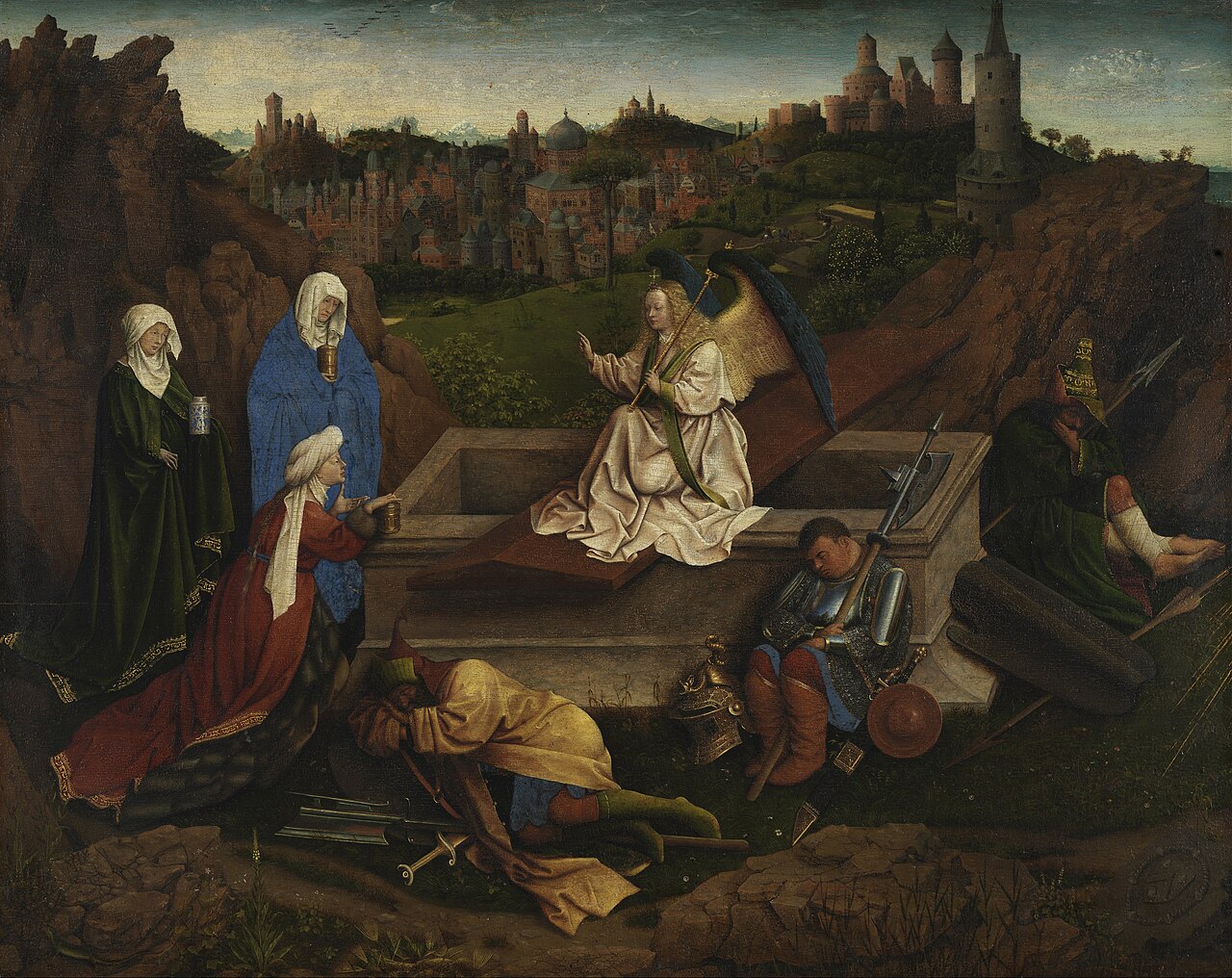
All four Gospels agree that the resurrection was discovered on the first day of the week. Mark tells us that when the Sabbath was over, Mary Magdalene, Mary the mother of James, and Salome bought spices to anoint Jesus’s body, “and very early in the morning, the first day of the week, they come to the sepulchre, the sun being now risen.” They found the stone rolled away, and a young man in white told them, “He is risen, he is not here” (Mark 16:1-6).
The risen Jesus chose that same day to meet his gathered disciples. John tells us that “when it was late that same day, the first of the week”, Jesus came and stood among them in the locked room and said, “Peace be to you.” Then, “after eight days”, meaning the following Sunday by the Jewish way of counting, the disciples were together again, Thomas with them, and Jesus appeared once more (John 20:19, 26).
Even the coming of the Holy Spirit fell on the first day. The Law of Moses fixed the feast of Pentecost (Weeks) on the day after the seventh Sabbath following Passover, “even unto the morrow of the seventh week be expired, that is to say, fifty days” (Leviticus 23:16). On the reckoning followed by the Temple priests and by Christian tradition, that day after the Sabbath is a Sunday. It was on this feast that “they were all together in one place” and the Holy Spirit came upon them (Acts 2:1-4).
2. The first day in the New Testament
The New Testament itself shows the first day of the week becoming the day of Christian assembly, while the apostles were still alive.
At Troas, on his third missionary journey, Paul met with the local Christians. Luke records: “on the first day of the week, when we were assembled to break bread, Paul discoursed with them, being to depart on the morrow; and he continued his speech until midnight” (Acts 20:7). “Breaking bread” was an early Christian term for the Eucharist. The Christians at Troas gathered on the first day to celebrate it.
Writing to the Corinthians about a collection for the poor Christians in Jerusalem, Paul instructed: “On the first day of the week let every one of you put apart with himself, laying up what it shall well please him; that when I come, the collections be not then to be made” (1 Corinthians 16:2). The first day was already the natural day for Christians to bring their offerings.
By the end of the first century, Christians had a name for it. The apostle John, exiled to the island of Patmos, begins the Book of Revelation: “I was in the spirit on the Lord’s day, and heard behind me a great voice, as of a trumpet” (Revelation 1:10). “The Lord’s day” (in Greek, kyriakē hēmera) became the standard Christian name for Sunday. In modern Greek, Sunday is still Kyriakí, and in Italian, Spanish and French, domenica, domingo and dimanche, all from the Latin dies Dominica, “the Lord’s day”.
3. Two centuries before Constantine
A common claim is that the Emperor Constantine invented Sunday worship in the fourth century. But Christian writers describe Sunday worship two hundred years before Constantine, so he cannot have invented it.
The Didache, a Christian church manual written around the year 100, perhaps even earlier, instructs: “On the Lord’s own day, gather yourselves together and break bread and give thanks, having first confessed your transgressions, that your sacrifice may be pure” (Didache 14).
Around 110, St Ignatius, bishop of Antioch, on his way to martyrdom in Rome, wrote to the Christians of Magnesia in Asia Minor. He described Christians who had been raised in Judaism but “came to the newness of hope, no longer keeping the Sabbath, but living according to the Lord’s day, on which also our life rose again through him” (Letter to the Magnesians 9). Within a generation of the apostles, Jewish Christians had moved from Sabbath to Sunday.
Around 155, St Justin Martyr, a philosopher who had become a Christian and taught in Rome, wrote a defence of Christianity addressed to the Emperor Antoninus Pius. He explained what Christians did each week: “on the day called Sunday, all who live in cities or in the country gather together to one place”, where the writings of the apostles and prophets are read, the presider preaches, prayers are offered and the Eucharist is celebrated. He gave the reason: “Sunday is the day on which we all hold our common assembly, because it is the first day on which God… made the world; and Jesus Christ our Saviour on the same day rose from the dead” (First Apology 67).
4. What Constantine actually did
So what did Constantine do? He made Sunday a civil day of rest in the Roman Empire. He did not invent Sunday worship, and for centuries many Christians continued to honour Saturday as well.
On 7 March 321, Constantine issued a law, preserved in the later Code of Justinian (3.12.2), ordering that “on the venerable day of the Sun” judges, city people and craftsmen should rest. He made an exception for farmers, who were allowed to work in the fields if the weather was right for sowing or harvesting. The law made it easier for Christians to worship on Sunday, but they had been doing so for nearly three centuries.
In fact, many Christians continued to keep Saturday as a special day too, long after Constantine. Around 364, a regional council of bishops at Laodicea in Asia Minor decreed that “Christians must not judaize by resting on the Sabbath, but must work on that day, rather honouring the Lord’s Day” (canon 29). The rule shows that some Christians were still resting on Saturday.
Around 440, the church historian Socrates of Constantinople noted that “although almost all churches throughout the world celebrate the sacred mysteries on the Sabbath of every week, yet the Christians of Alexandria and at Rome, on account of some ancient tradition, have ceased to do this” (Ecclesiastical History 5.22). For centuries, many Christians honoured both days.
5. The commandment’s meaning for Christians
How, then, do Catholics understand the commandment to keep the Sabbath holy? They hold that its moral core, to give God worship and to rest, still binds everyone. But the particular day, the seventh, belonged to the ceremonial law of the old covenant, which was fulfilled in Christ.
St Paul wrote to the Colossians: “Let no man therefore judge you in meat or in drink, or in respect of a festival day, or of the new moon, or of the sabbaths, which are a shadow of things to come, but the body is of Christ” (Colossians 2:16-17). Paul saw the Sabbath as a shadow pointing to Christ, who is the reality.
Jesus himself showed authority over the Sabbath. When the Pharisees criticised his hungry disciples for plucking ears of grain on the Sabbath, Jesus defended them, and declared: “The sabbath was made for man, and not man for the sabbath. Therefore the Son of man is Lord of the sabbath also” (Mark 2:27-28).
In the thirteenth century, St Thomas Aquinas explained the Catholic view carefully. The commandment to keep the Sabbath, he said, is partly moral and partly ceremonial. It is moral in that human beings should set aside some time to give to God; that obligation is permanent. It is ceremonial in that it fixed the seventh day in memory of creation; that detail belonged to the old covenant, and Christians now keep the Lord’s Day in memory of the new creation begun in the resurrection (Summa Theologiae II-II, q. 122, a. 4).
6. The Sabbath-keepers’ case
Christians who keep Saturday as the Sabbath have serious arguments, and they deserve a fair hearing. They argue that the seventh day was blessed by God at creation, before there were any Jews; that Jesus kept it; and that Scripture never explicitly revokes it.
The Sabbath goes back to creation. “On the seventh day God ended his work which he had made: and he rested on the seventh day… And he blessed the seventh day, and sanctified it” (Genesis 2:2-3). When God gave the Ten Commandments at Sinai, he appealed to that creation rest: “in six days the Lord made heaven and earth… and rested on the seventh day: therefore the Lord blessed the seventh day, and sanctified it” (Exodus 20:11). Sabbatarians argue that a commandment rooted in creation applies to all people for all time.
Jesus kept the Sabbath. Luke says that he went to Nazareth and “went into the synagogue, according to his custom, on the sabbath day” (Luke 4:16). He healed on the Sabbath and debated how to keep it, but never abolished it.
The modern Seventh-day Adventist movement arose from these convictions. In 1846, Joseph Bates, a retired sea captain who had been a follower of William Miller, published a tract titled The Seventh Day Sabbath, a Perpetual Sign. It persuaded James and Ellen White, who became the leaders of the movement, to begin keeping Saturday as the Sabbath. Today the Seventh-day Adventist Church has over twenty million members, and is known for its health work, schools and hospitals.
7. The Catholic reply
The Catholic reply is that the resurrection began a new creation, and that the apostolic Church had authority to mark it with a new day.
The early Christians saw Sunday not simply as the first day of the week, but as the “eighth day”, the beginning of a new creation beyond the seven days of the old. Around 130, the Epistle of Barnabas, an early Christian writing, explained that God would make “a beginning of the eighth day, that is, a beginning of another world. Wherefore also we keep the eighth day for rejoicing, in the which also Jesus rose from the dead” (Barnabas 15).
St Paul also teaches that Christians should not condemn one another over days. “One man judgeth between day and day: and another judgeth every day: let every man abound in his own sense… He that regardeth the day, regardeth it unto the Lord” (Romans 14:5-6). Catholics read this as allowing different practices, while the Church as a whole gathers on the Lord’s Day.
Catholics are honest that the Bible contains no explicit command to move worship to Sunday. In 1876, James Gibbons, later Cardinal Archbishop of Baltimore, wrote in his popular book The Faith of Our Fathers that one may read the Bible from Genesis to Revelation and not find a single line authorising the sanctification of Sunday. He argued that this showed the need for the Church’s authority and Tradition alongside Scripture. Adventists still quote his words to show that Sunday rests on human authority. Catholics see it rather as an example of how the apostolic Church, guided by the Spirit, faithfully developed what the New Testament shows in seed. See Why Don’t Catholics Go by the Bible Alone?
8. The Sunday obligation
Church law obliges Catholics to attend Mass on Sundays and holy days, and to rest from unnecessary work, a duty with ancient roots.
In 304, during the last great Roman persecution, forty-nine Christians in the North African town of Abitinae were arrested for gathering to celebrate the Sunday Eucharist, which the Emperor Diocletian had forbidden. When the proconsul asked why they had disobeyed, one of them, Emeritus, in whose house they had met, replied: “We cannot live without the Lord’s Day” (sine dominico non possumus). They were tortured, and died for their faith.
Early Church law treated Sunday worship as a serious obligation. Around 305, a council of bishops at Elvira in Spain ruled that anyone living in a town who missed church for three Sundays in a row should be excluded from Communion for a short time, as a correction (canon 21).
On 31 May 1998, Pope John Paul II wrote an apostolic letter, Dies Domini (“The Day of the Lord”), urging Catholics to rediscover the meaning of Sunday. He restated the obligation to attend Mass, but presented Sunday above all as a gift: a day of joy, rest, family, charity and encounter with the risen Christ. The Catechism teaches that Catholics who deliberately miss Sunday Mass without a serious reason commit a grave sin (CCC 2181), but that illness, care for infants and similar reasons excuse.
9. A shared day of rest is good for everyone
A shared weekly day of rest is good not only for worshippers, but for workers and families. Societies that tried to abolish it soon gave up.
The Sabbath law in Deuteronomy extended rest to everyone in the household, not just to free men: “thou shalt not do any work therein, thou nor thy son nor thy daughter, nor thy manservant nor thy maidservant, nor thy ox, nor thy ass… and the stranger that is within thy gates.” And it gave a reason: “Remember that thou also wast a servant in Egypt” (Deuteronomy 5:14-15). The weekly day of rest was a memorial of freedom from slavery.
After the French Revolution, the revolutionary government abolished the Christian calendar. In 1793 it introduced a new republican calendar, with ten-day weeks called décades, so that workers rested only every tenth day instead of every seventh. It was deeply unpopular. Napoleon restored the Gregorian calendar, with its seven-day week and Sunday, from 1 January 1806.
Some Christians have made great sacrifices to keep Sunday holy. In 1924, Eric Liddell, a Scottish athlete and devout Christian, was one of the favourites for the 100 metres at the Paris Olympics. When he learned that the heats would be run on a Sunday, he refused to run, because he believed Sunday was the Lord’s Day. He entered the 400 metres instead, an event for which he was not expected to win, and won the gold medal in a world-record time. His story was told in the film Chariots of Fire. Liddell later died as a missionary in a Japanese internment camp in China in 1945.
10. Come on a Sunday
The best way to understand the Lord’s Day is to come to a Catholic Mass on a Sunday, and see Scripture opened and bread broken, as the first Christians did, while respecting those Christians who keep Saturday holy.
On the very first Easter Sunday, two disciples were walking to the village of Emmaus when the risen Jesus joined them, unrecognised. He explained the Scriptures to them, and when they sat down to eat, “he took bread, and blessed, and brake, and gave to them. And their eyes were opened, and they knew him” (Luke 24:30-31). The pattern of every Sunday Mass, Word and Eucharist, is there on the first Lord’s Day.
The Second Vatican Council called Sunday “the original feast day”. By a tradition handed down from the apostles, it said, which took its origin from the very day of Christ’s resurrection, the Church celebrates the paschal mystery every eighth day, when the faithful gather to hear the word of God and take part in the Eucharist (Sacrosanctum Concilium 106).
Some Christians honour both days. The Ethiopian Orthodox Church, one of the oldest churches in the world, keeps both Saturday and Sunday holy. After long disputes in the fifteenth century between monks who kept the Saturday Sabbath and church leaders who did not, the Emperor Zara Yaqob summoned the Council of Debre Mitmaq in 1450, which approved the observance of both days. Christians who disagree about the day can still agree about the Lord who rose.
Frequently asked questions
Did the Pope change the Sabbath to Sunday? No. Christians were worshipping on Sunday in the first century, as the New Testament and the earliest Christian writings show.
Is Sunday the “Christian Sabbath”? Catholics call it the Lord’s Day. It fulfils the meaning of the Sabbath, rest and worship, but celebrates the new creation begun in the resurrection.
Can Catholics go to Mass on Saturday evening? Yes. A Mass celebrated on Saturday evening fulfils the Sunday obligation, because liturgically the day begins the evening before, as in Jewish custom (canon 1248).
Is it wrong to keep Saturday as the Sabbath? Catholics respect the conscience of Sabbath-keeping Christians, while believing that the Lord’s Day is the proper Christian day of worship.
You may also like Why Are the Catholic Ten Commandments Numbered Differently? and How to Find a Reverent Catholic Mass
Sources and further reading
- The Bible: Genesis 2:2-3; Exodus 20:8-11; Leviticus 23:15-16; Deuteronomy 5:12-15; Mark 2:23-28; 16:1-6; Luke 4:16; 24:13-35; John 20:19, 26; Acts 2:1; 20:7-12; Romans 14:5-6; 1 Corinthians 16:2; Colossians 2:16-17; Revelation 1:10.
- Catechism of the Catholic Church, 2168-2195.
- Second Vatican Council, Sacrosanctum Concilium 106; John Paul II, Dies Domini (1998); Code of Canon Law (1983), canons 1246-1248.
- Didache 14; St Ignatius, Letter to the Magnesians 9; Epistle of Barnabas 15; St Justin Martyr, First Apology 67; Acts of the Martyrs of Abitinae.
- Council of Elvira (c. 305), canon 21; Council of Laodicea (c. 364), canon 29; Code of Justinian 3.12.2; Socrates, Ecclesiastical History 5.22.
- St Thomas Aquinas, Summa Theologiae II-II, q. 122, a. 4.
- Joseph Bates, The Seventh Day Sabbath, a Perpetual Sign (1846); James Gibbons, The Faith of Our Fathers (1876).
- D. A. Carson (ed.), From Sabbath to Lord’s Day (1982).
