
Do Catholics Worship Mary? Honour, Veneration and Worship Explained
No, Catholics do not worship Mary. Here is the difference between worship and honour, why Catholics kneel before her statues, and what titles like Queen of Heaven mean.
No. Catholics worship God alone: the Father, the Son and the Holy Spirit. The Catholic Church teaches that giving Mary the worship that belongs only to God would be idolatry, which it counts among the gravest of sins. What Catholics give Mary is honour: a deep, loving respect for the woman God chose to be the mother of his Son. If you have seen Catholics kneeling before a statue of Mary, lighting candles, crowning her image with flowers or calling her “Queen of Heaven”, it is easy to see why the question arises. This article explains the difference between worship and honour, where Marian devotion comes from, the fair criticisms that have been made of it, and how to tell healthy devotion from unhealthy.
1. The plain answer: worship belongs to God alone
When Satan took Jesus to a high mountain, showed him all the kingdoms of the world and offered them to him in exchange for one act of worship, Jesus answered with a line from Deuteronomy: “The Lord thy God shalt thou adore, and him only shalt thou serve” (Matthew 4:10). Catholics take that sentence as absolute. No creature, not even the holiest, may receive the adoration owed to the Creator.
The Church has defended this line against people who crossed it, including people who were trying to honour Mary. Around the year 375, St Epiphanius of Salamis, a bishop on Cyprus, wrote about a strange sect in Arabia called the Collyridians. Its members, mostly women, baked small loaves or cakes and offered them to Mary as a sacrifice, in the way pagans offered cakes to goddesses. Epiphanius, who loved Mary, condemned them without hesitation. His summary is still the Catholic rule: let Mary be held in honour, but let the Father, Son and Holy Spirit be worshipped; let no one worship Mary (Panarion 79).
The Catechism of the Catholic Church says the same in modern language. Devotion to Mary, it says, “differs essentially from the adoration which is given to the incarnate Word and equally to the Father and the Holy Spirit” (CCC 971). The word “essentially” matters. The difference is not one of degree, as though Mary got a little less worship than God. It is a difference in kind.
2. Three different words for three different things
English has only one handy word, “worship”, and it has shifted meaning over time. (An old English marriage service even has the groom say to his bride, “with my body I thee worship”, meaning “honour”.) The Church, working in Greek and Latin, has always used separate words.
St Augustine drew the line around the year 400 in his long reply to Faustus, a teacher of the Manichean sect who accused Christians of turning martyrs into idols. Augustine answered that Christians honour the martyrs with love and fellowship, as holy people of God, but that they build altars and offer sacrifice to God alone, never to a martyr (Against Faustus 20.21).
In 787 the Second Council of Nicaea, which Catholics and Orthodox both accept, made the distinction official. It taught that the faithful may give images and saints an “honourable veneration” (in Greek, proskynesis), but that true worship, latreia, belongs to the divine nature alone.
In the thirteenth century St Thomas Aquinas gave the terms still used in Catholic theology. Latria is the adoration owed only to God. Dulia, from the Greek for “service”, is the honour given to the saints as God’s faithful servants. Hyperdulia, “higher honour”, is the special honour given to Mary because of her unique closeness to Christ (Summa Theologiae II-II, q. 103, a. 4). The key point is that hyperdulia is still dulia. It is the highest honour given to a creature, and it remains infinitely below the worship given to God.
3. Honouring Mary starts in the Bible
Catholics did not invent the honour paid to Mary. It begins in the first chapter of Luke’s Gospel.
When the pregnant Mary visited her cousin Elizabeth, Luke says Elizabeth was “filled with the Holy Ghost” and cried out with a loud voice: “Blessed art thou among women, and blessed is the fruit of thy womb.” She then asked why she should be so favoured “that the mother of my Lord should come to me” (Luke 1:41-43). The first person in the Gospels to honour Mary does so under the inspiration of the Holy Spirit, and her words became the opening of the Hail Mary.
Moments later, Mary herself made a prophecy: “from henceforth all generations shall call me blessed. Because he that is mighty hath done great things to me” (Luke 1:48-49). Catholics take her at her word. Calling Mary blessed is not an addition to Scripture but the fulfilment of a prophecy in it. And notice the reason she gives: not her own greatness, but what God has done for her.
The earliest Christian writers continued the theme. Around the year 155, St Justin Martyr, a philosopher who had become a Christian and taught in Rome, compared Mary with Eve. Eve, a virgin, listened to the serpent and brought forth disobedience and death; Mary, a virgin, listened to the angel and brought forth the One who destroys the serpent’s work (Dialogue with Trypho 100). The “new Eve” theme was repeated by St Irenaeus a generation later. From the beginning, Christians honoured Mary precisely because of her role in the story of salvation through Christ.
4. “Mother of God” is really a statement about Jesus
Few titles cause more alarm than “Mother of God”. To many Protestants it sounds as though Mary existed before God or gave God his divinity. Catholics mean neither.
St Paul wrote that “when the fulness of the time was come, God sent his Son, made of a woman” (Galatians 4:4). The person Mary carried and bore was the eternal Son of God, who took human nature from her. She is not the source of his divinity, but she is truly the mother of a person who is God.
In the early fifth century, Nestorius, the archbishop of Constantinople, objected to the Greek title Theotokos, “God-bearer”, preferring to call Mary “Christ-bearer”. The problem was that his position seemed to split Christ into two persons, a divine Son of God and a human son of Mary, loosely joined together. In 431 the Council of Ephesus upheld the title Theotokos, not mainly to exalt Mary but to protect the truth that Jesus is one person, fully God and fully man.
St Cyril of Alexandria, who led the council, left an unforgettable description of the day. In a letter home he reported that the people of Ephesus had waited from morning till evening for the decision. When they heard that Nestorius had been condemned and the title upheld, they burst into praise, and escorted the bishops back to their lodgings with torches and incense through the city (Cyril, Letter 24). For ordinary Christians, the title was a matter of defending who Jesus is.
5. Kneeling and bowing are not always worship
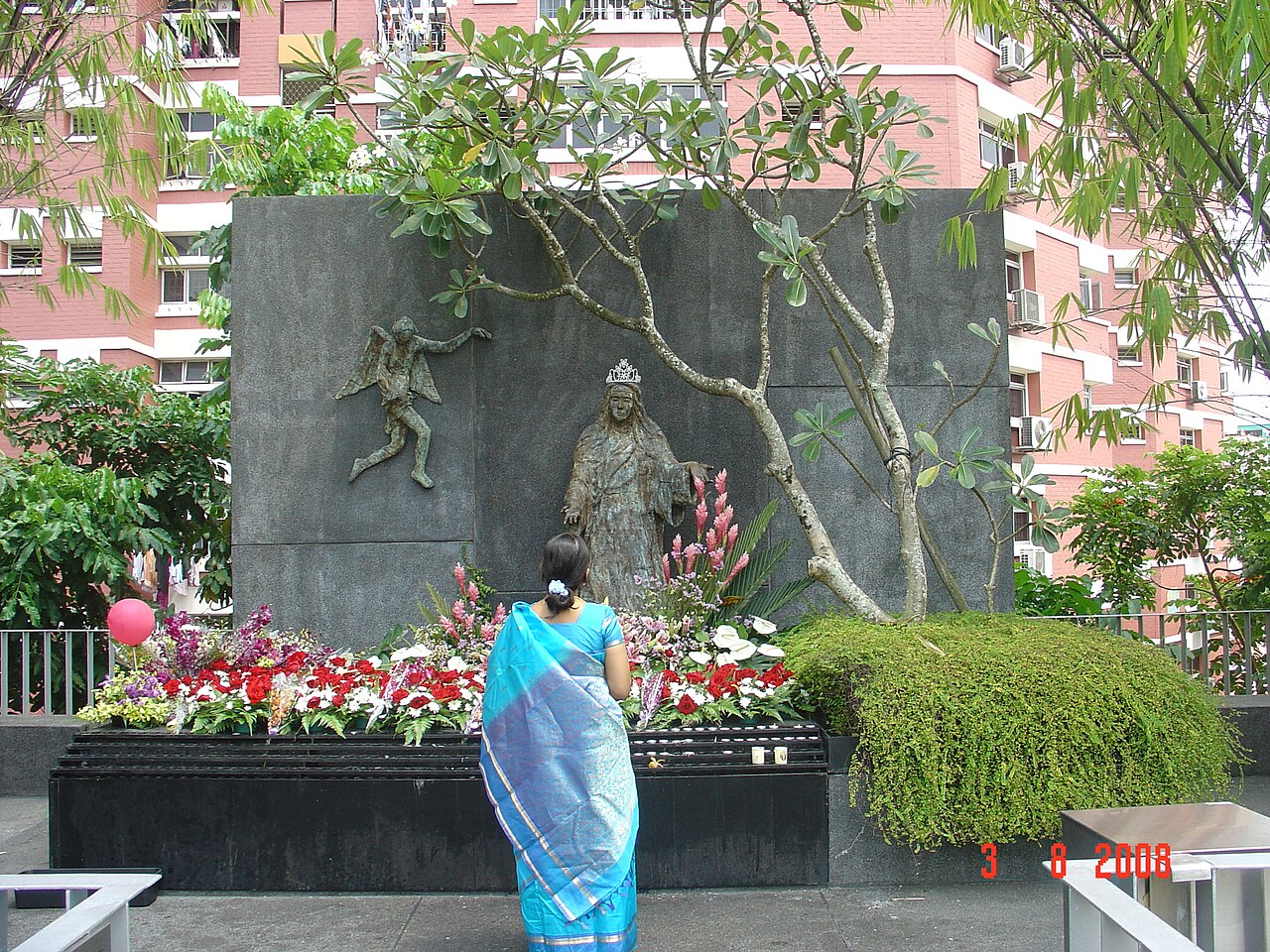
Much of the suspicion comes from what Catholics do with their bodies: kneeling before Mary’s statue, bowing, kissing an image, lighting candles, bringing flowers. Doesn’t that look like worship?
The Bible itself shows that these gestures can express honour to human beings without any idolatry. When Bathsheba came to see her son, King Solomon, “the king arose to meet her, and bowed to her, and sat down upon his throne: and a throne was set for the king’s mother, and she sat on his right hand” (1 Kings 2:19). Nobody thinks Solomon was worshipping his mother.
When Jacob returned home and went to meet his brother Esau, whom he had cheated years before, he “bowed himself to the ground seven times” as he approached (Genesis 33:3). It was a gesture of respect and reconciliation, not adoration.
St John of Damascus, a monk in Palestine who defended Christian images in the 730s, gathered example after example of such biblical bows: Abraham bowing to the sons of Heth, Joseph’s brothers bowing to Joseph, Nathan bowing to David. His point was that the same outward gesture can mean adoration when given to God and honour when given to a creature. What makes the difference is the intention of the heart and the teaching of the community.
In many cultures, including much of Asia, people bow, kneel or offer flowers before photographs of their parents or grandparents. Visitors from elsewhere may misunderstand, but those taking part know exactly what they mean. Catholic gestures before Mary’s image belong to the same family of human gestures.
6. The objection deserves a fair hearing
It would be unfair to pretend that the worry about Marian devotion comes only from ignorance. Serious Christians have raised it in good faith.
The Church of England’s Thirty-Nine Articles of 1571 rejected “invocation of saints” as “a fond thing vainly invented, and grounded upon no warranty of Scripture” (Article 22). Its authors had seen late-medieval practices that seemed to them to put Mary and the saints where Christ belonged.
Martin Luther is an interesting case, because he loved Mary. In 1521 he wrote a beautiful commentary on the Magnificat, Mary’s song of praise, calling her a model of humble faith. Yet in the same work he warned that Mary must never be made into an idol who gives what only God gives, and that she herself wants to direct all honour to God.
Remarkably, the Catholic Church has said something similar about its own members. The Second Vatican Council urged theologians and preachers to avoid “all false exaggeration” as well as excessive narrowness when speaking of Mary, and to avoid anything in word or deed that could mislead other Christians about the true doctrine of the Church (Lumen Gentium 67, 1964). The council added that true devotion consists neither in sterile emotion nor in a vain credulity, but comes from true faith and leads to imitation of Mary’s virtues. Catholics can admit that some popular piety has sometimes gone too far while insisting that the doctrine itself is sound.
7. “Queen of Heaven” and other titles
Some Marian titles sound alarming to anyone who knows their Old Testament. The prophet Jeremiah condemned families in Jerusalem in which “the children gather wood, and the fathers kindle the fire, and the women knead the dough, to make cakes to the queen of heaven” (Jeremiah 7:18). That “queen of heaven” was a pagan goddess, probably the Mesopotamian Ishtar or a Canaanite equivalent. Catholics condemn the worship of any goddess as firmly as Jeremiah did.
So what do Catholics mean when they sing the Regina Caeli? The answer lies in the royal imagery of the Bible. In ancient Israel the queen was not the king’s wife (kings often had several) but his mother, the gebirah or “great lady”, who sat at his right hand, as Bathsheba did. When Pope Pius XII instituted the feast of Mary’s Queenship in 1954, he grounded the title in Christ’s kingship: Mary is queen because she is the mother of the King and was uniquely associated with his saving work, and her dignity is wholly derived from his (Ad Caeli Reginam, 1954).
The Church also polices Marian titles that could mislead. On 4 November 2025 the Vatican’s Dicastery for the Doctrine of the Faith published a doctrinal note, Mater Populi Fidelis (“Mother of the Faithful People of God”), approved by Pope Leo XIV. It judged that it would not be appropriate to call Mary “Co-redemptrix”, because the title risks obscuring Christ’s unique role as Redeemer and can create confusion. Some Catholics had campaigned for decades to have the title defined as dogma. The Church said no, precisely to protect the uniqueness of Christ.
8. Every Marian doctrine says that Mary needed a Saviour
One simple test shows that Catholics do not treat Mary as divine: every single Catholic teaching about her presents her as a creature who depends on God.
Mary’s own song begins, “My soul doth magnify the Lord, and my spirit hath rejoiced in God my Saviour” (Luke 1:46-47). Only a creature needs a Saviour. Catholics sing that song every evening in the Church’s official prayer.
When Pope Pius IX defined the Immaculate Conception in 1854, the doctrine Protestants often cite as proof that Catholics exalt Mary too far, he stated that she was preserved from original sin “in view of the merits of Jesus Christ, the Saviour of the human race” (Ineffabilis Deus). Even Mary’s greatest privilege is a gift of Christ’s redemption, given to her in advance.
St Louis de Montfort, a French missionary priest who died in 1716, is often seen as the most ardent of all Marian writers. His True Devotion to Mary is the book most often blamed for “Mariolatry”. Yet near its very beginning he wrote that, compared with God’s infinite majesty, Mary is “less than an atom”, indeed nothing at all, since God alone is “He who is” (True Devotion 14). Pope St John Paul II took his own episcopal motto, Totus Tuus, from Montfort, and he too insisted that true devotion to Mary leads entirely to Christ.
9. Good devotion points to Jesus
How can an ordinary person tell sound Marian devotion from unsound? The best guide is Mary’s own last recorded words in the Gospels.
At the wedding in Cana, after telling Jesus the wine had run out, Mary turned to the servants and said, “Whatsoever he shall say to you, do ye” (John 2:5). She never speaks again in the Gospel narratives. Her final instruction to humanity is to obey her Son. Any devotion that leaves people more focused on Mary than on Jesus has missed her point.
When Pope John Paul II wrote about the Rosary in 2002, he called it a Christ-centred prayer, “a compendium of the Gospel”, and added five new “Luminous Mysteries” drawn from Jesus’s public ministry: his baptism, the wedding at Cana, his proclamation of the Kingdom, the Transfiguration and the institution of the Eucharist (Rosarium Virginis Mariae, 2002). Of the twenty mysteries now meditated on, every one is an event in the life of Christ or flows from it.
Many people assume that Catholics must believe in Marian apparitions such as Lourdes or Fatima. They do not. In 1862 Bishop Bertrand-Sévère Laurence of Tarbes declared, after years of investigation, that Mary had truly appeared to the young Bernadette Soubirous at Lourdes in 1858. Yet the Church classes all such appearances as “private revelation”, which may help people live the faith but adds nothing to it, and which no Catholic is obliged to accept (CCC 67). Public revelation ended with Christ and the apostles.
10. Read the texts and judge for yourself
The best way to test the Catholic claim is to read the key passages about Mary in the New Testament and ask whether honouring her leads towards her Son or away from him.
Start at the foot of the cross. As Jesus was dying, he saw his mother and the disciple whom he loved standing near. He said to his mother, “Woman, behold thy son”, and to the disciple, “Behold thy mother.” John adds that “from that hour, the disciple took her to his own” (John 19:26-27). Catholics see in this scene Jesus giving his mother to the whole Church, represented by the beloved disciple. The honour Catholics show her is the honour of children for the mother Jesus gave them.
Then look at the first days of the Church. After the Ascension, the apostles gathered in the upper room in Jerusalem to wait for the Holy Spirit, and Luke notes that they “were persevering with one mind in prayer with the women, and Mary the mother of Jesus” (Acts 1:14). Mary is not on a pedestal there. She is praying among the disciples, waiting for the Spirit like everyone else.
Finally, notice that Mary’s song is not only a Catholic treasure. When Thomas Cranmer, the Protestant archbishop of Canterbury, compiled the first Book of Common Prayer in 1549, he kept the Magnificat as a fixed part of Evening Prayer. To this day it is sung at Anglican Evensong in cathedrals across England, just as it is sung at Catholic Vespers. Christians who disagree about many things still join Mary in saying, “My soul doth magnify the Lord.”
Frequently asked questions
Why do Catholics kneel in front of statues of Mary? Kneeling is a posture of prayer. A Catholic kneeling before Mary’s statue is usually praying to God or asking Mary to pray for them. The statue is a reminder, like a family photograph. See our article Why Do Catholics Have Statues?
Do Catholics believe Mary is divine? No. The Church teaches that Mary is a human creature, saved by Christ, with no divine nature of her own.
Do Catholics pray to Mary instead of God? Catholics ask Mary to pray for them, as you might ask a friend. Prayer to God remains the centre of Catholic life. See Why Do Catholics Pray to Mary and the Saints?
Is the Rosary worship of Mary? No. The Rosary is a meditation on the life of Christ. Its central prayers are the Our Father, addressed to God, and the Glory Be, addressed to the Trinity.
Sources and further reading
- The Bible: Genesis 33:3; 1 Kings 2:19; Jeremiah 7:18 and 44:17-19; Matthew 4:10; Luke 1:26-56; John 2:1-11; John 19:25-27; Acts 1:14; Galatians 4:4.
- Catechism of the Catholic Church, 67, 495, 963-971.
- Second Council of Nicaea (787), definition on images; Council of Ephesus (431).
- Second Vatican Council, Lumen Gentium (1964), chapter 8, especially 60-67.
- Pius IX, Ineffabilis Deus (1854); Pius XII, Ad Caeli Reginam (1954); John Paul II, Rosarium Virginis Mariae (2002).
- Dicastery for the Doctrine of the Faith, Mater Populi Fidelis, doctrinal note of 4 November 2025 (vatican.va).
- St Epiphanius, Panarion 79; St Augustine, Against Faustus 20.21; St Justin Martyr, Dialogue with Trypho 100; St Cyril of Alexandria, Letter 24; St John of Damascus, On the Divine Images; St Thomas Aquinas, Summa Theologiae II-II, q. 103.
- Martin Luther, Commentary on the Magnificat (1521); Thirty-Nine Articles (1571), Article 22.
- St Louis-Marie Grignion de Montfort, True Devotion to Mary.
