
Why Do Catholics Have Statues? Is It Idolatry?
Catholics don’t worship statues. Here is what the commandment on graven images really forbids, why God commanded images himself, and what Catholics do when they kneel before one.
Walk into almost any Catholic church in the world and you will see statues: Christ on the cross, Mary holding her Son, St Joseph, St Anthony, the patron saint of the parish. You may see someone kneeling in front of one of them with their head bowed, or lighting a candle at its feet. If you were raised on the Ten Commandments, the sight may be troubling. Doesn’t God forbid “graven images”? Isn’t this exactly what the prophets condemned? This article explains what Catholics believe about statues and images, what the commandment really forbids, how the Bible itself uses sacred art, the long history of Christian debate about images, and what is actually going on when a Catholic kneels before a statue.
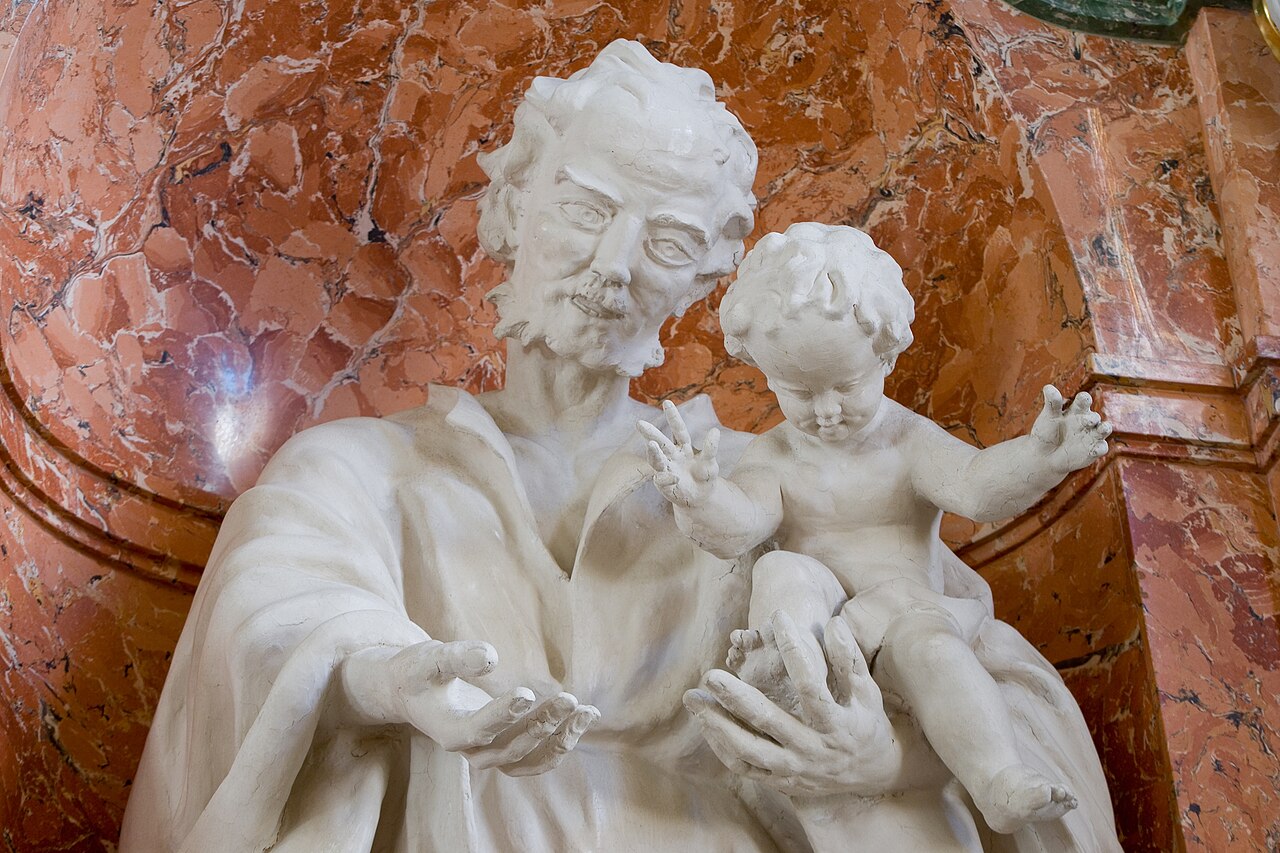
1. No, it is not idolatry
Idolatry means treating a created thing as a god: believing that a piece of wood, stone or metal is divine, or has power of its own, and worshipping it. Catholics believe no such thing about their statues.
The prophet Isaiah gives the most vivid description of real idolatry in the whole Bible. He describes a craftsman who cuts down a tree, uses half of it to warm himself and bake his bread, and then carves the other half into a figure. “He boweth down before it, and adoreth it, and prayeth unto it, saying: Deliver me, for thou art my god” (Isaiah 44:17). Isaiah’s mockery is aimed at the belief that the carved block itself is a god that can save. No Catholic thinks a statue of St Joseph can deliver anyone.
The early Christians explained the difference with a comparison everyone in the Roman Empire understood. Around 375, St Basil the Great noted that the emperor’s image is itself called “the emperor”, and that the honour paid to the image passes to the one it represents (On the Holy Spirit 18.45). The image is honoured only because of the person it represents.
The Council of Trent, in 1563, stated the Catholic position in the plainest terms. Images of Christ, Mary and the saints are to be kept in churches and given due honour, it said, “not that any divinity or virtue is believed to be in them”, nor that anything is to be asked of them, nor that trust is to be put in them, “as was of old done by the Gentiles who placed their hope in idols.” The honour shown to them is referred to the persons they represent.
2. What the commandment actually forbids
The commandment in Exodus reads: “Thou shalt not make to thyself a graven thing, nor the likeness of any thing that is in heaven above, or in the earth beneath… Thou shalt not adore them, nor serve them” (Exodus 20:4-5). The key is the second sentence. The prohibition is against making images in order to bow down and serve them as gods.
We know this is the right reading because the same God who gave the commandment soon afterwards commanded images himself. Only five chapters later, God instructs Moses to make two cherubim of beaten gold for the lid of the Ark of the Covenant, facing each other with outstretched wings (Exodus 25:18-20). The holiest object in Israel’s worship was decorated with carved figures of heavenly beings, the very kind of “likeness of any thing that is in heaven above” the commandment mentions.
Later, when the Israelites were dying of snakebite in the desert, God told Moses to make a bronze serpent and put it on a pole, “whosoever being struck shall look on it, shall live” (Numbers 21:8-9). Jesus himself later used this image as a picture of his own crucifixion (John 3:14).
Some Protestants suspect that Catholics have hidden the commandment against images by renumbering the Ten Commandments. In fact Catholics follow the numbering used by St Augustine around 400, who treated the ban on images as part of the first commandment against false gods (Questions on Exodus 71). Martin Luther kept exactly the same numbering in his Small Catechism of 1529, and Lutherans still use it. Nothing has been hidden; the commandment is read in full in Catholic Bibles. For more on this, see our article on why the commandments are numbered differently.
3. God commanded images for his own house
The cherubim on the Ark were not an exception. Israel’s places of worship were full of images, by God’s command.
When King Solomon built the Temple in Jerusalem, he placed in the Holy of Holies two enormous cherubim of olive wood overlaid with gold, each ten cubits (about fifteen feet) high. He carved the walls all round with cherubim, palm trees and open flowers. In the courtyard stood a huge bronze basin, the “sea”, resting on twelve bronze oxen (1 Kings 6:23-29; 7:23-25). The Bible records all of this with approval.
The prophet Ezekiel, in exile in Babylon, saw a vision of a renewed Temple. Its walls were carved all round with cherubim and palm trees, each cherub having two faces (Ezekiel 41:17-20). Even in a vision of the perfect worship of the future, images had their place.
Archaeology shows that ancient Jews themselves did not always read the commandment as a ban on religious art. In 1932, archaeologists excavating the Roman frontier town of Dura-Europos on the Euphrates in Syria uncovered a synagogue built around AD 245. Its walls were covered from floor to ceiling with colourful paintings of biblical scenes: Moses leading Israel out of Egypt, Elijah on Mount Carmel, Ezekiel’s vision of the dry bones, the finding of the infant Moses. It is one of the most important archaeological discoveries of the twentieth century, and it shows a Jewish congregation praying surrounded by images of its sacred history.
4. The Incarnation changed everything
There is a deeper reason why Christians make images of Christ, and it goes to the heart of the Christian faith.
When Moses reminded Israel why they must not make images of God, he gave a specific reason: “You saw not any similitude in the day that the Lord God spoke to you in Horeb from the midst of the fire” (Deuteronomy 4:15). God had no visible form. Any image of him would be invented, and therefore false.
But Christians believe that something changed. St Paul calls Christ “the image of the invisible God” (Colossians 1:15); the Greek word for “image” is eikōn, from which we get “icon”. John writes that “the Word was made flesh, and dwelt among us, and we saw his glory” (John 1:14). The invisible God took a human face, a human body, a human voice. People saw him, touched him and ate with him. If God has made himself visible, then it is no longer a lie to depict him.
St John of Damascus, a monk near Jerusalem who wrote in the 730s against those who were destroying images, put it memorably. He wrote that in former times God, who has neither body nor form, could never be depicted. But now that God has been seen in the flesh and lived among us, “I make an image of the God whom I see.” And in perhaps his most famous line: “I do not worship matter; I worship the Creator of matter, who became matter for my sake” (On the Divine Images 1.16). For John, to forbid images of Christ was to deny that the Word truly became flesh.
5. Christian images are older than Constantine
It is sometimes claimed that images entered the Church only after the Emperor Constantine made Christianity respectable in the fourth century, bringing pagan habits with him. The evidence shows otherwise.
In the same town of Dura-Europos, a few streets from the synagogue, archaeologists found the oldest known Christian house church, converted for worship around the year 240. Its baptistery, the room where new Christians were baptised, was painted with scenes including the Good Shepherd carrying a sheep, Jesus healing the paralysed man, Jesus and Peter walking on the water, and the women coming to the tomb on Easter morning. These are among the oldest Christian paintings in the world, made while Christianity was still an illegal religion.
In the Catacomb of Priscilla, an underground Christian burial place on the Via Salaria in Rome, there is a faded wall painting of a woman holding a child at her breast, with a man beside her pointing to a star. It is generally identified as Mary and the infant Jesus with a prophet, probably Balaam or Isaiah, and dated to the third century. It is often called the oldest known image of the Virgin and Child.
Eusebius of Caesarea, the first great historian of the Church, writing around 313, says that at Caesarea Philippi (Paneas), north of Galilee, he had seen a bronze statue of a woman kneeling before a standing man, said to represent Jesus healing the woman with the haemorrhage. He also mentions that he had seen painted portraits of the apostles Peter and Paul and of Christ himself, kept by Christians from ancient times (Church History 7.18).
6. Christians have fought over images
It would be dishonest to pretend that all Christians have agreed about images. The question has caused some of the bitterest controversies in Christian history.
Around 726, the Byzantine Emperor Leo III began to act against icons, perhaps influenced by the strict ban on images in the rapidly expanding Islamic world. His son, Constantine V, summoned a council of bishops to his palace at Hieria in 754, which condemned all images of Christ and the saints. Icons were smashed, monks who defended them were persecuted, and some were killed.
In 787, the Empress Irene summoned the Second Council of Nicaea, the seventh ecumenical council. It restored the use of images and gave the classic explanation: honour given to an image “passes to its prototype”, the person it represents, and whoever venerates an image venerates the person depicted in it. True worship, the council insisted, belongs to God alone.
The struggle broke out again in the ninth century. Finally, in 843, the Empress Theodora restored the icons for good. Eastern Christians still celebrate that event every year on the first Sunday of Lent as the “Triumph of Orthodoxy”, carrying icons in procession round their churches.
7. The strongest objection, fairly stated
Many Protestants still believe, sincerely and for serious reasons, that images in churches are dangerous. Their concern deserves a fair statement.
The Heidelberg Catechism of 1563, one of the most important Reformed Protestant confessions, teaches that God must not be pictured in any way, and that images may not be tolerated in churches even as “books for the laity”, because God wants his people taught by the living preaching of his Word, not by “dumb images” (Questions 96-98). The worry is that people inevitably begin to treat images as sacred objects and give them the devotion owed to God.
That conviction sometimes exploded into violence. In August 1566, in what the Dutch call the Beeldenstorm (“statue storm”), crowds in the Low Countries broke into hundreds of churches and monasteries, smashing statues, stained glass, altars and organs. Similar outbreaks took place in England, Scotland and Switzerland.
Not all Protestants agreed. Martin Luther hurried back from hiding at the Wartburg Castle in March 1522 partly because his colleague Andreas Karlstadt had been stirring up image-breaking in Wittenberg. In a series of eight sermons preached on successive days, Luther argued that images were neither necessary nor forbidden, and that tearing them down by force was wrong. Lutheran churches kept their crucifixes, altarpieces and paintings, and many still have them.
8. The Church admits images can be abused
Catholics should not pretend that images have never been misused. The Bible itself records an example, and the Church has repeatedly corrected abuses.
The bronze serpent that God commanded Moses to make was preserved for centuries. But by the time of King Hezekiah, around 700 BC, the people of Judah had begun burning incense to it as if it were a god. Hezekiah broke it in pieces (2 Kings 18:4), and the Bible praises him for doing so. A good image had become an idol, and it had to go.
Pope St Gregory the Great dealt with the opposite problem around the year 600. He heard that Bishop Serenus of Marseilles had smashed the images in his churches because some people were adoring them. Gregory wrote to him twice. He praised the bishop for forbidding anyone to adore images, but rebuked him for destroying them, because pictures are used in churches so that those who cannot read may at least read on the walls what they cannot read in books. The right remedy, Gregory said, was teaching, not destruction.
The Council of Trent took the same approach. It ordered bishops to remove all superstition from the use of images, to stamp out money-making connected with them, to forbid anything indecent or misleading, and to teach the people carefully that images are reminders that lead the mind to the persons they represent.
9. What a kneeling Catholic is really doing
So what is actually happening when you see a Catholic kneeling before a statue? Almost always, that person is praying to God, or asking the saint shown in the statue to pray for them. The statue is a focus for attention, the way a photograph of a loved one helps us think of them.
The Bible shows people praying before a sacred object without worshipping the object. After Israel’s defeat at Ai, Joshua tore his clothes and “fell flat on the ground before the ark of the Lord until the evening” (Joshua 7:6), crying out to God. Nobody imagines he was praying to the gilded wooden box. The Ark was the place where he met the Lord.
In the 380s a remarkable woman named Egeria, probably from Spain or Gaul, made a pilgrimage to the Holy Land and kept a detailed journal. She describes Good Friday in Jerusalem: the bishop sat holding the relic of the wood of the Cross, and the people filed past one by one, bowing, touching the wood with their foreheads and eyes, and kissing it (Egeria, Travels 37). Catholics still do the same on Good Friday, kneeling to kiss the crucifix. No one thinks the wood saves them; they are honouring the One who died on it.
In the 1440s Fra Angelico, a Dominican friar and one of the finest painters of the early Renaissance, decorated the friary of San Marco in Florence. In each friar’s small cell he painted a scene from the life of Christ, simple and quiet, to help his brothers pray. Fra Angelico was beatified in 1982 and is the patron of artists. His paintings were not objects of worship but windows into the Gospel.
10. Read the church like a book
The best way to understand Catholic statues is to walk slowly round a Catholic church and read its images the way they were meant to be read: as the Gospel told for the eye.
The Bible itself honours religious artists. The first person in Scripture described as “filled with the spirit of God” is not a prophet or a king but a craftsman, Bezalel, whom God gifted “with wisdom and understanding and knowledge in all manner of work” to make the Tabernacle and its furnishings (Exodus 31:1-5). Sacred art is presented as a gift of the Holy Spirit.
In the 1140s Abbot Suger rebuilt the abbey church of Saint-Denis near Paris in the new Gothic style, with soaring windows of stained glass. He wrote that the beauty of the church lifted his mind from material things to immaterial ones, carrying him in spirit from this lower world towards the higher (De Administratione). For Suger, beautiful images were a ladder for the soul.
Perhaps the most familiar images in any Catholic church are the fourteen Stations of the Cross around the walls, showing Jesus’s journey from condemnation to burial. In the eighteenth century the Franciscan preacher St Leonard of Port Maurice set up more than 570 sets of Stations across Italy, so that ordinary people who could never travel to Jerusalem could walk the way of the Cross in their own parish. In 1750 he erected the Stations inside the ruined Colosseum in Rome, where, according to tradition, Christians had been martyred. The Pope still leads the Way of the Cross there every Good Friday.
Frequently asked questions
Do Catholics pray to statues? No. Catholics pray to God, or ask the saint represented by the statue to pray for them. The Church teaches that nothing should be asked of the image itself.
Why do Catholics kiss statues and crucifixes? For the same reason people kiss a photograph of someone they love. It is a sign of affection for the person represented, not belief that the object is holy in itself.
Are statues required in Catholic churches? Every Catholic church must have a crucifix near the altar, and images of the saints are encouraged. Their number and style are left to local custom.
Do Orthodox Christians use statues? The Orthodox mainly use flat painted icons rather than statues, but they venerate them in the same way, following the Second Council of Nicaea.
You may also like Do Catholics Worship Mary? and Why Are the Catholic Ten Commandments Numbered Differently?
Sources and further reading
- The Bible: Exodus 20:4-5; 25:18-20; 31:1-5; Numbers 21:8-9; Deuteronomy 4:15-16; Joshua 7:6-9; 1 Kings 6:23-29; 7:23-25; 2 Kings 18:4; Isaiah 44:9-20; Ezekiel 41:17-20; John 1:14; 3:14; Colossians 1:15.
- Catechism of the Catholic Church, 1159-1162 and 2129-2132.
- Second Council of Nicaea (787), definition on images.
- Council of Trent, Session 25 (1563), Decree on Sacred Images.
- St Basil, On the Holy Spirit 18.45; St Augustine, Questions on the Heptateuch 2.71; St John of Damascus, On the Divine Images; St Gregory the Great, Letters to Serenus of Marseilles (599, 600); Egeria, Travels 37; Eusebius, Church History 7.18.
- Abbot Suger, De Administratione (c. 1145).
- Heidelberg Catechism (1563), Questions 96-98; Martin Luther, Invocavit Sermons (March 1522); Luther, Small Catechism (1529).
- Carl H. Kraeling, The Synagogue and The Christian Building, Excavations at Dura-Europos, Final Reports (Yale, 1956 and 1967).
