
A Teenager’s Friend Is Disrespectful at Mass. How Should a Parent Respond?
Respond to disruptive behaviour at Mass with clear boundaries, charity and reverence, while protecting young people and involving parish clergy.
Respond to disrespect at Mass with calm, clear boundaries and an effort to understand what happened. A teenager’s unfamiliarity, nervous laughter, disability or restlessness should not automatically be treated as deliberate contempt. Deliberate disruption, however, needs correction, and a concern involving the Eucharist should be brought promptly and discreetly to the priest or responsible minister.
Parents often feel caught between protecting reverence and keeping the door open to a young person. Those responsibilities can work together. Welcoming someone does not mean leaving expectations unexplained, and correcting someone does not require public humiliation.
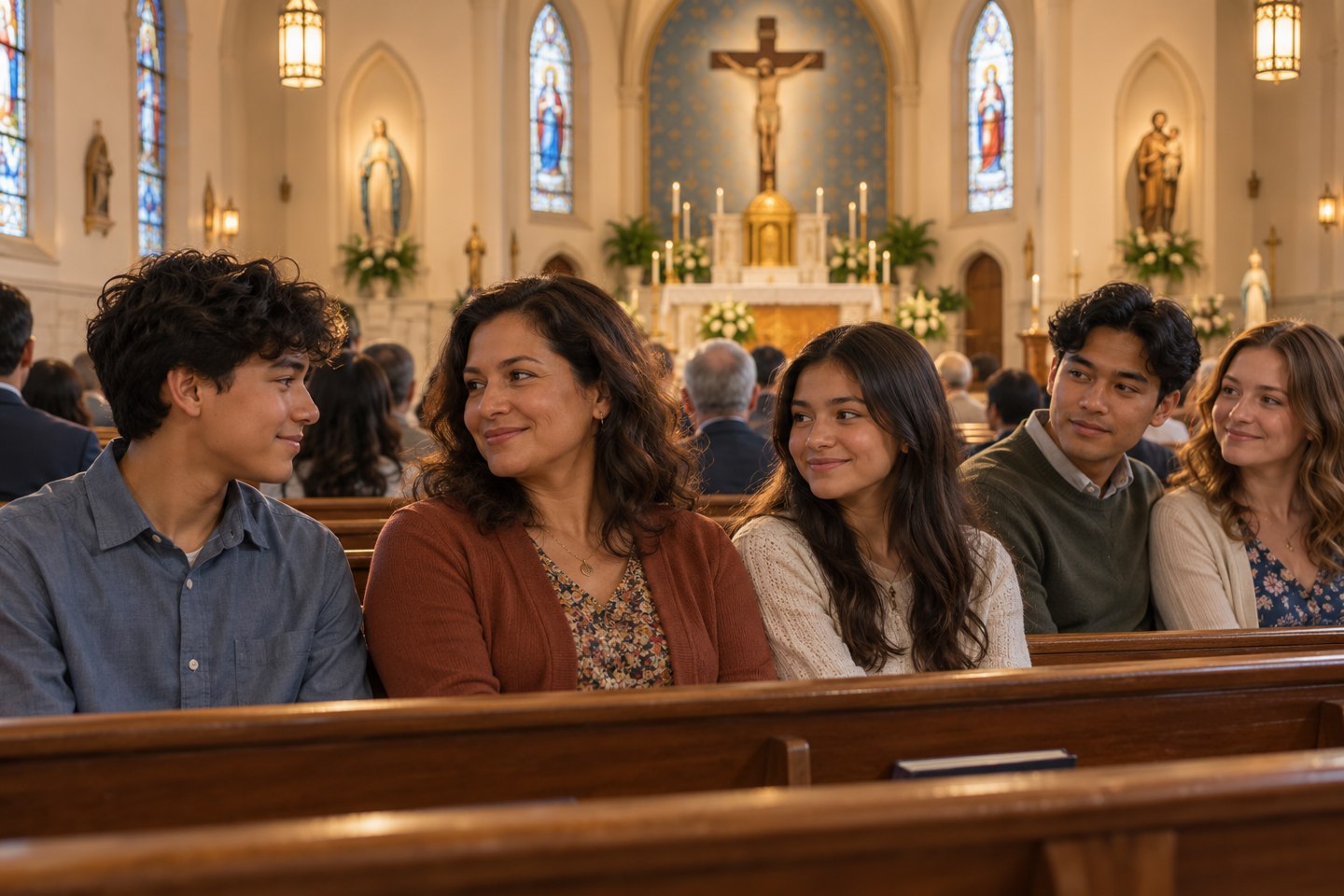
Begin with what you actually observed
“He laughed while the priest was speaking” describes behaviour. “He hates God” claims knowledge of a person’s heart. Begin with the first kind of statement.
Ask yourself whether the visitor has attended Mass before, whether anyone explained it, and whether the behaviour continued after a gentle reminder. What looked like boredom might be confusion. A whispered question may be an attempt to understand. Repetitive movement, difficulty with eye contact or sensory distress should not be used as evidence of unbelief.
This does not mean every action is harmless. It means a just response depends on reliable facts. Avoid building a confrontation around what you imagine the young person intended.
When something happens during Mass, a quiet reminder or a brief move to the porch may be enough. If there is an immediate threat to anyone’s safety, seek appropriate assistance. An extended argument in the pew will usually add another disturbance.
Explain why reverence matters
Catholics believe that Christ is truly present in the Eucharist. Reverence is a response to him, not simply a preference for quiet buildings or formal manners. Our explanation of the Real Presence can help an older child understand that belief.
You do not need to begin with an examination in theology. Try: “You do not have to pretend to believe everything we believe. But this is sacred to us, and we ask visitors to respect the people praying.”
Explain practical details before the next visit: when to silence the phone, how to follow the congregation, where to find the readings, and what to do during Communion. Someone who has been told only “be respectful” may still have no idea what Catholics expect.
The Church’s liturgical instructions describe common postures and silence as part of shared worship. They are not a warrant for diagnosing another person’s devotion from their posture when illness or disability affects what they can do.
Do not assume every visitor should receive Communion
Friendship is not a substitute for sacramental preparation. If your child invites a friend, explain beforehand that Catholics have particular requirements for receiving Communion and that remaining in the pew is perfectly acceptable.
Do not tell an unprepared visitor to receive so that nobody feels awkward. Equally, do not embarrass the person by announcing their religious status to everyone nearby. Have the conversation privately and simply.
For fuller guidance, see which sacraments a person can receive and attending Mass when you are not baptised. The general rules and exceptions belong to the Church, not to a parent improvising a special arrangement in the Communion line.
If you are uncertain whether a particular guest may receive, ask the priest before Mass. A visitor can participate respectfully through listening and prayer without receiving the Eucharist.
An illustration: a guest in a music room
This is an original illustrative story.
A young visitor entered a room where an orchestra was rehearsing. He tapped a drum during a quiet passage. The conductor stopped, explained what the musicians were doing, and showed him when he could try the instrument later.
When the visitor tapped again, the conductor calmly moved the drum out of reach. He did not call the boy worthless or expel every young person from the room. He protected the music and continued teaching the guest how to listen.
Mass is far more than a performance, and the Eucharist is not an instrument. The story illustrates one limited point: welcome becomes more effective when it includes explanation and sensible boundaries.
What if the behaviour was clearly deliberate?
Speak after Mass when everyone can listen. Name the action, explain its effect, and ask for a specific change. “You kept playing videos after we asked you to stop. That disturbed people praying. If you come with us again, your phone needs to stay put away.”
Avoid a long speech about what “young people today” are like. This is one young person, one incident and one relationship. A practical expectation is easier to understand than a sweeping accusation.
You may reasonably pause invitations if the friend repeatedly refuses basic respect. That boundary can be expressed without condemnation: “We would like you to come again when you are willing to follow these expectations.” Consider another setting for friendship and conversation in the meantime.
For minors, coordinate appropriately with their parent or guardian. Do not make your own teenager responsible for policing another young person’s conscience. Your child can support reasonable expectations without being forced to choose between humiliation of a friend and loyalty to the family.
What if a consecrated Host may have been mishandled?
Treat this seriously and discreetly. Tell the priest, deacon or responsible Communion minister what you actually saw, as soon as reasonably possible. Avoid guessing, physical confrontation or attempts to investigate the visitor publicly.
Redemptionis Sacramentum, paragraph 92, directs that the Host be consumed immediately and addresses the prevention of profanation. A minister needs accurate information to respond appropriately. “I saw someone leave with the Host still in their hand” is more useful than a speculative accusation shouted across the church.
The priest can address protection of the sacrament, speak to those involved and determine any further pastoral or canonical steps. An online discussion is not the place to pronounce a young person guilty of a canonical crime. Knowledge, intention, age and other circumstances can matter.
Do not film or post identifying details. Protecting reverence does not require turning a minor into a public example. If serious concerns are mishandled, follow the parish and diocesan process; our guide to raising a Church complaint may help.
Make room for repair
An apology should be sincere and proportionate. Sometimes it is enough to apologise to the host family and agree on better conduct. A more serious incident may require a conversation with the priest. Do not invent a public penance for someone else.
If your own child was involved, apply the same standards: listen, establish facts, correct the behaviour and support a better choice. The Catechism’s teaching on family responsibilities places education within love and respect, rather than treating a child as an embarrassment to be managed.
After correction, let genuine improvement count. A teenager should not be permanently identified with the worst ten minutes of a first visit to church. Keep boundaries where needed, but leave a path back to trust.
What should the parent aim for?
Aim for a church in which people can pray, the Eucharist is treated reverently, and a young visitor can learn without being shamed. You cannot force faith by controlling a child’s facial expression. You can model respect, give clear explanations and respond consistently to actual choices.
The most persuasive lesson may be the way you handle the incident: serious about what is sacred, truthful about what happened, and charitable towards a person who still has much to learn.
Sources and further reading
- General Instruction of the Roman Missal: Structure of the Mass
- Redemptionis Sacramentum, especially 92
- Catechism: The duties of family members, 2214–2231
Sources checked 26 September 2026. Original illustrative stories are teaching aids, not reported events or quotations from Scripture. This article offers general formation; personal sacramental, legal and health questions require the appropriate qualified adviser.
