
Why Do Catholics Light Candles in Church?
A candle in a Catholic church is a sign of Christ the light and a prayer that keeps burning. Here is its biblical meaning, its history, what votive candles are and aren’t, and how anyone can light one.
Walk into almost any Catholic church and you will see them: racks of small candles flickering in front of a statue of Mary or a saint, a tall candle beside the altar, a red lamp glowing near the tabernacle. You might see someone drop a coin in a box, light a candle, kneel for a moment and leave. If you are not Catholic, you may wonder what is going on. Are they paying for favours? Praying to the statue? Is it a pagan custom that crept into the Church? This article explains why Catholics light candles: what the light means, its roots in Israel’s worship and the early Church, the great candle-lit moments of Catholic worship, what a votive candle is and is not, the old objections, why people of every background light candles in grief and hope, and how anyone can light one.
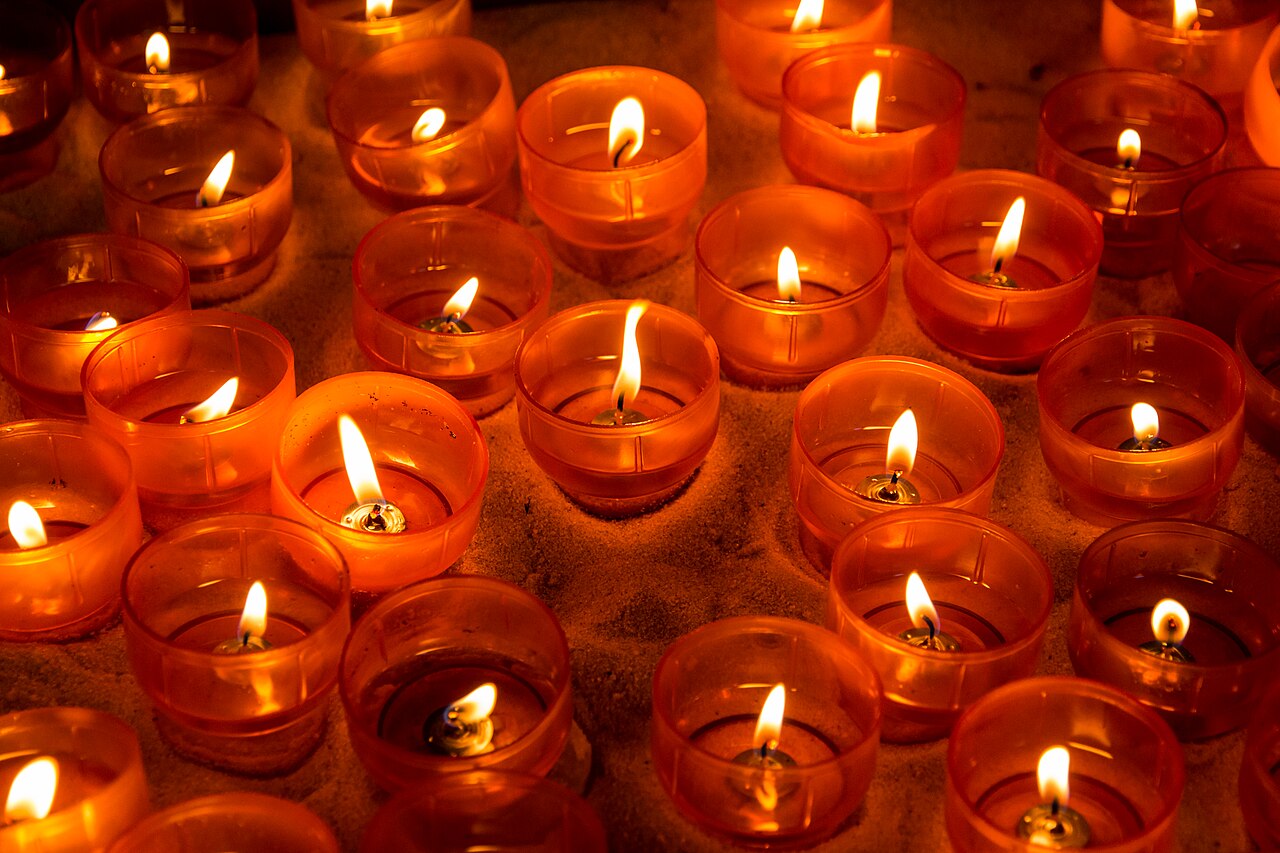
1. Christ the light, and a prayer that keeps burning
For Catholics, a candle is a sign of Christ, “the light of the world”, and of a prayer that continues after the person who lit it has gone.
Jesus called himself the light of the world during the Jewish feast of Tabernacles in Jerusalem. During that festival, great golden lamps were lit in the Temple courts, so bright, according to Jewish tradition, that they lit up every courtyard in the city. Standing in the Temple, Jesus declared: “I am the light of the world: he that followeth me, walketh not in darkness, but shall have the light of life” (John 8:12).
The most powerful candle in Catholic worship is the Easter candle. At the Easter Vigil, the most important night of the Christian year, the church is in complete darkness. A new fire is kindled outside, and a large candle, marked with a cross, the Greek letters Alpha and Omega and the year, is lit from it. The deacon carries it into the dark church, singing “The Light of Christ”, and everyone lights their own small candle from it, until the whole church is filled with light. The Easter candle stands for the risen Christ, who has conquered the darkness of sin and death.
Jesus also told his disciples that they themselves were to be light: “You are the light of the world… Neither do men light a candle and put it under a bushel, but upon a candlestick, that it may shine to all that are in the house” (Matthew 5:14-15). A candle lit in church is a reminder of this calling, too.
2. God commanded lamps in his worship
Sacred light is thoroughly biblical. God himself commanded lamps in Israel’s worship, so Christians did not borrow the custom from pagans.
In the desert, God told Moses: “Command the children of Israel that they bring thee the purest oil of the olives, and beaten with a pestle: that a lamp may burn always in the tabernacle of the testimony.” Aaron and his sons were to tend it “from evening until morning before the Lord” (Exodus 27:20-21). A lamp burning continually before God was part of Israel’s worship from the beginning.
The great seven-branched lampstand, the menorah, stood in the Temple in Jerusalem. When the Greek king Antiochus IV defiled the Temple in the second century before Christ, and the Maccabees recaptured it, one of the first things they did was to make a new lampstand and relight it. “They lighted the lamps that were upon the candlestick, and they gave light in the temple”, and they celebrated the rededication for eight days (1 Maccabees 4:49-59). Jesus later went to the Temple for this very feast, the Dedication, which Jews now call Hanukkah (John 10:22-23).
The image of the lampstand continues into the last book of the Bible. When St John received his vision on the island of Patmos, the first thing he saw was the risen Christ “in the midst of the seven golden candlesticks”, and Christ explained that “the seven candlesticks are the seven churches” (Revelation 1:12-20). The Church itself is a lampstand, holding up the light of Christ.
3. The first Christians prayed by lamplight
The first Christians prayed by lamplight, partly from necessity, since they often met at night, and soon gave the evening lighting of lamps a special meaning.
When St Paul visited the Christians at Troas, they gathered “on the first day of the week… to break bread”, and Paul preached until midnight. Luke adds the detail that “there were a great number of lamps in the upper chamber” (Acts 20:7-8). It was during this long sermon that a young man named Eutychus fell asleep, fell out of a third-storey window, and was restored to life by Paul.
By the fourth century, the daily lighting of lamps had become a beautiful ceremony. Around 383, the pilgrim Egeria described the evening service in Jerusalem, called the Lucernare (“lamp-lighting”). At about four in the afternoon, all the people gathered in the church built over the tomb of Christ. The light was not brought in from outside, but taken from the lamp that burned constantly inside the tomb itself, and from it all the lamps and candles were lit, “and there is an infinitely great light” (Itinerarium 24).
The early Christians sang a hymn when the lamps were lit, the Phos Hilaron (“O Gladsome Light”). Around 375, St Basil the Great wrote that this hymn was already so old that no one knew who had written it, and that the people sang it as they gave thanks at the lighting of the evening lamp (On the Holy Spirit 29.73). It is still sung at Orthodox Vespers every evening, and in many Anglican and Catholic churches too.
4. Candles at the most solemn moments
Candles mark the Church’s most solemn moments: the altar at every Mass, the presence of Christ in the tabernacle, baptism, and the feast of the Presentation.
Church law requires that at least two lighted candles be placed on or near the altar at every Mass, and more on solemn occasions (General Instruction of the Roman Missal 117). Wherever the Blessed Sacrament is reserved in a tabernacle, a special lamp, often red, must burn continually before it, as a sign of honour to Christ present there (Code of Canon Law, canon 940). This is the Christian successor to the lamp that burned always before the Lord in the tabernacle of Moses.
At baptism, after the water and the anointing, the godparent lights a candle from the Easter candle, and the priest says: “Receive the light of Christ.” He tells the parents and godparents that this light is entrusted to them to be kept burning brightly, so that the child, enlightened by Christ, may walk always as a child of the light (Rite of Baptism for Children, 1969).
Forty days after Christmas, on 2 February, the Church celebrates the Presentation of the Lord in the Temple. When Mary and Joseph brought the infant Jesus to the Temple, the old man Simeon took him in his arms and praised God for “a light to the revelation of the Gentiles, and the glory of thy people Israel” (Luke 2:32). Because of Simeon’s words, candles are blessed and carried in procession on this feast, which is also called Candlemas.
5. What a votive candle is
A votive candle (from the Latin votum, “a vow” or “a prayer”) is a small candle lit before a statue, an icon or the altar as a sign of a prayer. It is a small offering that stands in for the person and their intention, continuing to burn as a silent prayer after they have left.
The idea of ordinary people supplying the light for God’s house goes back to the Bible. God told Moses that the people themselves were to bring the oil for the lamp that burned continually before him: “Command the children of Israel, that they bring unto thee the finest and clearest oil of olives, to furnish the lamps continually” (Leviticus 24:2). The light in the sanctuary was an offering from ordinary households.
In medieval England, providing lights in church was a central part of ordinary people’s devotion. The historian Eamon Duffy, in his study of late-medieval English religion, The Stripping of the Altars (1992), shows from hundreds of wills that villagers routinely left small sums of money, or quantities of wax, to keep lights burning before the crucifix, the statue of Mary or the image of their favourite saint. Parish guilds were formed to maintain particular lights. A candle was a way of staying present before God, even after death.
The custom continues on a vast scale today. At Lourdes, every evening from spring to autumn, thousands of pilgrims gather for a candlelight procession around the sanctuary, singing the “Ave Maria” as their candles flicker in the dark. The procession has been held since the 1860s, a few years after the apparitions to St Bernadette. Seen from above, it looks like a river of light.
6. “Candles are useless or pagan”
The objection that candles in church are useless, or pagan, is very old, and the Church has long answered that such signs are for us, not for God.
Around 310, the Christian writer Lactantius mocked pagans for lighting lamps in their temples to honour the gods. Do they think God needs light, he asked, the God who made the sun? (Divine Institutes 6.2). Lactantius was attacking pagan sacrifice, but his words show that early Christians were aware of the danger of thinking that God needs our offerings.
Around 406, a priest from Gaul named Vigilantius attacked the Christian custom of lighting candles at the tombs of the martyrs in broad daylight, calling it a pagan practice. St Jerome replied with characteristic fury. The candles, he said, are lit not to drive away darkness, but as a sign of joy and honour. Just as in the Gospel the woman poured precious ointment on Jesus out of love, so the faithful light candles to the martyrs out of love, not because they think the dead need light (Against Vigilantius).
Some Protestant reformers went further. In 1547, the Royal Injunctions issued in the name of the young King Edward VI ordered that no candles or lights be set before any image or picture in English churches. Yet even these reformers kept “two lights upon the high altar, before the sacrament”, explaining that they signified that Christ is the true light of the world. The sign itself was too biblical to abandon.
7. Not worship, and not for sale
Lighting a candle before a statue of Mary or a saint is not worship of the statue, and the coin dropped in the box buys nothing from God.
In 787, the Second Council of Nicaea, accepted by both Catholics and Orthodox, explicitly allowed the faithful to offer lights and incense before holy images, as an act of honour. It explained that the honour given to an image passes to the person it represents, and that true worship belongs to God alone. A candle before a statue of Mary honours Mary and expresses a prayer, asking for her intercession; it does not worship her or the statue.
The money in the candle box is a donation to cover the cost of the candles and to support the church, not a payment for answered prayers. The Bible condemns any attempt to buy God’s gifts. When Simon the magician offered the apostles money in exchange for the power to give the Holy Spirit, Peter rebuked him sharply: “Keep thy money to thyself, to perish with thee, because thou hast thought that the gift of God may be purchased with money” (Acts 8:20). Anyone may light a candle whether or not they can afford to put money in the box.
The Council of Trent, in 1563, taught that no divinity or power resides in images, that nothing is to be asked of the images themselves, and that no trust should be placed in them. It also ordered bishops to stamp out every form of superstition and profiteering connected with images and the veneration of saints. A candle has no magic. Its value lies in the prayer it expresses.
8. Light in grief and hope for everyone
People of every background light candles in moments of grief and hope, which is why the custom speaks to non-Catholics too.
Perhaps the most dramatic example in recent history came in East Germany in 1989. For years, people had gathered for “peace prayers” on Monday evenings in the Lutheran Nikolaikirche in Leipzig. On 9 October 1989, after the prayers, some seventy thousand people marched through the city centre carrying candles, chanting “We are the people” and “No violence”. Thousands of armed police and soldiers had been deployed, and many feared a massacre. But the troops did not fire. One East German official later said that they had planned for everything, except candles and prayers. A month later, the Berlin Wall fell.
In April 2005, as Pope John Paul II lay dying in the Vatican, tens of thousands of people of all ages kept vigil in St Peter’s Square, many holding candles, praying and singing through the night. When his death was announced on the evening of 2 April, the square fell silent, then broke into applause.
At every Catholic funeral, the Easter candle stands lit beside the coffin, as a sign that the person was baptised into Christ’s death and resurrection and a promise of the light of the resurrection to come (Order of Christian Funerals).
9. How to light one
Anyone may light a votive candle in a Catholic church. If there is a box for offerings, put in what you can; if you cannot afford anything, light the candle anyway. Say a short prayer, perhaps for someone you love, someone who has died, or something weighing on your heart, and leave the candle burning.
Candles have spread into Christian homes too. In 1839 a Lutheran pastor in Hamburg, Johann Hinrich Wichern, who ran a home for poor and orphaned boys, made a large wooden wheel with twenty small candles and four large ones, lighting one more each day of Advent, so that the children could count the days to Christmas. His invention became the Advent wreath, now used in Catholic and Protestant churches and homes around the world.
Candles also appear in Catholic blessings. On 3 February, the feast of St Blaise, a fourth-century bishop and martyr said to have saved a boy choking on a fishbone, priests bless people’s throats by holding two crossed candles, blessed the day before at Candlemas, against their necks and praying for protection from illness of the throat.
In Jesus’s parable of the ten bridesmaids, the wise ones were those who kept their lamps burning by bringing extra oil, so that they were ready when the bridegroom came at midnight (Matthew 25:1-13). A candle can be a simple reminder to keep the lamp of faith burning.
10. Step in and light one
The simplest next step, for anyone curious, is to step into a Catholic church, light a candle for someone, and stay for a moment of quiet.
At Christmas Midnight Mass, the Church reads from the prophet Isaiah: “The people that walked in darkness, have seen a great light: to them that dwelt in the region of the shadow of death, light is risen” (Isaiah 9:2). A single candle in a dark church makes that promise visible.
Some of the most moving candlelit prayer today happens across Christian divisions. In the small village of Taizé in Burgundy, a community founded in 1940 by Brother Roger Schutz, a Swiss Reformed Protestant, brothers from Catholic and Protestant backgrounds pray three times a day. Every week, thousands of young people from every church and none join them for evening prayer by candlelight, singing simple, repeated chants in many languages.
Even in largely Lutheran Sweden, an ancient Catholic saint is honoured with candles. Every year on 13 December, the feast of St Lucy (Lucia), a young Sicilian martyr who died around 304, Swedish girls dressed in white, the leader wearing a crown of candles on her head, sing in processions in schools, churches and homes. Lucy’s name means “light”, and on one of the darkest days of the northern winter, her feast proclaims that the light of Christ is coming.
Frequently asked questions
Can I light a candle if I’m not Catholic? Yes. Anyone may light a votive candle and say a prayer.
Do I have to pay? An offering is customary, to cover the cost of candles, but it is not a payment for prayers, and no one should be turned away for lack of money.
Why are some candles red? The red lamp near the tabernacle shows that the Blessed Sacrament is present there. Votive candles are often in red or other coloured glass simply for decoration.
Is lighting a candle for the dead a Catholic practice? Yes. Catholics often light candles while praying for the dead. See Why Do Catholics Pray for the Dead?
You may also like Why Do Catholics Use Incense at Mass? and Why Do Catholics Have Statues?
Sources and further reading
- The Bible: Exodus 27:20-21; Leviticus 24:1-4; 1 Maccabees 4:49-59; Isaiah 9:2; Matthew 5:14-16; 25:1-13; Luke 2:25-32; John 8:12; 10:22-23; Acts 8:18-24; 20:7-8; Revelation 1:12-20.
- Roman Missal, Easter Vigil; General Instruction of the Roman Missal 117; Code of Canon Law (1983), canon 940; Rite of Baptism for Children; Order of Christian Funerals; Book of Blessings.
- Second Council of Nicaea (787); Council of Trent, Session 25 (1563).
- Egeria, Itinerarium 24; St Basil, On the Holy Spirit 29.73; Lactantius, Divine Institutes 6.2; St Jerome, Against Vigilantius.
- Royal Injunctions of Edward VI (1547).
- Eamon Duffy, The Stripping of the Altars (1992).
- Accounts of the Leipzig demonstration of 9 October 1989.
