
Why Do Catholics Pray for the Dead?
Catholics pray for the dead because love does not end at death and they trust God lets prayer help. Here is the meaning, the history, the Bible, the objections, and how to pray for your own dead.
If you have recently lost someone you love, you may have found yourself wanting to pray for them, and wondering whether it makes any sense. Or perhaps you are a Protestant attending a Catholic funeral, hearing the priest pray that the deceased may be forgiven and brought into God’s presence, and wondering what such prayers could possibly achieve if a person’s fate is fixed at death. This article explains, gently and honestly, why Catholics pray for the dead: what it means and what it does not mean, the belief in the “communion of saints” that lies behind it, its Jewish and early Christian roots, how Catholics pray for the dead at Mass, the Protestant objections and the Catholic reply, and how anyone can begin.
1. Love does not stop at death
The simplest answer is this: Catholics pray for the dead because love does not stop at death, and they trust that God lets our prayer help those we love.
Jesus himself felt the grief of death. When his friend Lazarus died, Jesus came to the tomb in Bethany, saw Mary weeping, and “groaned in the spirit, and troubled himself”. Then, John records in the shortest verse in the Bible, “Jesus wept.” Before calling Lazarus out of the tomb, he prayed aloud to his Father (John 11:33-44). Grief and prayer belong together, even for the Son of God.
In 395, the great Christian emperor Theodosius died in Milan. St Ambrose, the bishop of Milan, who had once barred Theodosius from church until he did public penance for a massacre, preached at his funeral forty days later. Speaking of the emperor, Ambrose said, “I loved him, and therefore I follow him to the land of the living; nor will I leave him till by tears and prayers I shall lead the man… where his merits summon him” (On the Death of Theodosius 37). For Ambrose, prayer was what love does when the beloved has gone ahead.
Recent popes have kept All Souls’ Day, 2 November, by praying among the graves of the war dead. On 2 November 2021, Pope Francis celebrated Mass at the French Military Cemetery in Rome, where soldiers who died in the Italian campaign of the Second World War are buried. On 2 November 2023 he celebrated Mass at Rome’s Commonwealth War Cemetery, praying for soldiers from Britain and its Commonwealth, most of them not Catholics.
2. Praying for the dead is not contacting them
It is important to be clear about what praying for the dead is not. It is not trying to contact the dead, receive messages from them or summon their spirits. The Catholic Church strictly forbids séances, mediums and every form of necromancy. Praying for the dead simply means entrusting them to God.
The Bible condemns attempts to contact the dead. King Saul, abandoned by God before a desperate battle, disguised himself and went by night to a medium at Endor, asking her to call up the spirit of the prophet Samuel so that he could learn the future (1 Samuel 28:7-20). The First Book of Chronicles counts this among the sins for which Saul died: he “consulted also a witch, and trusted not in the Lord” (1 Chronicles 10:13-14).
The Law of Moses forbids Israel to consult mediums or wizards or anyone “that seeketh the truth from the dead” (Deuteronomy 18:10-12). The Catechism of the Catholic Church repeats this firmly: all practices of “conjuring up” the dead are to be rejected (CCC 2116-2117).
During the First World War, when so many families had lost sons, interest in spiritualism and séances grew rapidly. On 24 April 1917, the Holy Office in Rome ruled that Catholics may not take part in séances or spiritualist sessions, whether with or without a medium, and not even as passive observers. A Catholic speaks to God about the dead; he does not try to speak to the dead without God.
3. One family: the communion of saints
Behind Catholic prayer for the dead lies the belief Christians profess in the Apostles’ Creed: “I believe in… the communion of saints.” Catholics believe that the living on earth, the dead being purified, and the saints in heaven are one family in Christ, bound together by love and prayer.
St Paul described the Church as a single body. “If one member suffer any thing, all the members suffer with it; or if one member glory, all the members rejoice with it” (1 Corinthians 12:26). Catholics believe that death does not cut a member off from Christ’s body.
The phrase “communion of saints” was a relatively late addition to the creed. The earliest known writer to use it is Nicetas, bishop of Remesiana (in present-day Serbia), in his Explanation of the Creed, written around 400. He explained that the Church is the gathering of all the saints, from the beginning of the world: patriarchs, prophets, martyrs and all the just, past, present and future, and that in this one Church we believe we shall attain the communion of saints.
In 1964 the Second Vatican Council described this family in three states: some of Christ’s disciples are pilgrims on earth; others have died and are being purified; still others are in glory, contemplating God. All, it said, are united in charity, and the union of those on earth with those who have died “is in no way interrupted” (Lumen Gentium 49-51).
4. Older than Christianity
Praying for the dead is older than Christianity. Jews prayed for their dead before the time of Christ, and they still do today.
The clearest early example is in the Second Book of Maccabees. After a battle around 163 BC, Judas Maccabeus found that some of his fallen soldiers had been wearing amulets of pagan idols under their tunics. He and his men “betook themselves to prayers, beseeching him, that the sin which had been committed might be forgotten”. Then he took up a collection and sent it to Jerusalem so that a sacrifice could be offered for the dead. The writer praises this as “a holy and wholesome thought to pray for the dead, that they may be loosed from sins” (2 Maccabees 12:39-46).
Jewish mourners still pray for their dead. After the death of a parent, Jews traditionally recite the Mourner’s Kaddish daily for eleven months, a prayer praising God that has come to be associated with honouring the dead. At memorial services they pray El Malei Rachamim, “God full of mercy”, asking God to grant the soul of the departed perfect rest under the wings of his presence. These customs took their present form in the medieval Jewish communities of the Rhineland.
The New Testament may also contain an example. St Paul, writing to Timothy near the end of his life, prayed for “the house of Onesiphorus”, and then for Onesiphorus himself: “The Lord grant unto him to find mercy of the Lord in that day” (2 Timothy 1:16-18). Since Paul greets only the household elsewhere, many scholars believe Onesiphorus had died, and that Paul was praying for him.
5. The first Christians did it everywhere
The first Christians prayed for their dead everywhere, and they treated it not as a new idea but as something handed down from the beginning.
Around 211, the North African writer Tertullian listed customs that Christians kept by tradition even though they were not written in Scripture. Among them: “We offer sacrifices for the dead on their birthday anniversaries”, meaning the anniversaries of their deaths, their “birthdays” into eternal life (De Corona 3).
Around 350, St Cyril of Jerusalem explained the Eucharist to people who had just been baptised at Easter. He told them that during the Eucharistic prayer the Church prays for the holy fathers and bishops who have fallen asleep, and for all who have died among us, believing that it will be a great benefit to the souls for whom prayer is offered while the holy and awesome sacrifice is present (Mystagogical Catechesis 5.9-10).
Around 392, St John Chrysostom, preaching in Antioch, urged his people not to hesitate to help the dead. He reminded them that Job offered sacrifices for his living children to purify them (Job 1:5). If Job’s sacrifices helped his sons, he asked, why should we doubt that our offerings for the dead bring them some consolation? “Let us not hesitate to help those who have died and to offer our prayers for them” (Homily 41 on 1 Corinthians).
6. The Mass: the greatest prayer for the dead
The chief way Catholics pray for the dead is the Mass. Catholics believe that in the Mass Christ’s one sacrifice on the cross is made present, and that nothing can help the dead more than to be united to it.
St Monica understood this. Dying at Ostia in 387, she told her sons Augustine and Navigius not to worry about where her body would be buried. “Lay this body anywhere,” she said; “let not the care of it in any way disturb you. This only I request of you, that you would remember me at the altar of the Lord, wherever you may be” (Augustine, Confessions 9.11).
Pope St Gregory the Great tells a story from his own monastery in Rome. A monk named Justus, a physician, had secretly kept three gold coins, against the monastic vow of poverty. As he lay dying he admitted it, and he died repentant. After his death, Gregory, who had founded the monastery, ordered that Mass be offered for him every day for thirty days. On the thirtieth day, Justus appeared to his brother in a vision and told him he had been released (Dialogues 4.55). Catholics still have thirty consecutive Masses said for a dead person, called “Gregorian Masses”.
The ancient Roman Canon, the oldest Eucharistic Prayer of the Western Church, in use by the seventh century and still prayed today, includes a beautiful prayer for the dead: “Remember also, Lord, your servants N. and N., who have gone before us with the sign of faith and rest in the sleep of peace. Grant them, O Lord, we pray, and all who sleep in Christ, a place of refreshment, light and peace.”
7. The Protestant objections
Many Protestants object to praying for the dead for two main reasons: that judgement follows death immediately, so nothing can change after it, and that the key biblical text, 2 Maccabees, is not in their Bible.
The first objection rests on the Letter to the Hebrews: “it is appointed unto men once to die, and after this the judgment” (Hebrews 9:27). If judgement follows death, what can prayer change?
The second objection goes back to the beginning of the Reformation. In July 1519, at a public debate in Leipzig, the Catholic theologian Johann Eck cited 2 Maccabees in support of purgatory and prayer for the dead. Luther replied that the book was not part of the canonical Scriptures, and so could not settle a question of doctrine.
In England, the rejection of prayer for the dead had dramatic consequences. For centuries, wealthy people had left money in their wills to found “chantries”, endowments that paid priests to say Masses for their souls. In 1547, the Parliament of the boy-king Edward VI passed the Chantries Act, dissolving all chantries in England, condemning them as superstitious, and seizing their wealth for the Crown. Thousands of priests lost their positions, and the practice of public prayer for the dead largely disappeared from English life for centuries.
8. The Catholic reply, and surprising allies
Catholics reply that prayer for the dead does not reverse God’s judgement. Those who die rejecting God cannot be prayed out of hell. But those who die in God’s friendship, yet are still imperfectly purified, can be helped by our prayers in their final purification. And many other Christians agree that praying for the dead is at least permissible.
The Lutherans themselves did not entirely forbid it. In the Apology of the Augsburg Confession (1531), an official Lutheran document, Philip Melanchthon wrote that “we do not forbid prayer for the dead” (Article XXIV), even as he rejected the idea that the Mass earns benefits for them.
In England, the First World War changed attitudes. With hundreds of thousands of young men killed, grieving families longed to pray for them. In 1917, the Church of England issued authorised forms of prayer for wartime which, for the first time since the Reformation, included explicit official prayers for the dead, despite protests from some evangelical bishops. Prayers for the departed have since become part of official Anglican liturgy.
The Eastern Orthodox churches have always prayed for the dead. They hold memorial services, called panikhida in the Slavic tradition, especially on the third, ninth and fortieth days after death and on anniversaries, and they keep several “Saturdays of Souls” each year for all the departed.
9. Never for sale
A common suspicion is that Catholic prayer for the dead is a money-making scheme. The Church firmly teaches that prayer for the dead is never for sale. When a family requests a Mass for a deceased relative, they usually give an offering, called a “stipend”, which helps support the priest. But Church law forbids anything that looks like trade.
The New Testament condemns trying to buy spiritual things. When Simon the magician saw the apostles giving the Holy Spirit through the laying on of hands, he offered them money to give him the same power. Peter rebuked him sharply: “Keep thy money to thyself, to perish with thee, because thou hast thought that the gift of God may be purchased with money” (Acts 8:20). This sin, the buying and selling of spiritual things, is still called “simony”.
The Council of Trent, aware of abuses in its own day, ordered bishops on 17 September 1562 to stamp out every kind of avarice surrounding Masses: bargaining over stipends, demanding payment, and everything that looked like trafficking (Session 22, Decree on things to be observed and avoided in the celebration of Mass).
Church law today says that even “any appearance of trafficking or trading” in Mass offerings must be entirely excluded, and it urges priests to celebrate Mass for the intentions of the faithful, especially the poor, even without receiving any offering (Code of Canon Law, canons 945-947). A Mass for your loved one does not depend on your ability to pay.
10. How to pray for your own dead
Anyone can pray for the dead. Name your dead before God in your own words. Visit their graves, and pray there. Ask your parish to have a Mass offered for them, or simply attend Mass and remember them. Pray the traditional prayer: “Eternal rest grant unto them, O Lord, and let perpetual light shine upon them. May they rest in peace. Amen.”
The Book of Tobit shows the spiritual value of caring for the dead. Tobit, a devout Jew living in exile in Nineveh, risked his life and lost his property to bury fellow Israelites whose bodies had been left in the street by the Assyrian king. Even when he was warned, he went out at night to bury the dead (Tobit 1:16-20; 2:1-8). The Church counts burying the dead among the corporal works of mercy and praying for the living and the dead among the spiritual works of mercy.
During the First World War, as millions died on the battlefields of Europe, Pope Benedict XV was deeply moved by the slaughter. On 10 August 1915, in the apostolic constitution Incruentum Altaris, he granted every priest in the world permission to celebrate three Masses on All Souls’ Day, one for the priest’s own intention, one for all the faithful departed, and one for the intentions of the Pope. Priests still have this privilege today.
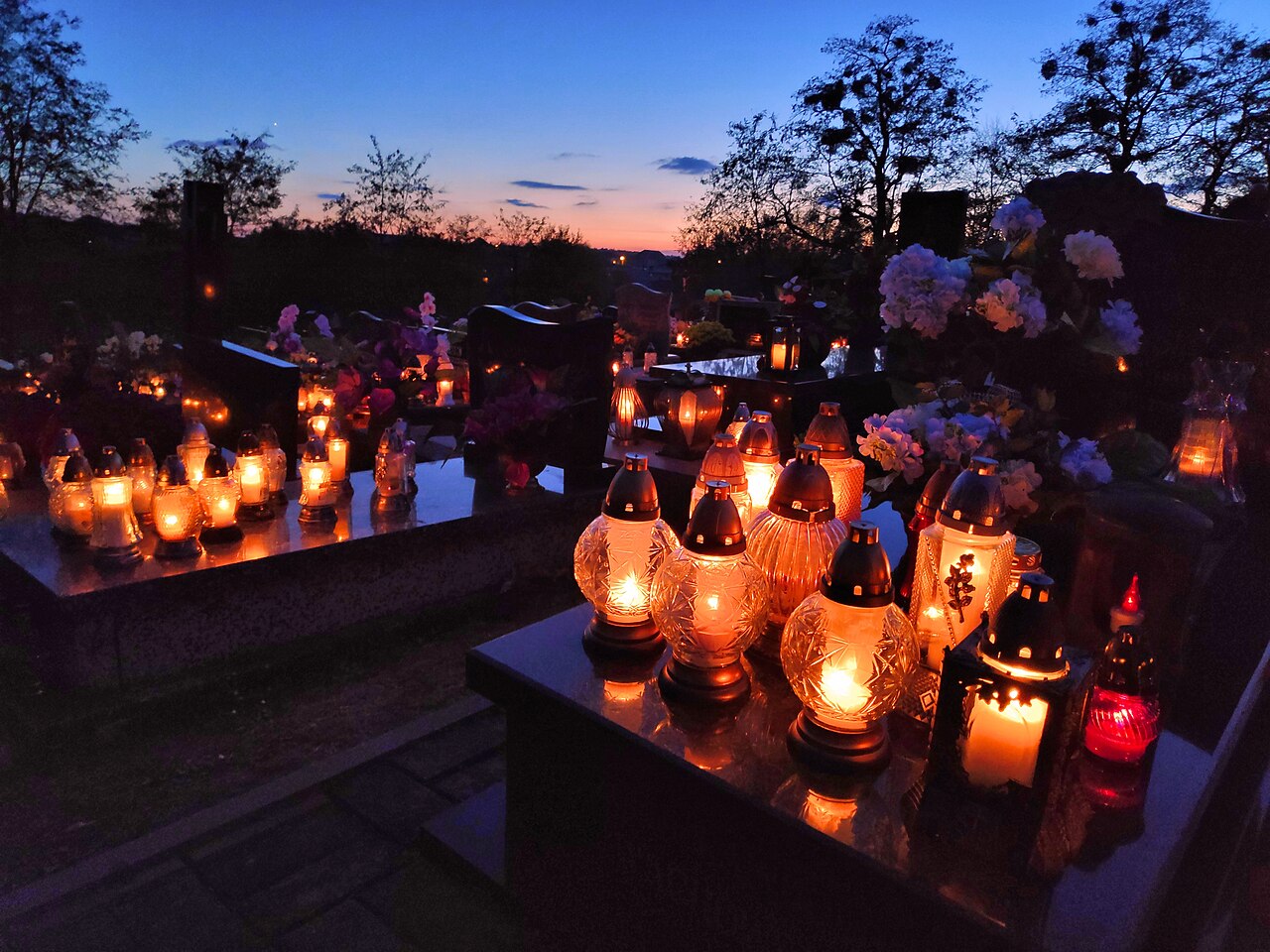
Different cultures express this love in their own ways. In Mexico, families spend the first days of November at the graves of their loved ones, decorating them with marigolds, candles, photographs and favourite foods, in the celebration known as Día de Muertos, the Day of the Dead. Its roots mingle Catholic All Saints and All Souls with older indigenous traditions. In 2008 UNESCO inscribed it on its list of the Intangible Cultural Heritage of Humanity. In Poland, as in the picture at the top of this article, whole cemeteries glow with candles on the evening of All Saints’ Day.
Frequently asked questions
Do Catholics pray to the dead or for the dead? For the dead: Catholics ask God to have mercy on those who have died. Catholics also ask the saints in heaven to pray for us. See Why Do Catholics Pray to Mary and the Saints?
Can I pray for a non-Catholic or someone who wasn’t religious? Yes. Catholics may pray for anyone who has died, entrusting them to God’s mercy.
Can I have a Mass said for someone who wasn’t Catholic? Yes. Masses may be offered for anyone who has died.
Is it too late to pray for someone who died long ago? No. God is outside time, and prayer is never wasted.
You may also like Is Purgatory in the Bible? and Can Souls in Purgatory Pray for the Living?
Sources and further reading
- The Bible: Deuteronomy 18:9-12; 1 Samuel 28:3-20; 1 Chronicles 10:13-14; Tobit 1:16-20; 2:1-8; Job 1:5; 2 Maccabees 12:39-46; John 11:32-44; Acts 8:18-24; 1 Corinthians 12:12-27; 2 Timothy 1:16-18; Hebrews 9:27-28.
- Catechism of the Catholic Church, 954-962, 1032, 1371 and 2116-2117.
- Second Vatican Council, Lumen Gentium 49-51.
- Council of Trent, Session 22 (17 September 1562); Code of Canon Law (1983), canons 945-947.
- Holy Office, decree on spiritualism (24 April 1917); Benedict XV, Incruentum Altaris (10 August 1915).
- Tertullian, De Corona 3; St Cyril of Jerusalem, Mystagogical Catechesis 5; St John Chrysostom, Homily 41 on 1 Corinthians; St Ambrose, On the Death of Theodosius; St Augustine, Confessions 9.11; St Gregory the Great, Dialogues 4.55; Nicetas of Remesiana, Explanation of the Creed.
- Apology of the Augsburg Confession (1531), Article XXIV; Chantries Act (1547).
- Alan Wilkinson, The Church of England and the First World War (1978).
- UNESCO, “Indigenous festivity dedicated to the dead” (inscribed 2008).
