
Do Celibate Priests Find Weddings Painful? Vocation, Joy and Human Feelings
Can a priest feel joy and sadness at a wedding? Explore celibacy, friendship, sacrifice and support without making assumptions about every priest.
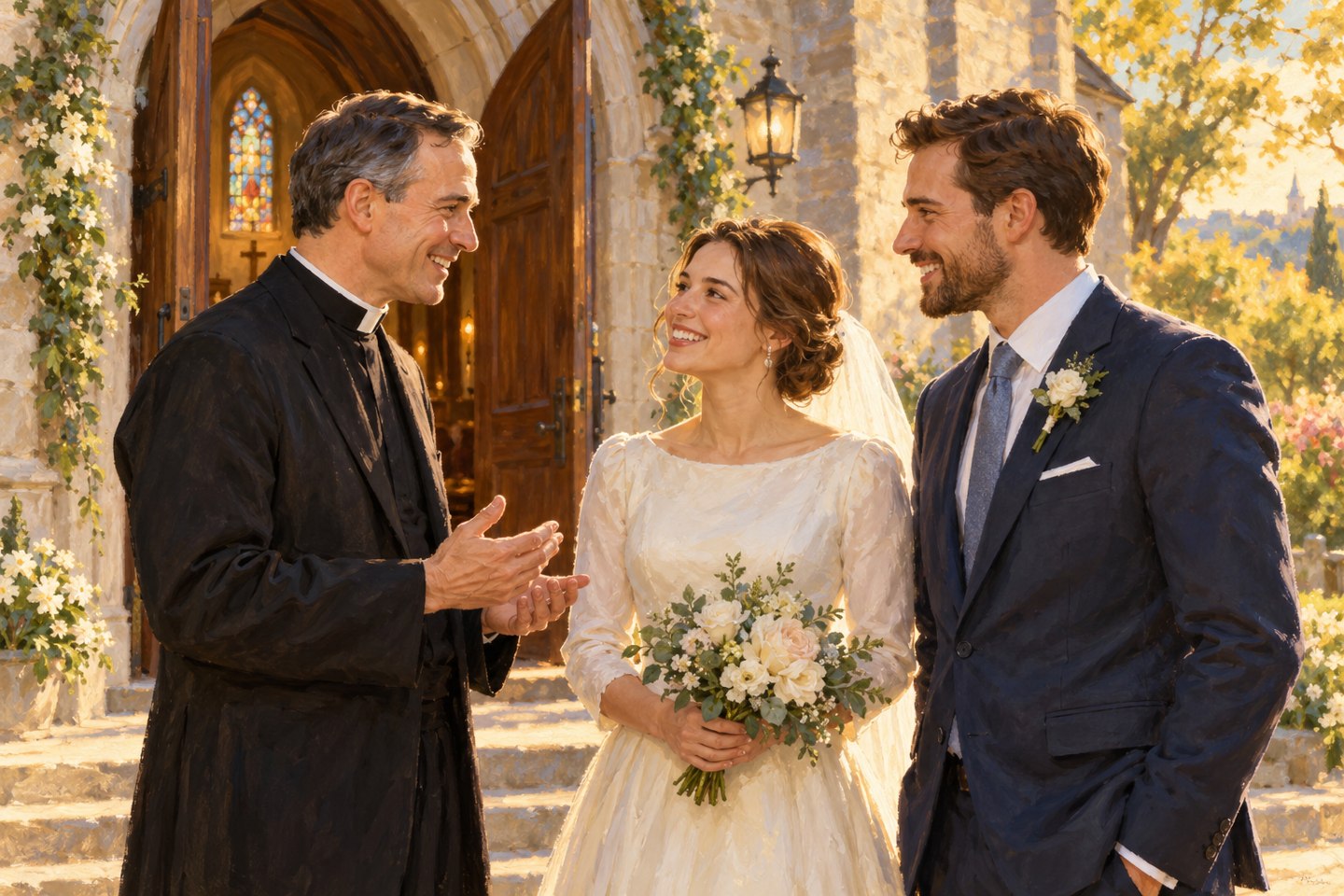
A wedding may bring a celibate priest joy, gratitude, memories, a sense of sacrifice, or several feelings at once. There is no single emotional response shared by every priest. It is unwise to assume that a priest celebrating someone else’s marriage must secretly regret his vocation—or that a faithful priest can never feel the cost of remaining unmarried.
The question often comes from kindness. A couple sees a priest preparing them for family life and wonders whether their happiness reminds him of something he has given up. A thoughtful answer begins by allowing him to be a complete human person without inventing a private story about him.
Celibacy does not mean being incapable of love
Catholic priestly celibacy is not based on the idea that marriage is dirty, affection is dangerous, or a priest should become emotionally numb. It is a way of giving one’s life to Christ and the Church without marrying.
Vatican II’s Presbyterorum Ordinis, paragraph 16, presents celibacy as a gift connected with dedication to Christ and service of his people. It also acknowledges that celibacy is not demanded by the nature of priesthood itself, referring to the different discipline of the Eastern Churches.
That distinction helps prevent a common mistake: treating a priest’s humanity as a problem that ordination should have removed. Ordination does not erase personality, family history or the need for healthy friendship.
A priest can appreciate a beautiful marriage precisely because he knows that marriage is good. His commitment to another vocation need not require him to depreciate the one he is helping a couple to embrace.
Are all Catholic priests unmarried?
No. The normal discipline in the Latin Church is priestly celibacy, with some exceptions. In the Eastern Catholic Churches, married men may be ordained priests under their proper discipline, while bishops are chosen from celibate clergy. The Catechism, paragraphs 1579–1580, explains the distinction.
The ordinary possibility of ordaining a married man in those Churches should not be confused with permission for a priest to marry after ordination. Nor should a married permanent deacon automatically be described as a married priest: the diaconate and priesthood are distinct degrees of Holy Orders.
These facts matter because the emotional question should not be built on an inaccurate picture of Catholic life. The Church includes both priestly celibacy and longstanding traditions of married clergy, and it honours marriage as a sacrament.
Can a good choice still involve grief?
Yes. Choosing one genuine good often means relinquishing another. A person who faithfully cares for an elderly parent may feel the loss of opportunities that care has limited. A married person may sometimes remember a different path without wishing to abandon the family they love.
Likewise, a celibate priest may recognise the real goodness of marriage and fatherhood while remaining convinced of his own vocation. The presence of a feeling does not by itself establish that his choice was mistaken.
It is also possible for a priest to experience a wedding simply as a joyful part of his ministry. He may be glad to see a couple he has accompanied make a serious commitment. We should not insist on finding sadness beneath every smile.
There is no reliable basis here for saying what priests “usually” feel as a measurable group. Individual testimony can illuminate one person’s experience, but it should not be turned into a statistic or a universal psychological rule.
An illustration: the musician and the orchard
This is an original illustrative story.
A musician loved the orchard where she had grown up. When she chose to spend her life teaching music in another town, she knew she would not inherit the daily work of tending its trees. Years later, she played at her brother’s wedding beneath their branches.
She felt a moment of sadness for a life she had not lived, and deep happiness for the life she had chosen. Neither feeling made the other dishonest. She could bless her brother’s home without regarding her own calling as empty.
Priesthood is not simply a career preference, and celibacy has a spiritual meaning beyond this comparison. The story illustrates a limited truth: gratitude and sacrifice can inhabit the same heart.
A priest’s role at a wedding points beyond himself
At a Catholic wedding, the central human commitment is the spouses’ free exchange of consent. The priest or deacon who assists receives that consent in the Church’s name according to the applicable law. See the marriage canons, especially 1057 and 1108.
The celebration is therefore not a public test of whether the minister is satisfied with his own life. His task is to serve the couple and the Church, preach the Gospel, witness their commitment and help them prepare for the responsibilities ahead.
Someone need not have lived every possible human vocation to serve others within it. A priest’s usefulness in marriage preparation depends on sound teaching, listening, humility and appropriate pastoral experience—not on pretending that ordination gives him personal knowledge of every couple’s daily life.
Good preparation can also involve married couples and other qualified people. Recognising their experience does not diminish the priest’s ministry. It allows different gifts to serve the same marriage.
Should a couple ask whether their wedding makes him sad?
Usually there is no need to make that the focus of the occasion. A priest who wants to speak about his vocation can choose to do so. A wedding couple is not responsible for investigating his private emotions or reassuring him that his life has value.
You can express gratitude naturally: “Thank you for helping us prepare and for celebrating with us.” If you know him well, an ordinary invitation to an appropriate gathering may be welcome. Respect his schedule, boundaries and freedom to decline.
Avoid jokes that imply he must envy the groom, has never loved anyone, or has chosen an inferior substitute for family life. Even affectionate teasing can repeat a misunderstanding of his vocation.
Equally, do not idealise him as a person who never needs companionship or rest. Respect means neither prying into his interior life nor pretending he does not have one.
What if a priest is lonely or struggling?
Persistent loneliness, exhaustion or emotional distress deserves attention. The answer is not simply to tell him to work harder or be holier. Healthy friendship, rest, spiritual guidance, support from fellow clergy and appropriate professional care can all have a place.
Presbyterorum Ordinis, paragraph 8, stresses priestly fraternity and mutual support. The Church’s account of chastity also recognises the importance of friendship; see Catechism paragraph 2347. A celibate life is not intended to be a life without human relationships.
Parishioners can contribute through ordinary kindness, fair expectations and respect for time away from work. They should not attempt to become a substitute spouse, a private therapist or the exclusive source of emotional support. Clear boundaries protect everyone involved.
If a priest himself asks for help, encourage appropriate support through trusted people and professional channels. One observation at a wedding is not enough to diagnose a problem.
Does marriage have less value because celibacy is praised?
The Church’s praise of celibacy for the kingdom does not make spouses second-class Christians. Married life has its own sacramental grace, responsibilities and call to holiness. Both vocations require fidelity expressed in ordinary choices, not just an inspiring ceremony at the beginning.
A wedding can remind a priest of the generosity of marital love. A priest’s celibacy can remind a couple that their marriage also belongs within a larger love for God and neighbour. Each can encourage the other without being made identical.
Our articles on marriage and free consent and why adults become Catholic place personal vocation within this wider life of faith.
Let the priest be both a priest and a person
Some priests may feel the cost of celibacy particularly sharply at a wedding. Others may find such celebrations among the happiest parts of their work. Many human experiences do not fit neatly into one category.
The charitable response is to avoid guessing, thank him for his service, and respect the vocation he has undertaken. A good priest can sincerely rejoice when a couple promises a kind of love different from his own. Their joy does not have to be his loss.
Sources and further reading
- Vatican II: Presbyterorum Ordinis, especially 8 and 16
- Catechism: Celibacy and Holy Orders, 1579–1580
- Code of Canon Law: Marriage, canons 1055–1165
- Catechism: The vocation to chastity, including paragraph 2354
Sources checked 26 September 2026. Original illustrative stories are teaching aids, not reported events or quotations from Scripture. This article offers general formation; personal sacramental, legal and health questions require the appropriate qualified adviser.
