
Why Do Catholics Get Ashes on Ash Wednesday? Can Non-Catholics Receive Them?
Ashes on Ash Wednesday are a public admission of sin and mortality that begins Lent, and anyone may receive them. Here is their biblical meaning, history, rules and how to take part.
Once a year, on a Wednesday in February or early March, you may notice colleagues, classmates or people on the train with a dark smudge on their foreheads, often in the shape of a cross. If you are not Catholic, you might wonder what it means. Is it a badge of membership? A way of showing off one’s religion? And could you get one too, if you wanted? This article explains why Catholics receive ashes on Ash Wednesday: what the ashes mean, their roots in the Bible, how the custom developed, how the ashes are made and given, what the Church requires and does not, why non-Catholics are welcome, the honest objection about public piety, and how Catholics keep the day and the season of Lent that it opens.
1. A sign of sin and mortality, open to all
Ashes are a public admission of two hard truths: that we are sinners, and that we will die. Received on Ash Wednesday, they open the forty days of Lent, the Church’s season of repentance before Easter. And anyone, Catholic or not, may receive them.
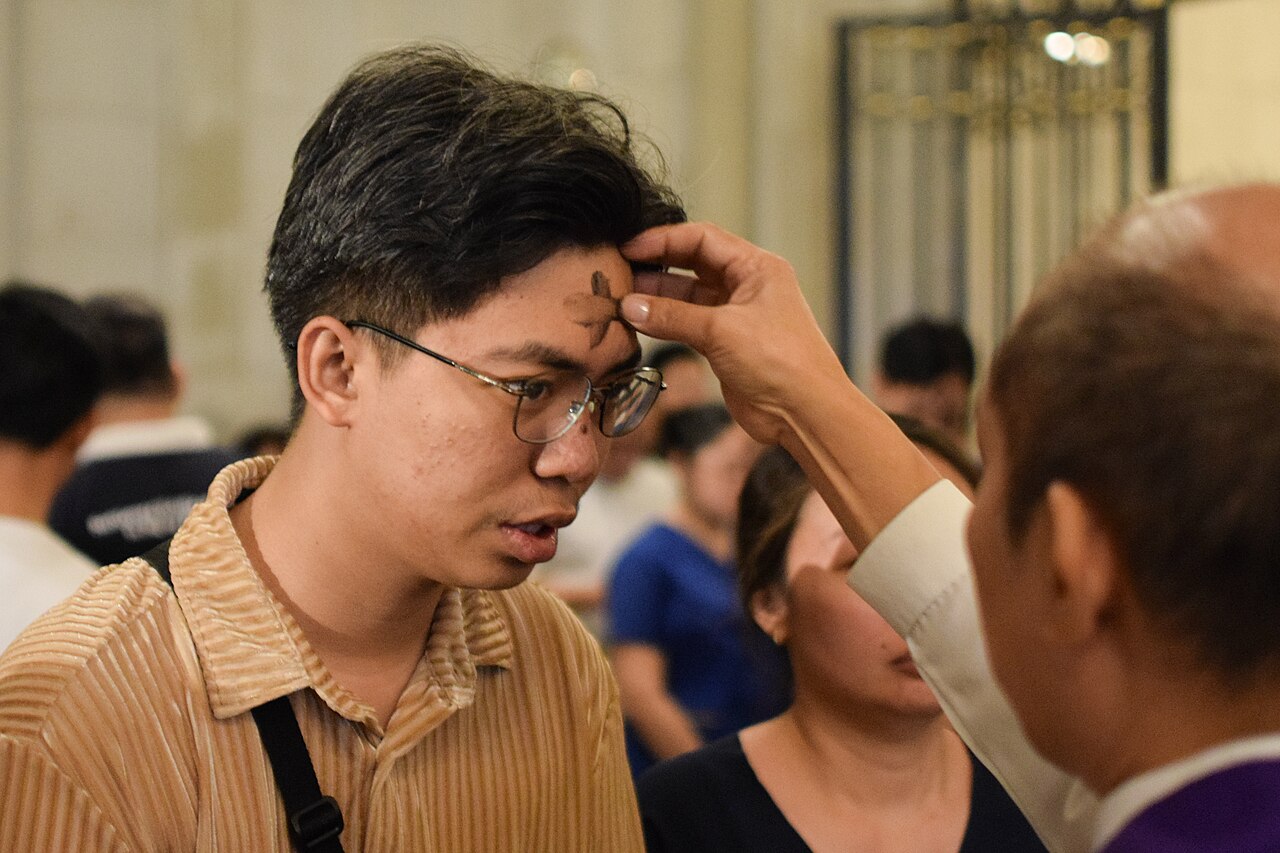
As the minister marks the forehead with ashes, he or she says one of two sentences. The first comes from the Book of Genesis. After Adam and Eve’s sin, God told Adam: “dust thou art, and into dust thou shalt return” (Genesis 3:19). The Church uses this as a stark reminder that every human life will end, and that only God can raise us from the dust.
The second sentence is the very first message of Jesus’s public preaching. Mark tells us that Jesus came into Galilee proclaiming: “The time is accomplished, and the kingdom of God is at hand: repent, and believe the gospel” (Mark 1:15). Many ministers now use these words: “Repent, and believe in the Gospel.”
The forty days of Lent echo Jesus’s own forty days of fasting. Before beginning his public ministry, “Jesus was led by the spirit into the desert, to be tempted by the devil. And when he had fasted forty days and forty nights, afterwards he was hungry” (Matthew 4:1-2). Lent invites Christians to join him in the desert.
2. Ashes in the Bible
The sign of ashes comes straight from the Bible, where sitting in sackcloth and ashes is the ordinary language of repentance and grief.
The most dramatic example is the city of Nineveh. When the reluctant prophet Jonah finally walked through the great pagan city crying out that it would be destroyed in forty days, the people believed God and proclaimed a fast. The king himself “rose up out of his throne, and cast away his robe from him, and was clothed with sackcloth, and sat in ashes.” When God saw their repentance, he spared the city (Jonah 3:5-10). Ash Wednesday asks Christians to do what Nineveh did.
Jesus himself referred to this custom. Rebuking the towns of Galilee that had seen his miracles but had not repented, he said: “Woe to thee, Corozain, woe to thee, Bethsaida: for if in Tyre and Sidon had been wrought the miracles that have been wrought in you, they had long ago done penance in sackcloth and ashes” (Matthew 11:21). For Jesus, ashes were the natural sign of a repentant heart.
The early Christians continued the practice for serious sinners. Around 203, Tertullian described the public penance of Christians who had committed grave sins. They were to lie in sackcloth and ashes, to fast, to groan and weep, to throw themselves at the feet of the priests and ask the prayers of their brothers and sisters (On Repentance 9).
3. From penitents to everyone
What began as a rite for serious public sinners was gradually taken up by every Christian.
In the early medieval Church, people who had committed grave public sins began their penance at the start of Lent. Around 906, a German abbot and canon lawyer named Regino of Prüm described the rite in his handbook for bishops. On the Wednesday before Lent, the penitents came barefoot to the door of the church, where the bishop sprinkled them with ashes and clothed them in sackcloth, before they were expelled from the church until Holy Thursday (De synodalibus causis).
Gradually, ordinary Christians began to join the penitents, recognising that all are sinners. Around 1000, the English abbot Aelfric of Eynsham, one of the finest writers of Old English, wrote in his Lives of the Saints that at the beginning of Lent everyone, both men and women, should have ashes strewn on their heads, as a sign that they must repent of their sins during the Lenten fast. He told a cautionary tale of a man who refused the ashes and died soon afterwards.
In 1091, a council at Benevento in southern Italy, presided over by Pope Urban II, ordered that all the faithful, clergy and laity, men and women, should receive ashes on the first day of Lent. From then on, “Ash Wednesday” became a day for the whole Church.
4. Burnt palms on forehead or head
The ashes used on Ash Wednesday are traditionally made by burning the palm branches blessed and carried on Palm Sunday the year before. The palms that welcomed Christ into Jerusalem become, a year later, the ashes of repentance. The Roman Missal directs that the ashes be made from olive branches or the branches of other trees blessed the previous year.
The ashes are blessed during Mass, after the homily, and then given to the people. In many countries, including the English-speaking world, the minister traces a cross of ashes on the forehead with his thumb. In Italy and some other countries, the ashes are instead sprinkled on the crown of the head. Each year the Pope receives ashes in this Italian way, sprinkled on his head, during the Ash Wednesday liturgy at the ancient Basilica of Santa Sabina on the Aventine Hill in Rome, where popes have begun Lent for centuries.
During the coronavirus pandemic, the Vatican drew on that custom. On 12 January 2021, the Congregation for Divine Worship issued a note asking priests everywhere to say the formula once over everyone, then clean their hands, put on a mask, and sprinkle ashes on each person’s head in silence, without touching their foreheads.
5. A sacramental, not an obligation
Ashes are a sacramental, not a sacrament, and the Church does not require Catholics to receive them. Surprisingly to many people, Ash Wednesday is not a holy day of obligation. What the Church does require is fasting and abstinence.
The Code of Canon Law names Ash Wednesday and Good Friday as days of fasting and abstinence (canon 1251), but Ash Wednesday does not appear in its list of holy days on which Catholics must attend Mass (canon 1246). Yet it is one of the best-attended days of the year in many parishes, often more crowded than an ordinary Sunday.
The fast itself has a long history. In 1966, Pope Paul VI simplified the Church’s laws on penance in the apostolic constitution Paenitemini (17 February 1966). He reduced the number of obligatory fast days, but kept Ash Wednesday and Good Friday as the two days on which all adult Catholics must fast.
The Second Vatican Council explained the difference between sacraments and sacramentals. Sacramentals are “sacred signs which bear a resemblance to the sacraments”. Their effects, especially spiritual ones, are obtained through the Church’s intercession. They dispose people to receive the grace of the sacraments, and make holy various occasions of life (Sacrosanctum Concilium 60). The ashes do not forgive sins. They express a desire for conversion.
6. Non-Catholics are welcome
Because the ashes are a blessing and not Holy Communion, non-Catholics and even the unbaptised are welcome to come forward and receive them.
Church law states that blessings are given first of all to Catholics, but may also be given to catechumens and even to non-Catholics, unless there is a Church prohibition to the contrary (canon 1170). There is no such prohibition for ashes.
The Bible shows outsiders receiving signs from God’s people. Naaman, the commander of the army of Syria, a foreigner and a pagan, came to the prophet Elisha to be healed of leprosy. Elisha told him simply to wash seven times in the Jordan. Naaman was offended at first, but when he humbly did as he was told, “his flesh was restored, like the flesh of a little child” (2 Kings 5:1-14). He came to believe in the God of Israel.
Other Christians have also found ways to offer ashes to anyone. In 2007, Episcopal clergy in St Louis, Missouri, began standing on street corners and at railway stations on Ash Wednesday, offering “Ashes to Go” to passers-by. By 2012, according to the Episcopal News Service, the practice had spread to cities across the United States and beyond. Many Catholic parishes also welcome anyone to their Ash Wednesday services.
7. “Don’t show off your fasting”
The strongest objection to Ash Wednesday comes from Jesus himself. In the Sermon on the Mount he warned against showy religion: “when you fast, be not as the hypocrites, sad. For they disfigure their faces, that they may appear unto men to fast… But thou, when thou fastest anoint thy head, and wash thy face” (Matthew 6:16-17). Isn’t walking around all day with a smudge on your forehead exactly what Jesus told his followers not to do?
The Church takes the objection so seriously that it reads this very Gospel passage aloud at Mass every Ash Wednesday, just before the ashes are given. It is a pointed reminder that the ashes are worthless if they are worn to impress people.
The first reading of the day, from the prophet Joel, holds the tension together. Joel calls: “rend your hearts, and not your garments, and turn to the Lord your God.” But in the very next breath he calls for a public fast: “Blow the trumpet in Sion, sanctify a fast, call a solemn assembly, gather together the people” (Joel 2:13-16). Repentance is both inward and communal. The ashes are a public sign of a private conversion, and they are received together as a community of sinners.
Some Christians have rejected ashes altogether. In January 1548, under the Protestant boy-king Edward VI, England’s Privy Council banned the use of ashes on Ash Wednesday, along with candles at Candlemas and palms on Palm Sunday, as superstitious. Yet in 1979 the Episcopal Church in the United States restored the imposition of ashes in its new Book of Common Prayer, and many Anglicans, Lutherans and Methodists now receive them.
8. Not a badge of holiness
The smudge on the forehead does not mark the wearer as a holier person or a member of a club. It marks him or her as a sinner asking for mercy.
Jesus told a parable about two men who went up to the Temple to pray. The Pharisee stood and listed his virtues: “I fast twice in a week: I give tithes of all that I possess.” The tax collector stood far off, would not even raise his eyes to heaven, beat his breast and said, “O God, be merciful to me a sinner.” Jesus said that it was the tax collector who went home justified (Luke 18:9-14). The ashes are meant to make us like the tax collector.
Even the powerful have done public penance. In 390, after the Emperor Theodosius ordered a massacre at Thessalonica in which thousands of civilians were killed, St Ambrose, bishop of Milan, refused to let him receive Communion until he had done public penance. The emperor laid aside his imperial robes and did penance in Milan cathedral for months before being readmitted.
In England, King Henry II made one of history’s most famous acts of penance. His angry words had led four of his knights to murder Archbishop Thomas Becket in Canterbury Cathedral in December 1170. On 12 July 1174, Henry walked barefoot through the streets of Canterbury to the cathedral, wearing a penitent’s woollen shirt. At Becket’s tomb he was scourged by the bishops and monks, and spent the night in prayer beside it. Ashes on a Wednesday morning are a much smaller sign of the same truth: no one is above the need for mercy.
9. How Catholics keep the day
In practice, Ash Wednesday involves fasting, abstaining from meat, and beginning Lent’s three traditional practices: prayer, fasting and almsgiving.
Church law requires Catholics from the age of eighteen until their fifty-ninth birthday to fast on Ash Wednesday. That means one full meal, with some food allowed in the morning and evening; this is commonly explained as two smaller meals that together do not equal a full one, with no food in between. Catholics aged fourteen and over must abstain from meat (canons 1251-1252). The sick, pregnant women and others with good reason are excused.
Fasting is never meant to be only about food. The prophet Isaiah condemned people who fasted while oppressing their workers. “Is this such a fast as I have chosen,” God asks, “for a man to afflict his soul for a day?… Is not this rather the fast that I have chosen?… Deal thy bread to the hungry, and bring the needy and the harbourless into thy house: when thou shalt see one naked, cover him” (Isaiah 58:5-7). The money saved by fasting is meant to be given away.
This principle inspired one of the great Catholic charities. In 1960, Catholic women in England and Wales organised a “Family Fast Day” during Lent, asking families to eat a simple meal and give the money saved to feed mothers and children on the Caribbean island of Dominica. The idea spread, and in 1962 the bishops of England and Wales founded CAFOD, the Catholic Agency for Overseas Development, which today works in dozens of countries. Its Lent Fast Days are still held every year.
10. Ashes point to Easter
Ashes are not the end of the story. They point forward to Easter. The invitation is to walk in, receive them, and keep Lent with everyone else.
In the early Church, Lent was the final season of preparation for adults who were to be baptised at Easter. Around 383, the pilgrim Egeria described how, in Jerusalem, those who wished to be baptised gave in their names to the bishop at the start of Lent, and were then instructed in the Scriptures and the faith every day for forty days before their baptism at the Easter Vigil (Itinerarium 45).
One of those candidates, a few years later, was St Augustine. In his Confessions, he recalls that when the time came, he gave in his name in Milan to be baptised, and at the Easter Vigil of 387 he was baptised by St Ambrose, together with his son Adeodatus and his friend Alypius (Confessions 9.6). Lent was his road home.
The spirit of Ash Wednesday is captured in Jesus’s parable of the prodigal son. When the younger son, ruined and hungry, finally came to himself and set out for home, “when he was yet a great way off, his father saw him, and was moved with compassion, and running to him fell upon his neck, and kissed him” (Luke 15:20). Ash Wednesday is the first step on the road home, and the Father is already running to meet us.
Frequently asked questions
Can a non-Catholic receive ashes? Yes. Ashes are a blessing, not a sacrament, and anyone may receive them, including the unbaptised.
Do I have to keep the ashes on all day? No. There is no rule. Many people leave them on as a reminder; others wipe them off, especially at work.
Is Ash Wednesday a holy day of obligation? No, but it is a day of fasting and abstinence for Catholics.
What if I eat meat by mistake? An honest mistake is not a sin. See Accidentally Ate Meat on a Friday in Lent? and Why Don’t Catholics Eat Meat on Fridays?
Sources and further reading
- The Bible: Genesis 3:19; 2 Kings 5:1-14; Isaiah 58:5-7; Joel 2:12-17; Jonah 3:5-10; Matthew 4:1-2; 6:1-6, 16-18; 11:21; Mark 1:15; Luke 15:11-32; 18:9-14.
- Roman Missal, Ash Wednesday; Congregation for Divine Worship, Note on the distribution of ashes (12 January 2021).
- Code of Canon Law (1983), canons 1170, 1246, 1249-1253.
- Paul VI, Paenitemini (1966); Second Vatican Council, Sacrosanctum Concilium 60.
- Tertullian, On Repentance 9; Egeria, Itinerarium 45; St Augustine, Confessions 9.6.
- Regino of Prüm, De synodalibus causis (c. 906); Aelfric of Eynsham, Lives of the Saints; Council of Benevento (1091).
- Episcopal News Service, reports on “Ashes to Go” (2012); Book of Common Prayer (1979).
- CAFOD, history of the Family Fast Day (1960).
