
Why Do Catholics Use Incense at Mass?
Incense at Mass is prayer made visible and a sign of honour. Here is why God commanded it in the Bible, why early Christians refused it, how it is used today, and what about asthma.
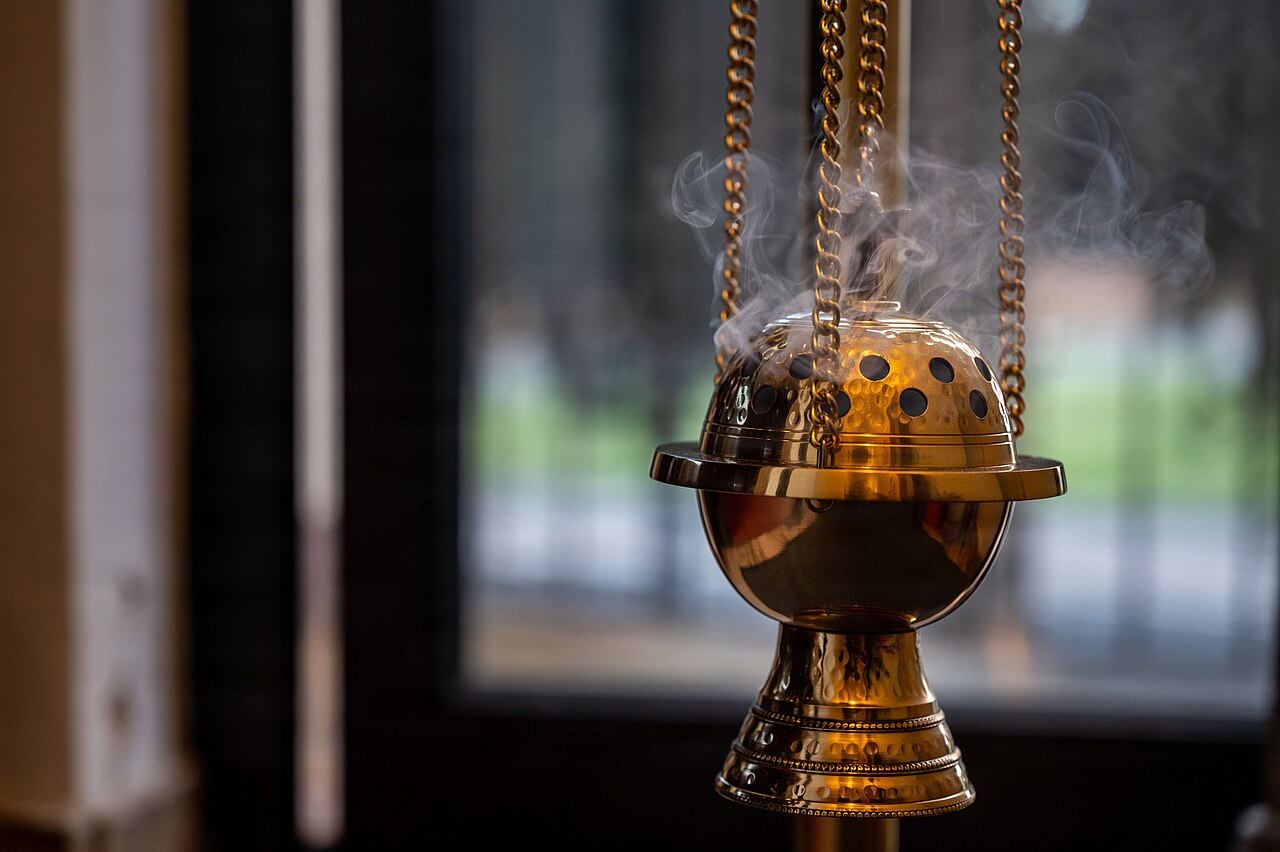
If you have ever been to a solemn Catholic Mass, a funeral or Benediction, you may have been startled by clouds of sweet-smelling smoke billowing from a metal vessel swung on chains. The server swinging it is called a thurifer, the vessel a thurible or censer, and the smoke comes from incense: grains of fragrant tree resin burning on hot charcoal. If you are not used to it, you might wonder whether it is biblical, pagan, or just theatre. This article explains why Catholics use incense: what it means, how God commanded it in Israel, how the New Testament begins and ends with it, why the first Christians refused it for three centuries, how it entered Christian worship, how it is used at Mass today, the fair objections, what incensing people and objects means, and practical matters such as asthma.
1. Prayer you can see
Incense is a visible prayer: sweet smoke rising up towards God, and a mark of honour for what is holy. It appeals to the senses of sight and smell, involving the whole body in worship.
The meaning is given in the Psalms. “Let my prayer be directed as incense in thy sight; the lifting up of my hands, as evening sacrifice” (Psalm 141:2). This verse is sung at Evening Prayer in the Catholic and Orthodox Churches, often while incense is offered. Just as the smoke rises, so our prayers rise to God.
The Book of Revelation gives the same picture of heaven’s worship. John saw an angel standing at the golden altar before God’s throne, holding a golden censer. “There was given to him much incense, that he should offer of the prayers of all saints upon the golden altar… And the smoke of the incense of the prayers of the saints ascended up before God from the hand of the angel” (Revelation 8:3-4). Catholics believe that when they use incense at Mass, they join in this heavenly worship.
The Church’s own instructions for Mass explain incense in exactly these terms. The General Instruction of the Roman Missal says that incensation “expresses reverence and prayer”, and cites both Psalm 141 and Revelation 8:3 (GIRM 276).
2. God commanded it
Catholics did not invent incense, nor borrow it from paganism. God himself commanded it in Israel’s worship.
God told Moses to build a special altar for incense, overlaid with pure gold, and to place it before the veil of the Holy of Holies. “And Aaron shall burn sweet smelling incense upon it in the morning. When he shall dress the lamps, he shall burn it: and when he shall place them in the evening, he shall burn an everlasting incense before the Lord throughout your generations” (Exodus 30:1-8). Incense was offered every morning and evening.
On the holiest day of the year, the Day of Atonement, the high priest entered the Holy of Holies, the innermost room of the sanctuary, carrying “a censer, which he shall fill with the burning coals of the altar, and taking up with his hands the compounded incense for a sweet odour… that the cloud and vapour thereof may cover the oracle” (Leviticus 16:12-13). The cloud of incense surrounded him as he came into God’s presence.
The prophet Malachi foretold that one day incense would be offered to God not only in Jerusalem, but everywhere: “from the rising of the sun even to the going down, my name is great among the Gentiles, and in every place there is sacrifice, and there is offered to my name a clean oblation” (Malachi 1:11). The Didache, a Christian handbook from around the year 100, applied this verse to the Sunday Eucharist of the Christians (Didache 14).
3. The New Testament begins and ends with incense
The New Testament begins and ends with incense, from the Temple and the manger to the worship of heaven.
The Gospel of Luke opens in the Temple in Jerusalem. The elderly priest Zechariah had been chosen by lot to burn incense in the sanctuary, while all the people prayed outside. As he stood at the altar of incense, the angel Gabriel appeared to him and announced that his wife Elizabeth would bear a son, John the Baptist (Luke 1:8-13). The first good news of the New Testament came amid clouds of incense.
When the wise men came from the East to worship the newborn Jesus, they brought him gifts: “gold, frankincense, and myrrh” (Matthew 2:11). Christians have long seen meaning in these gifts: gold for a king, frankincense for God, and myrrh, used in burial, for one who would die.
As we have seen, the last book of the Bible shows incense rising before God’s throne with the prayers of the saints (Revelation 5:8; 8:3-4). Around 180, St Irenaeus of Lyons quoted John’s vision when explaining the Eucharist, teaching that the incense offered to God is “the prayers of the saints” (Against Heresies 4.17.6).
4. Three centuries of refusal
Surprisingly, for nearly three hundred years, Christians avoided using incense in their worship. The reason is moving: in the Roman Empire, burning a pinch of incense to the emperor’s image was the test of whether you had abandoned your faith.
Around 112, Pliny the Younger, the Roman governor of the province of Bithynia in Asia Minor, wrote to the Emperor Trajan asking how to deal with people accused of being Christians. He explained his procedure: those who denied being Christians, he released if they invoked the gods, offered incense and wine to the emperor’s image, and cursed Christ, “none of which”, he added, “those who are really Christians can be forced to do” (Letters 10.96).
Around 197, Tertullian, defending Christians to the Roman authorities, admitted that Christians did not buy frankincense for worship. If the incense-sellers of Arabia complained, he said, they should know that Christians used far more spices burying their own dead than the pagans did burning incense to their gods (Apology 42).
In 250, the Emperor Decius ordered every inhabitant of the empire to offer sacrifice and receive a certificate proving they had done so. Many Christians, afraid of torture and death, gave in. Those who had burned incense before the gods were called thurificati, “incense-burners”. St Cyprian of Carthage wrote about how they were to be received back into the Church after doing penance (On the Lapsed). For Christians of that era, incense smelled of apostasy.
5. Incense enters Christian worship
Once the danger of persecution passed, after the Emperor Constantine granted freedom to Christians in 313, incense entered Christian worship in the fourth century and never left it.
Around 383, the pilgrim Egeria described the Sunday morning service in Jerusalem, in the great church built over the tomb of Christ. Censers were carried into the cave of the Resurrection, she wrote, “so that the whole basilica is filled with the odours” (Itinerarium 24). The fragrance of incense now filled the place where Christ had risen.
The Liber Pontificalis, a collection of biographies of the popes compiled in the sixth century, records that among the gifts the Emperor Constantine gave to the Lateran Basilica, the Pope’s cathedral in Rome, were golden censers set with precious stones.
By around 700, incense had a fixed place in the papal liturgy. The Ordo Romanus I, a detailed description of how the Pope celebrated Mass in Rome, shows a subdeacon carrying a golden censer before the Pope as he entered the church, and before the Gospel book as it was carried to be read. Incense was now a sign of honour for Christ present in his word and in his minister.
6. How incense is used at Mass
At Mass, incense is optional. It may be used at any form of Mass, though it is usually kept for solemn occasions. When it is used, it honours the altar, the Gospel book, the bread and wine, the priest, the people and the Eucharist.
The Church’s instructions allow incense to be used at five moments of the Mass: during the entrance procession; at the beginning of Mass, to incense the cross and the altar; at the procession and proclamation of the Gospel; at the preparation of the gifts, to incense the bread and wine, the cross, the altar, the priest and the people; and at the elevation of the consecrated Host and chalice after the consecration (GIRM 276-277).
Incense is also used at funerals, where the priest incenses the coffin. This honours the body of the dead person, which, St Paul reminds us, was “the temple of the Holy Ghost” (1 Corinthians 6:19), and expresses the prayer that the person’s soul may rise to God like incense.
The most spectacular use of incense in the world is at the Cathedral of Santiago de Compostela in Spain, the destination of the famous pilgrimage route, the Camino. There, a giant silver-plated censer called the Botafumeiro, weighing over fifty kilograms, is swung by a team of men on ropes in a great arc across the transept of the cathedral, almost touching the ceiling. It has been used since the Middle Ages, and it is said that it originally helped to sweeten the air in a cathedral full of weary, unwashed pilgrims.
7. “God calls incense an abomination”
A fair objection comes from the Old Testament itself. Through the prophet Isaiah, God seemed to reject incense: “Offer sacrifice no more in vain: incense is an abomination to me” (Isaiah 1:13). Doesn’t this show that God does not want incense?
The context shows what God was really rejecting. Isaiah was speaking to people who offered sacrifices and incense while their “hands are full of blood”. God goes on: “Wash yourselves, be clean… seek judgment, relieve the oppressed, judge for the fatherless, defend the widow” (Isaiah 1:15-17). God condemned not incense, which he had commanded, but hypocrisy: worship without justice.
The Bible also shows God judging pride in offering incense. King Uzziah of Judah, after many successes, “was lifted up to his own destruction”. He went into the Temple to burn incense on the altar himself, although this was the role of the priests. When the priests confronted him and he raged at them, leprosy broke out on his forehead (2 Chronicles 26:16-21). Again, God judged the heart behind the offering.
Some Christians have rejected incense entirely. In the nineteenth century, the use of incense by Anglo-Catholic clergy caused bitter controversy in the Church of England. On 31 July 1899, the Archbishops of Canterbury and York, after hearing arguments, gave their formal opinion that the liturgical use of incense was not lawful in the Church of England. Yet today incense is used in many Anglican cathedrals and parishes, and in the Lutheran and Methodist traditions too.
8. Incensing people and things
When a priest incenses a statue, a coffin or the congregation, he is honouring them, not worshipping them.
In 787, the Second Council of Nicaea, accepted by Catholics and Orthodox alike, explicitly permitted incense and lights to be offered before holy images as a mark of honour. It made clear that this honour passes to the person represented, and that true adoration (latreia) belongs to God alone.
At a solemn Mass, after incensing the bread and wine, the cross and the altar, the deacon or server incenses the priest, and then turns to incense the whole congregation (GIRM 75, 178). This is a striking gesture: the people are honoured because they are the baptised, the holy people of God, temples of the Holy Spirit. Visitors are sometimes surprised to find themselves being incensed, and may simply bow in return.
The question of what incense means came up dramatically in China. For centuries, Catholic missionaries debated whether Chinese Catholics could take part in traditional ceremonies honouring Confucius and their ancestors, which involved bowing and burning incense. In the eighteenth century Rome forbade it, fearing it was idolatry. But on 8 December 1939, after the Chinese government declared that these ceremonies were civil, not religious, the Vatican issued an instruction, Plane compertum est, allowing Chinese Catholics to take part in them. Incense, it recognised, can express civil respect as well as religious worship.
9. Practical matters, and asthma
In practical terms, incense is fragrant tree resin, sometimes blended with spices and essential oils, sprinkled on burning charcoal in the thurible. The smoke rises from the resin as it heats.
God gave Moses a specific recipe for the incense of the sanctuary: equal parts of stacte, onycha, galbanum and pure frankincense, seasoned with salt, to be reserved for worship alone. Anyone who made it for their own use was to be cut off from the people (Exodus 30:34-38).
Frankincense, the main ingredient of most church incense, comes from the resin of Boswellia trees, which grow in southern Arabia and the Horn of Africa. In ancient times it was one of the most valuable trade goods in the world, carried by camel caravans across Arabia. In 2000, UNESCO inscribed the “Land of Frankincense” in Oman, including frankincense groves and the remains of ancient caravan oases and ports, as a World Heritage Site.
Incense smoke can affect people with asthma or other breathing problems. In 2004, researchers at Maastricht University in the Netherlands measured the air quality in a church after candles and incense had been burning for some hours, and found levels of fine particles and free radicals far above those normally found outdoors (European Respiratory Journal, 2004). People with respiratory problems may want to sit towards the back, near a door, or attend a Mass where incense is not used. Many parishes publish which Masses are celebrated with incense.
10. Come and see
To understand why incense has endured for so long, the best thing to do is to attend a solemn Mass, Vespers (evening prayer) or Benediction of the Blessed Sacrament, and let the sign speak for itself.
The prophet Isaiah received his call in a vision filled with incense-like smoke. He saw the Lord “sitting upon a throne high and elevated”, and seraphim crying to one another, “Holy, holy, holy, the Lord God of hosts, all the earth is full of his glory.” And “the house was filled with smoke” (Isaiah 6:1-4). Catholics sing the seraphim’s words at every Mass.
According to the Russian Primary Chronicle, around 987 Prince Vladimir of Kyiv sent envoys to study the religions of his neighbours. When they returned from attending the liturgy in the great church of Hagia Sophia in Constantinople, with its singing, its lights and its incense, they reported: “We knew not whether we were in heaven or on earth… We only know that God dwells there among men.” Vladimir was baptised, and the faith of Ukraine and Russia began.
One of the loveliest moments of Catholic worship is Benediction, when the consecrated Host is placed in a monstrance on the altar, honoured with incense and song, and the priest blesses the people with it. At Benediction, Catholics sing the hymn Tantum ergo, the last two verses of a hymn written by St Thomas Aquinas in 1264 for the new feast of Corpus Christi. As the smoke rises around the Blessed Sacrament, the words sum up the meaning of every sign: “Faith, our outward sense befriending, makes the inward vision clear.”
Frequently asked questions
Is incense pagan? No. God commanded incense in Israel’s worship, and it appears throughout the Bible. Pagans also used it, which is why early Christians avoided it for a time.
Is incense used at every Mass? No. It is optional, and is usually reserved for Sundays, feasts, funerals and other solemn occasions.
I have asthma. What should I do? Sit near the back or a door, or choose a Mass where incense is not used. Many parishes will tell you which Masses use incense.
Why is the congregation incensed? To honour the baptised, who are temples of the Holy Spirit and the holy people of God.
You may also like Why Do Catholics Light Candles in Church? and How to Find a Reverent Catholic Mass
Sources and further reading
- The Bible: Exodus 30:1-10, 34-38; Leviticus 16:12-13; 2 Chronicles 26:16-21; Psalm 141:2; Isaiah 1:11-17; 6:1-4; Malachi 1:11; Matthew 2:11; Luke 1:8-13; 1 Corinthians 6:19; Revelation 5:8; 8:3-4.
- General Instruction of the Roman Missal 75, 178, 276-277; Order of Christian Funerals.
- Second Council of Nicaea (787); Sacred Congregation for the Propagation of the Faith, Plane compertum est (1939).
- Didache 14; Pliny the Younger, Letters 10.96; Tertullian, Apology 42; St Cyprian, On the Lapsed; St Irenaeus, Against Heresies 4.17.6; Egeria, Itinerarium 24; Liber Pontificalis; Ordo Romanus I.
- Archbishops of Canterbury and York, Opinion on the liturgical use of incense (31 July 1899).
- T. M. de Kok and others, “Radicals in the church”, European Respiratory Journal 24 (2004).
- UNESCO World Heritage List, “Land of Frankincense” (2000).
- The Russian Primary Chronicle, entry for 987.
