
Catholic vs Methodist: Beliefs, Sacraments and Worship Compared
Methodists and Catholics are close on grace and holy living. Here is where they agree, where they differ on authority, sacraments, ministry and the Eucharist, and how they work together.
If you are a Methodist engaged to a Catholic, or a Catholic with Methodist neighbours, you may have noticed something: on many of the things that matter most, the two churches seem surprisingly close. Both speak warmly about grace. Both believe that faith must show itself in holiness of life and in care for the poor. Both baptise babies. Both sing the great hymns of Charles Wesley. So where do they really part? This article compares what Catholics and Methodists believe about grace, authority, the sacraments, the Eucharist, ministry, Mary and the saints, and Communion, and tells the story of a movement that began as a revival inside the Church of England. It also shows how the two churches have worked together since the 1960s.
1. Close on grace, different on authority
Methodists and Catholics share the creeds, recognise each other’s baptism and hold a strong doctrine of grace. They differ mainly on authority, the number of sacraments, ordained ministry and the Eucharist.
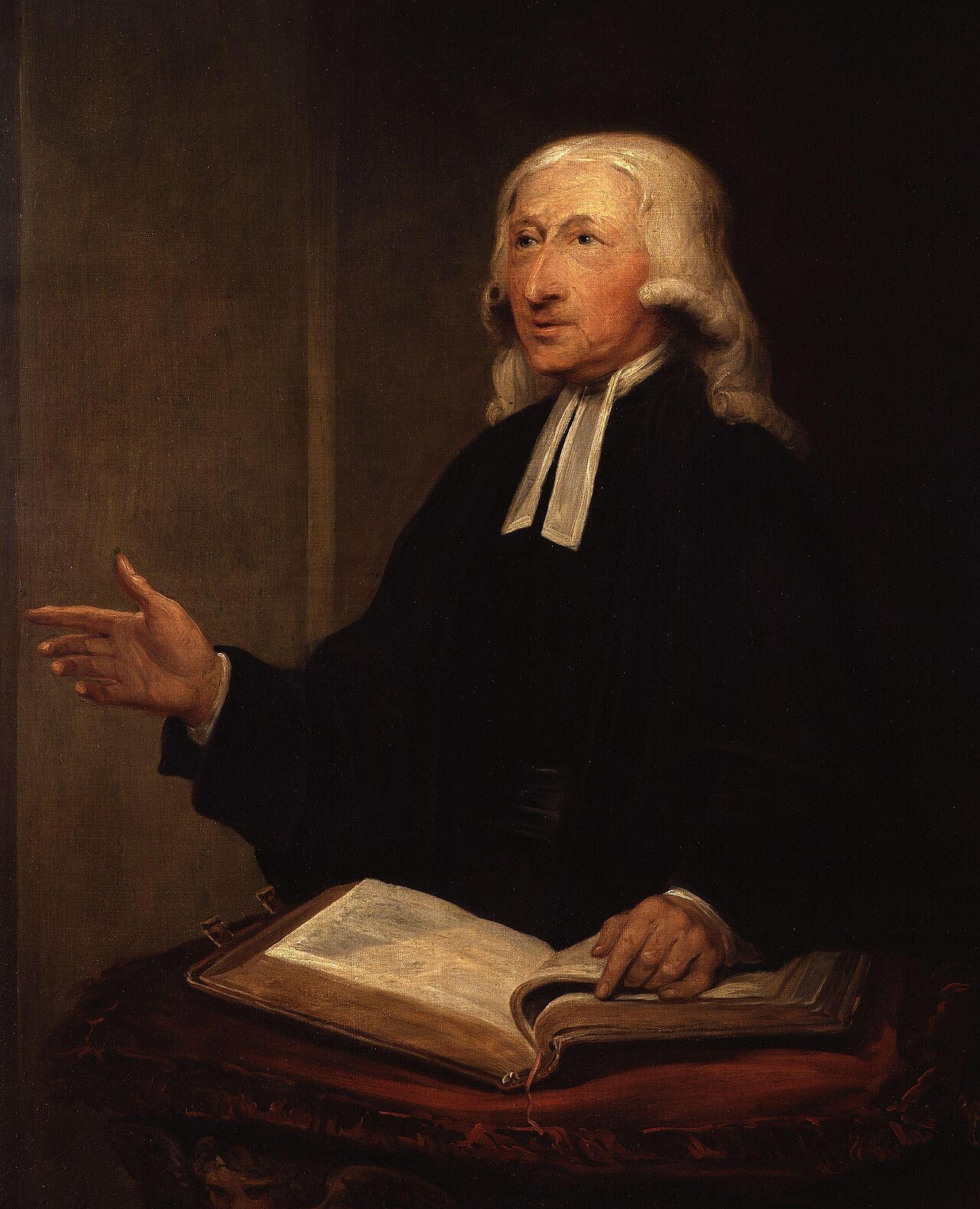
Methodism’s founder, John Wesley, was an Anglican priest whose spiritual life was changed in a single evening. On 24 May 1738, he went “very unwillingly” to a meeting of a religious society in Aldersgate Street, London, where someone was reading aloud from Martin Luther’s preface to St Paul’s Letter to the Romans. “About a quarter before nine,” Wesley wrote in his journal, “while he was describing the change which God works in the heart through faith in Christ, I felt my heart strangely warmed. I felt I did trust in Christ, Christ alone, for salvation.”
Wesley could be generous towards Catholics. On 18 July 1749 he wrote an open Letter to a Roman Catholic from Dublin. He set out at length the beliefs that Protestants and Catholics share, from the Trinity to the Virgin Birth, and appealed to both sides to stop attacking each other and to help one another towards the kingdom of God. “If we cannot as yet think alike in all things,” he wrote, “at least we may love alike.”
But Wesley was a man of his time. In January 1780 he wrote to a London newspaper, the Public Advertiser, arguing that Catholics should not be granted toleration by a Protestant government, because he believed they could not be loyal subjects. A few months later London was torn apart by the anti-Catholic Gordon Riots. Methodists today recognise that Wesley’s attitudes to Catholics were mixed, and their relations with Catholics are far warmer than his were.
2. A renewal movement that became a church
Methodism began not as a new church but as a renewal movement within the Church of England, and it became a separate church only gradually.
In 1729, at Oxford University, John Wesley’s younger brother Charles gathered a few students for regular prayer, study of the Greek New Testament, frequent Communion, fasting, and visiting prisoners and the poor. Other students mocked their strict routine and called them the “Holy Club” and “Methodists”, for their methodical habits. John soon became the group’s leader, and the nickname stuck.
After his Aldersgate experience, Wesley began preaching about personal faith and holiness with a new fire. Many Anglican clergy disapproved and closed their pulpits to him. On 2 April 1739, at the urging of his friend George Whitefield, he did something he had once thought almost sinful: he preached in the open air, to around three thousand people, many of them miners and labourers, in a brickyard on the edge of Bristol. “I submitted to be more vile,” he wrote. For the next fifty years he travelled the length of Britain on horseback, preaching in fields, market squares and town halls.
Wesley never wanted to leave the Church of England. But after the American Revolution, the Methodists in America were left without clergy to baptise or celebrate Communion. When no Anglican bishop would ordain ministers for them, Wesley, himself only a priest, ordained men for America in 1784. That December, at the “Christmas Conference” in Baltimore, the American Methodists organised themselves as the Methodist Episcopal Church. In Britain, Methodism separated from the Church of England after Wesley’s death in 1791.
3. Grace and holiness: real closeness
On grace, Methodists and Catholics are close, closer than either is to some other Protestant traditions. Both teach that God’s grace comes first, before we can even turn to him; that we are free to respond to it or resist it; and that faith must grow into real holiness of life.
Both often quote St Paul’s words to the Philippians: “with fear and trembling work out your salvation. For it is God who worketh in you, both to will and to accomplish” (Philippians 2:12-13). God’s grace and our free response work together.
Wesley’s most distinctive teaching was “Christian perfection” or “entire sanctification”. He taught that Christians should expect, by grace, to be made perfect in love in this life, so that the love of God and neighbour fills the heart and drives out deliberate sin. He did not mean that Christians would never make mistakes, but that love could truly reign in them. He set this out in A Plain Account of Christian Perfection (1766). Catholics recognise in this something very like their own teaching on the universal call to holiness and on the saints.
The closeness has been formally recognised. On 23 July 2006, meeting in Seoul, South Korea, the World Methodist Council formally joined the Joint Declaration on the Doctrine of Justification, signed by Catholics and Lutherans in 1999. Methodists thereby affirmed with Catholics that we are accepted by God by grace alone, through faith in Christ’s saving work, not because of any merit of our own.
4. How doctrine is decided
Methodists and Catholics decide questions of doctrine in different ways. Catholics look to the bishops in communion with the Pope as the authentic interpreters of Scripture and Tradition. Methodists speak of Scripture as primary, read in the light of tradition, reason and experience (sometimes called the “Wesleyan quadrilateral”), and they make decisions through representative gatherings called “conferences”.
Both can look back to the New Testament. When the early Church faced its first great dispute, over whether Gentile converts needed to be circumcised, the apostles and elders met in Jerusalem and sent a letter saying, “it hath seemed good to the Holy Ghost and to us” (Acts 15:28). Catholics see the bishops gathered with Peter’s successor as continuing this; Methodists see their conferences as following the same pattern.
The Methodist conference system began in June 1744, when Wesley invited a handful of Anglican clergy and lay preachers to the Foundery, his headquarters in London, to “confer” on what to teach, how to teach it and how to organise the work. The conference has remained the governing body of Methodism ever since.
Recent events show both the strength and the weakness of the system. In the United States, debates over sexuality divided the United Methodist Church for decades. Between 2019 and 2023 about a quarter of its American congregations left, many to form the Global Methodist Church. In May 2024, the General Conference meeting in Charlotte, North Carolina, voted to remove the church’s bans on ordaining openly gay clergy and on clergy performing same-sex weddings. Catholics hold that such questions of faith and morals cannot be changed by vote.
5. Sacraments: seven or two
Catholics celebrate seven sacraments. Methodists recognise two, Baptism and the Lord’s Supper, as sacraments ordained by Christ.
When Wesley prepared a statement of faith for the American Methodists in 1784, he cut the Church of England’s Thirty-Nine Articles down to twenty-five. He kept the article which says there are two sacraments ordained of Christ in the Gospel, Baptism and the Lord’s Supper, and that the other five rites “commonly called sacraments” are not of the same kind (Articles of Religion, Article XVI). This remains the official Methodist position.
The Council of Trent, by contrast, defined in 1547 that “the sacraments of the New Law were all instituted by Jesus Christ our Lord”, and that there are seven: Baptism, Confirmation, the Eucharist, Penance, Extreme Unction (Anointing of the Sick), Orders and Matrimony (Session 7, canon 1). In practice, Methodists do practise confirmation, marriage, ordination and prayer for the sick, but they do not regard them as sacraments in the same sense.
One thing Methodists and Catholics share, unlike Baptists, is infant baptism. Both point to the household baptisms in the New Testament, such as the jailer at Philippi, who after an earthquake opened the prison doors “himself was baptized, and all his house immediately” that very night (Acts 16:33). Methodists see infant baptism as a sign of God’s “prevenient” grace, the grace that goes before us before we can respond.
6. Holy Communion
Methodists believe that Christ is truly present in Holy Communion, but spiritually, and most Methodist churches welcome anyone who loves Christ to the table. Catholics believe that the bread and wine become the body and blood of Christ, and normally offer Communion only to Catholics.
The Methodist tradition has a rich theology of the Lord’s Supper, often richer than people realise. In 1745 John and Charles Wesley published Hymns on the Lord’s Supper, a collection of 166 hymns, mostly by Charles. They are full of the language of presence and sacrifice. Wesley himself received Communion very frequently, often several times a week, and urged his followers to do the same, calling it a “constant duty”.
Both churches read St Paul’s question to the Corinthians: “The chalice of benediction, which we bless, is it not the communion of the blood of Christ? And the bread, which we break, is it not the partaking of the body of the Lord?” (1 Corinthians 10:16).
In 2004 the United Methodist Church adopted an official statement on Holy Communion called This Holy Mystery. It affirms that Christ is truly present in the sacrament, but declines to define how, calling it a holy mystery. Catholics would agree that the Eucharist is a mystery beyond full understanding, while holding that the Church has rightly described the change with the word “transubstantiation”. See Do Catholics Really Believe Jesus Is Present in the Eucharist?
7. Ordained ministry
Catholic priests are ordained by bishops in apostolic succession, and only men can be ordained. Methodist ministers, both women and men, are ordained through the conference, and in the United States by bishops who are elected by conferences.
Both look to the New Testament pattern of ordained leadership. St Paul wrote to his companion Titus that he had left him in Crete to “ordain priests in every city” (Titus 1:5). Catholics believe this ministry has been passed on through bishops in unbroken succession. Methodists believe the ministry is passed on faithfully through the church’s ordered life, even though the chain of bishops was broken when Wesley ordained ministers himself.
Methodist ministry has always been mobile and hard-working. The first American Methodist bishop, Francis Asbury, rode an estimated quarter of a million miles on horseback across the American frontier between 1771 and his death in 1816, supervising “circuit riders”, young preachers who travelled from settlement to settlement. Methodism grew from a few thousand members to become the largest Protestant denomination in the United States by the mid-nineteenth century.
Methodists have also ordained women for decades. In 1956 the Methodist Church in America granted women full clergy rights, and Maud Keister Jensen, a missionary in Korea, became the first woman to receive them. The Catholic Church teaches that it has no authority to ordain women as priests. See Why Can’t Women Be Catholic Priests?
8. Mary, the saints and the dead
Methodists honour Mary as the mother of Jesus and remember the saints, especially on All Saints’ Day, but they do not ask the saints to pray for them, and they reject purgatory.
Wesley’s Articles of Religion, following the Church of England, declare that “the Romish doctrine concerning purgatory, pardon, worshipping and adoration, as well of images as of relics, and also invocation of saints, is a fond thing, vainly invented” (Article XIV). Catholics respond that prayer for the dead and asking the prayers of the saints are ancient Christian practices, older than the medieval abuses that the Reformers rightly attacked.
Yet Methodists and Catholics both pray Mary’s own words. Mary’s song, the Magnificat, “My soul doth magnify the Lord… all generations shall call me blessed” (Luke 1:46-55), is used in Catholic Evening Prayer and appears in Methodist hymnals and evening services.
Prayer for the dead has very ancient roots. In 387, St Monica fell ill at the port of Ostia, near Rome, on her way home to Africa. Her son Augustine, recently converted, sat with her. Knowing she was dying far from home, she said she did not care where her body was buried. She asked only one thing: “that you will remember me at the altar of the Lord, wherever you may be” (Augustine, Confessions 9.11). Catholics have done the same for their dead ever since. See Why Do Catholics Pray for the Dead?
9. Why not open Communion?
Methodists often ask why the Catholic Church does not welcome every baptised Christian to Communion, as Methodist churches do. It is a sincere question and deserves a respectful answer.
The Methodist practice has roots in Wesley’s own experience. In September 1739 his mother, Susanna Wesley, told him that she had never felt assurance that her sins were forgiven until, a short time before, while receiving the cup at Communion from her son-in-law, she had felt that God, for Christ’s sake, had forgiven her all her sins (Wesley’s Journal, 3 September 1739). Wesley concluded that Communion could be a “converting ordinance”, a means by which God brings people to faith, and should not be withheld from earnest seekers.
Catholics answer that Communion is not only a personal encounter with Christ but a sign of full unity in faith within the Church. Around 155, St Justin Martyr wrote that no one is allowed to share in the Eucharist “but the man who believes that the things which we teach are true, and who has been washed with the washing that is for the remission of sins” (First Apology 66). To receive Communion is to say “Amen” to everything it expresses.
Catholics also take seriously Paul’s warning that “whosoever shall eat this bread, or drink the chalice of the Lord unworthily, shall be guilty of the body and of the blood of the Lord. But let a man prove himself” (1 Corinthians 11:27-28). The Catholic practice is not a judgement on the faith of individual Methodists, but an acknowledgement that the churches are not yet fully united.
10. Holiness and the poor: working together
Catholics and Methodists recognise each other’s baptism, share a passion for holiness and for the poor, and can pray and serve together today.
Both find their mission in Jesus’s parable of the sheep and the goats, where the King says, “I was hungry, and you gave me to eat… I was in prison, and you came to me”, and explains, “as long as you did it to one of these my least brethren, you did it to me” (Matthew 25:35-40). Wesley’s early Methodists visited prisons and workhouses; the Catholic Church has its religious orders, hospitals and schools.
Wesley’s concern for the poor extended to the enslaved. On 24 February 1791, six days before his death, the eighty-seven-year-old Wesley wrote his last letter. It was addressed to William Wilberforce, the young member of Parliament campaigning to abolish the slave trade. Wesley urged him to “go on, in the name of God and in the power of his might”, calling slavery “that execrable villainy” and the scandal of religion. The trade was abolished in the British Empire in 1807.
Since 1967, just after the Second Vatican Council, a joint international commission of Catholics and Methodists has met continuously, producing a series of reports on shared questions, from the Church and the sacraments to holiness and the saints. Few ecumenical dialogues have lasted so long or been so friendly. Many Catholic and Methodist parishes also share food banks, Bible studies and prayer services, especially during the Week of Prayer for Christian Unity.
Frequently asked questions
Can a Catholic receive Communion in a Methodist church? No. Catholics should receive Communion only in Catholic churches (and, in some circumstances, Orthodox ones).
Can a Methodist receive Communion at Mass? Ordinarily no, except in rare cases of grave need. Methodists are welcome to attend and may come forward for a blessing. See Which Sacraments Can I Receive If I’m Not Catholic?
Can a Catholic marry a Methodist? Yes, with the bishop’s permission. See Can a Catholic Marry a Non-Catholic?
Does a Methodist who becomes Catholic need to be rebaptised? No. Methodist baptism with water in the name of the Trinity is recognised as valid.
Sources and further reading
- The Bible: Matthew 25:31-46; Luke 1:46-55; Acts 15:22-29; 16:25-34; 1 Corinthians 10:16-17; 11:27-29; Philippians 2:12-13; Titus 1:5.
- John Wesley, Journal (24 May 1738; 2 April 1739; 3 September 1739); Letter to a Roman Catholic (1749); A Plain Account of Christian Perfection (1766); Letter to William Wilberforce (24 February 1791).
- John and Charles Wesley, Hymns on the Lord’s Supper (1745).
- Methodist Articles of Religion (1784), Articles XIV and XVI.
- United Methodist Church, This Holy Mystery: A United Methodist Understanding of Holy Communion (2004).
- Council of Trent, Session 7 (1547), canon 1.
- World Methodist Council, Statement of Association with the Joint Declaration on the Doctrine of Justification (Seoul, 2006).
- Methodist-Roman Catholic International Commission, reports from 1971 to the present.
- St Justin Martyr, First Apology 66; St Augustine, Confessions 9.11.
- Henry D. Rack, Reasonable Enthusiast: John Wesley and the Rise of Methodism (3rd ed., 2002).
