
Which Sacraments Can I Receive If I Don’t Practise, or If I’m Not Catholic? A Clear Guide
Lapsed Catholic, Orthodox or Protestant? Here’s which sacraments you can receive, which need Confession first, and when the Church makes exceptions.
Short answer: A non-practising Catholic is still a Catholic. Baptism leaves a permanent mark, so every sacrament remains open to you — the door back in is Confession, and you can walk through it any time. If you’re aware of serious sin, and deliberately skipping Sunday Mass counts as serious matter, go to Confession before you receive Communion (canon 916; CCC 1385, 1457). A baptised non-Catholic — Orthodox, Protestant, or another Christian — can receive the Eucharist, Confession, or Anointing from a Catholic priest only in defined circumstances (canon 844): an Orthodox or Eastern Christian may ask on their own initiative if properly disposed, though their own Church’s rules usually say no; a Protestant may receive only in danger of death or another grave necessity, judged by the bishop, and must be unable to reach their own minister, ask freely, share the Catholic faith about that sacrament, and be properly disposed. For anyone already baptised, the ordinary way into full sacramental life is reception into full communion, not rebaptism. See our companion piece on who can receive Communion at a Catholic Mass for the details on Communion specifically.
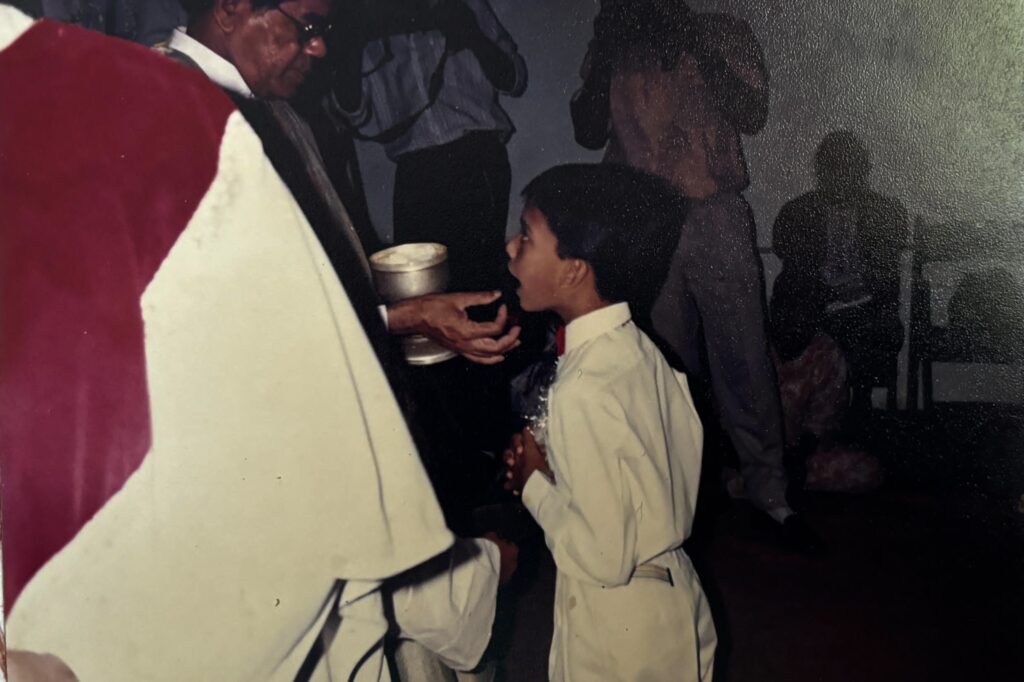
First, which group are you in?
The rules differ depending on your own situation, so it helps to know which group you fall into before reading further.
- Group A: a baptised Catholic who no longer practises — sometimes called “lapsed,” “non-practising,” or “cultural” Catholic.
- Group B: a baptised member of an Eastern Church — Orthodox or Oriental Orthodox.
- Group C: a baptised Protestant or another Christian from a Reformation-era community.
This article doesn’t cover the unbaptised. If that’s you, see what to expect at a Catholic Mass if you aren’t baptised and, if you’re considering becoming Catholic, how the OCIA process works.
At a glance: which sacraments are open to you
This table summarises the rest of the article. Read the section for your group afterward for the reasoning and the exceptions.
| Sacrament | Non-practising Catholic | Orthodox / Eastern Christian | Protestant / other baptised Christian |
|---|---|---|---|
| Baptism | Already received; never repeated | Already received; considered valid | Normally considered valid; not repeated unless there’s a real doubt, in which case it may be given conditionally |
| Confession | Yes, at any time — this is the door back | Yes, if they ask on their own and are properly disposed | Only in danger of death or grave necessity, and only under the conditions below |
| Eucharist | Yes, if in a state of grace; go to Confession first if aware of serious sin | Same conditions as Confession, above | Same conditions as Confession, above |
| Confirmation | Yes, if not yet confirmed, after suitable preparation | Eastern Christians are ordinarily chrismated (the Eastern equivalent of Confirmation) as infants, so this rarely applies; ask your priest if you’re unsure | Given on reception into full communion, not received separately beforehand |
| Anointing of the Sick | Yes, when seriously ill or elderly | Same conditions as Confession, above | Danger of death or grave necessity, same conditions as Confession |
| Marriage | Yes, with preparation; if someone has publicly and notoriously rejected the faith, the bishop’s permission is needed first | Marrying a Catholic requires permission for a mixed marriage; ask your priest about any additional norms for your own Church | Marrying a Catholic requires permission for a mixed marriage; a marriage between two baptised Christians is already sacramental |
| Holy Orders | Requires integral faith and proven virtue — not realistic without returning to practice | Not applicable | Not applicable |
If you’re a Catholic who has stopped practising
Start with this: you are still Catholic. Baptism marks the soul in a way the Church has always taught cannot be undone (CCC 1272; canon 845), whatever your Mass attendance has looked like in the meantime. Canon 912 puts it plainly — any baptised person who isn’t prohibited by law can and must be admitted to Communion. The real question isn’t whether you still belong. It’s whether you’re properly disposed to receive.
Confession is always open to you, and it’s the ordinary door back. All it takes is turning away from sin with a genuine intention to change (canon 987), naming your serious sins as best you can remember after an honest look at your life (canon 988), and Catholics are asked to do this at least once a year if they’re aware of serious sin (canon 989). If it’s been years and you’re nervous, that’s completely normal — see our guide to returning to Confession after a long time away, and if you’re worried you won’t remember everything, this piece on what to do when you can’t remember your sins should help.
On Communion specifically: canon 916 and CCC 1457 teach that someone aware of serious sin shouldn’t receive Communion without going to Confession first. The one exception is a serious reason with no real chance to confess beforehand — and even then, you’re expected to make an act of perfect contrition and resolve to confess as soon as you reasonably can. St. Paul’s own words are the classic reference here: “let a man prove himself, and so let him eat of that bread, and drink of the chalice” (1 Cor 11:28), which is why CCC 1385 asks Catholics to examine their conscience before receiving.
Here’s the part that’s often glossed over, but the Church is honest about it: deliberately skipping Sunday Mass without a good reason is treated as serious matter (CCC 2181). So if you’ve been away for years by choice, not because of illness, caring for a baby, or some other real obstacle, it’s worth going to Confession before you receive Communion again rather than assuming it’s fine. That’s not the Church trying to shame you — it’s simply naming what she’s always taught about the seriousness of the Sunday obligation, alongside genuine relief that the door is open. Canon 915, which lets a minister refuse Communion to someone obstinately persisting in manifest serious sin, is aimed at narrow, public situations, not ordinary Catholics coming back after years away. Don’t let anyone use it to frighten you.
Once you’re back, canon 920 asks Catholics to receive Communion at least once a year, ideally during the Easter season. Our guide to who can receive Communion at Mass covers the practical details, like the one-hour fast.
Anointing of the Sick is available to any Catholic who is seriously ill or elderly (canons 1004 and 1007) — see our piece on what happens when last rites are needed for someone who’s unconscious if that’s the situation you’re facing for a family member. If you were never confirmed, Confirmation is also open to you: canon 889 asks for suitable instruction, proper disposition, and the ability to renew your baptismal promises, and most parishes prepare adults for it in a short programme. If you’ll need to pick a confirmation name, here’s how to choose a confirmation saint.
Marriage in the Church remains open to non-practising Catholics, with the usual preparation (canon 1063). The one wrinkle: if someone has publicly and notoriously rejected the Catholic faith — not just drifted away, but made a clear, public break with it — a priest needs the local bishop’s permission before assisting at that marriage (canon 1071 §1, 4° and §2). That’s a high bar, aimed at formal, public rejection rather than years of irregular Mass attendance, so don’t assume it applies to you; ask your parish if you’re unsure.
One more thing that brings a lot of people to this question in the first place: being asked to be a godparent. Canon law requires a godparent to be a confirmed Catholic who has received the Eucharist and who leads a life of faith that fits the role (canon 874). Many parishes ask for a sponsor certificate from your own parish to confirm this. Honestly, this is often exactly where a non-practising Catholic realises it’s time to come back to the sacraments first.
If you’re Orthodox or from another Eastern Church
Canon 844 §3 allows Catholic priests to give Penance, the Eucharist, and Anointing to members of Eastern Churches that aren’t in full communion with Rome, as long as they ask for these sacraments of their own accord and are properly disposed. CCC 1399 explains why: these Churches have true sacraments, above all the priesthood and the Eucharist, so given the right circumstances and Church approval, some sharing isn’t just tolerated — it’s actively encouraged.
That said, this is a one-way permission from the Catholic side. Most Orthodox Churches teach their own faithful not to receive Communion outside Orthodoxy, and the Church’s own ecumenical norms ask Catholic ministers to respect that discipline. In practice, that means the honest answer to “can I receive?” is often “the Catholic Church says yes, but check with your own priest first,” because your own Church’s rules may say no even when ours say yes.
The reverse also exists, in a narrower form: canon 844 §2 lets Catholics receive from Orthodox ministers when it’s physically or morally impossible to reach a Catholic priest, when there’s a genuine spiritual need or benefit, and as long as there’s no risk of error or indifferentism about what the sacraments mean. It’s a real provision, but a limited one, mostly relevant when no Catholic church is realistically reachable.
On marriage: an Orthodox Christian marrying a Catholic needs the same kind of permission for a mixed marriage as any other baptised non-Catholic (canons 1124–1125). Because Eastern Churches and Catholic canon law share some common ground on questions like this, there can be additional pastoral considerations specific to Eastern marriages — your parish priest or the local eparchy can walk you through anything particular to your situation.
If you’re a Protestant or another baptised Christian
Here the door is narrower, and it helps to understand why rather than just memorising the rule. Canon 844 §4 allows Catholic priests to give Penance, the Eucharist, or Anointing to other baptised Christians only in danger of death, or in another situation of grave necessity recognised by the diocesan bishop or the bishops’ conference — and even then, only if the person can’t get to a minister of their own community, asks for the sacrament freely, shows Catholic faith about what that sacrament actually is, and is properly disposed to receive it.
CCC 1400 and 1401 explain the reasoning: communities that trace to the Reformation don’t have the Eucharist in the same way Catholics understand it, chiefly because they don’t have the sacrament of Holy Orders in the form the Catholic Church recognises. That’s what makes ordinary shared Communion impossible — not any judgment about someone’s personal faith. Pope St. John Paul II addressed this directly in Ecclesia de Eucharistia (2003), nos. 45–46: giving the Eucharist to an individual in these narrow, exceptional circumstances meets a real and grave spiritual need for that person, and it is not the same thing as “intercommunion” between whole church communities, which remains impossible until there’s full, visible unity.
So this isn’t the Church drawing a line to exclude anyone. Receiving Communion together is meant to be a sign that two people already share the same faith about what’s happening on the altar — the Eucharist expresses a unity that has to exist first, rather than creating it. Our pieces on who can receive Communion and the Church’s teaching on the Real Presence go further into what’s actually being professed. What a Protestant spouse or family member absolutely can do at Mass is pray, participate fully in everything except Communion, and make a spiritual communion (see also this prayer of spiritual communion). Whether coming forward for a blessing with arms crossed is appropriate depends on local parish and diocesan custom rather than any universal rule, so it’s worth simply asking beforehand.
On marriage, a wedding between two baptised Protestants is already considered sacramental by the Catholic Church, since any valid marriage between two baptised Christians is a sacrament (canon 1055 §2). Marrying a Catholic requires the Catholic party’s bishop to grant permission for a mixed marriage (canons 1124–1125); the Catholic promises to stay faithful to the Catholic faith and to do what they reasonably can so their children are baptised and raised Catholic, and the other party is simply informed of those promises. And to say it again, gently, because it comes up often: none of this involves rebaptising anyone.
A baptised non-Catholic can’t formally serve as a godparent, but can stand alongside a Catholic godparent as a “Christian witness” (canon 874 §2) — a real and recognised role, just a different one.
The fuller path: reception into full communion
For anyone already validly baptised, the ordinary way into full participation in the sacraments isn’t a workaround or an exception — it’s reception into full communion with the Catholic Church. Baptised Christians are never rebaptised (canons 845 and 869 §2); instead, they make a profession of the Catholic faith and are then confirmed and receive the Eucharist, usually in one celebration. If this is where your questions are heading, our guide to how the OCIA process works is the natural next step, and if a past marriage is part of the picture, this piece on becoming Catholic while waiting on an annulment covers a complication that comes up often.
A word on funerals
A funeral isn’t a sacrament, but this question comes up constantly, so it’s worth answering plainly: a non-practising Catholic is ordinarily given a full Catholic funeral. Canon law reserves the denial of a Church funeral for narrow, public cases — notorious apostates, heretics, or schismatics, and certain manifest sinners where a funeral would cause public scandal — and even then, not if there were signs of repentance before death (canon 1184). If there’s ever doubt, it’s the bishop who decides, not a parish secretary or a rule of thumb. For most families asking this question out of worry for a loved one who drifted away, the answer brings real relief.
The Gospel picture behind these rules
It’s easy to read canon numbers and hear only restriction. But the law here is trying to protect something the Gospels describe as pure invitation. In the parable of the wedding feast, the master tells his servant, “Go out into the highways and hedges, and compel them to come in, that my house may be filled” (Luke 14:23). God wants the house full — which is exactly why the Church both invites and prepares people, rather than leaving either one out.
If you’re the Catholic coming back after years away, the story that fits is the prodigal son: “when he was yet a great way off, his father saw him, and was moved with compassion” (Luke 15:20). Confession is that embrace, not a toll booth. And Jesus said it himself: “there shall be joy in heaven upon one sinner that doth penance” (Luke 15:7).
The careful rules around sharing the Eucharist with other Christians come from the same longing, not its opposite. Christ prayed “that they all may be one, as thou, Father, in me, and I in thee” (John 17:21), and spoke of “other sheep I have, that are not of this fold… and there shall be one fold and one shepherd” (John 10:16). Canon 844’s narrow exceptions exist precisely because that unity matters so much — the Church would rather wait for real, full unity than pretend a smaller thing is the same. Alongside that longing sits the seriousness of what’s actually happening at the altar: “except you eat the flesh of the Son of man, and drink his blood, you shall not have life in you” (John 6:54), which is why St. Paul also asks everyone, Catholic or not, to “prove himself” before eating that bread (1 Cor 11:28). Welcome and reverence aren’t in tension here. They’re the same concern, seen from two sides.
Frequently asked questions
I haven’t been to Mass in years. Can I receive Communion at my niece’s wedding?
Go to Confession first if you’re aware of serious sin (canon 916). Many parishes hear confessions on Saturday afternoons, or you can simply ask the priest before the wedding — it’s a common enough situation that no one will be surprised.
Can my Protestant husband receive Communion at our child’s First Communion?
Ordinarily, no. Canon 844 §4 only covers danger of death or another grave necessity recognised by the bishop, and a First Communion Mass doesn’t meet that bar. He’s warmly welcome to be there, to pray, and to make a spiritual communion.
Can an Orthodox friend receive Communion at a Catholic Mass?
The Catholic Church permits it if she asks and is properly disposed (canon 844 §3), but her own Church may teach otherwise. She should check with her own priest before receiving.
Can a lapsed Catholic be a godparent?
The law asks for a life of faith that fits the role (canon 874), which usually means being confirmed, having received the Eucharist, and practising the faith. Talk to the parish preparing the baptism — they can tell you what’s needed, and this is often a good reason to return to the sacraments first.
Does a lapsed Catholic need to be rebaptised?
No, never. Baptism is never repeated (canon 845).
Sources
- Code of Canon Law, canons 834–878 (incl. 844, 845, 869, 874)
- Code of Canon Law, canons 879–958 (Confirmation, Eucharist)
- Code of Canon Law, canons 959–997 (Penance)
- Code of Canon Law, canons 998–1165 (Anointing, Orders, Marriage)
- Code of Canon Law, canons 1166–1190 (incl. funerals, canon 1184)
- Catechism of the Catholic Church, “The Paschal Banquet” (CCC 1382–1401)
- Catechism of the Catholic Church, “The Lord’s Day” (CCC 2168–2195)
- Catechism of the Catholic Church, “The Sacrament of Penance and Reconciliation”
- John Paul II, Ecclesia de Eucharistia (2003), nos. 45–46
- Douay-Rheims Bible, drbo.org
