
Do Catholics Really Believe Jesus Is Present in the Eucharist? What the Surveys Show and What the Church Says
Did only a third of Catholics really say they believe in the Real Presence? What the surveys show, why belief faded, and what the Church teaches.
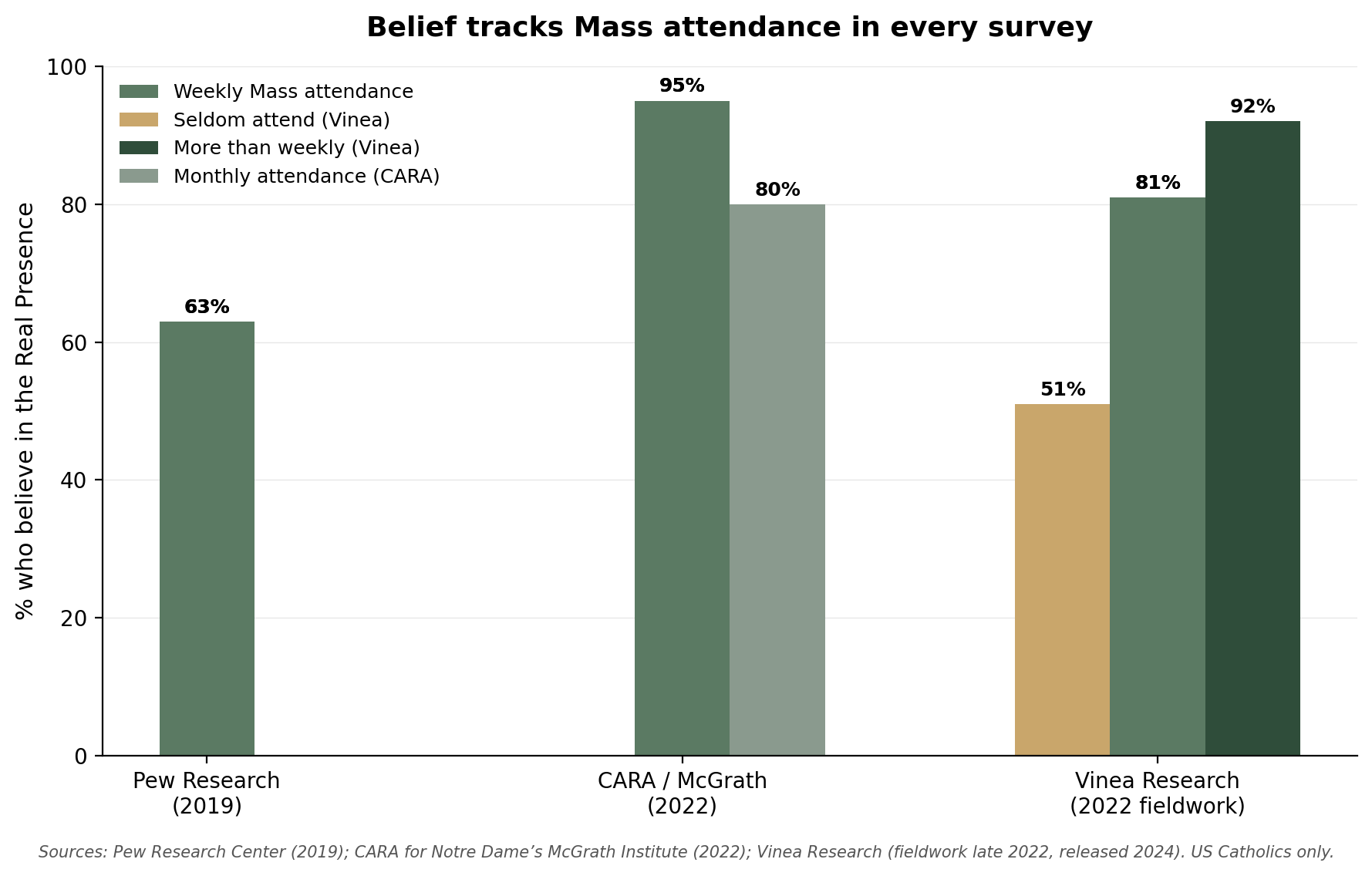
Short answer: Yes — the Catholic Church teaches, without qualification, that Christ is truly present in the Eucharist. And every survey on the subject shows that Catholics who go to Mass regularly overwhelmingly believe it, with belief running at 80–95% among weekly Mass-goers. But the same surveys are honest about a real gap: a meaningful share of Catholics are unsure what the Church teaches, or don’t believe it. That is worth facing directly rather than explaining away — and it is where this article starts.
What the surveys actually show
In August 2019, Pew Research Center published a finding that went off like a small bomb inside American Catholic media: only 31% of U.S. Catholics said that during Mass, the bread and wine “actually become” the body and blood of Jesus. The other 69% said they think of the bread and wine as “symbols” of the body and blood of Christ. Headlines shortened this to “only a third of Catholics believe in the Real Presence,” and the number has been repeated ever since.
Two later studies, using better-designed questions, found higher numbers. A study conducted for the University of Notre Dame’s McGrath Institute for Church Life by CARA (the Center for Applied Research in the Apostolate), fielded 11 July–2 August 2022 among 1,031 U.S. adult Catholics (margin of error ±4.45 points), found that 64% believe in the Real Presence. And Vinea Research, in fieldwork from late 2022 released 3 June 2024, surveyed about 2,200 U.S. Mass-going Catholics and found that 69% believe Jesus is “truly present” in the Eucharist — though only 41% chose the more exact wording “actually become” when offered Pew’s original phrasing.
Here is how the three studies line up:
| Survey (fieldwork) | Who and how many | Headline finding | What else it found |
|---|---|---|---|
| Vinea Research (late 2022; released 3 June 2024) | About 2,200 US Mass-going Catholics | Believe Jesus is “truly present”: 69% | Only 41% chose “actually become” when given Pew’s wording. Belief by attendance: 51% seldom attenders, 81% weekly, 92% more than weekly. |
| CARA for Notre Dame’s McGrath Institute (11 July–2 August 2022) | 1,031 US adult Catholics, ±4.45 points | Believe in the Real Presence: 64% | Only 49% correctly identified the Church’s teaching. Belief by attendance: 95% weekly, 80% monthly. Only 17% attend weekly, down from 24% in 2019. |
| Pew Research Center (2019) | US Catholics | “Actually become”: 31% · “Are symbols”: 69% | 43% of all US Catholics held the “symbol” view without knowing the Church teaches otherwise; 22% knew the teaching and rejected it; 28% knew it and accepted it. Among weekly Mass-goers, 63% believed. |
A few things are worth being honest about before drawing conclusions.
The 2019 figure is real, but it is incomplete on its own. Pew asked respondents to choose between two options: the bread and wine “actually become” the body and blood of Christ, or they “are symbols” of the body and blood of Christ. Catholic teaching does not accept that framing as an either/or — the Eucharist is both a sign and a true, substantial presence. Pope Paul VI himself acknowledged that the symbolism of the Eucharist “no one will deny is certainly present,” while insisting that symbolism alone does not exhaust what Christ’s presence means (Mysterium Fidei, nn. 11, 44). CARA’s Fr. Thomas Gaunt, S.J., and Vinea’s Hans Plate have both made the same point about their own data: some Catholics who answered “symbol” may still believe in the Real Presence — they may simply have heard “symbol” as the natural word for a sign that truly contains what it signifies.
Even so, the gap is real. On the most careful reading of the data, roughly a third of U.S. Catholics do not believe Christ is truly present, and about half cannot correctly state what the Church actually teaches on the subject (CARA found only 49% could).
The single biggest factor, in every study, is Mass attendance. Belief runs at 80–95% among people who attend Mass weekly or more, and it falls sharply among those who attend occasionally. That is not a footnote — it reframes the whole question. This is not only a crisis of belief; it is bound up with a crisis of practice.
Not knowing is different from rejecting. Pew’s own breakdown makes this clear: of the Catholics who didn’t affirm the Church’s teaching, the large majority (43 points out of the 69% who answered “symbol”) simply didn’t know the Church teaches something different — they weren’t rejecting a teaching they understood, they had never been taught it clearly. Only 22% of all U.S. Catholics knew the teaching and consciously disagreed with it. That points toward a catechesis problem more than a crisis of rebellion.
These are American studies. All three surveys — Pew, CARA and Vinea — sampled U.S. Catholics only. This article has found no comparable, methodologically similar survey for Malaysia, Asia, or the Catholic world as a whole, and it would be dishonest to assume the U.S. picture simply transfers elsewhere. If you are reading this from outside the United States, take the numbers as a description of one country’s Catholics, not a global diagnosis.
One more study is worth a careful mention, held at arm’s length. A 2025 study by psychologist Natalie Lindemann, surveying 860 U.S. Catholics and published in the Catholic Social Science Review (reported by Catholic World Report, 22 September 2025), found stronger belief in the Real Presence among Catholics who receive Communion on the tongue, who attend parishes offering the Traditional Latin Mass, and who hear the bells rung at the consecration. Lindemann herself notes this is a correlation, not proof that any one practice causes belief. It does not mean, and this article does not suggest, that Catholics who receive Communion in the hand believe any less.
Why so many Catholics struggle to believe
This is the heart of the matter, and it deserves to be handled without blame. Doubt about the Eucharist is not a modern invention, and most of what follows is not a moral failure on anyone’s part — it is how belief actually forms, and sometimes doesn’t, in real parishes and real families.
1. Doubt is not new. This is where to start, because it is reassuring. The very first time Jesus taught this — “unless you eat the flesh of the Son of man, and drink his blood, you shall not have life in you” — the reaction was immediate refusal. “After this many of his disciples went back, and walked no more with him” (John 6:66–67, Douay-Rheims). Jesus did not soften the teaching to keep them. He turned to the Twelve and asked, “Will you also go away?” Within a few generations, the early Church was already defending this teaching against those who denied it: St. Ignatius of Antioch, writing to the Smyrnaeans around the year 110, identified as heretics those who “abstain from the Eucharist” because they refused to confess it as the flesh of Christ. The Church answered deniers again in the eleventh century, against Berengarius of Tours, and again at the Reformation, culminating in the Council of Trent’s definitive teaching in 1551. The struggle over this teaching is as old as the teaching itself.
2. Many Catholics were never clearly taught. Both Pew and CARA found that a large share of Catholics cannot accurately state what the Church teaches about the Eucharist. For many people, formation on this subject effectively ended at First Communion or Confirmation — at a child’s level of explanation, never revisited as an adult.
3. Fewer people go to Mass, and belief and attendance move together. CARA found that only 17% of U.S. Catholics attend Mass weekly, down from 24% in 2019. It is hard to sustain belief in a presence you rarely encounter, and it is hard to keep attending something you no longer believe in. Which comes first — declining belief or declining attendance — is genuinely unclear, and this article won’t pretend to settle it.
4. The word “symbol” misleads people in both directions. In everyday English, a symbol is only a sign — a flag standing in for a country, nothing more. In Catholic sacramental theology, a sacrament is a sign that truly contains and effects what it signifies. Many Catholics say “symbol” when they actually mean “sacrament,” and many others hear the word “symbol” used anywhere, including at times in poorly worded catechesis, and understandably conclude it means “just a reminder.”
5. It still looks, tastes, and tests like bread. The senses report bread and wine, full stop, and a culture trained to trust only what can be measured finds that genuinely hard to square with the Church’s claim. The Church’s own vocabulary — a change of “substance” while the “appearances” (or “accidents”) remain — is unfamiliar and can sound like a dodge if no one has ever explained what it means. We explain that vocabulary properly on our page on the Real Presence — this article keeps to the short version.
6. What we see at Mass shapes what we believe. The old maxim is lex orandi, lex credendi — the way we pray shapes what we believe. When nearly everyone in the pews goes forward for Communion but relatively few go to Confession, when a tabernacle is tucked out of sight, or when a church stays noisy and casual right up to the consecration, the unspoken message some people absorb is that nothing especially significant is happening. This has to be handled carefully: Communion in the hand, contemporary music, and other permitted variations in how the Mass is celebrated are debated among Catholics in good faith, and none of them are, by themselves, proof that anyone present disbelieves.
7. Other Christian traditions shape how Catholics hear the word “Communion.” Many Protestant communities teach that the Lord’s Supper is a memorial meal, or a spiritual presence rather than a bodily one. In mixed families, in religiously plural societies, and in a country like Malaysia with large and visible evangelical and Pentecostal communities, Catholics can absorb that understanding by osmosis — through friends, media, or intermarriage — without ever consciously deciding to hold it.
8. Sometimes it’s a wider crisis of faith wearing a Eucharistic mask. Someone unsure whether God exists, whether Jesus rose from the dead, or whether the Church has any real authority to teach, will naturally struggle to believe a claim this specific and this demanding. Doubt about the Eucharist is sometimes really a deeper question about God, dressed in Eucharistic clothing.
9. Visible Eucharistic devotion became less common for a while, and is now reviving. Practices like Eucharistic adoration, processions, and Benediction grew rarer in many places after the 1960s, though they have been reviving in recent years. The U.S. bishops’ three-year National Eucharistic Revival, launched in 2022, was designed partly with this decline in mind.
None of this is about assigning blame to any particular group, generation, liturgical style, or pope. If you are the person reading this while genuinely unsure what you believe, none of the above is a verdict on you. It is an honest account of why this is hard for a great many sincere Catholics.
What the Church actually teaches, in brief
The Church’s teaching itself is not complicated, even if living it out is. In four points:
Christ — body and blood, soul and divinity — is truly, really, and substantially present under the outward appearances of bread and wine (Catechism of the Catholic Church [CCC] 1374; Council of Trent, Session XIII, 1551). This is not a metaphor softened for modern ears; it is what the Church has always meant.
Calling this the “Real” Presence does not mean Christ’s other ways of being present to his people are unreal. He is present in his Word proclaimed at Mass, in the praying Church gathered together, in the poor, and in the priest acting in his person. What is distinct about the Eucharist is that Christ is present here “in the fullest sense” of all these (CCC 1373–1374; Paul VI, Mysterium Fidei, n. 39).
The Eucharist is a sign — but a sign that actually contains the reality it signifies, not a sign that merely points to a meaning somewhere else. Paul VI explicitly rejected theories that reduce the change to a change of meaning alone, sometimes called “transignification” (Mysterium Fidei, n. 11). This is the direct answer to the confusion the surveys keep turning up over the word “symbol.”
And the Church is honest that none of this can be seen, touched, or measured. It is known only by faith, trusting Christ’s own word, as St. Thomas Aquinas and St. Cyril of Alexandria both taught (CCC 1381). Aquinas’s own hymn on the subject, Adoro te devote, says exactly this: sight, touch, and taste are all deceived by what remains bread and wine to the senses — only hearing, that is, trusting what Christ says, can be relied on.
The teaching has not moved. In his homily for Corpus Christi on 22 June 2025, Pope Leo XIV called the Eucharist “the true, real, and substantial presence of the Saviour,” who “transforms bread into himself in order to transform us into himself.” That is the same claim the Church has made since the beginning: St. Justin Martyr, writing around the year 155, told a pagan emperor that Christians do not receive the Eucharist “as common bread and common drink,” but as the flesh and blood of the incarnate Jesus (First Apology, ch. 66). St. John Paul II restated the Council of Trent’s teaching in his own encyclical Ecclesia de Eucharistia (2003), n. 15.
Read the full explanation, including what transubstantiation actually means and the four most common misunderstandings, on our page: Is the Eucharist Really the Body of Christ?
Honest answers to the objections doubters actually raise
“If it still looks, tastes, and tests like bread, how can it be Christ?”
The Church agrees with you about what your senses report, and about what a laboratory would report too — nothing changes at that level. What the Church claims changes is what the bread and wine are — their substance — not how they appear to any of your senses or any instrument. This is known by faith in Christ’s own word, not by observation (CCC 1381). For the full explanation of what “substance” means here, see our page on the Real Presence, under “The change is chemical.”
“Jesus was speaking figuratively in John 6.”
When his listeners took his words about eating his flesh literally and, scandalized, began to leave, Jesus did not call them back to clarify that he’d only meant it symbolically. He let them go. Then he turned to his own closest followers and asked whether they wanted to leave too — a strange thing to ask if the whole controversy rested on a simple misunderstanding he could have cleared up in a sentence (John 6:60–69). See “Where This Comes From” on our Real Presence page for the fuller argument from Scripture.
“The early Christians only saw it as a memorial.”
The earliest Christian writers outside the New Testament say the opposite. Ignatius of Antioch, writing around 110, and Justin Martyr, writing around 155, both describe the Eucharist in terms of Christ’s actual flesh, not a symbolic remembrance. And “do this in memory of me” (Luke 22:19), in the way the Church has always understood it, means re-presenting Christ’s one sacrifice sacramentally, not merely recalling it the way you’d recall a friend by looking at an old photograph (CCC 1363–1366).
“I’m a good Catholic, but I honestly can’t say I believe it.”
Honest doubt is not the same thing as rejection. Many canonized saints wrestled with real doubt at points in their lives. The father in Mark’s Gospel who cried out to Jesus, “Lord, I believe; help my unbelief” (Mark 9:24), is given to us in Scripture as a model, not a warning. Belief in this teaching, like most belief, tends to grow through practice — through going to Mass, through time spent in adoration, through returning to Confession — more than through argument alone.
“If most Catholics don’t believe it, why should I?”
Whether a teaching is true has never depended on a vote, in the Church or anywhere else. And the numbers above cut the other way from how the headlines suggest: among Catholics who actually practice their faith by attending Mass regularly, belief in the Real Presence runs at 80–95% in every study that measured it.
“Aren’t Eucharistic miracles just legends?”
Some reported Eucharistic miracles, such as the one at Lanciano, have received a degree of local Church approval over the centuries. But no Catholic is required to believe in any particular Eucharistic miracle as a condition of the faith. The Church’s belief in the Real Presence rests on Christ’s own word at the Last Supper and in John 6, not on any miracle reported since.
“Does it matter what I actually believe, if I still go up and receive Communion?”
Yes, it does. St. Paul warned the Corinthians that receiving “without discerning the body” of the Lord brings judgment on the person who receives unworthily (1 Corinthians 11:27–29). The word “Amen” said just before receiving Communion is not a formality — it is a profession of faith in what you are about to receive.
Two Gospel scenes worth sitting with
Scripture doesn’t leave this as an abstract doctrine; it gives us two stories.
The first is the ending of John 6 itself. After the hard teaching about eating his flesh, “many of his disciples went back, and walked no more with him.” Jesus turns to the twelve and asks a question that must have hung in the air: “Will you also go away?” It is Simon Peter who answers, not with a tidy explanation of what he’d just heard, but with something closer to resignation and trust at once: “Lord, to whom shall we go? Thou hast the words of eternal life” (John 6:67–69, Douay-Rheims). Peter doesn’t claim to have resolved the difficulty. He stays anyway, because he has nowhere better to go.
The second is the road to Emmaus. Two disciples, walking away from Jerusalem in grief and confusion on the very day of the Resurrection, are joined by a stranger who explains the Scriptures to them as they walk. They don’t recognize him — not through his words, however moving. Luke tells us plainly how it finally happened: he was “known unto them in the breaking of bread” (Luke 24:30–35). Recognition came at the table, in the same gesture the Church repeats at every Mass.
How the Church is responding
The concern behind this article’s questions is one the Church itself has been actively responding to, not ignoring.
In the United States, the bishops launched a three-year National Eucharistic Revival in 2022, moving from the diocesan level to the parish level and then into a “Year of Mission,” partly in direct response to the 2019 Pew findings. Its high point was the 10th National Eucharistic Congress, held in Indianapolis from 17 to 21 July 2024, drawing roughly 50,000 people, preceded by four cross-country pilgrimage routes that carried the Blessed Sacrament to reach them.
This isn’t a new instinct for recent popes. Pope Benedict XVI, in his 2007 apostolic exhortation Sacramentum Caritatis (nn. 66–67), “heartily” recommended Eucharistic adoration, both individually and as a community, and specifically asked that it be accompanied by good catechesis so people understand what they are doing and why.
And the same CARA data cited above contain real grounds for hope: among Catholics who actually attend Mass weekly, belief in the Real Presence runs at 95%. The core problem, on this evidence, is less that practicing Catholics have rejected the Church’s teaching, and more that a great many Catholics have drifted away from the practice that sustains and expresses that belief in the first place.
If you struggle to believe: eight practical steps
- Go to Mass, and arrive a few minutes early. Belief and practice tend to grow together, not one before the other.
- Spend time before the tabernacle, or at Eucharistic adoration, even just ten minutes a week. See our guide to Eucharistic adoration and visits to the Blessed Sacrament.
- Pray honestly, starting from where you actually are. “Lord, I believe; help my unbelief” (Mark 9:24) is a complete prayer on its own. Aquinas’s Adoro te devote and the Anima Christi are both written for exactly this struggle. You can read both here.
- Read John chapter 6 slowly, in one sitting, and then read our fuller explanation of the doctrine.
- Go to Confession before receiving Communion if you’re aware of serious sin. It restores the sense that what you’re about to receive is genuinely sacred, not routine. Our guide to going to Confession walks through what to expect.
- Let your body pray too. Genuflect, bow before receiving, keep silence when it’s called for. Actions can carry and strengthen belief, not just express it — this is the same lex orandi, lex credendi principle in reverse.
- Ask your parish about adult formation — an OCIA refresher for already-Catholic adults, or a parish Bible study on the Eucharist, if one is offered.
- If you are a parent or catechist, teach children the why, not only the how, of First Communion. A child who only learns the steps of the rite, without ever hearing why the Church makes such an extraordinary claim about it, grows into exactly the kind of adult these surveys describe.
Frequently asked questions
Is it a sin to doubt?
Not necessarily. The Catechism distinguishes between voluntary doubt, which knowingly “disregards or refuses to hold as true what God has revealed,” and involuntary doubt, which is simply “hesitation in believing, difficulty in overcoming objections connected with the faith, or… anxiety aroused by [faith’s] obscurity” (CCC 2088). Struggling honestly with a hard teaching is not the same thing as deliberately rejecting it.
Should I stop receiving Communion if I’m unsure what I believe?
Talk to a priest about your specific situation rather than deciding alone from an article. Saying “Amen” before receiving is meant to be a real profession of faith, so genuine, settled disbelief is worth discussing with a priest before you next go forward — but ordinary doubt, of the kind described throughout this article, is not the same thing as disbelief.
Why do Catholics kneel and genuflect around the Eucharist?
Because if the Church’s claim is true — that this is truly Christ, body, blood, soul and divinity — then the same worship owed to God is owed here (CCC 1378). Kneeling, genuflecting, and similar gestures are the body’s way of saying what the doctrine claims.
What is Eucharistic adoration?
Time spent in prayer before the Blessed Sacrament, either exposed in a monstrance or reserved in the tabernacle, outside of Mass. See our full guide to Eucharistic adoration and visits to the Blessed Sacrament.
Sources
Surveys and research
- Pew Research Center, “Just one-third of U.S. Catholics agree with their church that Eucharist is body, blood of Christ” (5 August 2019)
- CARA study for the University of Notre Dame’s McGrath Institute for Church Life (fieldwork 11 July–2 August 2022)
- EWTN News, report on the Vinea Research study (June 2024)
- Catholic World Report, report on the Lindemann study (22 September 2025)
Church documents
- Catechism of the Catholic Church, nn. 1373–1381, 2088
- Paul VI, Mysterium Fidei (1965)
- John Paul II, Ecclesia de Eucharistia (2003)
- Benedict XVI, Sacramentum Caritatis (2007)
- Leo XIV, Homily for the Solemnity of the Most Holy Body and Blood of Christ (22 June 2025)
- Council of Trent, Session XIII (1551)
Early Church and Scripture
- St. Ignatius of Antioch, Letter to the Smyrnaeans, ch. 7
- St. Justin Martyr, First Apology, ch. 66
- Scripture quoted from the Douay-Rheims translation: John 6:60–69; Matthew 26:26–28; Luke 22:19–20; 1 Corinthians 11:27–29; Luke 24:30–35; Mark 9:24
Revival and context
- 10th National Eucharistic Congress, Indianapolis, 17–21 July 2024
