
Do Catholics Celebrate Halloween? All Hallows’ Eve Explained
Halloween is the eve of All Saints’ Day, a Catholic feast. Here is where it came from, the truth about Samhain, the fair worries about the occult, and how Catholic families keep it well.
Every October, the same debate breaks out in Christian families and parish newsletters. Some people say Halloween is a pagan or even satanic festival that Christians should avoid. Others say it is harmless fun for children. Many Catholics are surprised to learn that the name itself is Catholic: “Halloween” is a shortened form of “All Hallows’ Eve”, the evening before All Saints’ Day (“hallow” is an old English word for a saint). This article explains where All Saints and Halloween came from, the three days the Church dedicates to the dead, what the evidence really says about the Celtic festival of Samhain, where costumes and trick-or-treating came from, the serious objection that Halloween glamorises evil, where the Church draws the line, why Christians have long laughed at death, how Catholic families keep the day, and why Halloween can be a doorway to the feast of all the saints.
1. Halloween is the eve of a Catholic feast
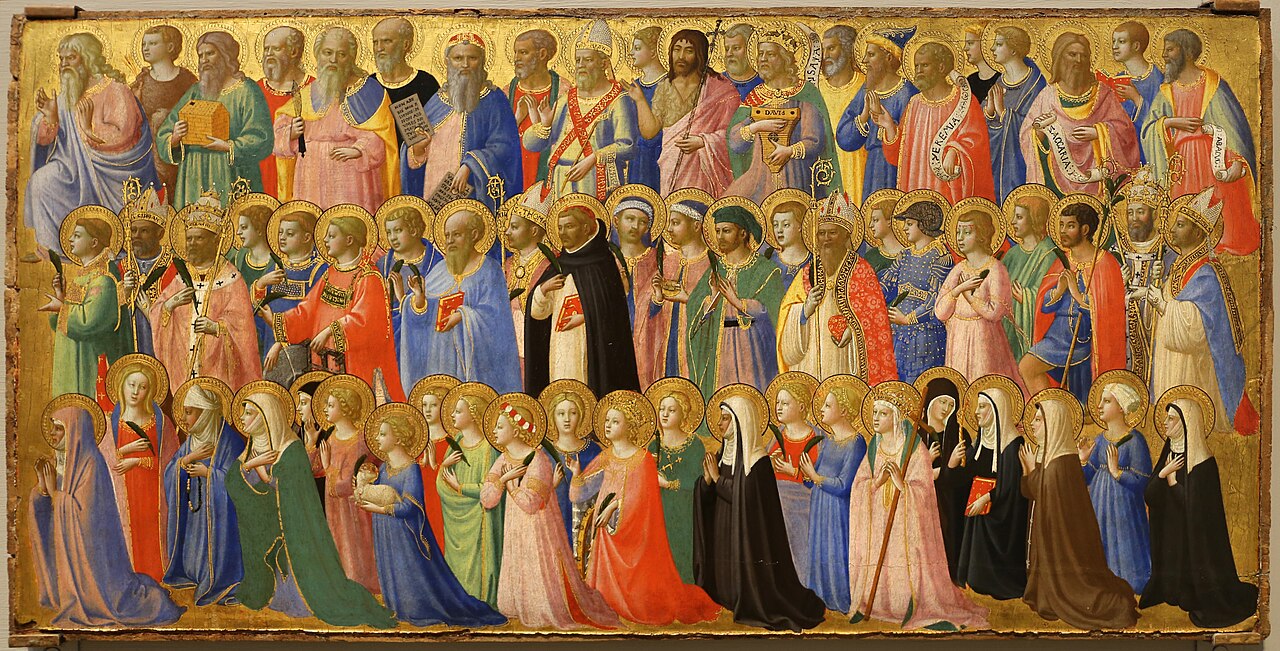
Yes, Catholics may celebrate Halloween. It is the eve, or vigil, of All Saints’ Day on 1 November, one of the great feasts of the Catholic year, and Catholics are free to keep it.
The 1 November date goes back to eighth-century Rome. Pope Gregory III, who reigned from 731 to 741, dedicated a chapel in St Peter’s Basilica to the relics “of the holy apostles and of all saints, martyrs and confessors”. This is the usual explanation of how the Roman feast came to be kept on 1 November.
About a century later, around 835, Pope Gregory IV, with the support of the Emperor Louis the Pious, son of Charlemagne, extended the feast of All Saints on 1 November throughout the Frankish empire, which covered most of Western Europe. From there it spread across the whole Latin Church.
The Church still ranks All Saints among its most important feasts. It is a holy day of obligation in the universal law of the Church (Code of Canon Law, canon 1246), though in some countries, such as England and Wales, the obligation may be transferred to the nearest Sunday. And in the Church’s liturgical calendar, the celebration of the greatest feasts begins on the evening before, just as Sunday begins on Saturday evening (Universal Norms on the Liturgical Year 11). So the evening of 31 October already belongs to All Saints. That is why it is called “All Hallows’ Eve”.
2. All Saints grew out of honouring the martyrs
The feast of All Saints did not begin as a response to Irish or Celtic customs. It grew out of the early Christian habit of honouring the martyrs, who gave their lives for Christ, long before Christianity reached Ireland’s pagan festivals.
In Rome, the Pantheon was a great temple dedicated to all the gods of the Roman world. On 13 May in 609 or 610, Pope Boniface IV, with the permission of the Byzantine Emperor Phocas, consecrated it as a church dedicated to St Mary and all the Martyrs. A temple to all the gods became a church honouring all the martyrs. It still stands today as a church.
In the Eastern Churches, a feast of all the martyrs was kept even earlier. In the late fourth century, St John Chrysostom preached at Antioch, in what is now Turkey, on a feast of all the martyrs kept on the Sunday after Pentecost (Homily on All the Martyrs). The Orthodox and Eastern Catholic Churches still keep All Saints on that Sunday today.
The 1 November date was spreading in the Latin West by about 800. Alcuin of York, the English scholar who served at Charlemagne’s court, wrote to his friend Arno, Bishop of Salzburg, around 800, commending the feast of All Saints on 1 November to him. The feast was already being kept in England and the Frankish lands, places with no connection to Samhain.
3. Three days about the dead
Halloween opens three days that the Church dedicates to the dead: All Hallows’ Eve on 31 October, All Saints on 1 November, which honours the saints in heaven, and All Souls on 2 November, when the Church prays for all the faithful departed who may still be undergoing purification.
All Souls’ Day began in the great Benedictine abbey of Cluny in France. Around 998, Abbot Odilo of Cluny ordered all the monasteries under his authority to pray for all the departed on the day after All Saints. The custom spread throughout the Church, and Rome eventually adopted 2 November as All Souls’ Day for the whole Latin Church.
The practice of praying for the dead is very ancient. In the second century BC, after a battle, the Jewish leader Judas Maccabeus found that some of his fallen soldiers had been wearing pagan amulets. He took up a collection and sent it to Jerusalem to offer a sacrifice for their sins, “thinking well and religiously concerning the resurrection”. The book concludes: “It is therefore a holy and wholesome thought to pray for the dead, that they may be loosed from sins” (2 Maccabees 12:39-46). See also Why Do Catholics Pray for the Dead?
In medieval and early modern England, these days had their own customs. On Hallowmas, poor people and children went from door to door asking for “soul cakes”, small spiced cakes, in return for which they promised to pray for the dead of the household. This custom of “souling” is one of the ancestors of trick-or-treating. Shakespeare refers to it in The Two Gentlemen of Verona (around 1590), where a servant teases his lovesick master for speaking “like a beggar at Hallowmas” (Act 2, scene 1).
4. The Samhain theory rests on thin evidence
Many books and websites claim that the Church took over a Celtic pagan festival of the dead called Samhain, held on 1 November, and turned it into All Saints. The evidence for this is much thinner than often claimed.
The early Irish Church did not keep All Saints at Samhain at all. The Martyrology of Oengus, an Irish calendar of saints written around 800, lists a feast of the saints of Europe on 20 April, and a feast of all the saints of Ireland and the world at other times of year. If the Church had wanted to replace Samhain with All Saints, Ireland is where we would expect to see it. We do not.
The idea that Samhain was a pagan festival of the dead which the Church “baptised” was popularised by the Scottish anthropologist James Frazer in The Golden Bough (first published in 1890, and much expanded later). Frazer believed that many Christian customs were survivals of ancient pagan religion. His theories were very influential, but many of them have since been questioned by scholars.
Ronald Hutton, a historian of British folk customs and pagan religion at the University of Bristol, examined the evidence in The Stations of the Sun (1996). He found that Samhain was certainly an important seasonal festival in early Ireland, but that there is no firm evidence that it was a festival of the dead. He also traced the 1 November date of All Saints to Germany and England, not to Ireland. Some customs of the season, such as bonfires and fortune-telling, may have roots in older folk traditions. But Halloween as a name and a date is Christian.
5. Costumes and trick-or-treating are folk customs
Costumes, lanterns and trick-or-treating are not part of the Church’s liturgy. They are folk customs, mostly from Scotland and Ireland, that were later reshaped in North America.
In 1785, the Scottish poet Robert Burns wrote a long poem called “Halloween”. It describes Scottish country people gathering on that night for games, songs and various kinds of fortune-telling, especially to discover whom they would marry. Burns added notes explaining these customs to readers who did not know them. The poem shows a night of neighbourly fun, with a hint of the uncanny.
Halloween customs reached America with Irish and Scottish immigrants. During the Great Famine of 1845 to 1852, more than a million Irish people emigrated, many of them to American cities. They brought their customs with them, including carving lanterns from turnips. In America, people found that the native pumpkin was larger and easier to carve, and the jack-o’-lantern was born.
The phrase first appears in print in Canada. A newspaper in Sault Ste. Marie, Ontario, used “tricks or treats” in 1917, and on 4 November 1927 a newspaper in Lethbridge, Alberta, reported from the small town of Blackie that young pranksters had gone from house to house on Halloween night demanding “trick or treat”. By the 1950s, trick-or-treating had become a children’s custom across North America, and it has since spread to many other countries.
6. The serious objection: making evil look like fun
The serious objection to Halloween, raised by many evangelical Protestants and by some Catholics, is not mainly about its origins. It is that modern Halloween can make evil, the devil and the occult look like harmless fun.
Critics most often cite the law of Moses, which forbids all forms of divination and sorcery: “Neither let there be found among you any one… that consulteth soothsayers, or observeth dreams and omens, neither let there be any wizard, nor charmer, nor any one that consulteth pythonic spirits, or fortune tellers, or that seeketh the truth from the dead. For the Lord abhorreth all these things” (Deuteronomy 18:10-12).
Many Protestants have a different reason to mark 31 October. On that date in 1517, Martin Luther sent his Ninety-five Theses to his archbishop and, it is said, posted them on the church door in Wittenberg. He chose it because the feast of All Saints drew large crowds to Wittenberg to venerate the relics kept in its Castle Church, where indulgences were available. Many Protestant churches now keep 31 October as Reformation Day, rather than Halloween.
Some Catholic voices have also warned against Halloween. In October 2009, the Vatican newspaper L’Osservatore Romano published comments by a Spanish liturgist, Joan Maria Canals, who warned that Halloween had an undercurrent of occultism and was, in his view, anti-Christian. The Daily Telegraph reported his comments on 30 October 2009. This was the opinion of one writer, not an official ruling of the Church, but it shows that the concern is not only a Protestant one.
7. Where the Church draws the line
The Church shares the concern where it truly applies. Fortune-telling, séances, Ouija boards, spells and anything occult are ruled out for Catholics, on Halloween or any other night.
The Bible gives a vivid warning about the danger of consulting the dead. King Saul had banned mediums from Israel. But on the eve of a battle against the Philistines, terrified and abandoned by God, he went in disguise to a woman at Endor who was a medium, and asked her to call up the dead prophet Samuel. Saul heard only his doom: that he and his sons would die the next day, as they did (1 Samuel 28:3-20; 31:1-6).
The first Christians turned away from magic completely. When St Paul preached in Ephesus, a city famous for magic, many new believers who had practised magic brought their books and burned them publicly. The books were valued at fifty thousand pieces of silver, a huge sum (Acts 19:18-20). They were willing to pay a high price to break with the occult.
The Catechism is clear that “all forms of divination are to be rejected: recourse to Satan or demons, conjuring up the dead or other practices falsely supposed to ‘unveil’ the future. Consulting horoscopes, astrology, palm reading, interpretation of omens and lots, the phenomena of clairvoyance, and recourse to mediums” all conceal a desire for power over time and other people (CCC 2116). It also rejects all practices of magic or sorcery (CCC 2117). Dressing up as a pirate is not the problem; playing at summoning spirits is.
8. Christians have long laughed at death
Skulls, skeletons and mock horror are not un-Christian in themselves. Christians have long looked death in the face, and even laughed at it, because Christ has conquered it.
In 1424 to 1425, a famous mural of the Dance of Death (Danse Macabre) was painted in the cemetery of the Holy Innocents in Paris. It showed skeletons leading people of every rank, pope, emperor, king, merchant, monk and peasant alike, in a dance to the grave. The mural reminded everyone that death comes to all, and that we must be ready. Similar paintings appeared all over Europe.
In Rome, beneath the church of Santa Maria della Concezione on the Via Veneto, Capuchin friars arranged the bones of some 3,700 of their dead brothers into a series of decorated chapels, from the seventeenth to the nineteenth centuries. A sign in the crypt says, in several languages: “What you are now, we once were; what we are now, you shall be.” Visitors find it eerie, but its message is Christian: life is short, and eternity is long.
C. S. Lewis, the Anglican writer, opened The Screwtape Letters (1942), his famous book of imaginary letters from a senior devil to a junior one, with a remark of St Thomas More: that the devil, “that proud spirit”, cannot endure to be mocked. Christians do not take evil lightly. But laughing at the devil and at death, as people defeated by Christ, is an old Christian tradition. As St Paul wrote: “O death, where is thy victory? O death, where is thy sting?” (1 Corinthians 15:55).
9. How Catholic families keep the season
Catholic families keep Halloween and the days that follow in many different ways, and the Church attaches real spiritual practices to these days.
The Church encourages Catholics to pray for the dead in the first days of November. It grants a plenary indulgence, applicable only to the souls in purgatory, to those who devoutly visit a cemetery and pray for the dead on any day from 1 to 8 November, under the usual conditions of confession, Communion, prayer for the Pope’s intentions and detachment from all sin (Enchiridion of Indulgences, grant 29, 1999 edition). See also What Are Indulgences?
In Mexico, families keep the Day of the Dead (Día de Muertos) on 1 and 2 November. They build home altars (ofrendas) decorated with marigolds, candles, photographs and the favourite food of their departed relatives, and many keep vigil at the graves of their loved ones, praying and sharing food. In 2008 UNESCO added the indigenous festivity dedicated to the dead to its list of the Intangible Cultural Heritage of Humanity.
Some young Catholics have invented new ways of keeping the evening. In 2002, young Catholics in Paris launched “Holywins”, a play on the word “Halloween” meaning “holiness wins”. On the evening of 31 October, they organise prayer, music, adoration, and parties where children dress up as saints. The idea has spread to other parts of France and to other countries. Many parishes also hold “All Saints parties” where children come dressed as their favourite saint.
10. A doorway to the feast of all the saints
The best way for Catholics to keep Halloween is to treat it as a doorway to the feast that follows: to go to Mass on All Saints’ Day, and to meet the people the feast honours.
The first reading at Mass on All Saints is from the Book of Revelation. St John saw “a great multitude, which no man could number, of all nations, and tribes, and peoples, and tongues, standing before the throne, and in sight of the Lamb, clothed with white robes, and palms in their hands.” These are the people who “are come out of great tribulation, and have washed their robes, and have made them white in the blood of the Lamb” (Revelation 7:9-14). All Saints celebrates not only the famous saints, but all of them, known and unknown.
The Second Vatican Council taught that this crowd is meant to include us. In the fifth chapter of Lumen Gentium (1964), its constitution on the Church, the Council taught that all the faithful, in every walk of life, are called to holiness, not only priests and religious. The saints in heaven include mothers and fathers, farmers and doctors, children and grandparents.
A recent saint shows that holiness can look very ordinary. Carlo Acutis was born in London in 1991 and grew up in Milan. He was a normal teenager who liked football, video games and computers. He also went to Mass every day, prayed the Rosary, and used his computer skills to build a website documenting Eucharistic miracles around the world. He died of leukaemia in 2006, at the age of fifteen. On 7 September 2025, Pope Leo XIV declared him a saint. A boy who might have gone trick-or-treating is now one of the saints the Church honours on 1 November.
Frequently asked questions
Is Halloween a pagan holiday? No. The name and the date are Christian: it is the eve of All Saints’ Day. Some folk customs may be older.
Can Catholic children go trick-or-treating? Yes. It is a folk custom, and families can choose freely, avoiding anything occult or degrading.
Is All Saints’ Day a holy day of obligation? Yes, in the universal law of the Church, though in some countries the obligation is transferred to Sunday. Check with your parish.
What is the difference between All Saints and All Souls? All Saints (1 November) honours the saints in heaven. All Souls (2 November) is a day of prayer for all the faithful departed.
You may also like Can Souls in Purgatory Pray for Us? and Why Do Catholics Pray to Mary and the Saints?
Sources and further reading
- The Bible: Deuteronomy 18:9-12; 1 Samuel 28:3-20; 2 Maccabees 12:39-46; Acts 19:18-20; 1 Corinthians 15:54-57; Revelation 7:9-17.
- Catechism of the Catholic Church, 958, 1030-1032, 2116-2117.
- Code of Canon Law (1983), canon 1246; Universal Norms on the Liturgical Year and the Calendar (1969), 11.
- Second Vatican Council, Lumen Gentium, ch. 5 (1964).
- Enchiridion of Indulgences (1999 edition), grant 29.
- St John Chrysostom, Homily on All the Martyrs; Alcuin of York, Letter to Arno of Salzburg (c. 800); Martyrology of Oengus (c. 800).
- Ronald Hutton, The Stations of the Sun: A History of the Ritual Year in Britain (Oxford, 1996).
- James Frazer, The Golden Bough (1890 and later editions).
- Robert Burns, “Halloween” (1785).
- C. S. Lewis, The Screwtape Letters (1942).
- UNESCO, Indigenous festivity dedicated to the dead (Mexico), inscribed 2008.
