
Do Catholics Believe Jesus Is God? The Trinity in Plain English
Yes. Catholics believe Jesus is truly God and truly man, one of the three persons of the Trinity. Here is what that means, where it comes from, the main objections, and why it matters.
Some people suspect that Catholics have pushed Jesus to the side, replacing him with Mary, the saints or the Pope. Others, including Muslims and Jehovah’s Witnesses, think that Christians who call Jesus “God” have betrayed the belief in one God, or that the Trinity means believing in three gods. If you have wondered about any of this, here is the short answer: Catholics believe that Jesus Christ is truly God and truly man, and that there is only one God, who is Father, Son and Holy Spirit. This is not a side issue for Catholics. It is the heart of the faith. This article explains what Catholics believe about Jesus, where the belief comes from in the New Testament, how the first Christians worshipped him, what the Council of Nicaea really did, what the Trinity means in plain English, why Jesus is also fully human, the strongest objections, some common misunderstandings, why it matters in practice, and the question Jesus still asks each of us.
1. Jesus is truly God and truly man
Yes: Catholics believe that Jesus Christ is truly God and truly man, and this belief is the centre of the Catholic faith. Everything else in the Church, its sacraments, its prayers, its honour for Mary and the saints, depends on it.
The belief is already clear in the Gospels. After the resurrection, the apostle Thomas refused to believe the other disciples when they told him that they had seen the risen Lord. “Except I shall see in his hands the print of the nails… I will not believe.” A week later Jesus appeared again and invited Thomas to touch his wounds. Thomas answered: “My Lord, and my God.” Jesus did not correct him. He accepted the words, and added: “Blessed are they that have not seen, and have believed” (John 20:24-29).
In 325, the bishops of the Church gathered at Nicaea, in what is now Turkey, for the first ecumenical (worldwide) council. Facing a teaching that denied that the Son was truly God, they declared in their creed that the Son is “God from God, Light from Light, true God from true God, begotten not made, of one substance with the Father”. The Greek word for “of one substance”, homoousios, became the touchstone of orthodox faith.
Catholics still recite that same creed today. Completed at the Council of Constantinople in 381, the Nicene Creed (strictly, the Nicene-Constantinopolitan Creed) is said or sung aloud at Mass every Sunday and on great feasts, all over the world. Every Sunday, Catholics publicly profess that Jesus is “true God from true God”. See also Catholic and Orthodox: What Does “God from God” Mean in the Creed?
2. What the New Testament says
The belief that Jesus is God was not invented by later theologians. It comes from the New Testament, where Jesus says and does things that only God may say and do.
In a heated debate in the Temple, Jesus told his critics that Abraham, the father of the Jewish people, had rejoiced to see his day. They mocked him: “Thou art not yet fifty years old, and hast thou seen Abraham?” Jesus answered: “Amen, amen I say to you, before Abraham was made, I am.” “I am” was the name God had revealed to Moses at the burning bush (Exodus 3:14). His listeners understood exactly what he meant. “They took up stones therefore to cast at him” (John 8:56-59), because they believed he had blasphemed.
Jesus also forgave sins on his own authority. When four men lowered a paralysed friend through the roof of a crowded house to reach him, Jesus said to the man: “Son, thy sins are forgiven thee.” Some scribes who were present thought to themselves: “Why doth this man speak thus? he blasphemeth. Who can forgive sins, but God only?” Jesus then healed the man, “that you may know that the Son of man hath power on earth to forgive sins” (Mark 2:1-12). Only God can forgive sins against God. Jesus claimed that power.
St Paul, writing to the Christians of Philippi in the 50s or early 60s, about twenty-five to thirty years after the crucifixion, quotes what seems to be an even earlier Christian hymn. It speaks of Christ Jesus, “who being in the form of God, thought it not robbery to be equal with God: but emptied himself, taking the form of a servant”, and became obedient to death on a cross. Therefore God exalted him, so that “every knee should bow” and “every tongue should confess that the Lord Jesus Christ is in the glory of God the Father” (Philippians 2:5-11). The words about every knee bowing echo Isaiah 45:23, where God says that every knee shall bow to him alone.
3. The first Christians worshipped Jesus
Christians worshipped Jesus as God from the very beginning, centuries before any Roman emperor took an interest in Christianity.
Around 107, St Ignatius, bishop of Antioch, was arrested and taken under armed guard to Rome to be thrown to wild beasts in the arena. On the way he wrote seven letters to Christian churches. In them he repeatedly calls Jesus Christ “our God”. To the Christians of Ephesus, he speaks of “our God, Jesus the Christ”, conceived by Mary. To the Romans, he writes of “the passion of my God”, asking them not to prevent his martyrdom.
Around 112, Pliny the Younger, the Roman governor of Bithynia in what is now northern Turkey, wrote to the Emperor Trajan asking how to deal with Christians. He reported what he had learned from interrogating them: that they were accustomed to meet on a fixed day before dawn and to sing a hymn “to Christ as to a god” (Letters 10.96). A pagan official noticed that Christians worshipped Christ.
Pagans also mocked Christians for worshipping Jesus. In 1857, archaeologists found a graffito scratched on a plaster wall on the Palatine Hill in Rome, probably dating from around 200. It shows a man raising his hand in worship towards a crucified figure with the head of a donkey. Underneath, someone has scratched in Greek: “Alexamenos worships his god.” It is one of the earliest surviving images of the crucifixion, and it shows that even pagans knew that Christians worshipped the crucified Jesus as God.
4. Nicaea did not invent the belief
A common claim is that the Council of Nicaea invented the idea that Jesus is God. It did not. The council defended a belief Christians already held, against a new teaching that denied it. And the struggle that followed was long and bruising.
Around 318, Arius, a popular priest of Alexandria in Egypt, began to teach that the Son of God was the first and greatest creature, but not truly God. His slogan was: “There was a time when he was not.” His bishop, Alexander, condemned him, and the controversy spread across the Eastern Church. The Council of Nicaea, in 325, rejected Arius’s teaching and declared that the Son is “of one substance with the Father”. The council’s creed added a list of Arius’s sayings that were condemned, including “there was a time when he was not.”
The struggle did not end at Nicaea. St Athanasius, who had attended the council as a young deacon and became bishop of Alexandria in 328, spent the rest of his life defending the Nicene faith. He was exiled five times by four different emperors, spending some seventeen years in exile, sometimes hiding in the Egyptian desert with the monks. Yet he never gave way.
At one point, the Arians seemed to have won. In 359, under heavy pressure from the Emperor Constantius II, who favoured the Arians, some four hundred Western bishops at the Council of Rimini in Italy were made to sign a vague formula that avoided saying the Son was of one substance with the Father. St Jerome later wrote, in a famous phrase, that “the whole world groaned, and was astonished to find itself Arian” (Dialogue against the Luciferians 19). But the bishops soon repudiated what they had signed, and in 381 the Council of Constantinople reaffirmed the Nicene faith.
5. The Trinity: one God in three persons
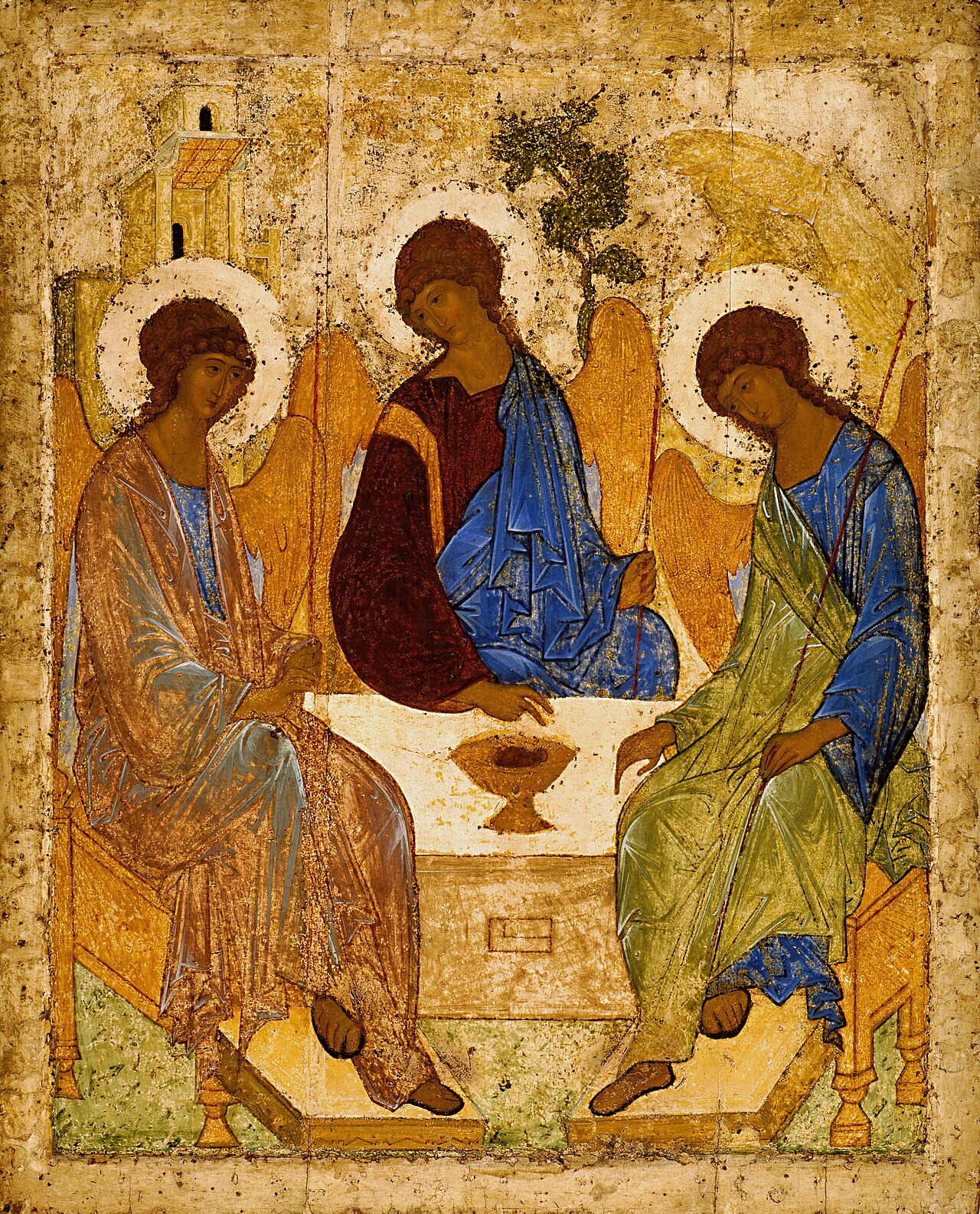
The Trinity means that there is one God, who exists eternally as three distinct persons: the Father, the Son and the Holy Spirit. It does not mean three gods. Nor does it mean one God who wears three masks, appearing sometimes as Father, sometimes as Son, sometimes as Spirit.
The three persons appear together at the baptism of Jesus. When Jesus came up out of the River Jordan, “the heavens were opened to him: and he saw the Spirit of God descending as a dove, and coming upon him. And behold a voice from heaven, saying: This is my beloved Son, in whom I am well pleased” (Matthew 3:16-17). The Father speaks, the Son stands in the water, the Spirit descends. The three are distinct, yet the Church teaches that they are one God.
Around 213, Tertullian, a Christian writer in Carthage in North Africa, became the first known writer to use the Latin word Trinitas, “Trinity”. In his work Against Praxeas, he argued against a teacher who claimed that the Father himself had been born and suffered on the cross, as if the Father and Son were simply two names for the same person. Tertullian spoke of three persons who share one substance, the language the Church still uses.
The Council of Constantinople in 381 completed the teaching on the Holy Spirit. Some Christians had begun to deny that the Spirit was truly God. The council added to the creed that the Spirit is “the Lord, the giver of life, who proceeds from the Father, who with the Father and the Son is adored and glorified”. The Catechism sums it up: “We do not confess three Gods, but one God in three persons… The divine persons do not share the one divinity among themselves but each of them is God whole and entire” (CCC 253).
6. Jesus is also fully human
Catholics believe that Jesus is fully God, but also that he is fully human, with a real human body, a human mind and a human will. His divinity does not swallow up or cancel out his humanity.
The Gospels show Jesus’s human emotions vividly. When he came to the tomb of his friend Lazarus and saw Mary, Lazarus’s sister, weeping, along with the mourners who were with her, he “groaned in the spirit, and troubled himself”. He asked where they had laid him. And “Jesus wept”. The bystanders said: “Behold how he loved him” (John 11:33-36). The same Jesus who would, minutes later, call Lazarus out of the tomb, first wept for his friend.
In 451, the Council of Chalcedon, held near Constantinople, settled a long dispute about how Jesus can be both God and man. The council received a letter from Pope Leo I, known as the Tome of Leo, and the bishops reportedly cried out: “Peter has spoken through Leo!” The council then defined that Christ is one person in two natures, divine and human, “without confusion, without change, without division, without separation”.
Some later Christians held that Christ had only one will, the divine will, and no real human will. St Maximus the Confessor, a monk and theologian, insisted that Christ had a real human will, freely obeying the Father, as when he prayed in Gethsemane, “Not what I will, but what thou wilt” (Mark 14:36). In 662, the imperial authorities in Constantinople had his tongue cut out and his right hand cut off, so that he could neither speak nor write his teaching, and sent him into exile, where he died. In 681, the Third Council of Constantinople vindicated his teaching, defining that Christ has two wills, divine and human, in perfect harmony.
7. The strongest objections
The strongest objections to the belief that Jesus is God come from texts where Jesus prays to the Father, says the Father is greater than he is, or admits he does not know something. From these, some conclude that Jesus is not God.
Jesus says in John’s Gospel: “the Father is greater than I” (John 14:28). In Mark, speaking of the end of the world, he says: “of that day or hour no man knoweth, neither the angels in heaven, nor the Son, but the Father” (Mark 13:32). Catholics have traditionally explained such sayings as referring to Jesus’s humanity. As man, the Son is less than the Father; as God, he is equal. The same John’s Gospel, after all, records Jesus saying: “I and the Father are one” (John 10:30).
The Qur’an deeply honours Jesus. It calls him the Messiah, born of the Virgin Mary, a word from God and a spirit from him. But it also tells Christians: “Do not say ‘Three’… God is only one God. He is far above having a son” (Qur’an 4:171). Another passage pictures God asking Jesus whether he told people to worship him and his mother as gods besides God, and Jesus denying it (Qur’an 5:116). Catholics agree that there is only one God, and that Mary is not a god. They believe, though, that the one God is Father, Son and Holy Spirit.
Jehovah’s Witnesses teach that Jesus is God’s first creation, a mighty spirit being, but not God himself. Their Bible translation, the New World Translation (New Testament published in 1950), renders the first verse of John’s Gospel as “In the beginning was the Word, and the Word was with God, and the Word was a god.” Almost all scholars of New Testament Greek, Catholic, Protestant and secular, reject this translation as a misreading of the Greek. Catholic Bibles read: “the Word was God” (John 1:1).
8. Common misunderstandings
Two of the most common misunderstandings are that the Emperor Constantine imposed the belief that Jesus is God, and that Catholics worship Mary alongside or instead of Jesus.
Dan Brown’s best-selling novel The Da Vinci Code (2003) has a character claim that Jesus was declared divine at Nicaea by “a relatively close vote”. In fact, of the roughly three hundred bishops at Nicaea, only two refused to sign the creed. And as we have seen, Christians were worshipping Jesus as God two centuries before Constantine was born.
The Church does honour Mary with the title “Mother of God”. But the title was defended precisely to protect the truth about Jesus. In the fifth century, Nestorius, the archbishop of Constantinople, objected to calling Mary Theotokos, “God-bearer”, because he thought Mary had given birth only to the human Jesus, not to God. The Council of Ephesus, in 431, affirmed the title. The point was not to make Mary a goddess, but to insist that the child she bore was truly God himself, in one person. See also Do Catholics Worship Mary?
The Church has always insisted that there is only one God. The Athanasian Creed, an old Western creed probably written in Gaul in the late fifth or early sixth century, and traditionally still used in the Church’s prayer, states it clearly: “So the Father is God, the Son is God, and the Holy Spirit is God. And yet they are not three Gods, but one God.”
9. Why it matters in practice
The belief that Jesus is God is not merely a matter of theory. It shapes how Catholics pray, how they worship, and what they hope for.
The first Christians prayed directly to Jesus. St Stephen, the first Christian martyr, was stoned to death in Jerusalem, perhaps around 34. As the stones struck him, he prayed: “Lord Jesus, receive my spirit.” Then he knelt and cried out: “Lord, lay not this sin to their charge” (Acts 7:55-60). His words echo Jesus’s own words on the cross to the Father. Stephen addressed Jesus as Israel addressed God.
St Athanasius explained why the divinity of Christ matters so much. In his short book On the Incarnation, he argued that only the Creator could restore his damaged creation. A creature, however great, could not save us. So the Word of God, through whom all things were made, became human, so that we might share in God’s own life: “He became human that we might become divine” (On the Incarnation 54). If Jesus were not God, he could not save us.
The belief also shapes Catholic worship. Catholics believe that in the Eucharist, Jesus is truly present, body, blood, soul and divinity, and they adore him there. In 1264, Pope Urban IV, in the bull Transiturus, established the feast of Corpus Christi for the whole Church, to honour Christ’s presence in the Eucharist. St Thomas Aquinas is traditionally credited with writing the hymns for the feast, such as Pange lingua. The prayer Adoro te devote, “I adore you devoutly, hidden God”, is also attributed to him. Catholics would never adore bread; they adore Christ, because he is God. See also Do Catholics Really Believe in the Real Presence?
10. “Who do you say that I am?”
The question Jesus put to his friends is still the invitation to everyone today: “Who do you say that I am?”
At Caesarea Philippi, near the source of the River Jordan, Jesus asked his disciples what people were saying about him. Some said he was John the Baptist, others Elijah, Jeremiah or one of the prophets. “But whom do you say that I am?” Simon Peter answered: “Thou art Christ, the Son of the living God.” Jesus replied: “Blessed art thou, Simon Bar-Jona: because flesh and blood hath not revealed it to thee, but my Father who is in heaven” (Matthew 16:13-17). See also Peter, the Rock and the Keys: The First Pope
C. S. Lewis, the Anglican writer and Oxford scholar, had been an atheist for many years before he became a Christian in 1931. During the Second World War, between 1941 and 1944, he gave a series of radio talks on the BBC, later published as Mere Christianity (1952). In them he argued that Jesus’s claims about himself leave us no room to call him merely a great moral teacher. A man who said what Jesus said would be either a madman, something worse, or exactly who he claimed to be: the Son of God. We must choose.
Edith Stein was born in 1891 into a devout Jewish family in Breslau (now Wrocław, Poland). As a teenager she gave up belief in God, and she became a brilliant philosopher. In the summer of 1921, staying with friends, she picked up the autobiography of St Teresa of Ávila, and read it through in a single night. When she finished, she is said to have closed the book with the words: “This is the truth.” She was baptised a Catholic on 1 January 1922, later became a Carmelite nun, Sister Teresa Benedicta of the Cross, and died at Auschwitz in 1942. Pope John Paul II canonised her in 1998. She had found the answer to Jesus’s question.
Frequently asked questions
Do Catholics believe Jesus is God? Yes. Catholics believe Jesus Christ is truly God and truly man, the second person of the Trinity.
Do Catholics believe in three gods? No. Catholics believe in one God, who is three persons: Father, Son and Holy Spirit.
Do Catholics worship Mary instead of Jesus? No. Catholics worship God alone. They honour Mary as the Mother of Jesus, who is God.
Do Catholics and Protestants believe the same about Jesus and the Trinity? Yes, almost all Protestant, Orthodox and Catholic Christians share the faith of Nicaea and Chalcedon.
You may also like Are Catholics Christian? and Why Do Catholics Use a Crucifix?
Sources and further reading
- The Bible: Exodus 3:13-15; Isaiah 45:22-23; Matthew 3:13-17; 16:13-17; Mark 2:1-12; 13:32; 14:36; John 1:1-14; 8:56-59; 10:30; 11:33-44; 14:28; 20:24-29; Acts 7:55-60; Philippians 2:5-11.
- Catechism of the Catholic Church, 232-267, 422-483.
- Councils of Nicaea (325), Constantinople I (381), Ephesus (431), Chalcedon (451) and Constantinople III (681); the Nicene-Constantinopolitan Creed and the Athanasian Creed.
- St Ignatius of Antioch, Letters to the Ephesians and Romans; Pliny the Younger, Letters 10.96; Tertullian, Against Praxeas; St Athanasius, On the Incarnation; St Jerome, Dialogue against the Luciferians.
- Urban IV, Transiturus (1264).
- The Qur’an, 4:171 and 5:116.
- C. S. Lewis, Mere Christianity (1952).
- Edith Stein (St Teresa Benedicta of the Cross), Life in a Jewish Family.
