
Can Catholics Get Tattoos? What the Church Says, and What Leviticus Means
The Catholic Church has no law against tattoos. Here is what Leviticus 19:28 really forbade, the long history of Christian tattoos, the fair objections, and the questions to ask first.
Perhaps you are a young Catholic thinking about getting a tattoo, and someone has shown you Leviticus 19:28: “You shall not make any cuttings in your flesh, for the dead, neither shall you make in yourselves any figures or marks.” Perhaps you are wondering whether a tattoo is a sin, whether it would stop you from receiving Communion, getting married in church or becoming a priest. Or perhaps you already have a tattoo and feel uneasy about it. This article explains what the Catholic Church teaches (and does not teach) about tattoos, what Leviticus actually meant, why Christians are not bound by the ritual laws of Moses, the surprisingly long history of Christian tattoos, the times when Christian authorities opposed them and why, the fair objection that the body is a temple of the Holy Spirit, what really matters morally, and the questions worth asking before you get one.
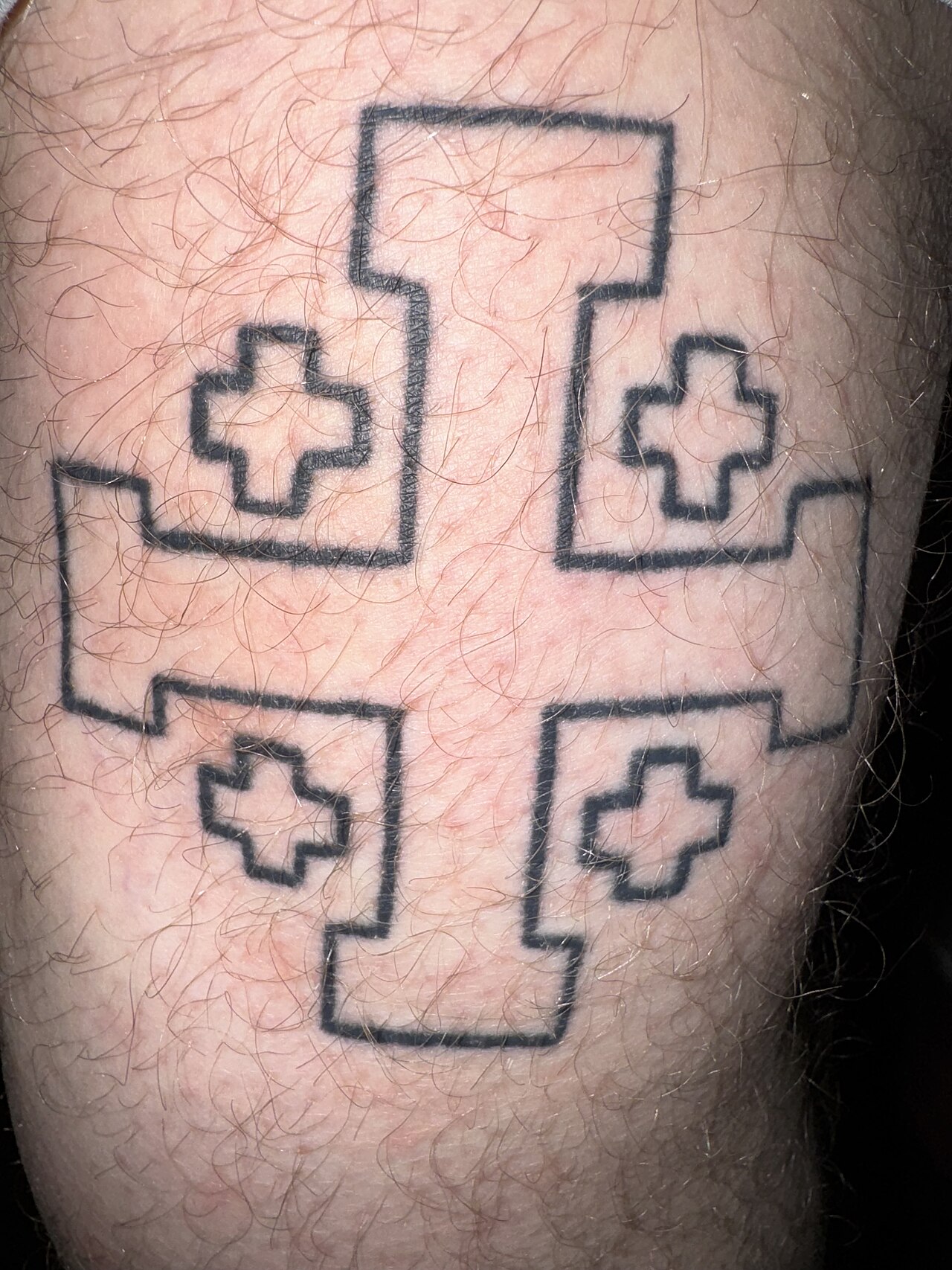
1. No law against tattoos
The Catholic Church has no law, rule or teaching that forbids tattoos. Getting a tattoo is not, in itself, a sin. It is a matter of prudence and good judgement, like other decisions about how we dress and present ourselves.
Pope Francis spoke about tattoos informally. On 19 March 2018, at a meeting with young people preparing for the Synod of Bishops on youth, a seminarian from Ukraine asked him how the Church should relate to young people’s culture, including tattoos. The Pope told him not to be afraid of tattoos. He recalled that Eritrean Christians, for example, have long tattooed a cross on their foreheads, and suggested that a tattoo could be a way to begin a conversation with a young person about what matters to them.
Some ancient Christian communities have long used tattoos as a sign of their faith. For centuries, many Coptic Christians in Egypt, a Christian minority in a Muslim-majority country, have tattooed a small cross on the inside of the right wrist, often in childhood. European pilgrims and travellers noticed and described the custom over several centuries. For Copts, the cross tattoo is a sign of belonging and, in times of persecution, a declaration that they will not deny Christ.
Catholic communities have had similar customs. In Bosnia and Herzegovina, under Ottoman rule, Catholic women and girls tattooed crosses and other Christian symbols on their hands, arms and chests. In the 1890s the Croatian archaeologist Ćiro Truhelka recorded and studied the custom. One reason often given was that the tattoos marked them as Christians and protected them from being taken into Muslim households.
2. What Leviticus 19:28 forbade
Leviticus 19:28 is the verse most often quoted against tattoos. But read in its context, it forbids a pagan mourning rite, cutting and marking the body for the dead, not decoration as such.
The verse belongs to a passage that lists practices of the surrounding pagan peoples that Israel must not copy. The previous verse forbids cutting the hair round the head or trimming the edges of the beard; then comes the ban on making “cuttings in your flesh, for the dead”, and on making marks on the body (Leviticus 19:27-28). These were mourning customs of the Canaanites and other neighbouring peoples, who gashed and marked themselves in grief and in honour of the dead or of their gods.
The Bible shows such practices in action. On Mount Carmel, the prophets of Baal, trying to make their god send fire on their sacrifice, “cut themselves after their manner with knives and lancets, till they were all covered with blood” (1 Kings 18:28). Cutting the body was part of pagan religion, an attempt to move a god by bloodshed.
Deuteronomy gives the reason for the ban plainly: “Be ye children of the Lord your God: you shall not cut yourselves, nor make any baldness for the dead. Because thou art a holy people to the Lord thy God” (Deuteronomy 14:1-2). Israel belonged to the Lord, and must not adopt pagan rites of mourning and devotion. The concern was idolatry, not body art.
3. Christians are not bound by the ritual laws of Moses
Even if Leviticus 19:28 were a general ban on all tattoos, Christians are not bound by the ritual and ceremonial laws of Moses. This is why Christians eat pork and shellfish and wear clothes of mixed wool and linen, which the Law of Moses forbids (Leviticus 11; 19:19; Deuteronomy 22:11).
The early Church settled this question at the very beginning. When some Jewish Christians insisted that Gentile converts must be circumcised and keep the Law of Moses, the apostles and elders met in Jerusalem. After much debate, they decided not to burden the Gentiles with the Law, asking them only to avoid a few practices connected with idolatry and immorality (Acts 15:1-29).
St Paul defended this freedom fiercely. When Peter, under pressure from strict Jewish Christians, stopped eating with Gentile believers as if the old food laws still applied, Paul “withstood him to the face, because he was to be blamed” (Galatians 2:11-14). Christians are bound by the moral law, such as the Ten Commandments, but not by the ceremonial laws of the old covenant.
The Catholic Church has taught this formally. In 1442, the Council of Florence declared, in its decree for the Copts, Cantate Domino, that the ceremonial and ritual prescriptions of the Old Law, such as its sacrifices, sacraments and food laws, were figures of what was to come, and ceased to bind once the Gospel had been proclaimed. Leviticus 19:28, as a ritual law, falls into this category.
4. An ancient Christian custom
Christian tattooing is surprisingly ancient. For many centuries, believers have marked their bodies with the cross or the name of Christ, as a sign of faith and of pilgrimage.
Around 500, Procopius of Gaza, a Christian scholar in Palestine, wrote a commentary on the prophet Isaiah. Isaiah 44:5 describes people who say, “I am the Lord’s“, and write on their hands, “To the Lord”. Procopius noted that many Christians of his day marked their wrists or arms with the sign of the cross or the name of Christ, in fulfilment of this verse.
Pilgrims to Jerusalem often came home with a tattoo as a souvenir and a sign of their pilgrimage. In 1612 William Lithgow, a Scottish traveller, visited Jerusalem and had a Jerusalem cross tattooed on his arm by a local Christian. He described the process in his travel book, and was proud of the mark for the rest of his life. Many other European pilgrims, Catholic and Protestant, did the same.
The tradition continues today. In Jerusalem’s Old City, near the Jaffa Gate, the Razzouk family, Coptic Christians originally from Egypt, have been tattooing pilgrims for generations. Their family tradition says they have been tattooing for some seven hundred years, first in Egypt and then in Jerusalem. They still use antique carved wooden stamps to outline traditional designs, such as the Jerusalem cross, before tattooing them. Catholic News Agency reported on the family’s work in July 2017. Pilgrims from around the world, including many Catholics, still come to be tattooed by them.
5. When Christian authorities opposed tattoos
Christian authorities have sometimes opposed tattoos. But when they did, it was usually because tattoos were connected with pagan rites or used as marks of degradation, not because ink in the skin is sinful.
In the Roman Empire, criminals and slaves were sometimes tattooed or branded on the face as a mark of punishment and ownership. Around 316, the first Christian emperor, Constantine, issued a law forbidding the tattooing or branding of condemned criminals on the face, because, he said, the human face is fashioned in the likeness of heavenly beauty and should not be disfigured (Theodosian Code 9.40.2).
In 786, two papal legates, George of Ostia and Theophylact, visited England and held councils with the English bishops and kings. Their report to Pope Hadrian I included a canon about tattoos. It condemned tattoos made out of pagan superstition, but distinguished them from marks borne “for God’s sake”, saying that a person who endured the pain of a tattoo for the love of God would be rewarded. The legates objected to pagan tattoos, not Christian ones.
Protestant missionaries have also opposed tattoos where they were tied to old religions. In Tahiti, tattooing was deeply bound up with the traditional Polynesian religion. In 1819, King Pomare II, who had become a Christian, issued a law code drawn up with the help of Protestant missionaries from the London Missionary Society, which banned tattooing along with other practices associated with the old gods.
6. “Your body is a temple”
The most serious objection to tattoos is that the body is “a temple of the Holy Spirit”, and that Christians should not mark or alter it. The Church agrees that the body is a temple, and forbids genuine mutilation. But it does not see tattoos as necessarily violating the temple.
St Paul’s famous words about the body as a temple were written to Christians in Corinth who were visiting prostitutes, arguing that what we do with our bodies does not matter. “Know you not, that your members are the temple of the Holy Ghost, who is in you… Glorify and bear God in your body” (1 Corinthians 6:19-20). Paul’s point was about sexual immorality, not about adornment. But the principle, that our bodies belong to God and should be treated with reverence, applies to every decision about them.
Temples, after all, were decorated. When Solomon built the Temple in Jerusalem, “all the walls of the temple round about he carved with divers figures and carvings: and he made in them cherubims and palm trees, and divers representations”, overlaid with gold (1 Kings 6:29-35). Decorating a temple is not the same as defiling it.
The Church does draw a line at real mutilation: destroying or damaging a healthy part of the body or its functions without serious medical reason. In 325, the Council of Nicaea, in its first canon, barred from the clergy any man who had castrated himself while healthy, though not those who had been castrated by doctors for medical reasons or by force. The Catechism teaches that “except when performed for strictly therapeutic medical reasons, directly intended amputations, mutilations, and sterilisations performed on innocent persons are against the moral law” (CCC 2297). A tattoo does not destroy any function of the body.
7. What matters: image, motive and effect
What really matters morally about a tattoo is the image, the motive, and the effect: nothing obscene, hateful or occult; nothing done out of pride, rebellion against legitimate authority or self-hatred; and nothing forced on another person.
St Paul gave a principle for disputed questions like this: “All things are lawful for me, but all things are not expedient. All things are lawful for me, but all things do not edify… Therefore, whether you eat or drink, or whatsoever else you do, do all to the glory of God” (1 Corinthians 10:23, 31). The question is not only “Is it allowed?” but “Is it wise? Does it build up? Does it glorify God?”
Tattoos can also be used to degrade. At Auschwitz, from 1941, the Nazis tattooed prisoners with serial numbers on their forearms, a mark imposed to turn persons into inventory. Survivors still bear the numbers today. A tattoo forced on someone, or used to dehumanise, is a grave evil.
The Book of Revelation contrasts two marks. On the one hand, God’s servants are “signed” with the seal of the living God “on their foreheads” (Revelation 7:2-4). On the other, the beast forces everyone to receive “a character in their right hand, or on their foreheads”, without which no one can buy or sell (Revelation 13:16-17). The question for a Christian is always: whose mark am I bearing? A tattoo of the cross, a saint or a Scripture verse can be a beautiful witness; a tattoo celebrating hatred, the occult or impurity would be a sin, not because it is a tattoo, but because of what it says.
8. A tattoo is no barrier to the sacraments
A tattoo does not bar anyone from baptism, Communion, confession, marriage or ordination. God looks at the heart.
When the prophet Samuel was sent to anoint one of Jesse’s sons as king of Israel, he was impressed by the eldest, Eliab, who was tall and handsome. But God told him: “Look not on his countenance, nor on the height of his stature… Nor do I judge according to the look of man: for man seeth those things that appear, but the Lord beholdeth the heart” (1 Samuel 16:7). God chose David, the youngest.
The early Church did not even require the bodily mark of circumcision for baptism. When the Holy Spirit fell on the Roman centurion Cornelius and his household, Peter said, “Can any man forbid water, that these should not be baptized, who have received the Holy Ghost, as well as we?” and baptised them without requiring them to be circumcised first (Acts 10:44-48).
Some of the Church’s recent martyrs bore Christian tattoos. In February 2015, twenty Coptic Christian migrant workers from Egypt, from a community whose members traditionally bear the wrist cross, and a companion from Ghana, were beheaded on a beach in Libya by Islamic State militants for refusing to deny Christ. In May 2023, Pope Francis announced that they would be added to the Roman Martyrology, the Catholic Church’s official list of martyrs.
9. Questions to ask first
In practice, the questions about a tattoo are the same as those about any permanent decision: Why do I want it? What will it show? Where on my body? Will I still stand by it in twenty or fifty years? How will it affect my family, my work and my witness as a Christian?
Jesus himself recommended thinking carefully before committing to something permanent. “Which of you having a mind to build a tower, doth not first sit down, and reckon the charges that are necessary, whether he have wherewithal to finish it?” (Luke 14:28). The same applies to a tattoo: count the cost, including the pain, the price, and the possibility of regret.
St Francis de Sales, the seventeenth-century bishop and spiritual director, gave sensible advice about dress and appearance in his Introduction to the Devout Life (1609). He recommended that people dress according to their state in life and circumstances, neatly and modestly, avoiding both showiness and slovenliness, and taking into account what is fitting and what will not give scandal to others (Introduction 3.25). His advice applies well to tattoos.
Even saints have regretted marking their bodies. The fourteenth-century German mystic Blessed Henry Suso, in an ardent moment of youthful devotion, cut the name of Jesus into the skin over his heart with a stylus, so deeply that the letters remained as scars for the rest of his life. In later years, he came to believe that the extreme physical penances of his youth were not what God really wanted of him, and gave them up. His story is a reminder that intense feelings can lead to permanent decisions we see differently later.
10. The mark that really counts
For a Christian, the mark that really counts is not a tattoo, but baptism, which the Church teaches leaves a spiritual seal that can never be removed.
The Council of Trent taught in 1547 that three sacraments, baptism, confirmation and holy orders, “imprint a character on the soul, that is, a certain spiritual and indelible sign, on account of which they cannot be repeated” (Session 7, canon 9). Every baptised person is permanently marked as belonging to Christ, whatever is or is not on their skin.
God himself uses the image of a tattoo, or engraving, for his love. Through the prophet Isaiah, he answers his people’s fear that he has forgotten them: “Can a woman forget her infant, so as not to have pity on the son of her womb? and if she should forget, yet will not I forget thee. Behold, I have graven thee in my hands” (Isaiah 49:15-16). God bears our names on his hands.
St Francis of Assisi did not mark himself. But in September 1224, while praying on Mount La Verna, he received the stigmata: wounds in his hands, feet and side like the wounds of the crucified Christ, which remained until his death two years later (St Bonaventure, Major Life 13). Francis became, in his very body, a sign of Christ’s love. Whether or not you choose a tattoo, the call is the same: to bear Christ’s image in your whole life.
Frequently asked questions
Is it a sin for a Catholic to get a tattoo? Not in itself. It depends on the image, the motive and the circumstances.
Does Leviticus 19:28 forbid tattoos for Christians? It forbade a pagan mourning rite for Israel. Christians are not bound by the ceremonial laws of Moses.
Can I receive Communion or get married in church if I have a tattoo? Yes. A tattoo is no barrier to any sacrament.
Can a man with tattoos become a priest? Yes, though a seminary might reasonably ask about tattoos that are offensive or that could cause scandal.
You may also like Why Do Catholics Make the Sign of the Cross?
Sources and further reading
- The Bible: Leviticus 11; 19:19, 27-28; Deuteronomy 14:1-2; 1 Samuel 16:6-13; 1 Kings 6:29-35; 18:25-29; Isaiah 44:5; 49:15-16; Luke 14:28-30; Acts 10:44-48; 15:1-29; 1 Corinthians 6:12-20; 10:23-31; Galatians 2:11-14; Revelation 7:2-4; 13:16-17.
- Catechism of the Catholic Church, 1272-1274, 2297.
- Council of Nicaea (325), canon 1; Council of Florence, Cantate Domino (1442); Council of Trent, Session 7 (1547), canon 9.
- Theodosian Code 9.40.2; Report of the papal legates George and Theophylact on the English councils (786); Procopius of Gaza, Commentary on Isaiah 44:5.
- William Lithgow, The Totall Discourse of the Rare Adventures and Painefull Peregrinations (1614 and later editions).
- Ćiro Truhelka, study of tattooing among Catholics in Bosnia (1890s).
- St Francis de Sales, Introduction to the Devout Life 3.25; Bl. Henry Suso, The Life of the Servant; St Bonaventure, Major Life of St Francis 13.
- Catholic News Agency, report on Razzouk Tattoo, Jerusalem (July 2017).
