
Catholic vs Lutheran: What Still Divides Them, and What No Longer Does
Lutheran and Catholic services look strikingly alike. Here is what the 500-year quarrel was about, what has since been agreed, and what still divides the two churches.
If you grew up Lutheran and attend Mass with a Catholic spouse, or grew up Catholic and visit a Lutheran church with your in-laws, you may be struck by how alike the services feel. There are vestments, candles, a liturgy that moves from the readings and sermon to the altar, the Creed, the Lord’s Prayer and Communion. Many Lutheran churches even have crucifixes and kneelers. So what is the five-hundred-year quarrel still about? This article explains what Lutherans and Catholics share, how the split began, which disputes have largely been resolved, and which questions, especially about authority, the Eucharist and ordained ministry, still divide them. It ends with how the two churches relate today.
1. Remarkably close
Lutherans and Catholics share far more than most people realise. Both confess the Apostles’ and Nicene Creeds. Both baptise infants and recognise each other’s baptisms. Both celebrate a liturgy of Word and Sacrament. And both believe that Christ is truly present in the Eucharist, not merely symbolised.
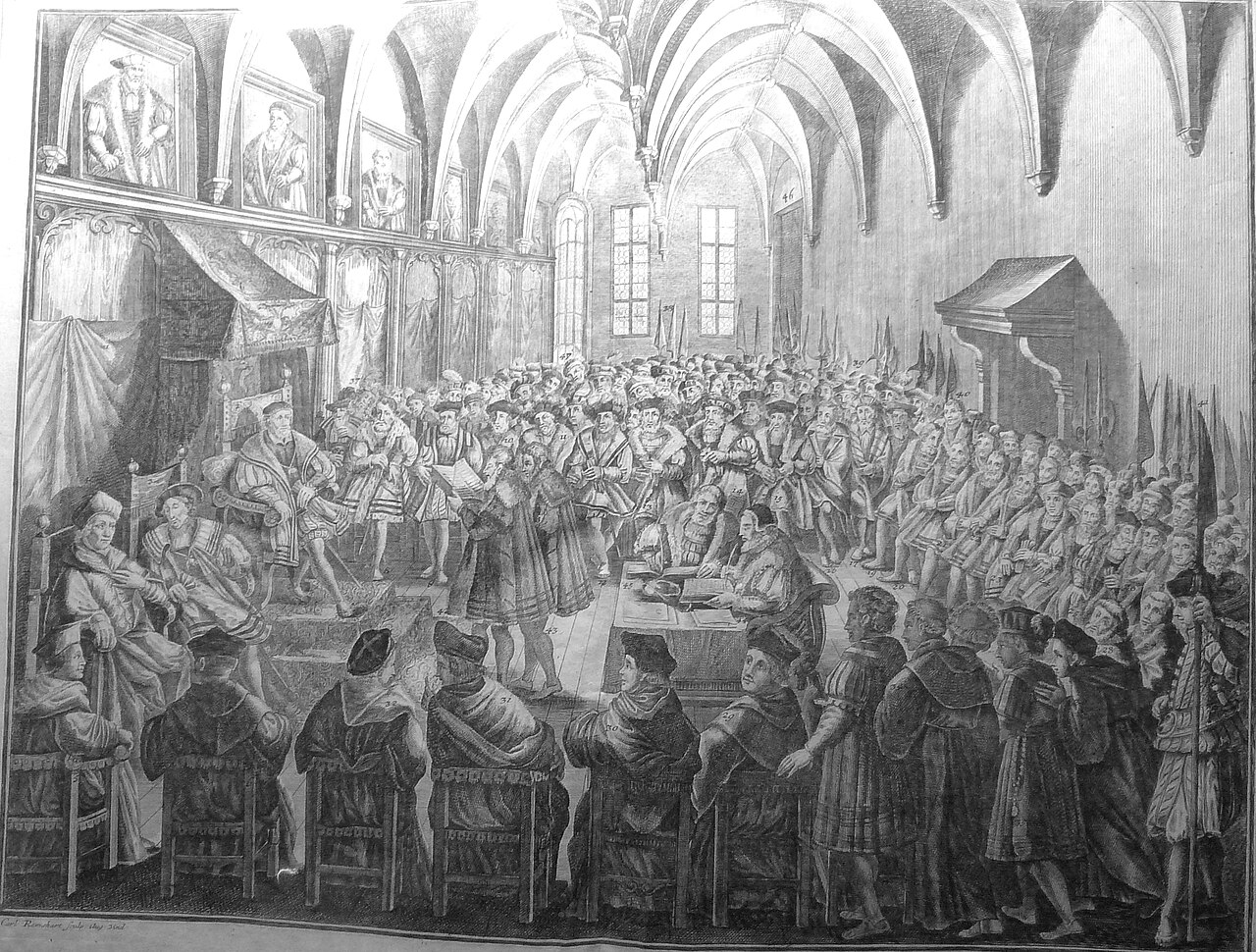
The Lutheran movement did not originally intend to create a new church. On 25 June 1530 the Lutheran princes of Germany presented a statement of their faith to the Emperor Charles V at the Imperial Diet in Augsburg. Drafted by Luther’s colleague Philip Melanchthon, the Augsburg Confession claimed that its teaching contained nothing contrary to Scripture or to the Catholic Church, and that the dispute was only about certain abuses. It remains the defining document of Lutheranism.
The year before, Luther had written a short catechism for fathers to teach their households. His Small Catechism of 1529 is built around the Ten Commandments, the Apostles’ Creed, the Lord’s Prayer, Baptism, Confession and the Sacrament of the Altar. A Catholic reading it today would find most of it familiar.
St Paul described what all Christians share: “One body and one Spirit… One Lord, one faith, one baptism” (Ephesians 4:4-5). For Lutherans and Catholics, that common ground is unusually broad. What divides them is mainly the question of authority, and its consequences for ministry, the papacy and the Eucharist.
2. A Catholic friar protesting real abuses
The Lutheran Reformation began with a Catholic friar protesting against real abuses. Martin Luther was an Augustinian friar and a professor of theology at the University of Wittenberg in Saxony. He sought to reform the Church, not to found a new one.
The spark was an indulgence. In 1517 a Dominican friar, Johann Tetzel, was preaching an indulgence in the territories near Wittenberg to raise funds for rebuilding St Peter’s Basilica in Rome. His preaching was crude and seemed to promise forgiveness in return for money; a popular jingle attributed to him ran, “As soon as the coin in the coffer rings, the soul from purgatory springs.” On 31 October 1517 Luther sent ninety-five theses criticising this preaching to Archbishop Albrecht of Mainz, Tetzel’s superior.
Behind the scenes, the story was even worse than Luther knew. Albrecht, a young prince of the powerful Hohenzollern family, had paid the papacy huge fees for permission to hold three bishoprics at once, which was against church law. He had borrowed the money from the Fugger banking house of Augsburg. By private agreement, half of the proceeds of the indulgence in his territories went to repay his debt to the bankers. A Fugger agent sometimes travelled with the preachers to collect the money.
The quarrel escalated rapidly. Luther was excommunicated in January 1521. In April he was summoned before the Emperor at the Diet of Worms and ordered to recant his writings. On 18 April 1521 he refused, unless he was convinced “by the testimony of Scripture or by clear reason”. His conscience, he said, was captive to the Word of God. The breach had become a division.
3. Justification: largely agreed
For Luther, the heart of the matter was justification: how a sinner is made right with God. Today, remarkably, this question is largely agreed.
Luther later described how, as a young professor, he had struggled with St Paul’s words “the just man liveth by faith” (Romans 1:17). He had understood God’s “righteousness” as the righteousness by which God punishes sinners, and he admitted that he hated that God. Then, he wrote, he grasped that it is the righteousness by which a merciful God justifies us through faith. “Here I felt that I was altogether born again and had entered paradise itself through open gates” (Preface to his Latin works, 1545).
The Catholic Church, at the Council of Trent, rejected some of Luther’s formulations but agreed on the essential point that justification is a free gift. Trent taught that “none of those things which precede justification, whether faith or works, merit the grace itself of justification” (Session 6, chapter 8, 1547).
After decades of dialogue, on 31 October 1999 (Reformation Day), Cardinal Edward Cassidy, representing the Vatican, and Bishop Christian Krause, president of the Lutheran World Federation, signed the Joint Declaration on the Doctrine of Justification in Augsburg. It states that together Lutherans and Catholics confess: “By grace alone, in faith in Christ’s saving work and not because of any merit on our part, we are accepted by God and receive the Holy Spirit.” It also declares that the mutual condemnations of the sixteenth century do not apply to the teaching of the other partner as set out in the Declaration. Differences of emphasis remain, but they are no longer seen as dividing the churches on this point.
4. Scripture and authority
The question that still divides Lutherans and Catholics most deeply is authority. Lutherans hold that Scripture is the only final judge of doctrine (sola scriptura). Catholics hold that Scripture is read within the living Tradition of the Church and authentically interpreted by the Church’s teaching office, the bishops in communion with the Pope.
Luther arrived at his position step by step. In 1519, at a public debate in Leipzig, the Catholic theologian Johann Eck pressed him on the authority of councils. Luther conceded that even a general council, such as the Council of Constance which had condemned the Czech reformer Jan Hus a century earlier, could err. With popes and councils both fallible, Scripture alone was left as the sure authority. It was a turning point.
Catholics argue that Scripture needs an interpreter. They often point to the Ethiopian court official in Acts, who was reading Isaiah in his chariot. When Philip asked whether he understood what he was reading, the official answered, “And how can I, unless some man shew me?” (Acts 8:31). Christians reading the same Bible have reached very different conclusions, including Lutherans and the Swiss Reformed on the Eucharist.
In April 1546 the Council of Trent decreed that the truth of the Gospel “is contained in the written books, and the unwritten traditions which, received by the Apostles from the mouth of Christ himself… have come down even unto us” (Session 4). For Catholics, Scripture and Tradition together form one deposit of faith.
5. The Eucharist: real presence, but not transubstantiation
Unlike most Protestants, Lutherans firmly believe that Christ’s body and blood are truly present in the Eucharist. This makes them much closer to Catholics on this point than to Baptists or Presbyterians. But Lutherans reject the Catholic doctrine of transubstantiation and the Catholic understanding of the Mass as a sacrifice.
Luther fought hard for the real presence. In October 1529, at Marburg Castle, he met the Swiss reformer Huldrych Zwingli, who taught that the bread merely signified Christ’s body. According to tradition, Luther wrote the words “This is my body” (Hoc est corpus meum) in chalk on the table, covered them with a cloth, and when Zwingli argued for a symbolic meaning, pulled back the cloth and pointed to them. He would not let Jesus’s words be explained away.
The Catholic Church describes the change in the Eucharist with the word “transubstantiation”. The Fourth Lateran Council used it in 1215, and the Council of Trent in 1551 called it the “most apt” term: the whole substance of the bread becomes the body of Christ, while the appearances of bread remain. Lutherans have traditionally said that Christ’s body is present “in, with and under” the bread, without the bread ceasing to be bread.
Both sides take seriously St Paul’s warning that “whosoever shall eat this bread, or drink the chalice of the Lord unworthily, shall be guilty of the body and of the blood of the Lord” (1 Corinthians 11:27). The disagreement is not whether Christ is present, but how, and whether the Mass is a sacrifice.
6. Sacraments and bishops
Catholics count seven sacraments. Lutherans usually count two, Baptism and the Lord’s Supper, though some count three, adding Confession and Absolution. Melanchthon’s Apology of the Augsburg Confession (1531), an official Lutheran document, names Baptism, the Lord’s Supper and Absolution as truly sacraments (Article XIII).
Catholics and Lutherans both value confession. Catholics root it in the evening of Easter Day, when the risen Jesus breathed on the apostles and said, “Whose sins you shall forgive, they are forgiven them; and whose sins you shall retain, they are retained” (John 20:22-23). Luther himself went to confession all his life, and the Small Catechism includes a form for it.
A bigger difference concerns ordained ministry. The Catholic Church holds that bishops in apostolic succession are essential to the Church, and that only validly ordained priests can celebrate the Eucharist. Most German and American Lutherans broke with the old line of bishops at the Reformation, and their ministers were ordained by other pastors. The Catholic Church therefore does not recognise Lutheran ordinations as valid.
The situation is more complicated in Scandinavia. When the Swedish church became Lutheran, it kept its bishops. In 1531 Laurentius Petri was consecrated Archbishop of Uppsala by Petrus Magni, Bishop of Västerås, who had himself been consecrated in Rome in 1524. Swedish Lutherans therefore claim an unbroken succession of bishops. The Catholic Church has not formally recognised it, but it is an important point in dialogue.
7. The Pope
Lutherans do not accept that the Pope’s authority over the whole Church was given by Christ. Yet the picture is more nuanced than many people think.
In 1537 Luther wrote the Smalcald Articles, a sharp statement of Lutheran belief prepared for a proposed council. In it he called the Pope the Antichrist. But when Melanchthon signed the Articles, he added a personal note: for the sake of peace and unity, he could accept the Pope’s oversight of other bishops, provided the Pope allowed the Gospel to be preached, as long as it was understood as a matter of human arrangement rather than divine right.
Catholics believe the Pope’s role rests on Christ’s words to Peter: “thou art Peter; and upon this rock I will build my church… And I will give to thee the keys of the kingdom of heaven” (Matthew 16:18-19). For more on this passage, see Why Did Jesus Call Peter a Rock?
In 1995 Pope John Paul II made an unusual invitation. In his encyclical on Christian unity, he asked leaders and theologians of other churches to help him find a way of exercising the papal primacy that could be recognised by all as “a service of love” (Ut Unum Sint 95-96). Some Lutheran theologians have responded that they could accept a reformed papacy as a ministry of unity, though not in its present form.
8. Mary, the saints, purgatory
Lutherans honour Mary and the saints, but they do not pray to them, and they reject purgatory and indulgences.
Luther himself had a deep love for Mary. In 1521, while he was in hiding after the Diet of Worms, he wrote a beautiful commentary on the Magnificat, Mary’s song in Luke 1. He praised her humility and faith and called her the Mother of God. He continued to believe in her perpetual virginity.
The Augsburg Confession teaches that the saints should be remembered, so that Christians may imitate their faith and good works, and be strengthened by seeing how God’s grace helped them. But it adds that Scripture does not teach us to invoke the saints or ask their help, because it sets forth Christ alone as mediator (Article XXI). Many Lutheran churches still keep saints’ days, especially of the apostles.
Catholics base prayer for the dead partly on the Second Book of Maccabees, which tells how Judas Maccabeus had prayers and a sacrifice offered for soldiers who had died in battle, “that they might be loosed from sins” (2 Maccabees 12:39-46). In his German Bible of 1534, Luther placed this book among the “Apocrypha”, useful to read but not Scripture, and so the passage carries no weight for Lutherans. See Is Purgatory in the Bible? and What Are Indulgences?
9. Was the Reformation necessary?
Lutherans believe the Reformation was necessary because the Church of their day refused to reform itself. Catholics today readily admit that there were grave abuses and that reform came too late, but they mourn the division and believe it was not the right way to reform.
There was a moment when it seemed Rome might listen. In January 1523, the new Pope, Adrian VI, a strict Dutch reformer, sent his legate Francesco Chieregati to the Imperial Diet at Nuremberg. The legate read out a remarkable confession: for many years, he said, abominable things had happened in the Holy See, and the sickness had spread from the head to the members, from the popes to the lower clergy. Adrian promised reform, but he died that September after only twenty months as Pope.
Real reform did come, but slowly. The Council of Trent, which met between 1545 and 1563, ordered sweeping changes, and in 1567 Pope St Pius V cancelled every indulgence that involved any payment of money. By then, half of Germany was Lutheran.
The division had terrible consequences. Between 1618 and 1648, the Thirty Years’ War, fought partly over religion between Catholic and Protestant states, devastated Germany. Historians estimate that millions died through fighting, famine and disease, and some regions lost more than a third of their population. No one can look at that war and believe Christian division is harmless.
10. Where things stand today
Catholics and Lutherans recognise each other’s baptism, pray together regularly, and have reached agreement on many questions. Shared Communion is not yet normal, because the churches do not yet agree fully on the Eucharist, ministry and authority. But the dialogue continues, and the change in relations in the last sixty years is extraordinary.
On 11 December 1983, marking five hundred years since Luther’s birth, Pope John Paul II visited the Lutheran Christuskirche in Rome and preached there, the first pope ever to preach in a Lutheran church.
On 23 September 2011, Pope Benedict XVI, himself a German, met leaders of the Evangelical Church in Germany in the chapter house of the Augustinian friary at Erfurt, where Luther had lived as a young friar. Benedict spoke warmly of Luther’s burning question, “How do I find a gracious God?”, saying it should be the question of every Christian.
On 31 October 2016, Pope Francis travelled to Lund in Sweden, where the Lutheran World Federation was founded in 1947. With Bishop Munib Younan, the Federation’s Palestinian president, he led a joint service of thanksgiving and repentance to open the commemoration of the Reformation’s five hundredth anniversary. Together they thanked God for the gifts of the Reformation, confessed the sins of division, and committed their churches to working for the day when they can share the Eucharist.
The joint commission that prepared for that anniversary published a report in 2013, From Conflict to Communion, which ends with five “ecumenical imperatives” that apply just as well in a mixed Lutheran and Catholic family as in a Vatican office. The first is to begin from the perspective of unity rather than division, strengthening what is held in common even when the differences are easier to see. Others are to be continually transformed by encountering each other, to seek visible unity, to rediscover together the power of the Gospel for our time, and to witness together to God’s mercy in proclamation and service to the world. In practice, that can mean a Lutheran and a Catholic spouse reading the Sunday Gospel together, praying the Lord’s Prayer and the Creed with their children, and bringing them to each other’s churches with respect, while being honest that the two churches do not yet share one table.
Frequently asked questions
Is a Lutheran service the same as a Catholic Mass? The structure is very similar, but Catholics do not regard Lutheran ordinations as valid, and the understanding of the Eucharist differs.
Can a Lutheran receive Communion at a Catholic Mass? Ordinarily no, except in rare cases of grave need, because Communion expresses full unity of faith. See Which Sacraments Can I Receive If I’m Not Catholic?
Can a Catholic marry a Lutheran? Yes, with the bishop’s permission. See Can a Catholic Marry a Non-Catholic?
Did Luther want to leave the Catholic Church? No. He wanted to reform it. He was excommunicated in 1521.
You may also like Catholic vs Protestant: The Main Differences.
Sources and further reading
- The Bible: Matthew 16:13-19; John 20:19-23; Acts 8:26-35; Romans 1:17; 1 Corinthians 11:23-29; Ephesians 4:4-6; 2 Maccabees 12:39-46.
- Augsburg Confession (1530), especially Article XXI; Apology of the Augsburg Confession (1531), Article XIII; Smalcald Articles (1537); Luther, Small Catechism (1529); Luther, Commentary on the Magnificat (1521); Luther, Preface to the Latin Writings (1545).
- Council of Trent, Session 4 (1546), Session 6 (1547), Session 13 (1551).
- Lutheran World Federation and Pontifical Council for Promoting Christian Unity, Joint Declaration on the Doctrine of Justification (1999).
- Lutheran-Roman Catholic Commission on Unity, From Conflict to Communion (2013).
- John Paul II, Ut Unum Sint (1995), 95-96.
- Benedict XVI, Address at the Augustinian Convent, Erfurt (23 September 2011); Joint Statement, Lund (31 October 2016).
- Diarmaid MacCulloch, Reformation: Europe’s House Divided 1490-1700 (2003); Lyndal Roper, Martin Luther: Renegade and Prophet (2016).
