I Pray but Feel Nothing: Is God Listening?
Feeling nothing when you pray does not, by itself, mean that God is absent or that you are praying badly. Catholic prayer…
Feeling nothing when you pray does not, by itself, mean that God is absent or that you are praying badly. Catholic prayer is a relationship with God, and your feelings are only one part of that relationship. You can speak honestly, listen to Scripture and remain present even when prayer feels dry.
Begin with something manageable. Set aside five quiet minutes, tell God what is actually happening, read a short Gospel passage and finish with one simple prayer. You do not need to manufacture peace before your prayer counts.
Perhaps you used to feel close to God and now feel almost nothing. Perhaps you never had the powerful experiences other people describe. Either way, it can hurt to keep showing up and wonder whether anyone is listening. That question deserves a thoughtful answer, rather than a quick instruction to try harder.

Is it normal for prayer to feel dry?
The Church recognises dryness as a real difficulty in prayer. The Catechism, paragraph 2731, describes times when a person finds little taste for prayer, even in spiritual thoughts or memories. The fact that the Catechism discusses this should help you resist the idea that you must be the only person experiencing it.
However, “dryness” is a description, not a complete explanation. It does not tell you automatically why you feel this way. You may be tired, grieving, distracted, disappointed or trying to pray in a way that does not fit your present circumstances.
You may also need to look honestly at habits or choices that are pulling you away from God. That examination can be useful without assuming that every difficult day is punishment for something you have done.
Avoid rushing to the most dramatic conclusion. A flat week does not prove that you have lost your faith. It also does not prove that you are passing through an advanced mystical stage. Start with the facts you can observe and seek help where you need it.
Why feelings cannot be your only measure of prayer
Feelings can be valuable. Gratitude may help you praise God. Sorrow may lead you to ask for mercy. A sense of peace can encourage you during a difficult period. You do not need to distrust those experiences.
But feelings change for many reasons. If you judge every prayer by its emotional effect, you may begin watching yourself instead of attending to God. Halfway through a prayer, you start checking: “Am I peaceful yet? Was that sincere enough? Why did yesterday feel better?”
That constant measuring can make a quiet moment feel like an exam. Try asking a different question afterwards: “Was I willing to bring my actual life before God?” The answer may be yes even when you were restless or sad.
The Catechism, paragraphs 2709–2711, presents contemplative prayer in terms of personal relationship and making time for God. It does not suggest waiting until your mood becomes ideal.
You can therefore choose a brief time for prayer while admitting that you do not feel eager to begin. Willingness can be quiet. It does not always arrive with enthusiasm.
Start by telling God the truth
You do not have to sound cheerful if you are disappointed. You do not have to use formal religious language if ordinary words are all you can manage.
Try: “God, I am here, but I feel far away from you.” Or: “I want to pray, but I am angry about what happened.” Or simply: “I do not know what to say today.” These are possible beginnings, not special formulas that guarantee an experience.
Name one specific concern. Perhaps you are worried about money, missing someone who died or ashamed of an argument. Staying with one real concern can be more helpful than rushing through a long list of things you think a good Christian ought to mention.
Then leave a little space. You do not need to fill every second. You also do not need to treat the next thought that enters your mind as a message from God. Let the moment remain simple.
If your words become repetitive, finish with a familiar prayer such as the Our Father. Familiar words can support you when your own words are difficult to find.
A simple way to pray for five minutes
This is a suggested practice, not a Church rule. Adjust it to your responsibilities, health and stage of life.
First, choose a realistic place and time. Put your phone out of reach if possible. Sit comfortably enough that you can pay attention. A kitchen chair before the household wakes may work better than an ambitious plan you never manage to begin.
Second, become aware that you are turning towards God. Make the Sign of the Cross if that is part of your practice. Take a natural breath and say one honest sentence about your day.
Third, read a short Gospel passage slowly. Choose a paragraph rather than several chapters. Notice one action of Jesus or one question someone asks him. You are not trying to produce a brilliant interpretation.
Fourth, respond in your own words. If the passage shows patience, you might ask for help being patient with someone. If it raises a difficult question, bring that question to God without pretending that you have solved it.
Finally, close with a brief prayer and one intention for the day. You might ask for help listening before you react. When the time ends, return to your responsibilities. There is no need to extend the session until a particular feeling appears.
Try the same modest pattern for several days before changing everything. A routine needs some room to become familiar.
What should I do when my mind keeps wandering?
Notice the distraction and return gently. You may need to do that many times. The Catechism, paragraph 2729, treats distraction as a common difficulty and encourages turning the heart back towards God.
If you remember an important task, write down a few words and return to prayer. That can be more useful than spending the next three minutes trying not to forget it.
If the same worry keeps appearing, you might bring that worry into the prayer: “This is what is taking up so much space in me.” You can also set aside another time to address the practical problem. Prayer does not remove the need to make the appointment, answer the message or ask for help.
Be careful about treating every wandering thought as a moral failure. An unwanted thought arriving is different from choosing to dwell on something. If you are regularly frightened by the contents of your mind, speak with someone qualified to help you understand what is happening.
For now, a return can be very small: read the sentence again, say Jesus' name or resume the prayer where you left off.
Could tiredness or stress be affecting my prayer?
Look at the ordinary conditions around you. Are you trying to pray only when you are falling asleep? Have you had space to grieve? Are you expecting silence while caring for young children in a busy room?
These questions are not excuses. They help you make a plan that belongs to your actual life. A parent may need several short moments. A shift worker may need a different time each week. Someone recovering from illness may need permission to keep things very simple.
Try one practical adjustment before concluding that prayer has become impossible. Change the time. Use a printed page instead of an app. Pray aloud if silent reading leaves you distracted. Take a short walk and speak to God in ordinary words if your surroundings allow it.
You do not have to copy the routine of someone with different health, work or family responsibilities. Ask what you can sustain without neglecting the people and duties already entrusted to you.
When should I seek mental health support?
If the emptiness reaches beyond prayer, pay attention. Loss of interest in things you normally enjoy, persistent low mood, changes in sleep or appetite, and difficulty functioning can warrant professional support. The National Institute of Mental Health's guide to depression explains these signs. Symptoms lasting around two weeks are a reason to seek assessment; you can ask for help sooner if they are severe or concerning.
Do not assume that a health problem is weak faith. A priest can offer spiritual support, while a qualified health professional can assess symptoms and discuss care. Those forms of help can work alongside each other.
You do not need to diagnose yourself before making an appointment. You can say, “I have felt emotionally flat, and it is affecting several parts of my life.” Describe what has changed and how long it has been happening.
If you are in immediate danger or might harm yourself, seek urgent local emergency or crisis support. That immediate need deserves attention before trying to solve the question through a longer prayer routine.
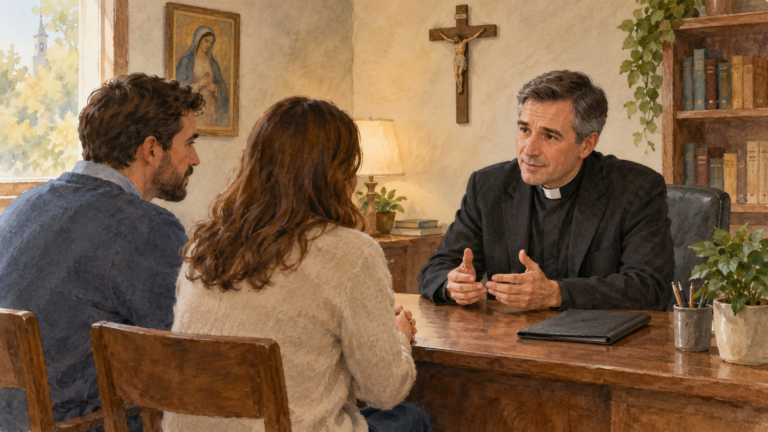
How can a priest or spiritual director help?
A useful conversation begins with concrete details. Instead of saying only, “My prayer is terrible,” explain what you do, when the difficulty began and what else has changed in your life.
You might say: “I pray for ten minutes most evenings. For the last month I have felt distracted and discouraged. I keep wondering whether I should stop.” That gives the other person a clearer starting point.
Ask for one or two suggestions, rather than a complete new spiritual programme. You might need a simpler routine, help understanding a passage of Scripture, or guidance about a moral concern that keeps troubling you.
If the advice leaves you confused, ask what it would look like on an ordinary Tuesday. “Be more open to God” may sound beautiful, but you may need help turning it into a concrete practice.
Allow time for the relationship with a spiritual guide to develop. At the same time, you should be able to ask respectful questions. Guidance should not require you to pretend that you understand something you do not.
Keep prayer connected to daily life
After praying, notice the next person or task in front of you. Is there someone you need to listen to? A duty you have been avoiding? A small act of kindness you can offer without drawing attention to yourself?
The Catechism, paragraph 2718, connects contemplative prayer with love expressed in action. Prayer is not sealed off from how you treat people during the rest of the day.
That does not mean turning kindness into another scorecard. You may still be impatient and need to apologise. But looking beyond your inner feelings can help you remember that faith has a daily shape.
Continue participating in the life of your parish as you are able. If you are Catholic, speak with your priest about sustaining your sacramental life. You do not have to solve every question about prayer before accepting the support of the Church's shared worship.
Related questions about feeling nothing in prayer
Is prayer still worthwhile if I feel bored?
Yes. Boredom does not make your decision to pray meaningless. Ask whether your routine needs a reasonable adjustment, then give it a fair chance. You can read slowly, use a familiar prayer or sit quietly for a brief period. You do not need a new method every time enthusiasm drops.
Should I pray longer until I feel God's presence?
Not necessarily. Increasing the time simply to force an experience can leave you frustrated. Keep a reasonable commitment and discuss persistent difficulties with a trusted guide. Longer prayer may be appropriate for some people, but length is not a reliable way to control feelings.
Does dryness mean God is punishing me?
You cannot draw that conclusion from the feeling alone. Look honestly at your life, seek reconciliation where needed and ask for guidance. Avoid inventing a hidden explanation for every difficult period. You are allowed to say that you do not yet understand what you are experiencing.
Is this the “dark night of the soul”?
That phrase has a particular place in Catholic spiritual writing and should not become a quick label for any sadness or boredom. A knowledgeable spiritual director can help you explore the question. Start by describing your experience plainly, including any health concerns, rather than trying to fit yourself into a dramatic category.
Can I use written prayers if my own words feel empty?
Yes. The Our Father, the Psalms and other established Catholic prayers can give you words when you struggle to find your own. Read slowly enough to notice what you are saying. You may stay with one line rather than rush through many pages.
What should I do tonight?
Choose five minutes you can realistically keep. Tell God one true thing. Read a short passage. Ask for help with tomorrow. Then let the prayer end without grading it. You can return again, even if tonight was quiet and nothing remarkable seemed to happen.