
Why Do Catholics Believe Mary Was Sinless? The Immaculate Conception Explained
Catholics believe Mary was preserved from original sin from her conception. Here is what the doctrine means, why it isn’t the Virgin Birth, and how Catholics answer “all have sinned”.
Yes. Catholics hold, as a dogma of faith, that Mary was preserved from original sin from the first moment of her existence in her mother’s womb, and they believe that she never committed a personal sin throughout her life. This teaching is called the Immaculate Conception. It is one of the most misunderstood Catholic beliefs: many people, including many Catholics, think it refers to the conception of Jesus, and many Protestants assume it means Mary did not need a Saviour. Neither is true. This article explains what the doctrine says and does not say, why Catholics believe it, the centuries of honest debate behind it, and how Catholics answer St Paul’s words that “all have sinned”.
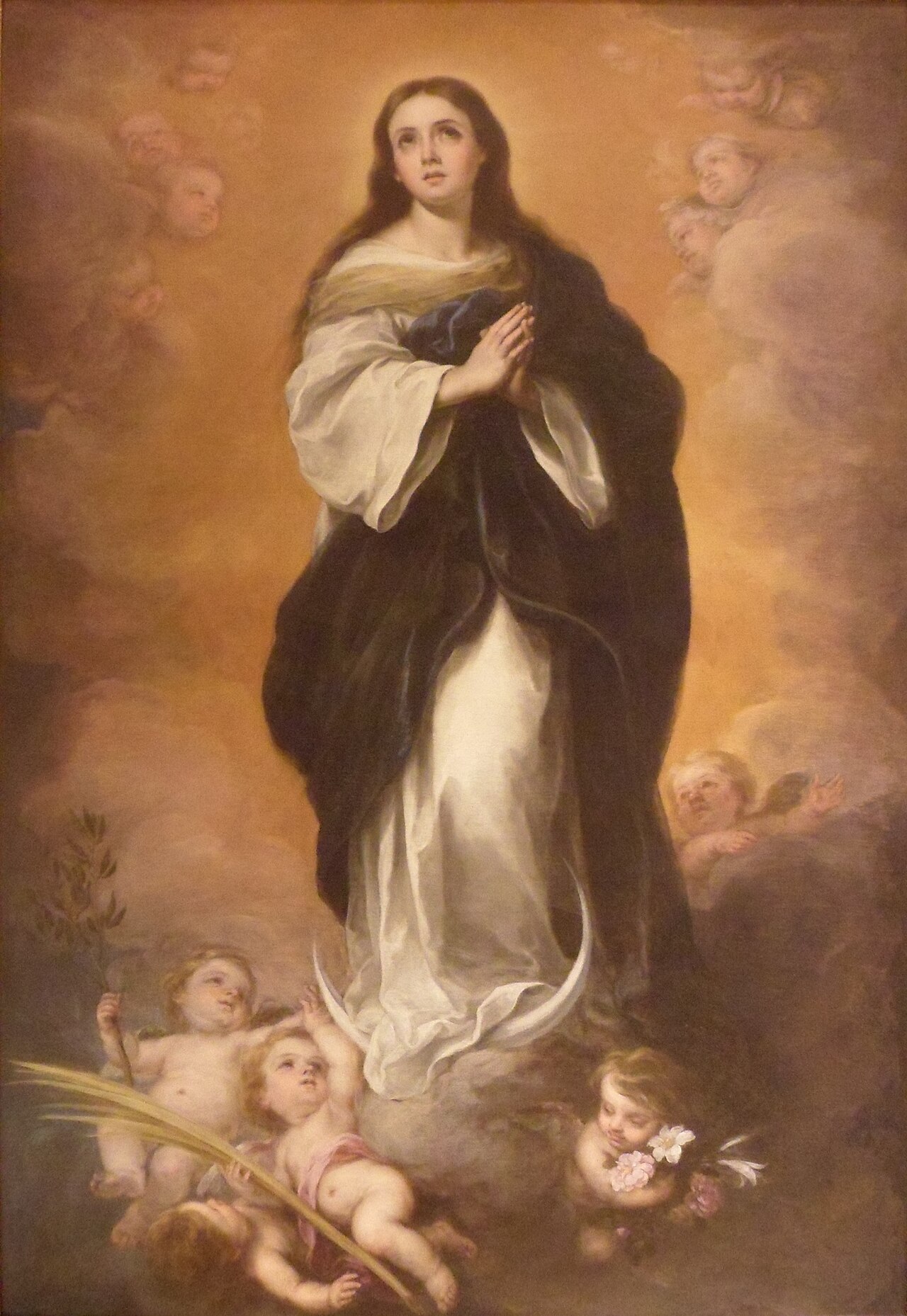
1. What Catholics actually believe
On 8 December 1854, Pope Pius IX solemnly defined, in the bull Ineffabilis Deus, that “the most Blessed Virgin Mary, in the first instance of her conception, by a singular grace and privilege granted by Almighty God, in view of the merits of Jesus Christ, the Saviour of the human race, was preserved free from all stain of original sin.” He declared this to be revealed by God and therefore to be believed firmly by all the faithful.
That definition concerns original sin, the wounded condition every human being inherits from Adam. But the Church also teaches that Mary never committed any personal sin. Three hundred years earlier, in 1547, the Council of Trent taught that no one can avoid all sins, even small, venial ones, for a whole lifetime, “except by a special privilege from God, as the Church holds in regard to the Blessed Virgin” (Session 6, canon 23).
The Gospel gives the starting point. When the angel Gabriel appeared to Mary in Nazareth, he did not greet her by name. He greeted her with a title: “Hail, full of grace” (Luke 1:28). The Greek word, kecharitōmenē, describes someone who has been, and remains, filled with God’s favour. Luke adds that Mary “was troubled at his saying, and thought with herself what manner of salutation this should be” (Luke 1:29). Something about her had been named that even she did not fully understand.
2. Not the Virgin Birth: a common mix-up
The Immaculate Conception is about Mary’s own conception by her parents, not about Jesus’s conception in Mary’s womb. The doctrine about Jesus is called the Virginal Conception or Virgin Birth: that Jesus was conceived by the power of the Holy Spirit without a human father. The two are completely different teachings.
The Church’s calendar makes this clear for anyone who counts. The feast of the Immaculate Conception falls on 8 December. The feast of Mary’s birth, her Nativity, falls on 8 September, exactly nine months later. The feast of Jesus’s conception, the Annunciation, is on 25 March, nine months before Christmas.
Mary’s conception happened in the ordinary way, through the marriage of her parents. Scripture does not name them, but a second-century Christian writing called the Protoevangelium of James, which is not part of the Bible, tells of an elderly, childless couple named Joachim and Anne who prayed for a child and were overjoyed when Anne conceived. The names have been honoured in the Church ever since, and the feast of Sts Joachim and Anne is kept on 26 July.
It is easy to see why people mix up the doctrines. The Gospel read at Mass on 8 December is the Annunciation story, Luke 1:26-38, in which Gabriel announces Jesus’s conception. The Church chose it because Gabriel’s greeting, “full of grace”, is the clearest biblical hint of Mary’s holiness. But a casual listener hears a story about Jesus’s conception on the feast of the “Immaculate Conception” and draws the wrong conclusion.
3. Mary needed Jesus as much as anyone
The most important point to grasp is that the Immaculate Conception does not exempt Mary from needing a Saviour. It is a statement about how she was saved.
Mary herself said so. In her great song of praise she sang, “my spirit hath rejoiced in God my Saviour” (Luke 1:47). The Church takes her words at face value. Mary had a Saviour, and he was her own Son.
The person who explained this most clearly was a Scottish Franciscan friar, Blessed John Duns Scotus, teaching at Oxford and Paris around the year 1300. Many theologians of his day objected that if Mary never had original sin, she would not need redemption. Scotus answered with a brilliant distinction. There are two ways to save someone from a pit: you can pull them out after they fall in, or you can catch them before they fall. Both are real rescues, but the second is the more perfect. A perfect Redeemer, Scotus argued, would save his own mother in the most perfect way, by preventing her from contracting the stain of sin at all. This is why Catholics call it “preservative redemption”.
Scripture already shows God making people holy before birth. The angel told Zechariah that his son, John the Baptist, would be “filled with the Holy Ghost, even from his mother’s womb” (Luke 1:15). And when the pregnant Mary greeted Elizabeth, the unborn John “leaped for joy” (Luke 1:44). If God could sanctify John before his birth, Catholics ask, why not sanctify Mary from the very beginning?
4. Where Catholics find it in the Bible
There is no single verse that states, “Mary was conceived without original sin.” Catholics are honest about that. The doctrine is drawn from several passages read together in the light of the Church’s tradition.
The first is in Genesis. After the fall, God told the serpent: “I will put enmities between thee and the woman, and thy seed and her seed” (Genesis 3:15). Christians very early read this “first gospel” as a prophecy of Christ, the woman’s offspring who would crush the serpent. If the woman’s enmity with the serpent is total, they asked, could she ever have been under the serpent’s power, even for a moment?
The second is the “new Eve” theme. Around the year 180, St Irenaeus of Lyons, who had learned the faith from St Polycarp, a disciple of the apostle John, wrote that “the knot of Eve’s disobedience was loosed by the obedience of Mary” (Against Heresies 3.22.4). Eve was created without sin; it seemed fitting to the early Christians that the new Eve should be no less.
The third is the way Luke tells the Visitation. When King David brought the Ark of the Covenant to Jerusalem, he cried, “How shall the ark of the Lord come to me?” and the Ark stayed in the house of Obededom for three months (2 Samuel 6:9-11). Luke tells us that Elizabeth cried, “whence is this to me, that the mother of my Lord should come to me?” and that Mary stayed in the hill country of Judah about three months (Luke 1:39-56). Many scholars see Luke presenting Mary as the new Ark, the holy dwelling of God. The old Ark was made of the purest materials and could not be touched carelessly. The new Ark carried God himself.
5. An ancient belief, East and West
Long before any pope defined it, Christians across the world spoke of Mary as wholly holy.
In the fourth century, St Ephrem the Syrian, a deacon and hymn-writer in what is now southern Turkey, addressed Christ in a hymn, saying that he and his mother alone are beautiful in every way, for “there is no blemish in you, nor any stain in your Mother” (Nisibene Hymns 27.8). Ephrem wrote in Syriac, far from Rome, and his hymns were sung in the churches of the East.
St Augustine of Hippo was the great theologian of original sin, the man who argued more forcefully than anyone that all humanity shares Adam’s guilt. Yet when his opponent Pelagius listed holy people who had supposedly lived without sin, Augustine dismissed every name but one. Concerning Mary, he wrote, “for the honour of the Lord, I wish to raise no question at all when it comes to sin” (On Nature and Grace 36.42, AD 415).
In the Greek-speaking East, Christians were celebrating a feast of Mary’s conception by the eighth century. St Andrew of Crete, a monk and bishop who died around 740, wrote hymns for it. The Orthodox still keep the feast, on 9 December, under the name “the Conception by St Anne of the Most Holy Mother of God”.
6. The honest history: saints disagreed
It would be misleading to suggest that everyone always agreed. For several centuries some of the greatest Catholic saints and theologians doubted or opposed the doctrine, and their disagreement is part of the story.
Around 1140, the canons of the cathedral of Lyons in France introduced a feast of Mary’s conception. St Bernard of Clairvaux, the Cistercian abbot famous throughout Europe for his love of Mary, wrote them a stern letter of rebuke (Letter 174). He feared that celebrating her conception would imply that the act of conception itself was holy, and he could not see how Mary could be holy before she existed as a person.
A century later St Thomas Aquinas, the greatest theologian of the Middle Ages, also held back. He taught that Mary was sanctified in her mother’s womb, but after her conception, because he could not see how she would otherwise need Christ as Redeemer (Summa Theologiae III, q. 27, a. 2). Scotus’s answer about preservative redemption had not yet been worked out.
The argument became so heated that the two great preaching orders turned it into a feud. Franciscans, following Scotus, defended the doctrine; many Dominicans, following Aquinas, opposed it. Pope Sixtus IV, himself a Franciscan, approved a Mass and Office of the Immaculate Conception in 1477. Then in 1483, with the quarrel growing bitter, he forbade either side to call the other heretics (Grave Nimis). The question was left open for another four centuries, until Pius IX defined it in 1854 after consulting the bishops of the whole world. Catholics do not have to pretend this history away. It shows the Church taking time, listening to objections and moving slowly.
7. “All have sinned”: the strongest objection
The strongest objection comes from St Paul: “all have sinned, and do need the glory of God” (Romans 3:23). If all have sinned, how can Mary be an exception?
Many Catholics answer that Paul is making a point about humanity as a whole, not compiling a list of every individual. His whole argument in Romans 1 to 3 is that Jews and Gentiles alike stand in need of God’s grace; neither group can boast. On this reading, “all” means “all kinds of people”, not “every person without exception”.
The same letter shows that Paul’s “all” has exceptions. Discussing the twins Jacob and Esau, Paul notes that “the children being not yet born, nor having done any good or evil” (Romans 9:11), God had already made his choice. Unborn babies have committed no personal sin. Nor have young children who die before reaching the age of reason. Above all, Jesus himself, who was “tempted in all things like as we are, without sin” (Hebrews 4:15), is a human being who did not sin. Catholics believe Mary is the one further exception, by the grace of her Son.
The question has even been studied ecumenically. In 2005, the official Anglican-Roman Catholic International Commission published a joint statement, Mary: Grace and Hope in Christ. Its members agreed that the teaching about Mary’s preservation from sin, understood within the biblical pattern of grace and hope, can be said to be consonant with Scripture and the ancient common tradition. The Anglican members still questioned whether it should be binding on all believers as dogma. That is a fair summary of where many thoughtful Christians stand today.
8. What the doctrine does not mean
Several misunderstandings need clearing away.
First, being sinless does not make Mary divine. Adam and Eve were created without sin, and they were fully human creatures (Genesis 1:27-31). Sinlessness is not a divine attribute; it is simply the way human beings were meant to be. Sin is what makes us less human, not more.
Second, it does not make Mary a robot without freedom. Adam and Eve were sinless and free, and their freedom is exactly what the story of the fall shows. Mary too was free. When Gabriel told her she would bear a son, she did not simply comply. She asked, “How shall this be done, because I know not man?” (Luke 1:34). Only after the angel explained did she give her consent: “be it done to me according to thy word” (Luke 1:38). Her yes was a real choice, made by a free woman.
Third, the doctrine implies nothing bad about her parents or about the act of conception. Mary was conceived through the ordinary married love of Joachim and Anne. What was unique was not the way she was conceived but what God did for her soul in that first moment.
It is worth adding that Orthodox Christians, who do not accept the 1854 definition largely because they understand original sin differently, still call Mary Panagia, “All-Holy”, and “immaculate” again and again in their liturgy. The disagreement is about the precise theology of original sin, not about Mary’s holiness.
9. How the doctrine shows up in Catholic life
For most Catholics, the Immaculate Conception is not an abstract idea but part of the rhythm of the year and of daily prayer.
In 1830 a young French novice of the Daughters of Charity, St Catherine Labouré, reported a series of visions in her convent chapel on the Rue du Bac in Paris. She described Mary standing on a globe, with rays of light streaming from her hands and the words “O Mary, conceived without sin, pray for us who have recourse to thee” around her. Catherine was asked to have a medal struck with this image. The “Miraculous Medal” spread so fast that millions were in circulation within a few years, two decades before the doctrine was defined. Catherine herself told almost no one she was the visionary; she spent the next forty-six years quietly caring for elderly men in a Paris hospice.
In 1846, eight years before the definition, the Catholic bishops of the United States meeting in Baltimore chose Mary under the title of the Immaculate Conception as the patroness of their country. The great Basilica of the National Shrine of the Immaculate Conception in Washington, DC, is today the largest Catholic church in North America.
Then in 1858, four years after the definition, came Lourdes. Bernadette Soubirous, a sickly, barely literate fourteen-year-old from the poorest family in town, reported that a beautiful lady was appearing to her at a grotto by the river. When her parish priest demanded that she ask the lady’s name, Bernadette went back. On 25 March 1858 the lady answered, in the local dialect, “I am the Immaculate Conception.” Bernadette did not understand the words. She repeated them to herself all the way to the presbytery so as not to forget them. The priest, who knew exactly what they meant and knew that Bernadette could not have known, was shaken.
10. Mary’s holiness is a promise to us
Why should any of this matter to someone who is not Catholic? Because, in Catholic eyes, Mary’s holiness is not just about her. It is a preview of what God’s grace intends for everyone who belongs to Christ.
St Paul wrote that God “chose us in him before the foundation of the world, that we should be holy and unspotted in his sight in charity” (Ephesians 1:4). Holy and spotless is not a special status reserved for Mary; it is God’s plan for every Christian. In Mary, God simply completed that work from the beginning. In the rest of us, he completes it gradually, through baptism, a lifetime of grace and, Catholics believe, purification after death.
Few people have taken this more seriously than St Maximilian Kolbe, a Polish Franciscan who founded a worldwide movement called the Militia of the Immaculata in 1917 and ran one of Poland’s largest Catholic publishing houses. Arrested by the Nazis and sent to Auschwitz, he volunteered at the end of July 1941 to take the place of a stranger, a husband and father named Franciszek Gajowniczek, who had been condemned to die of starvation. Kolbe spent two weeks in the starvation bunker leading the other condemned men in prayer and hymns before he was killed by lethal injection on 14 August, the eve of the Assumption. Gajowniczek survived the war and was present when John Paul II canonised Kolbe in 1982. For Kolbe, devotion to the Immaculate was never a distraction from Christ but a school of Christ-like love.
Even poets outside the Catholic Church have sensed the hope in the doctrine. William Wordsworth, a member of the Church of England, wrote a sonnet to the Virgin in 1822 in which he called her “our tainted nature’s solitary boast”. In one line he captured what Catholics believe: Mary is proof that God’s grace can make a human being wholly beautiful, and a sign of what he intends for us all.
Frequently asked questions
Is the Immaculate Conception the same as the Virgin Birth? No. The Virgin Birth is about Jesus being conceived without a human father. The Immaculate Conception is about Mary being conceived, in the ordinary way, without original sin.
Did Mary need a Saviour? Yes. Catholics believe she was saved by Christ in a unique way, by being preserved from sin rather than cleansed from it.
Do Catholics have to believe it? Yes. It is a defined dogma, so it is part of the Catholic faith. Private devotions connected with it, such as the Miraculous Medal, are optional.
Do Orthodox Christians believe it? They do not accept the 1854 definition, mainly because they understand original sin differently, but they call Mary “All-Holy” and honour her as wholly free from sin.
You may also like Do Catholics Worship Mary? and Dormition or Assumption? What Is the Difference?
Sources and further reading
- The Bible: Genesis 1:27-31; 3:1-6; 3:15; 2 Samuel 6:9-11; Luke 1:15, 26-56; Romans 3:9, 23; 9:11; Ephesians 1:4; Hebrews 4:15.
- Pius IX, Ineffabilis Deus (8 December 1854).
- Council of Trent, Session 6 (1547), canon 23.
- Catechism of the Catholic Church, 490-493.
- Sixtus IV, Cum Praeexcelsa (1477) and Grave Nimis (1483).
- St Irenaeus, Against Heresies 3.22.4; St Ephrem, Nisibene Hymns 27; St Augustine, On Nature and Grace 36.42; St Bernard of Clairvaux, Letter 174; St Thomas Aquinas, Summa Theologiae III, q. 27; Bl. John Duns Scotus, Ordinatio III, d. 3, q. 1.
- Anglican-Roman Catholic International Commission, Mary: Grace and Hope in Christ (2005).
- René Laurentin, Bernadette of Lourdes (1979), for the events of 25 March 1858.
- William Wordsworth, Ecclesiastical Sonnets, “The Virgin” (1822).
