
Why Do Catholics Keep Jesus on the Cross? Crucifix vs Empty Cross
Protestants often prefer an empty cross; Catholics display a crucifix. Here is why, whether it denies the resurrection or breaks the commandment, its history, and what it says to people in pain.
If you grew up in many Protestant churches, the cross you know is empty: a plain cross, often of wood or brass, on the wall behind the pulpit. When you walk into a Catholic church, you see something different: a crucifix, a cross with the figure of Jesus nailed to it, often vividly painted. Some Protestants feel uneasy about this. Doesn’t it leave Jesus on the cross, as if he had never risen? Doesn’t it break the commandment against graven images? This article explains why Catholics display the crucifix: what it proclaims, why it does not deny the resurrection, how the image developed over the centuries, its connection with the Mass, the question of images, the Protestant preference for an empty cross, what Catholics do not believe about the crucifix, and why it speaks so powerfully to people in pain.
1. Keeping Christ crucified in view
Catholics show Christ on the cross because his death is how he saved us, and they want it kept constantly in view.
St Paul summed up his whole message in a few words: “we preach Christ crucified, unto the Jews indeed a stumblingblock, and unto the Gentiles foolishness: But unto them that are called… Christ the power of God, and the wisdom of God” (1 Corinthians 1:23-24). Writing to the same church, he added: “I judged not myself to know any thing among you, but Jesus Christ, and him crucified” (1 Corinthians 2:2). A crucifix is that message made visible.
Paul also reminded the Galatians how vividly he had preached the cross to them: “O senseless Galatians, who hath bewitched you that you should not obey the truth, before whose eyes Jesus Christ hath been set forth, crucified among you?” (Galatians 3:1). The Greek word translated “set forth” means “placarded”, publicly portrayed, as on a poster. Paul’s preaching painted the crucified Christ before their eyes.
The Catholic Church requires a crucifix at every celebration of Mass. The General Instruction of the Roman Missal states that “on or close to the altar there is to be a cross, with the figure of Christ crucified upon it, a cross clearly visible to the assembled people” (GIRM 308). It is meant to remind the faithful of the saving Passion of the Lord.
2. It does not deny the resurrection
A crucifix does not deny the resurrection. Catholics believe as firmly as any Christian that Jesus rose from the dead, and Easter is the greatest feast of the Catholic year. The crucifix shows the price of our salvation; it is never displayed apart from faith in the risen Lord.
Even after his resurrection, Jesus still bears his wounds. When the apostle Thomas refused to believe the others’ report that Jesus had risen, Jesus appeared to him a week later and said: “Put in thy finger hither, and see my hands; and bring hither thy hand, and put it into my side; and be not faithless, but believing.” Thomas answered, “My Lord, and my God” (John 20:27-28). The risen body of Jesus still carries the marks of the cross.
The same is true in heaven. In the Book of Revelation, John sees, at the very centre of God’s throne, “a Lamb standing as it were slain” (Revelation 5:6). The risen, glorified Christ is still recognisable as the one who was crucified. The cross and the resurrection belong together.
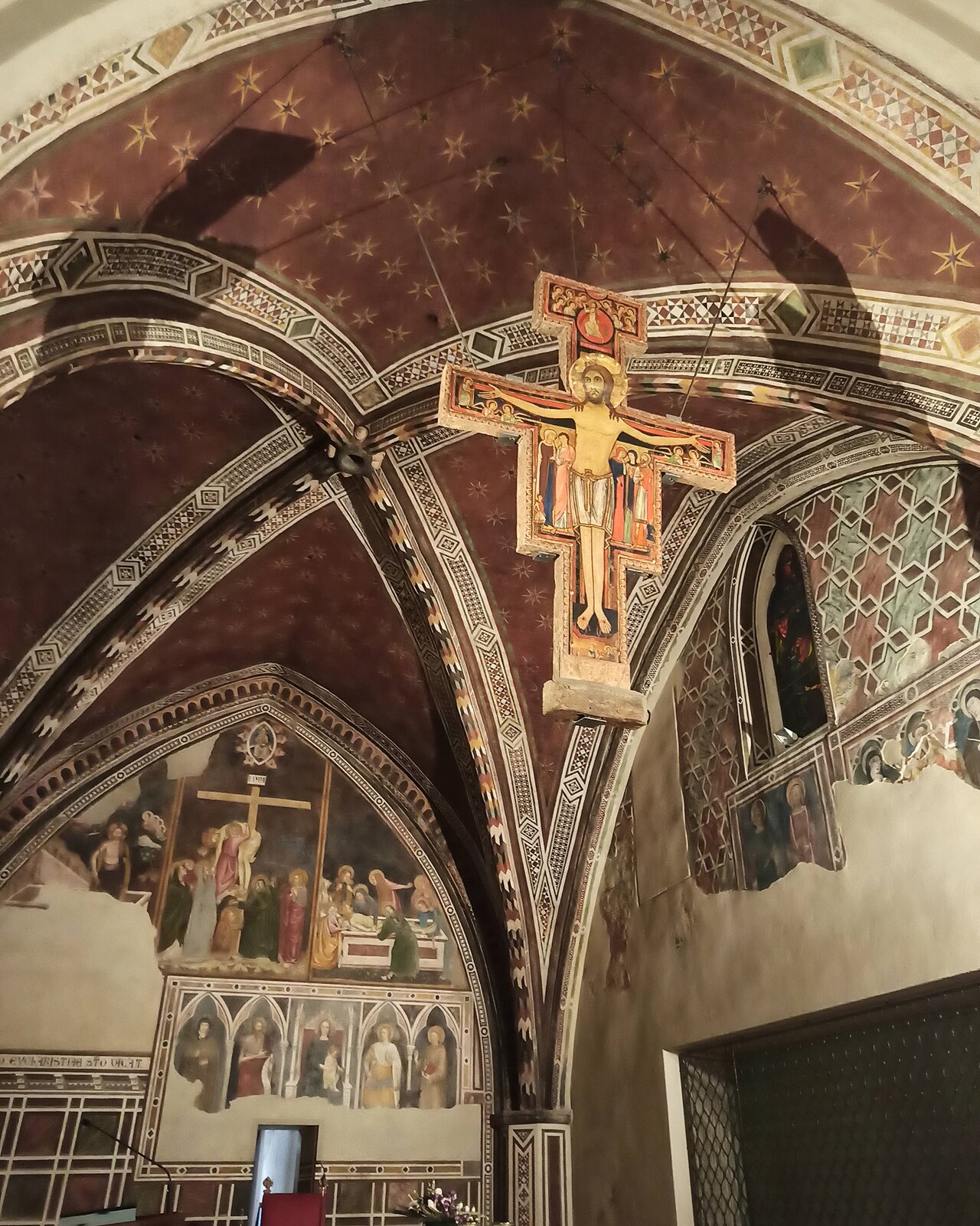
Some crucifixes make this explicit. The famous San Damiano Cross, painted in Umbria in the twelfth century and now kept in the Basilica of St Clare in Assisi, shows Christ on the cross not dead or slumped, but alive, upright and serene, with open eyes, surrounded by Mary, John and other witnesses. It is a crucifix and an image of victory at the same time.
3. Early Christians rarely pictured it
For their first few centuries, Christians rarely made pictures of the crucifixion. Crucifixion was the most shameful and agonising form of execution in the Roman world, reserved for slaves and rebels, and still in use. The image emerged only gradually.
The earliest known picture of a crucifixion is in fact a pagan mockery. Scratched on a plaster wall on the Palatine Hill in Rome, probably around the year 200, is a crude drawing of a man with a donkey’s head hanging on a cross, with another man raising his hand in a gesture of worship. Underneath, in Greek, is scrawled: “Alexamenos worships [his] god.” Someone was making fun of a Christian named Alexamenos for worshipping a crucified man.
Christians themselves began to depict the crucifixion openly only in the fifth century, after crucifixion had been abolished as a punishment by the Emperor Constantine. One of the earliest surviving examples is a small ivory panel made in Rome around 420-430, now in the British Museum, one of a set known as the “Maskell Ivories”. It shows Jesus, alive and with open eyes, on the cross, beside Judas hanging from a tree.
Another early example is on the great carved wooden doors of the Basilica of Santa Sabina in Rome, made around 432. Among the panels showing scenes from the Bible is a small crucifixion scene, with Christ and the two thieves standing with arms outstretched before a background of buildings. It is one of the first public crucifixion scenes in Christian art.
4. Showing Christ’s suffering
From around the tenth century, artists in the West began to show Christ’s suffering more plainly, to stir love and gratitude in the viewer, and to console people who were themselves suffering.
One of the first great examples is the Gero Cross, a large oak crucifix made around 970 for Archbishop Gero of Cologne, and still in Cologne Cathedral. Unlike earlier images of a triumphant Christ, it shows the dead Christ, his head sunk on his chest, his body sagging. It is the oldest surviving large sculpture of the crucified Christ north of the Alps.
Crucifixes have changed lives. Around 1205, a young man named Francis, son of a wealthy cloth merchant in Assisi, went into the tumbledown chapel of San Damiano and knelt before the painted crucifix described above. According to his biographer St Bonaventure, Francis heard Christ speak from the cross: “Francis, go and repair my house, which, as you see, is falling into ruin.” He began by rebuilding the little chapel stone by stone, before realising that the “house” was the whole Church (Major Legend 2.1).
The most harrowing crucifixion ever painted was made for people who were themselves suffering terribly. Between 1512 and 1516, Matthias Grünewald painted the great altarpiece for the hospital chapel of the Antonite monks at Isenheim in Alsace, who cared for victims of “St Anthony’s fire”, a disease (now known to be caused by a fungus on rye) that caused agonising burning pain, gangrene and disfigurement of the skin. Grünewald showed Christ’s body covered with sores, twisted and green with death. The patients, looking at it, could see that Christ had shared their suffering.
5. The crucifix and the Mass
The crucifix stands by the altar for a deeper reason: Catholics believe that in the Mass, Christ’s one sacrifice on the cross is made present.
St Paul wrote that “as often as you shall eat this bread, and drink the chalice, you shall shew the death of the Lord, until he come” (1 Corinthians 11:26). Every Eucharist proclaims the cross.
The Council of Trent taught in 1562 that in the Mass “the same Christ who once offered himself in a bloody manner on the altar of the cross is contained and immolated in an unbloody manner” (Session 22, chapter 2). The Mass does not repeat or add to the sacrifice of the cross; it makes the one sacrifice present, so that believers can join in it. That is why the crucifix stands by the altar. See also If We Receive the Eucharist, How Is the Mass a Sacrifice?
Honour for the cross of Christ goes back to the early Church. Around 383, the pilgrim Egeria described the Good Friday liturgy in Jerusalem. The bishop sat holding the relic believed to be the wood of the true cross, and the people came forward one by one, bowed, touched the wood with their foreheads and eyes, and kissed it (Itinerarium 37). Catholics still do something similar every Good Friday, when they come forward to venerate a crucifix by kneeling, bowing or kissing it.
6. The commandment and images
Some Protestants object that a crucifix breaks the commandment against “graven images” (Exodus 20:4). Catholics answer that the commandment forbids making idols to worship, not all images, and that God himself commanded images to be made, including one that Jesus applied to his own crucifixion.
When the Israelites in the desert were bitten by poisonous snakes, God told Moses: “Make a brazen serpent, and set it up for a sign: whosoever being struck shall look on it, shall live.” Moses did so, and those who looked at it were healed (Numbers 21:8-9). Jesus himself used this image to explain his crucifixion: “as Moses lifted up the serpent in the desert, so must the Son of man be lifted up: That whosoever believeth in him, may not perish; but may have life everlasting” (John 3:14-15). An image lifted up on a pole, looked at in faith, was God’s own picture of the cross.
In the eighth century, when Byzantine emperors began destroying images, St John of Damascus defended them with a powerful argument. In the Old Testament, God had no visible form, so he could not be depicted. But in Jesus, God took flesh and was seen. “I make an image of the God whom I see,” John wrote (On the Divine Images). To forbid images of Christ, he argued, was to deny that the Word truly became flesh.
In 787 the Second Council of Nicaea, accepted by both Catholics and Orthodox, ended the first wave of image-breaking. It distinguished the honour given to images, which passes to the person they represent, from the worship that belongs to God alone. See Why Do Catholics Have Statues? Is It Idolatry?
7. The Protestant empty cross
Many Protestants prefer an empty cross, to proclaim that Christ’s work is finished and that he is risen. This is a sincere and beautiful conviction. But the Reformers themselves disagreed sharply about crucifixes.
Some Reformers removed all images, crucifixes included. In June 1524, in Zurich, at the urging of Huldrych Zwingli, the city council ordered all images removed from the city’s churches. Teams of councillors and craftsmen went from church to church, locking the doors behind them, and within about two weeks every statue, painting and crucifix had been taken down, and the walls whitewashed.
Martin Luther took a very different view. When his former colleague Andreas Karlstadt attacked images, Luther replied in 1525 in a treatise called Against the Heavenly Prophets. He argued that images were neither commanded nor forbidden, and that crucifixes could be helpful. “Whether I will or not,” he wrote, “when I hear of Christ, an image of a man hanging on a cross takes form in my heart.” If it is not a sin to have that image in the heart, he asked, why should it be a sin to have it before the eyes? Lutheran churches still often have crucifixes on their altars.
Even in Protestant England, the crucifix did not disappear at once. When Queen Elizabeth I restored Protestantism in 1559, she kept a silver crucifix and candles on the altar of her private Chapel Royal, despite repeated protests from her own Protestant bishops, some of whom said they would rather resign than minister before it. She kept it for most of her reign.
8. What the crucifix does not mean
Catholics do not worship the crucifix as an object, nor do they believe that Christ is still suffering on the cross. And Catholics use plain crosses too.
St Paul is clear: “Christ rising again from the dead, dieth now no more, death shall no more have dominion over him. For in that he died to sin, he died once” (Romans 6:9-10). Christ’s suffering is over. The crucifix reminds us of what he did once for all; it does not suggest he is still in agony.
The Council of Trent stated in 1563 that images, including crucifixes, are not to be honoured because any divinity or power is believed to be in them, or because anything is to be asked of them, but because the honour shown to them is referred to the persons they represent (Session 25). A Catholic who kisses a crucifix is expressing love for Christ, not for the wood or metal.
Catholics also have a rich tradition of the empty, glorious cross. Two of the most beautiful mosaics in Christian art show a jewelled cross with no figure on it. In the apse of the church of Santa Pudenziana in Rome, made around 400, a great golden cross set with jewels rises above the risen Christ enthroned among his apostles. In the apse of Sant’Apollinare in Classe near Ravenna, consecrated in 549, a jewelled cross shines in a starry blue sky above green fields. Catholics display both kinds of cross.
9. A God who has suffered with us
Perhaps the deepest reason the crucifix has endured is that it speaks most powerfully to people in pain. It shows a God who has suffered with them.
The prophet Isaiah described a mysterious “Servant of the Lord” who would suffer for others: “Despised, and the most abject of men, a man of sorrows, and acquainted with infirmity… Surely he hath borne our infirmities and carried our sorrows… he was wounded for our iniquities, he was bruised for our sins” (Isaiah 53:3-5). This passage is read in every Catholic church on Good Friday. Christians see it fulfilled in Christ on the cross.
In May 1373, an English woman of about thirty, later known as Julian of Norwich, lay so ill that she and those around her expected her to die. A priest came and held a crucifix before her eyes, saying, “I have brought thee the image of thy Maker and Saviour: look thereupon and comfort thee therewith.” As she looked at it, she began to receive a series of visions of Christ’s Passion and love. She recovered, became an anchoress living in a cell beside a church in Norwich, and wrote Revelations of Divine Love, the first book in English known to have been written by a woman, with its famous words: “All shall be well, and all shall be well, and all manner of thing shall be well.”
A Protestant pastor, writing in a Nazi prison, said something similar. On 16 July 1944, Dietrich Bonhoeffer, the Lutheran theologian imprisoned for resisting Hitler, wrote to his friend Eberhard Bethge that God lets himself be pushed out of the world onto the cross, and that “only the suffering God can help”. He was executed in April 1945, weeks before the end of the war.
10. Look at one
Rather than arguing about crucifixes, the best thing may be to look at one for a few minutes, as people have done since the first Good Friday.
The very first person to grasp the meaning of the crucifixion was looking at it. Mark tells us that “the centurion who stood over against him, seeing that crying out in this manner he had given up the ghost, said: Indeed this man was the son of God” (Mark 15:39). A pagan soldier, watching Jesus die, saw who he was.
In 1719, a young German nobleman, Count Nikolaus von Zinzendorf, a Lutheran, visited an art gallery in Düsseldorf. He stopped before a painting by Domenico Fetti of the “Ecce Homo”, Christ crowned with thorns and scourged, under which was written in Latin: “This have I done for thee; what hast thou done for me?” Zinzendorf was deeply moved and resolved to give his life to Christ. He later became the leader of the Moravian Church and sponsored some of the first Protestant missionaries in the world.
On Good Friday, 25 March 2005, Pope John Paul II, by then too ill to lead the Way of the Cross at the Colosseum in Rome as he had done for years, followed it on television from his private chapel. Cameras showed him from behind, sitting and clasping a crucifix to himself. A week later he died. Millions who saw the image understood something about suffering, faith and the cross without a word being spoken.
Frequently asked questions
Do Catholics think Jesus is still on the cross? No. Catholics believe Jesus died once, rose from the dead and is alive for ever. The crucifix recalls his saving death.
Is it wrong for a Catholic to use an empty cross? No. Catholics use both crucifixes and plain crosses; the crucifix is required near the altar at Mass.
Why do some Catholics kiss the crucifix? As a sign of love and gratitude to Christ, especially on Good Friday.
Do Orthodox Christians use crucifixes? The Orthodox usually use painted icons of the crucifixion rather than carved crucifixes, but they honour the image of the crucified Christ in the same way.
Sources and further reading
- The Bible: Numbers 21:8-9; Isaiah 53:3-5; Mark 15:39; John 3:14-15; 20:24-29; Romans 6:9-10; 1 Corinthians 1:23-24; 2:2; 11:26; Galatians 3:1; Revelation 5:6.
- General Instruction of the Roman Missal 308.
- Second Council of Nicaea (787); Council of Trent, Session 22 (1562) and Session 25 (1563).
- Egeria, Itinerarium 37; St John of Damascus, On the Divine Images; St Bonaventure, Major Legend of St Francis 2.1; Julian of Norwich, Revelations of Divine Love.
- Martin Luther, Against the Heavenly Prophets (1525).
- Dietrich Bonhoeffer, Letters and Papers from Prison, letter of 16 July 1944.
- Felicity Harley-McGowan, studies of the Alexamenos graffito and the Maskell Ivories; Richard Viladesau, The Beauty of the Cross (2006).
