
Why Do Catholics Baptise Babies? Infant Baptism Explained
If baptism follows faith, why baptise a baby who cannot believe? Here is the Catholic answer from Scripture and the early Church, the Baptist objection, limbo, and what parents need to know.
If you were raised Baptist or evangelical, you were probably taught that baptism is a step you take after you have personally put your faith in Christ: a public declaration of a decision no baby can make. So when you see a Catholic priest pouring water over a sleeping infant, it may look like an empty ritual, or even a dangerous one, if it leaves people thinking they are Christians without ever having believed. Perhaps you are a parent in a mixed marriage, trying to decide what to do for your own child. This article explains why the Catholic Church baptises babies: what Catholics believe baptism is, the biblical evidence, what the earliest Christians wrote, the honest record of delayed baptisms, the Baptist objection and the Catholic reply, the question of children who die unbaptised, the importance of parents’ consent, and why baptism is only a beginning.
1. Baptism is God’s gift first
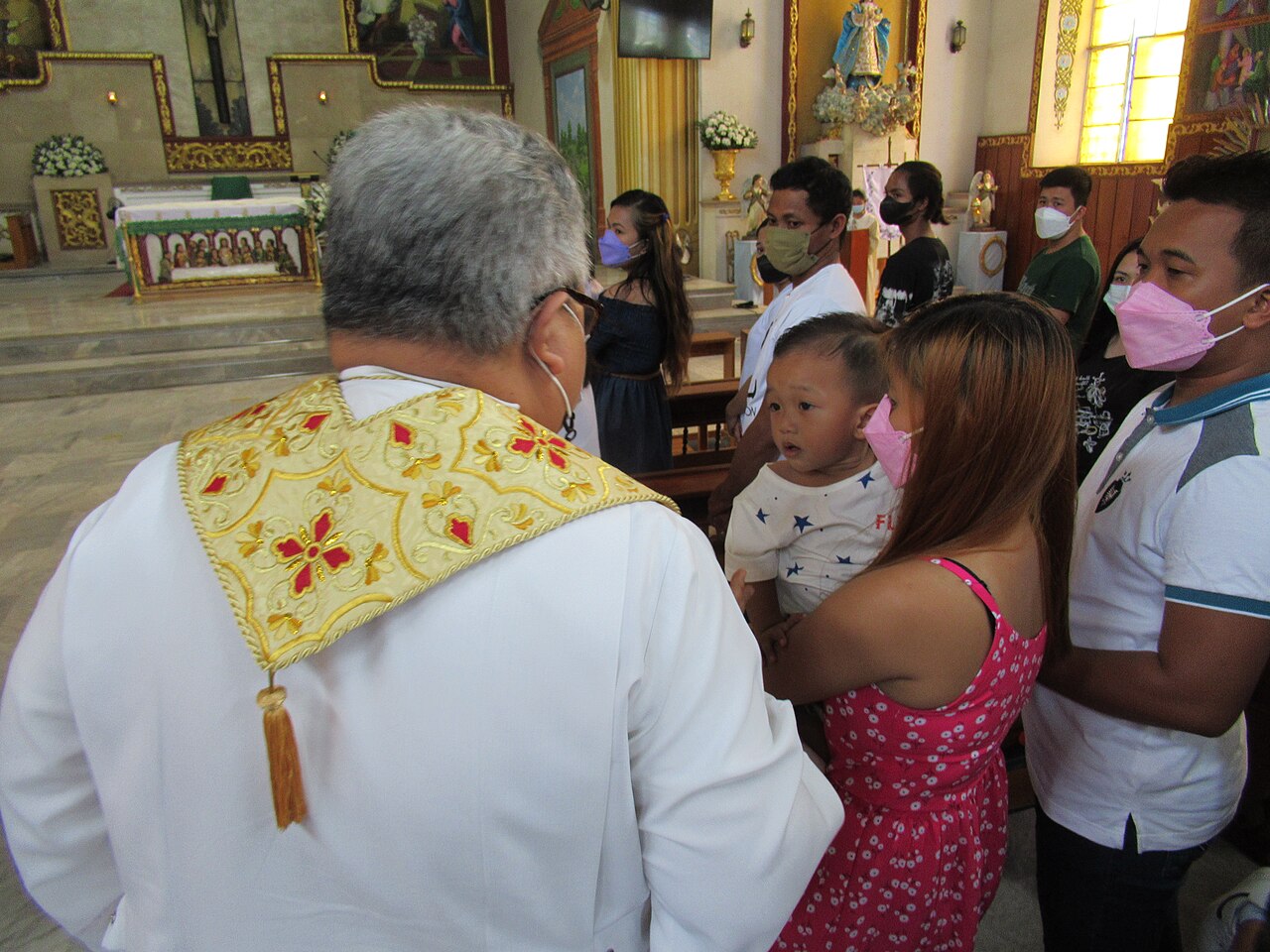
Catholics baptise babies because they believe baptism is first of all God’s gift of new life to a person, not first of all that person’s declaration of faith. A baby cannot make a decision for Christ, but a baby can receive a gift from Christ, just as a baby receives life, love, a name and a family without having chosen them.
The Gospels show Jesus welcoming even the smallest children. Luke tells us that “they brought unto him also infants, that he might touch them.” When the disciples tried to stop them, Jesus called the children to him and said, “Suffer children to come to me, and forbid them not: for of such is the kingdom of God” (Luke 18:15-16). Luke uses the Greek word brephē, which means babies, not older children.
Jesus also taught that baptism is necessary for entering God’s kingdom. He told Nicodemus, a leading Pharisee who came to him by night: “unless a man be born again of water and the Holy Ghost, he cannot enter into the kingdom of God” (John 3:5). Catholics see baptism as this new birth, which God can give to anyone, at any age.
In the 1970s some theologians and parents asked whether the Church should stop baptising infants and wait until children could choose for themselves. On 20 October 1980 the Vatican’s doctrinal office answered with an instruction, Pastoralis Actio. It reaffirmed infant baptism as a practice of immemorial tradition, rooted in the apostolic tradition, and explained that it expresses the free, unearned love of God which comes before any human response.
2. Freed from original sin, on the faith of parents and Church
The Catholic Church teaches that baptism frees a person from original sin, the wounded condition inherited from Adam that every human being is born with, and makes them a child of God and a member of Christ’s Church. Babies have no personal sins, but they share in the human condition that needs Christ’s redemption.
The Church defended this teaching early. In the fifth century, followers of the monk Pelagius argued that newborn infants have no sin of any kind, and so are not baptised “for the remission of sins”. In 418 a council of African bishops at Carthage condemned this view, declaring that even little children are baptised for the remission of sins, so that what they contracted by birth may be cleansed by rebirth (canon 2).
Since babies cannot profess faith themselves, they are baptised in the faith of their parents, godparents and the whole Church. The Gospels show Jesus responding to the faith of parents on behalf of their children. A Canaanite woman begged Jesus to heal her daughter, who was tormented by a demon. She persisted even when he seemed to refuse, and he said: “O woman, great is thy faith: be it done to thee as thou wilt.” Her daughter was healed “from that hour”, not because of the daughter’s faith, but because of her mother’s (Matthew 15:21-28).
In 1547 the Council of Trent taught that infants who are baptised are truly to be counted among the faithful, even though they have not yet made their own act of faith, and condemned the idea that they should be rebaptised when they grow up (Session 7, canons on baptism, canon 13).
3. Households and the new circumcision
Baptists often point out that the New Testament never explicitly mentions a baby being baptised. That is true. But it does describe whole households being baptised, and it treats baptism as the Christian equivalent of circumcision, which in Israel was given to babies.
At Philippi, Paul met a businesswoman named Lydia, a seller of purple cloth. “The Lord opened her heart”, Luke says, and “she was baptized, and her household” (Acts 16:14-15). Later, in the same city, after an earthquake shook open the prison where Paul and Silas were held, the jailer asked what he must do to be saved. That very night “he was baptized, and all his house immediately” (Acts 16:33). Paul also baptised “the household of Stephanas” in Corinth (1 Corinthians 1:16). In the ancient world a household usually included children, often young ones.
St Paul explicitly connects baptism with circumcision. He wrote to the Colossians: “In whom also you are circumcised with circumcision not made by hand… Buried with him in baptism” (Colossians 2:11-12). Under the old covenant, God commanded that every Israelite boy be circumcised at eight days old, as the sign of his membership in God’s people (Genesis 17:12), long before he could believe for himself. If baptism is the new circumcision, Catholics argue, it is natural to give it to children.
The early Church made this connection explicitly. Around 253, a North African bishop named Fidus wrote to St Cyprian of Carthage, asking whether newborn babies should be baptised before the eighth day, as circumcision was given on the eighth day. Cyprian put the question to a council of sixty-six bishops. They replied unanimously that God’s grace should not be withheld from anyone, and that newborn infants need not wait (Cyprian, Letter 64).
4. The earliest Christians baptised infants
Christian writers of the second and third centuries speak of infant baptism not as a new idea, but as an existing practice handed down from the apostles.
Around 180, St Irenaeus of Lyons, who had learned the faith from St Polycarp, a disciple of the apostle John, wrote that Christ came to save all who through him are born again to God: “infants, and children, and boys, and youths, and old men” (Against Heresies 2.22.4). For Irenaeus, “born again” meant baptism, and infants come first in his list.
Around 246, Origen of Alexandria, the greatest biblical scholar of the early Church, stated plainly: “The Church received from the apostles the tradition of giving baptism even to infants” (Commentary on Romans 5.9). Origen was born around 185 into a Christian family, and he was probably baptised as a baby himself.
A Roman church order called the Apostolic Tradition, traditionally attributed to Hippolytus of Rome and dated to around 215, gives detailed instructions for baptism. It directs: “First baptise the little ones. All who can speak for themselves should do so. As for those who cannot speak for themselves, their parents or someone from their family should speak for them” (chapter 21). Babies were baptised first, with their parents answering for them.
5. The honest record: some delayed
To be fair, the practice was not uniform in the early Church. Some Christians delayed baptism, sometimes for many years, and their stories are part of the honest record.
Around 200, the North African writer Tertullian advised against baptising little children too quickly. “Why should the age of innocence hasten to the remission of sins?” he asked, suggesting it was better to wait until children could understand the faith and choose it (On Baptism 18). His advice shows that infant baptism was already being practised, otherwise he would not have needed to argue against it.
Some adults delayed baptism for a different reason: they feared that sins committed after baptism could not easily be forgiven, so they put it off until death was near. The most famous example is the Emperor Constantine. He had favoured Christianity for twenty-five years, since his victory at the Milvian Bridge in 312, but he was baptised only on his deathbed, in May 337, near Nicomedia.
St Augustine’s baptism was also postponed. When he fell seriously ill as a boy, he begged to be baptised, and his Christian mother Monica prepared for it. But he recovered, and his baptism was put off. He went on to live a wild youth and was finally baptised by St Ambrose in Milan at Easter 387, aged thirty-two. In his Confessions, he later regretted the delay, asking why he had not been baptised earlier, when it might have protected him (Confessions 1.11).
6. The Baptist objection: believe first
Baptists and other believers’ churches object that the clear pattern of the New Testament is that people believe first and are baptised afterwards. They argue that baptism is meant to be a conscious act of obedience and public witness, which a baby cannot make.
The story of the Ethiopian official illustrates their point. Philip met him on the desert road from Jerusalem to Gaza, explained the passage of Isaiah he was reading, and told him about Jesus. When they came to some water, the official asked, “See, here is water: what doth hinder me from being baptized?” Philip baptised him after he had heard and believed (Acts 8:26-38).
The modern believers’ baptism movement began among radical Protestants in Switzerland. On 21 January 1525, in a house in Zurich, Conrad Grebel baptised a former priest named George Blaurock, who then baptised the others present. This was the beginning of the “Anabaptist” movement (meaning “re-baptisers”). Zurich’s Protestant city council treated it as a crime. On 5 January 1527 it had Felix Manz, one of the movement’s leaders, drowned in the river Limmat.
The English Baptists began a century later. In 1609 John Smyth, an English separatist pastor living in exile in Amsterdam, became convinced that his infant baptism in the Church of England was invalid. With no one he considered properly baptised to baptise him, he baptised himself, and then his congregation. His followers founded the first Baptist churches.
7. The Catholic reply: converts still believe first
Catholics reply that the New Testament accounts of believers’ baptism describe adult converts, and that adult converts in the Catholic Church still profess faith before baptism today. They also argue that God’s grace can come before human understanding.
The Catholic Church has a careful process for adults who wish to become Catholics. In 1972 it restored the ancient “catechumenate” in the Rite of Christian Initiation of Adults, issued on 6 January 1972. Adult converts go through a period of instruction, prayer and testing, often lasting a year or more, and then profess their faith publicly before being baptised, usually at the Easter Vigil. For adults, the Catholic pattern is exactly the New Testament one: believe, then be baptised.
For children of believing parents, Catholics point out that God’s grace can work in someone before they can understand it. Luke records that the angel told Zechariah his son John “shall be filled with the Holy Ghost, even from his mother’s womb” (Luke 1:15). When the pregnant Mary visited Elizabeth, the unborn John “leaped for joy” in his mother’s womb (Luke 1:44). If God could fill an unborn child with the Holy Spirit, he can give grace to a baby in baptism.
Catholics are not alone in this view. Martin Luther defended infant baptism vigorously against the Anabaptists in his Large Catechism of 1529, and John Calvin devoted a long chapter of his Institutes of the Christian Religion (IV.16) to defending it. Lutherans, Anglicans, Presbyterians, Methodists and Orthodox Christians all baptise infants. Worldwide, most Christians belong to churches that baptise babies.
8. What about babies who die unbaptised?
A painful question follows: if baptism is necessary for salvation, what happens to babies who die without it? Many people have heard of “limbo”. It is important to know that limbo was never defined as Church doctrine. The Church today entrusts such children to God’s mercy, with real hope.
St Augustine, in his fierce controversy with Pelagius, held that infants who die unbaptised share in Adam’s condemnation, though he believed they would suffer “the mildest condemnation of all” (Enchiridion 93). Later medieval theologians, uncomfortable with the idea of babies suffering at all, softened this into the idea of “limbo”: a state of natural happiness, without suffering, but without the vision of God. Limbo became a common theological opinion, but the Church never made it a dogma.
In 2007, the International Theological Commission, a body of theologians advising the Vatican, published a long study called The Hope of Salvation for Infants Who Die Without Being Baptised. Approved for publication by Pope Benedict XVI, it concluded that there are “serious theological and liturgical grounds for hope” that such infants are saved and brought into eternal happiness. The Catechism likewise says that the Church can only entrust them to God’s mercy, and that Jesus’s love for children allows us to hope (CCC 1261).
The Church has also, for many centuries, honoured as martyrs the baby boys killed by King Herod in Bethlehem, in his attempt to kill the infant Jesus (Matthew 2:16-18). They were not baptised and could not have understood who Jesus was. Yet the Church keeps their feast, the Holy Innocents, on 28 December, honouring them as saints.
9. Parents must consent
Church law requires the consent of at least one parent, and a realistic hope that the child will be raised in the Catholic faith, before a baby can be baptised (except in danger of death). Baptising children against their parents’ wishes is wrong, and Catholic history contains a painful example of what happens when this principle is violated.
The principle was stated clearly by St Thomas Aquinas in the thirteenth century. He argued that the children of Jews and other non-Christians must not be baptised against their parents’ will, because it would violate natural justice: a child belongs to its parents until it reaches the use of reason (Summa Theologiae III, q. 68, a. 10).
Yet in 1858 this principle was terribly violated. In Bologna, then part of the Papal States, a Catholic servant girl claimed that years earlier she had secretly baptised Edgardo Mortara, a Jewish baby in her care, when he was seriously ill. On the night of 23 June 1858, papal police took the six-year-old boy from his parents’ home, and he was raised as a Catholic in Rome under the protection of Pope Pius IX, despite international protests. Edgardo later became a priest. The Mortara case is rightly condemned today as a grave injustice to his family.
Current Church law protects parents’ rights. It requires that at least one parent, or whoever lawfully takes their place, consent to the baptism, and that there be a “founded hope” that the child will be brought up in the Catholic religion. If that hope is altogether lacking, the baptism is to be delayed (Code of Canon Law, canon 868).
10. A beginning, not an end
Baptism is not the end of anything; it is a beginning. Every baptised child must later make the faith their own, through instruction, Confirmation, the Eucharist and a life of prayer. The Church asks parents to promise at the baptism to raise their child in the faith.
Jesus himself was baptised in the Jordan by John the Baptist. “And forthwith coming up out of the water, he saw the heavens opened, and the Spirit as a dove descending, and remaining on him. And there came a voice from heaven: Thou art my beloved Son; in thee I am well pleased” (Mark 1:10-11). Catholics believe that in baptism, God says the same words to each newly baptised child.
St Louis IX, King of France in the thirteenth century, valued his baptism more than his crown. He was born in 1214 and baptised in the town of Poissy, west of Paris. According to his biographers, he sometimes signed himself “Louis of Poissy”. When asked why, he explained that at Poissy he had received a far greater honour than at Reims, where he was crowned: there he had become a child of God, while at Reims he had only received an earthly crown that would pass away.
On 12 January 2014, the feast of the Baptism of the Lord, Pope Francis baptised thirty-two babies in the Sistine Chapel, beneath Michelangelo’s great frescoes. As the ceremony began, some of the babies started to cry. The Pope told the mothers that if their children were hungry, they should feed them there and then, without worrying. It was a picture of baptism as what it is: God welcoming his youngest children, just as they are.
Frequently asked questions
Is it necessary to baptise babies? The Church urges parents to have their children baptised within the first weeks after birth (canon 867), so that they receive God’s grace as early as possible.
What if my baby is in danger of death? Anyone, even a non-Catholic, can baptise in an emergency by pouring water while saying “I baptise you in the name of the Father, and of the Son, and of the Holy Spirit”, provided they intend to do what the Church does when it baptises. See Can Anyone Baptise a Baby in an Emergency?
I was baptised as a baby in another church. Do I need to be baptised again? No, if your baptism used water and the Trinitarian formula. See Catholic vs Baptist.
What does baptism actually do? See Is Baptism Unfinished Until We Die?
Sources and further reading
- The Bible: Genesis 17:9-14; Matthew 2:16-18; 15:21-28; Mark 1:9-11; Luke 1:13-15, 39-44; 18:15-17; John 3:1-6; Acts 8:26-38; 16:14-15, 30-34; 1 Corinthians 1:16; Colossians 2:11-12.
- Catechism of the Catholic Church, 1213-1284, especially 1250-1252 and 1261.
- Council of Carthage (418), canon 2; Council of Trent, Session 7 (1547), canons on baptism; Code of Canon Law (1983), canons 867-868.
- Congregation for the Doctrine of the Faith, Pastoralis Actio (1980); International Theological Commission, The Hope of Salvation for Infants Who Die Without Being Baptised (2007); Rite of Christian Initiation of Adults (1972).
- St Irenaeus, Against Heresies 2.22.4; Tertullian, On Baptism 18; Apostolic Tradition 21; St Cyprian, Letter 64; Origen, Commentary on Romans 5.9; St Augustine, Confessions 1.11 and Enchiridion 93; St Thomas Aquinas, Summa Theologiae III, q. 68.
- Martin Luther, Large Catechism (1529); John Calvin, Institutes IV.16.
- David I. Kertzer, The Kidnapping of Edgardo Mortara (1997).
