
Do Priests Judge You in Confession? What Really Happens on the Other Side of the Screen
Afraid the priest will think less of you? Here’s what the Church says the confessor must do, what he may never do, and why he hears your sins as a servant.
Short answer: Yes and no, and the difference matters. Canon law does call the priest hearing your confession a “judge” — but a very particular kind. He weighs what you confess so he can offer sound guidance, a fitting penance, and absolution, acting as both judge and physician. He is not there to size you up as a person, to be shocked, or to remember your sins and hold them against you. The Catechism is blunt about this: the confessor is not the master of God’s forgiveness but its servant. Whatever he learns in the confessional, he is forbidden to use against you in any way, even if there were zero risk of anyone ever finding out. Break that seal, and a priest excommunicates himself automatically. So the word “judge” is real — but it means something closer to a doctor reading your symptoms than a courtroom passing sentence.
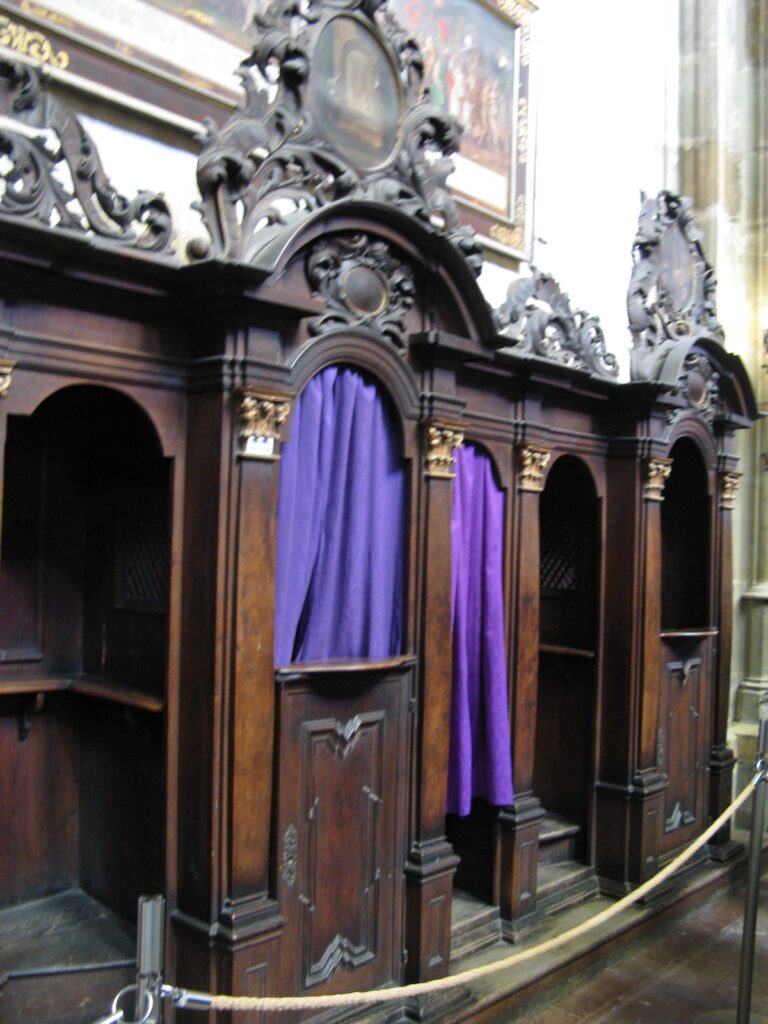
The fear behind the question
If you’re asking this question, you’ve probably already rehearsed the worst-case scenario in your head. He’ll think I’m a terrible person. He’ll recognize my voice and never look at me the same way at coffee hour. I’m about to be the worst thing he’s heard all week. Those fears are common, and they’re understandable — confession asks you to say out loud the things you’d rather no one ever knew. But they’re also, almost always, wrong about how the sacrament actually works and what the Church actually requires of the man on the other side of the screen. The law and the theology behind confession were built, quite deliberately, to protect you from exactly the scenario you’re afraid of. It’s worth walking through what the Church says a confessor must do, what he’s absolutely forbidden to do, and why “judge” doesn’t mean what you think it means.
Yes, the Church calls him a “judge” — here’s what that actually means
Canon law doesn’t dodge the word. It says that in hearing confessions, a priest must remember that he acts as both judge and physician, established by God as a minister of divine justice and divine mercy at once. That pairing is the key to the whole thing. The “judging” involved is discernment, not condemnation: the priest has to understand what you’re actually confessing, gauge whether you’re sorry, and figure out what counsel and penance will actually help you. It’s the same kind of judgment a doctor makes when reading your symptoms before writing a prescription — not a verdict on your worth as a human being, but a diagnosis aimed at healing.
If you’ve read older or more academic writing on confession, you may have run into the idea that the Council of Trent called absolution a “judicial act.” That’s true — Trent describes the priest’s absolution as pronounced “after the manner of a judicial act,” with the priest acting as a kind of judge. But look at what kind of verdict this “court” is built to hand down. Canon law is explicit: if the confessor has no doubt about your disposition and you’re asking for absolution, absolution is neither to be refused nor delayed. The whole system is engineered toward acquittal. It isn’t a trial where you might lose; it’s a courtroom that exists to forgive you.
The law also puts real guardrails on how the priest is allowed to question you. He’s required to proceed with prudence and discretion, taking into account your age and situation — no prying, no satisfying his own curiosity, and he’s specifically barred from asking you to name anyone who sinned with you. And the penance he assigns is supposed to be “salutary and suitable” — in plain English, something meant to heal you, fitted to your actual situation, not a punishment designed to make you suffer.
How the Church wants the priest to see you
The Catechism spells out, in fairly tender language, who the priest is supposed to be for you in that moment. He’s meant to carry out the ministry of the Good Shepherd searching for the one lost sheep, the Good Samaritan binding up wounds, and the father who watches the horizon for the son who ran away. He’s also called a “just and impartial judge” — but one whose judgment “reflects both justice and mercy.” Then comes the line that probably matters most for anyone hesitating outside the confessional: the priest is not the master of God’s forgiveness, only its servant. He’s asked to treat the person in front of him with respect and sensitivity, to be honest, faithful to what the Church actually teaches, and patient — leading you toward healing rather than shaming you toward the door.
Pope Francis put the same idea in a phrase that’s stuck with a lot of people: the confessional should never be a “torture chamber.” It should be an encounter with God’s mercy, the kind that actually spurs someone to try to do better — not a place designed to make you feel small. And here’s a detail worth sitting with: every priest hearing confessions is also, regularly, a penitent himself. He kneels down and confesses his own sins to another priest. Most confessors will tell you that hearing decades of confessions doesn’t make them cynical about people — if anything, it tends to deepen their respect for the courage it takes to walk in and be honest.
“Will he remember, and will he hold it against me?”
This is usually the real fear underneath the question, and canon law addresses it about as forcefully as law can address anything. The sacramental seal is described as inviolable: it is absolutely forbidden for a confessor to betray a penitent in any way, by word or by any other means, for any reason whatsoever. That obligation doesn’t stop with the priest, either — an interpreter, or anyone else who happens to learn something from a confession, is bound to the same secrecy.
It goes further still. A confessor is completely forbidden from using anything he learns in confession to your detriment — and the law specifically closes the loophole you might expect: even when there’s no danger whatsoever of the information ever getting out. In other words, he can’t quietly treat you differently, avoid you, or factor what he heard into some later decision about you, even in total secrecy where no one would ever know. If he happens to be your pastor or a superior with some kind of authority over you, he’s barred from using anything he learned in confession in his governing role, full stop.
The penalty for breaking this is about as severe as canon law gets for anyone. A confessor who directly violates the seal incurs automatic excommunication reserved to the Apostolic See — meaning it takes effect the instant he breaks it, with no trial required, and only Rome can lift it. This is canon 1386 §1 in the Code of Canon Law as revised in 2021 (older articles online may still cite canon 1388, which was the pre-2021 number for this same offense — the substance hasn’t changed, only where it sits in the book). The Catechism states the same principle even more simply: the sacramental seal admits no exceptions.
This isn’t just internal Church discipline, either. In 2019, the Vatican’s Apostolic Penitentiary — the tribunal that handles matters of conscience and confession — issued a formal note stating that the seal cannot be broken even under pressure from civil law, and that any government effort to force priests to violate it would be an attack on religious freedom itself. The note also makes clear a priest cannot make your absolution conditional on turning yourself in to civil authorities. The seal simply isn’t negotiable, from any direction.
One more thing worth saying honestly, because it’s the kind of practical reassurance people actually want to hear: many priests report — as personal testimony, not doctrine — that confessions blur together quickly in their memory, especially in parishes where they hear dozens or hundreds of them. That’s not a legal guarantee the way the seal is, but it lines up with what the seal is designed to produce: a place where what you say doesn’t follow you back out the door.
You choose how anonymous to be, and whom to confess to
If face-to-face confession makes you anxious, you’re not required to do it that way. Canon law requires that bishops’ conferences make sure confessionals with a fixed grille between penitent and priest are always available in an open part of the church for anyone who wants to use one. Anonymity isn’t a favor a parish grants you — it’s a right written into the law itself.
You also aren’t tied to your own parish priest. Every Catholic is free to confess to any lawfully approved confessor of their choice, even one from a different rite of the Church. If the idea of confessing to the priest who knows your family, or who’ll be at your table next Sunday, feels like too much, there’s nothing stopping you from driving to a neighboring parish, a cathedral, or a shrine or religious house that offers regular confessions to strangers passing through. Face-to-face or behind the screen, in your own parish or three towns over — both options are fully legitimate. Choose whatever setup actually lets you be honest.
What the priest might say, and what that doesn’t mean
Sometimes a priest will ask a clarifying question, offer some advice, or explain why he’s assigning a particular penance. None of that is judgment in the condemning sense — it’s the “physician” side of his role doing its job, trying to actually help rather than just process you through.
It’s fair, and honest, to say that absolution can occasionally be deferred — but only when there’s genuinely no sign of repentance, or when someone clearly intends to keep committing a serious sin without any intention of stopping. Even then, this isn’t about the priest’s mood or his personal judgment of you. Contrition — being sorry — is something the penitent brings; it’s your act, not his verdict. A priest isn’t withholding absolution because he’s decided you’re unworthy; he’s responding to whether repentance is actually present.
And if a confessor is genuinely harsh, dismissive, or behaves badly, it’s worth naming plainly: that’s a failure on his part, not a reflection of God’s mercy or of what the sacrament actually is. You’re free to go to a different confessor next time — the law guarantees that. If the behavior was serious enough to cross into misconduct, it can and should be reported through the Church’s own channels.
The Gospel picture: how Jesus treats the sinner who comes back
All of this law and theology is really just an attempt to protect something Jesus modeled directly. In the parable of the prodigal son, the father doesn’t wait at the door with arms crossed. Scripture says that “when he was yet a great way off, his father saw him, and was moved with compassion, and running to him fell upon his neck, and kissed him” — before the son has even finished his rehearsed confession. The son only manages “Father, I have sinned against heaven, and before thee” before his father is already calling for the best robe.
The publican in the temple prays the shortest, least polished confession in the Gospels — “O God, be merciful to me a sinner” — and Jesus says he went home justified, while the man confident in his own righteousness did not. To the woman caught in adultery, dragged in front of him by people looking to condemn her, Jesus says only: “Neither will I condemn thee. Go, and now sin no more.” Notice that both halves are there — no condemnation, and a real call to change. That’s exactly the balance confession is supposed to strike. The Good Samaritan, moved with compassion, doesn’t lecture the wounded man on the road — he “bound up his wounds, pouring in oil and wine” and paid for his care. And the authority behind all of it traces back to Christ himself, breathing on the apostles and saying: “Whose sins you shall forgive, they are forgiven them; and whose sins you shall retain, they are retained.” A priest hearing your confession is standing, however imperfectly, in that line.
How to walk in with less fear
If it’s been a long time, just say so. “Father, it’s been years, and I’m nervous” is a completely normal way to start, and most priests will gently walk you through the rest. There’s no rule against bringing a short written list of what you want to confess if you’re worried about freezing up or forgetting something — plenty of people do exactly that.
And it helps to keep the actual destination in view. The Psalms put it about as vividly as language allows: “As far as the east is from the west, so far hath he removed our iniquities from us.” That’s not a description of a priest’s memory. It’s a description of what confession is actually for.
If you’re ready for the practical next step, we’ve written a full walkthrough of how to go to confession, including what to say and how it’s structured. If it’s been a long time specifically, see our guide on returning to confession after years away. Worried you’ll blank on something? We’ve also covered what to do if you can’t remember your sins and what happens if you forget one afterward. You may also find it helpful to pray a short prayer before confession to settle your nerves, and a prayer after confession to close it well.
Frequently asked questions
Can a priest tell the police what I confess?
No. The sacramental seal binds absolutely, with no exceptions written into the law. The Vatican’s 2019 note on the internal forum is explicit that civil law has no authority to override it, and that any government attempt to force disclosure would be an assault on religious freedom.
Can he refuse to absolve me?
Only if there’s genuinely no sign of repentance. Otherwise, canon law is direct: if the confessor has no doubt about your disposition and you’re asking for absolution, it is neither to be refused nor delayed.
Will he treat me differently afterward?
He’s forbidden to use anything he heard in your confession in any way that could harm you — even in situations where there’s no possibility anyone would ever find out. That prohibition applies whether or not he happens to have some other kind of authority over you.
Do I have to confess to my own parish priest?
No. Every Catholic is free to confess to any lawfully approved priest of their choosing, including one outside their own parish or rite.
Sources
- Code of Canon Law, canons 959–997 (the sacrament of penance)
- Code of Canon Law, Book VI, canons 1364–1399, including canon 1386
- Catechism of the Catholic Church: The Minister of This Sacrament (CCC 1461–1467)
- Catechism of the Catholic Church: The Sacrament of Penance and Reconciliation (CCC 1422–1498)
- Pope Francis, Evangelii Gaudium (2013), no. 44
- Apostolic Penitentiary, Note on the Importance of the Internal Forum and the Inviolability of the Sacramental Seal (29 June 2019)
- Council of Trent, Session XIV, Chapter 6, on the minister of the sacrament and absolution
- Douay-Rheims Bible, drbo.org
