
Can Anyone Baptise a Baby in an Emergency? What Catholics Need to Know
In danger of death, anyone can validly baptise with water and the right words. Here’s exactly what to do and say, and what to tell the parish afterwards.
Short answer: Yes. If a baby (or anyone) is in danger of death and no priest or deacon can reach them in time, any person can validly baptise — including a parent, a nurse, or someone who is not even baptised themselves — as long as they intend to do what the Church does (Code of Canon Law, canon 861 §2; Catechism of the Catholic Church, 1256). All that is needed is ordinary water and the right words, said together. Pour water so it runs over the skin of the forehead and say, at the same moment: “N., I baptise you in the name of the Father, and of the Son, and of the Holy Spirit.” Afterwards, tell the parish priest so the baptism can be recorded in the register. If the child lives, the remaining ceremonies are completed later in church — the baptism itself is never repeated.
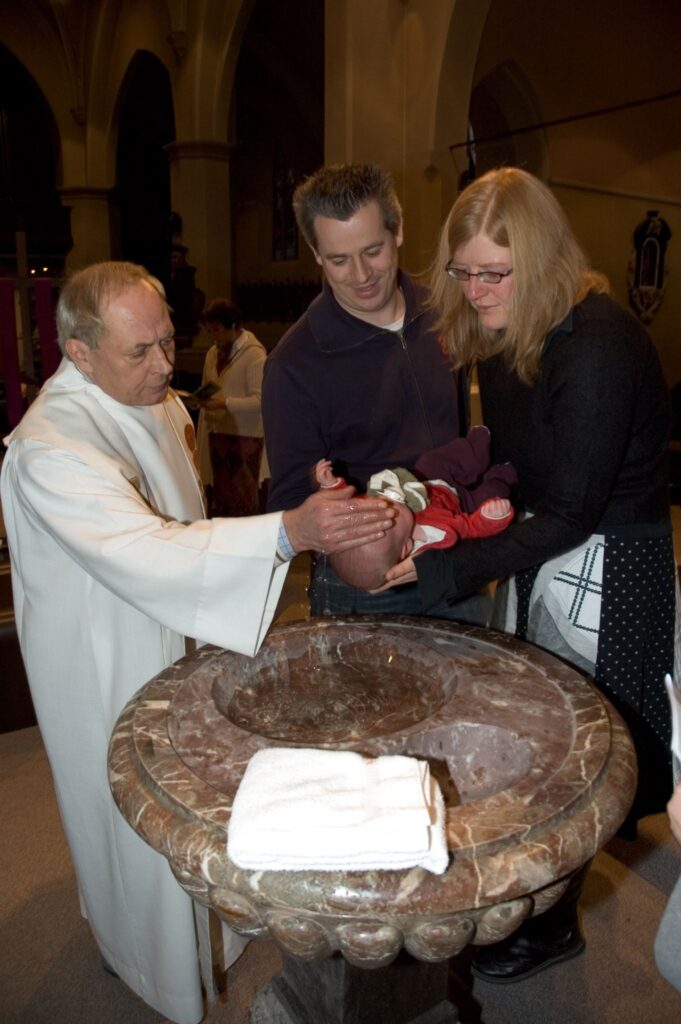
The short answer, in a little more detail
In a genuine emergency, anyone is able to baptise a baby validly. This is not a loophole or a folk custom; it is the Church’s own law, and it exists for a simple, weighty reason. God wills that everyone be saved, and the Church teaches that Baptism is necessary for salvation (CCC 1256–1257). Rather than leave a dying child’s eternal welfare to the accident of whether a priest happens to be nearby, the Church has always allowed — and in some cases required — ordinary people to step in. The rest of this article walks through exactly what the law says, precisely what to do and say, and what happens afterwards, because in a moment like this you should not have to guess.
What the Church’s law actually says
Ordinarily, Baptism is administered by a bishop, priest, or (in the Latin Church) a deacon — these are the sacrament’s ordinary ministers (canon 861 §1). But canon law goes further. When an ordinary minister is absent or unavailable, a catechist or someone else designated by the local bishop may baptise. And “in a case of necessity, any person with the right intention” may do so as well, validly and lawfully (canon 861 §2). The same canon quietly places a duty on pastors: to make sure the faithful are taught how to baptise correctly, precisely so this provision can actually be used when it is needed. That is really the purpose of this article.
The Catechism states the same principle even more plainly: “in case of necessity, any person, even someone not baptized, can baptize, if he has the required intention” (CCC 1256). That intention is simply to will to do what the Church does when she baptises, together with using the Trinitarian formula. You do not need to be a Catholic in good standing, or a Catholic at all, to baptise validly in an emergency — you need the right intention and the right words and matter.
Canon law is also emphatic about urgency. An infant in danger of death is to be baptised without delay (canon 867 §2). And in a case of urgent necessity, only what is strictly required for the sacrament’s validity has to be observed — everything else in the usual rite can wait (canon 850). That includes the water itself: outside an emergency, the water used for Baptism should be blessed, but in a case of necessity, ordinary water is entirely sufficient (canon 853). What can never be dispensed with, in any circumstance, is the one thing that actually makes Baptism valid: “a washing of true water with the proper form of words” (canon 849).
Exactly what to do: the emergency baptism steps
If you ever find yourself needing to do this, it helps to have it broken down into plain, ordered steps. This is written so it can be read at a bedside, printed, or saved to your phone.
- Get real water. Plain tap water or bottled water is fine. Do not use milk, juice, oil, saline gel, or a wet wipe — it must be true, ordinary water.
- Pour it on the baby’s head, ideally the forehead, so that the water actually runs and touches the skin — not just the hair. Pouring three times is the ordinary custom (CCC 1240), but pouring once, done correctly, is fully valid.
- At the very same moment you pour the water, say the words clearly: “N., I baptise you in the name of the Father, and of the Son, and of the Holy Spirit.” Use the baby’s name if one has been chosen; if not, you can simply leave the name out and say the rest of the formula.
- The same person must pour the water and say the words. It cannot be divided between two people (one pouring, another speaking).
- Have a witness if at all possible — anyone present who can later confirm what was said and done (canon 875). If you are completely alone, baptise anyway; a witness is desirable, not required for validity.
- Afterwards, tell the parish priest of the place where it happened, as soon as you reasonably can, so the baptism is entered in the parish register (canons 877–878). Tell him exactly what water was used and exactly what words were said — this matters, and it is explained below.
That is the whole procedure. Nothing else — no special vestments, no particular room, no permission slip — is required for the sacrament to be valid. Everything else belongs to the fuller ceremony, which can be completed later if the child lives.
Words and actions that make a baptism invalid
Because so much depends on getting this right, it is worth being just as clear about what does not work.
“We baptise you…” is invalid. In 2020, the Congregation for the Doctrine of the Faith formally ruled that changing “I baptise” to “we baptise” is not a minor variation but breaks the sacrament, because the minister acts in the person of Christ, not merely on behalf of a community. Pope Francis approved this ruling on 8 June 2020, and it was published on 24 June 2020. People baptised with that wording have to be baptised again, absolutely (not just conditionally), because the first attempt did not take effect at all.
Substituting other names for “Father, Son and Holy Spirit” is invalid. In 2008 the same Congregation ruled that formulas such as “in the name of the Creator, and of the Redeemer, and of the Sanctifier” or “in the name of the Creator, and of the Liberator, and of the Sustainer” do not confer Baptism, and that anyone baptised with them must likewise be baptised again absolutely. The names of the Father, the Son, and the Holy Spirit are not interchangeable with functional descriptions, however well-intentioned.
Water without the words, or words without water, is not Baptism. Both the matter (true water, poured or applied so it touches the skin) and the form (the Trinitarian words) have to be present together, said by the same person as the water is applied.
One reassurance for readers with roots in an Eastern Catholic or Eastern Christian tradition: the Eastern formula, “The servant of God, N., is baptised in the name of the Father, and of the Son, and of the Holy Spirit,” is entirely valid (CCC 1240). It is only arbitrary, invented changes to the words — not the legitimate variety between East and West — that break the sacrament.
Where this comes from in Scripture
The words themselves come from Christ’s own command to the apostles: “Going therefore, teach ye all nations; baptizing them in the name of the Father, and of the Son, and of the Holy Ghost” (Matthew 28:19, Douay-Rheims). Jesus told Nicodemus, “unless a man be born again of water and the Holy Ghost, he cannot enter into the kingdom of God” (John 3:5), and he was famously insistent about children: “Suffer the little children to come unto me, and forbid them not; for of such is the kingdom of God” (Mark 10:14). The urgency the Church attaches to Baptism is not a modern invention, either — in Acts, the Ethiopian eunuch is baptised the moment water is found (“See, here is water: what doth hinder me from being baptized?”, Acts 8:36), and the Philippian jailer and his household are baptised in the middle of the night, “the same hour” they came to faith (Acts 16:33). None of this waited for ideal conditions. The Church allowing anyone to baptise in an emergency is, at heart, the same logic as the shepherd who leaves the ninety-nine to go after the one sheep that is lost (Luke 15:4): no soul is too small, or too inconvenient a moment, to matter.
Who can do it, and who ideally should
In principle, absolutely anyone can baptise validly in a case of necessity — a Catholic, a non-Catholic Christian, or someone with no faith at all — as long as they use true water, say the Trinitarian words correctly, and intend to do what the Church does. This is one of the more striking features of Catholic sacramental theology: the effectiveness of the sacrament does not depend on the holiness, or even the faith, of the person pouring the water.
In practice, though, it is sensible to have some order in mind. If a Catholic is present and able, it is fitting that they baptise. A parent who knows the words may baptise their own child if no one else is available — there is nothing improper about this. Historically, midwives and nurses working in Catholic hospitals were routinely trained to baptise, precisely because they were often the person actually present at a birth going wrong. If you work in obstetrics, neonatal care, or as a midwife, it is worth simply memorising the words above; you may never need them, but if you do, there will be no time to look them up.
Parents’ consent, and non-Catholic families
Under ordinary circumstances, Church law requires that at least one parent (or whoever legally stands in their place) consent to an infant’s Baptism, together with a well-founded hope that the child will be raised Catholic (canon 868 §1). Danger of death is the one recognised exception: canon law states that an infant of Catholic parents, or even of non-Catholic parents, may be baptised licitly in danger of death even against the parents’ wishes (canon 868 §2).
This is a provision to know about, not a provision to act on lightly. It exists for genuine emergencies where there is truly no time or ability to seek consent — not as a way around parents who simply disagree. If you are a hospital chaplain, nurse, or other staff member and this situation arises, act with real pastoral sensitivity: be honest with the family about what is happening, and be mindful that your professional and hospital obligations still apply. If a hospital chaplain is available, involve them. This is not an invitation to act secretly or to override hospital policy; it is Church teaching about the sacrament’s validity and liceity, which exists alongside, not instead of, your civil and professional duties.
If the baby survives
A validly performed emergency baptism is complete and permanent. Baptism leaves an indelible spiritual mark on the soul, and for that reason it can never be repeated (canon 845 §1). If your baby is baptised in the hospital and then recovers, nothing further needs to be “undone” or redone as far as the sacrament itself is concerned.
What usually happens next is that the family brings the child to their parish church so the priest can supply the remaining ceremonies that were skipped in the emergency — the words of welcome, the anointing with sacred chrism, the white garment, and the baptismal candle. The Church’s official ritual book for Baptism includes rites for exactly this situation: receiving into the church a child who has already been validly baptised elsewhere. None of this repeats the baptism itself; it simply completes the ceremony around a sacrament that already happened.
If there is a genuine, reasonable doubt about whether the emergency baptism was done correctly — wrong water, garbled words, or uncertainty about what actually happened — tell the priest everything you remember. He is required to investigate seriously, and only if a prudent doubt remains after that investigation will he baptise conditionally, using a form such as “if you are not already baptised, I baptise you…” (canons 845 §2, 869 §1). This is not a small technicality to worry over on your own; it is exactly the kind of question a priest is there to help you work through.
If the baby has already died, or it is unclear
The sacraments are for the living. The Church does not baptise someone who has certainly, definitely died — Baptism cannot be given to a body after death.
Where it is genuinely uncertain whether any life remains — as can happen with a miscarriage, a stillbirth, or in the confusion of a resuscitation — the traditional and widely used pastoral practice, found in diocesan guidance for exactly these situations, is to baptise conditionally: pouring the water and saying words such as “If you are living, I baptise you in the name of the Father, and of the Son, and of the Holy Spirit.” This respects both truths at once: that Baptism cannot be given to the dead, and that no one wants to withhold it from a child who might still be alive. Canon law is explicit on one related point: if a miscarried child is alive, they are to be baptised so far as this is possible (canon 871).
For families whose baby died before Baptism could be given at all, the Church does not offer a formula that fixes this, because there is nothing to fix in the way grief wants there to be. What she offers instead is hope. The Catechism teaches that God’s mercy, and Christ’s own tenderness toward children, “allow us to hope that there is a way of salvation for children who have died without Baptism” (CCC 1261). The Church also provides a funeral rite for children who died without Baptism. We have written more on this painful and important question separately: see what the Church teaches about infants who die unbaptised.
Not only for babies
Everything above applies just as much to an adult in danger of death who wants to be baptised, such as someone preparing to become Catholic through OCIA (formerly RCIA) who suddenly falls seriously ill before they can be received. Canon law allows this: an adult in danger of death can be baptised if they have some knowledge of the main truths of the faith, have shown in any way at all a genuine intention to be baptised, and promise to keep the commandments of the Christian faith (canon 865 §2). The water and the words are exactly the same as for a baby, simply directed to an adult.
This article sits alongside our guide to last rites for someone unconscious or dying, since both cover what a family can and should do in a genuine danger-of-death emergency. If your loved one has already been baptised and is now dying, that is the article you need next.
Frequently asked questions
Is an emergency baptism a “real” baptism?
Yes, completely. If true water and the correct Trinitarian words are used by the same person with the intention of doing what the Church does, the baptism is fully valid — identical in effect to one performed by a priest at the font, even though the surrounding ceremony is missing.
Does the baby need to be baptised again in church?
No. Only the supplementary ceremonies (the anointing, white garment, candle, and words of welcome) are completed later, not the baptism itself, unless the priest finds a real, investigated doubt about whether the first baptism was valid — in which case he baptises conditionally.
Do I need holy water?
No. Ordinary tap or bottled water is entirely sufficient in a case of necessity (canon 853). Holy water is customary, never required for validity.
Can a non-Catholic, or someone with no faith, baptise?
Yes, provided they intend to do what the Church does when she baptises and use the correct water and words (CCC 1256). Validity does not depend on the minister’s own faith or church membership in this emergency situation.
What if I think I got the words slightly wrong?
Do not panic, and do not try to redo it yourself. Tell the parish priest exactly what water was used and exactly what words were said, as precisely as you can remember. He will investigate and decide whether a conditional baptism is needed. This is a normal, expected conversation for a priest to have — you will not be the first person to ask it.
Sources
- Code of Canon Law, canons 834–878 (the sacrament of Baptism)
- Catechism of the Catholic Church, how the sacrament of Baptism is celebrated (CCC 1229–1245)
- Catechism of the Catholic Church, who can baptise (CCC 1256)
- Catechism of the Catholic Church, the necessity of Baptism (CCC 1257–1261)
- Congregation for the Doctrine of the Faith, Responsum on the validity of baptism conferred with the formula “We baptise you…” (24 June 2020)
- Congregation for the Doctrine of the Faith, on the validity of baptism conferred with the formulas “Creator, Redeemer, Sanctifier” and “Creator, Liberator, Sustainer” (1 February 2008)
- Order of Baptism of Children (formerly the Rite of Baptism for Children), the rites for baptism in danger of death and for receiving into the church a child already baptised
- Douay-Rheims Bible (drbo.org) — Matthew 28:19, John 3:5, Mark 10:14, Luke 15:4, Acts 8:36, Acts 16:33
