
My Spouse Threatens Divorce If I Become Catholic: What Should I Do?
A Catholic guide to conversion and marriage conflict: honest conversation, freedom of conscience, pastoral support, safety and practical next steps.
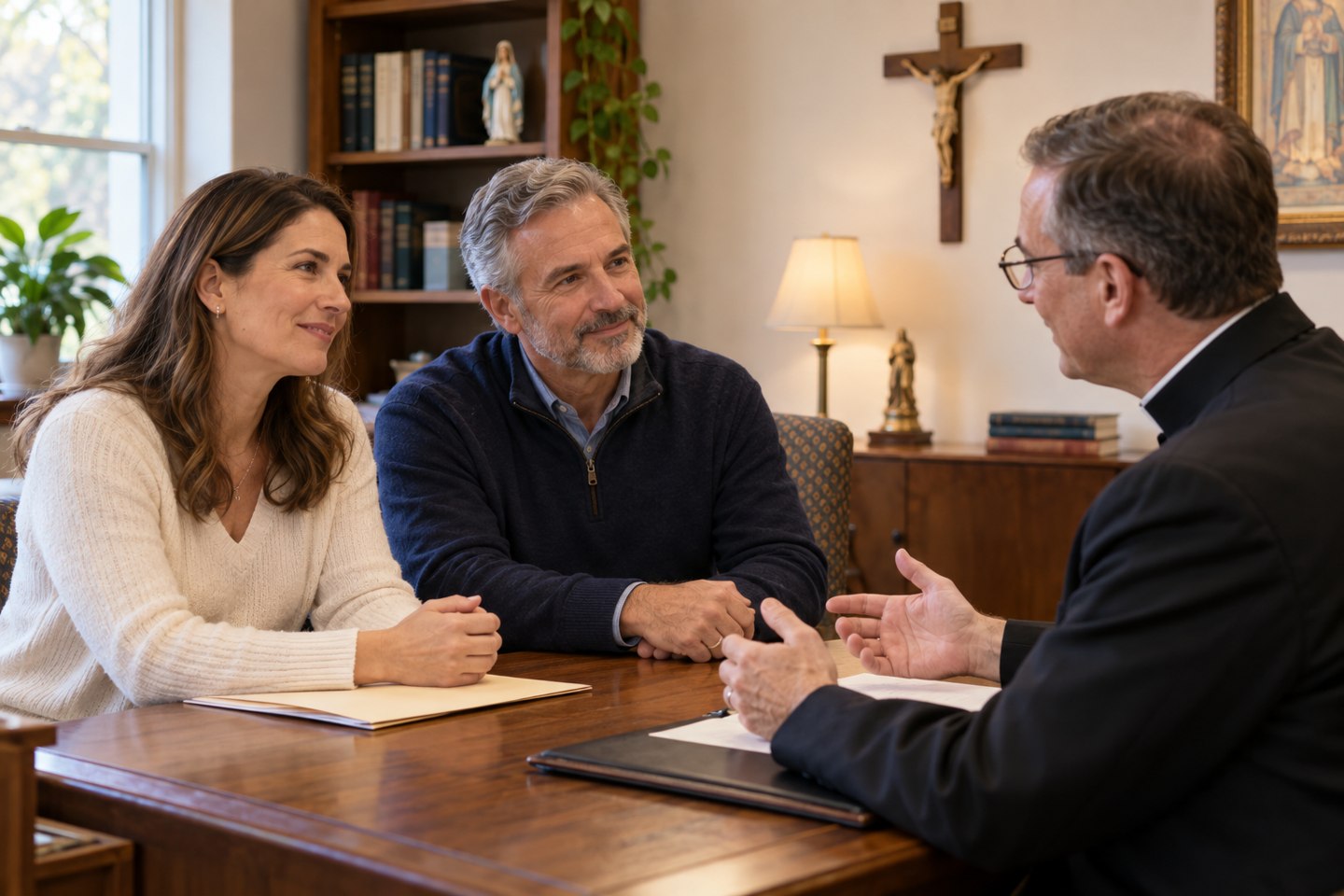
If your spouse threatens divorce because you want to become Catholic, take the threat seriously without making a life-changing decision in the heat of the argument. Speak privately with a priest, try to understand what your spouse fears, and protect yourself and any children if there is intimidation or danger. Conversion should be free, and your existing marriage deserves careful, individual pastoral attention.
You may feel caught between two loves: fidelity to God and fidelity to the person you married. The words “If you become Catholic, I will leave” can make even ordinary questions about prayer or Sunday worship feel frightening. A short online answer cannot determine your marriage’s future. It can help you identify a steadier next step.
First, separate disagreement, an ultimatum and danger
Some spouses speak harshly in shock and later become willing to talk. Others mean that a major change in religion raises questions they have not resolved. In some relationships, the threat forms part of a pattern of control, isolation, financial restriction or violence. These situations require different responses.
Do not assume every painful disagreement is abuse. Equally, do not dismiss coercion as merely a difficult stage in conversion. If you fear immediate harm, get to safety and contact local emergency help. Use a safe device when seeking confidential support if your communications are monitored.
The US bishops’ When I Call for Help rejects abuse and makes clear that preserving a marriage does not require remaining in an abusive situation. Pastoral advice must take safety seriously. Prayer and sacramental life are not substitutes for protection or qualified assistance.
Does Catholicism require me to abandon my spouse?
No. Becoming Catholic does not automatically dissolve a marriage or make a non-Catholic spouse disposable. In 1 Corinthians 7:12–16, Paul tells a believer not to dismiss an unbelieving spouse who is willing to remain together. He also recognises the painful reality of departure and calls Christians to peace.
The passage is not permission to declare yourself unmarried or free to remarry. Questions about a bond, separation, nullity or a possible privilege of the faith depend on facts and Church law. They belong with a priest and, when needed, the diocesan tribunal. Our guide to becoming Catholic while waiting for an annulment explains why investigation of a marriage is more precise than an online label.
Bring the full situation to the priest: any baptisms, previous marriages, civil or religious weddings, children, and the actual words and conduct causing concern. Your spouse’s disagreement alone does not answer the canonical questions.
Does my spouse have to agree before I can believe?
Faith cannot be produced by force. Dignitatis Humanae 2 and 10 teaches religious freedom and the voluntary character of the act of faith. That protects your conscience, and it protects your spouse from pressure to convert simply to keep you happy.
It does not follow that you should dismiss every concern with “My conscience settles everything.” Freedom and marital responsibility require honest conversation about how your decisions affect shared life. You can take your convictions seriously while explaining them patiently and listening carefully.
A parish priest or OCIA leader can help you discern readiness and a prudent pace. They should know about a serious ultimatum early. Do not hide it until the week before reception into the Church, when everyone feels pushed into an artificial deadline.
An illustration: a lamp in the house
This is an original illustrative story, not a report of a real couple.
Elena begins learning about Catholicism. Her husband hears her excitement as an accusation: “You think our whole life together was wrong.” The more books she brings home, the more defensive he becomes.
At a calm moment she asks, “What do you think I am leaving behind?” He talks about family Sundays, their wedding and whether the children will be taught to look down on him. Those concerns do not settle Elena’s religious convictions, but they finally make a real conversation possible.
A lamp brought into a house can illuminate the rooms without being shone into someone’s eyes. The story illustrates how truth can be communicated with tenderness. It does not promise that patient conversation will change every spouse’s mind, and it is not advice to remain exposed to abuse.
Questions that can open a safer conversation
Choose a time when neither of you is exhausted or already arguing. If it is safe, try questions such as:
- “What do you fear will change between us?”
- “Do you feel I have judged your faith or our marriage?”
- “Which practical questions concern you most: Sundays, money, children or extended family?”
- “Would you be willing to meet a priest simply to ask questions?”
Then listen without preparing a rebuttal after every sentence. You may discover misinformation that can be corrected gently. You may also hear a real disagreement that deserves time. An invitation to speak with a priest should be an invitation, not a staged debate in which your spouse feels outnumbered.
Explain your own position concretely: “I am trying to follow what I believe is true. I still love you, and I want to work through the practical consequences with care.” Avoid promising that nothing will change if that would be untrue.
What about children and family routines?
Do not turn children into messengers, judges or religious allies against the other parent. Discuss worship schedules, instruction, family celebrations and relationships with grandparents with as much calm as possible. If there are custody arrangements or legal disputes, obtain qualified local legal advice before making decisions that affect them.
Religious and family law differ by jurisdiction. A general Catholic article cannot tell you the legal consequences of conversion where you live. A priest can address pastoral and sacramental questions; a suitably qualified local lawyer can address civil rights and duties. Those are complementary forms of help.
Keep ordinary marital kindness alive where it is safe: listening, sharing work, keeping appointments and treating each other’s relatives respectfully. Conversion should deepen truthfulness and charity. It should not become permission to neglect the promises and responsibilities you already have.
Should we see a marriage counsellor?
A qualified counsellor who respects religious freedom can help when both spouses can speak safely and honestly. Ask about experience with religious differences and avoid someone who assumes the answer must be either forced conversion or abandonment of faith.
If there is coercive control or abuse, seek confidential individual support from a specialist service first. Joint counselling may expose information that puts you at further risk; the National Domestic Violence Hotline explains this concern. The question is not simply whether the counsellor is sympathetic to religion; it is whether the process is safe for you.
A priest can be an important support without being trained to handle every safety, mental-health or legal issue. A good pastoral response recognises when additional expertise is needed.
When might separation be justified?
Catholic teaching takes the marriage bond seriously, but living together and the existence of the bond are not identical questions. Canon 1153 recognises legitimate reasons for separation when grave physical or mental danger is caused to a spouse or children, or common life becomes too difficult. In immediate danger, the law does not require waiting for permission before leaving. See the Code of Canon Law’s treatment of separation.
Whether those provisions apply in your situation needs careful advice. Separation does not, by itself, establish freedom to enter another marriage. Keep questions of safety, civil arrangements and sacramental status distinct so that one urgent decision is not made to carry answers it cannot provide.
What if my spouse really leaves?
You cannot guarantee another adult’s response by finding perfect words or performing enough devotions. Grief over a departure does not prove that your conversion was insincere or that God has rejected you. Seek human companionship as well as pastoral care. The parish should help you find a place to belong, not simply celebrate your reception and disappear afterwards.
Our articles on why adults become Catholic and feeling lonely during conversion address the slower work of discernment and community. A sponsor, trusted friend or parish group may help you avoid facing every fear alone.
For today, you do not need to solve the next twenty years. Arrange a confidential conversation with a priest, write down the practical questions that need answering, and identify one safe person who can support you.
Lord, give me courage without harshness, patience without self-deception, and love rooted in truth. Protect my family, guide our decisions, and lead us towards peace. Amen.
Sources and further reading
- USCCB: When I Call for Help
- Vatican II: Dignitatis Humanae 2 and 10
- National Domestic Violence Hotline: Why joint counselling may be unsafe in an abusive relationship
- Code of Canon Law: Marriage, canons 1055–1165
Sources checked 26 September 2026. Illustrative stories are original teaching aids, not reported events or quotations from Scripture.
