Why Do Catholics Use Holy Water? Is It Superstition?
Holy water is ordinary water blessed by the Church to recall baptism and ask God’s protection. Here is its biblical roots, history, what it does and doesn’t do, and why it isn’t magic.
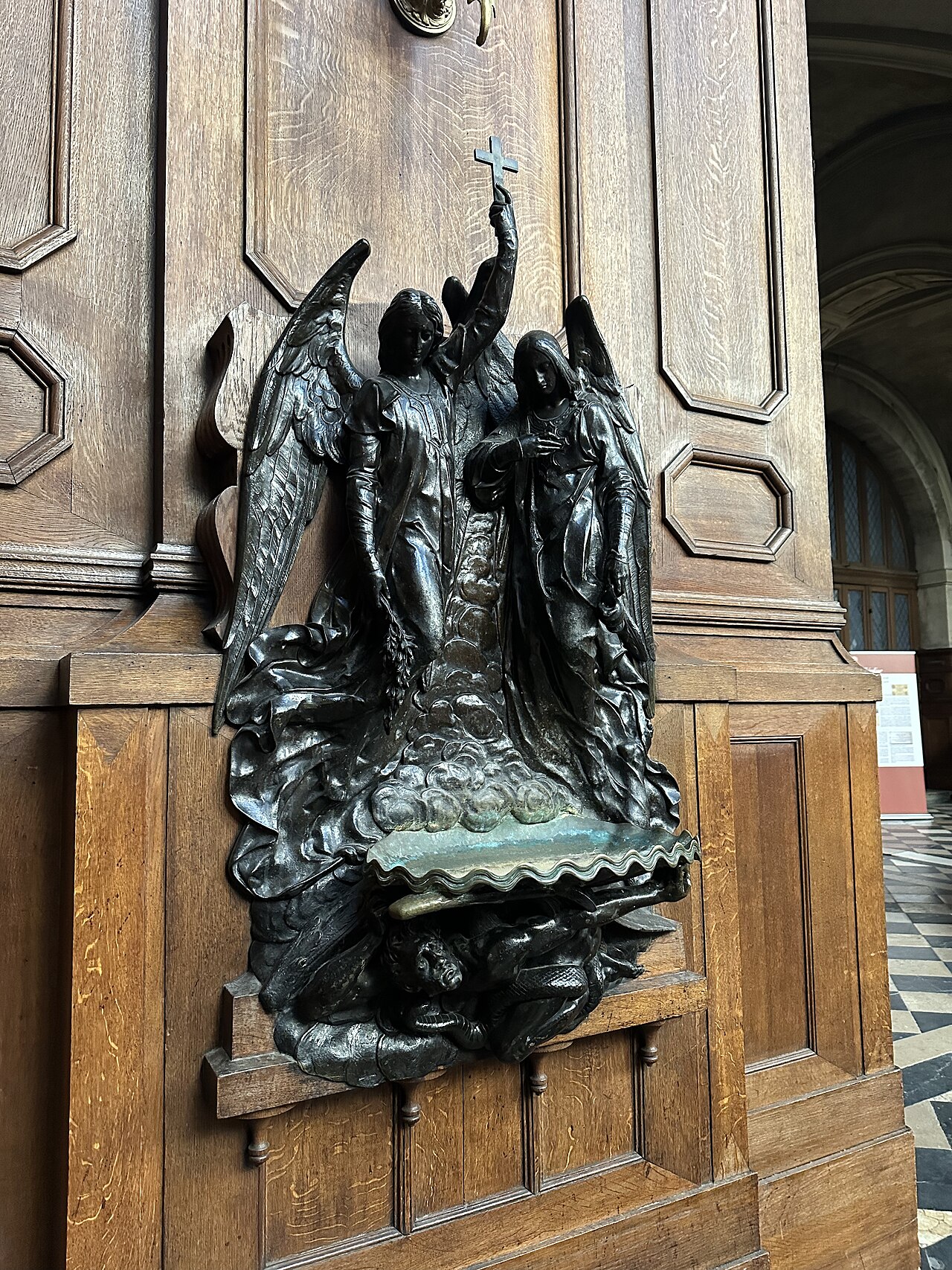
At the door of almost every Catholic church there is a small basin of water. As people come in, they dip their fingers in it and make the sign of the cross. At some Masses, the priest walks down the aisle sprinkling the congregation with water from a branch or a metal sprinkler. Catholics take bottles of “holy water” home, sprinkle it on their houses, and use it to bless the sick and the dying. To a sceptic or a Protestant, this can look like magic water, or a ritual with no basis in the Bible. This article explains what holy water is, its roots in Scripture, how early Christians used blessed water, how the customs of the font and the Sunday sprinkling developed, why it is a “sacramental” and not a sacrament, why the charge of superstition is serious and how the Church itself answers it, what holy water does not do, how Catholics use it, and why other Christians are free to use it too.
1. Ordinary water, blessed as a prayer
Holy water is ordinary water that has been blessed by a priest or deacon, using a prayer of the Church. There is nothing chemically special about it. It is used above all to recall baptism, and to ask God’s protection and blessing. It is a form of prayer, not magic.
Its first meaning is baptism. Jesus told Nicodemus: “Amen, amen I say to thee, unless a man be born again of water and the Holy Ghost, he cannot enter into the kingdom of God” (John 3:5). For Christians, water is forever connected with new birth in Christ. Every time a Catholic dips a finger in holy water and makes the sign of the cross, he or she is remembering, “I have been baptised.”
Christians have honoured water ever since Jesus himself went down into the Jordan to be baptised by John. Matthew tells us that “Jesus being baptized, forthwith came out of the water: and lo, the heavens were opened to him: and he saw the Spirit of God descending as a dove” (Matthew 3:16). Many early Christian writers taught that, by entering the Jordan, Christ sanctified all the waters of the world.
At Sunday Mass, especially in the Easter season, the priest may bless water and sprinkle the congregation with it in place of the usual penitential act at the beginning of Mass. The prayer asks God to bless the water so that it may be a reminder of baptism and a sign of his protection (Roman Missal, Rite for the Blessing and Sprinkling of Water).
2. God cleanses and heals through water
Scripture repeatedly shows God cleansing, healing and blessing people through water used at his word.
The Law of Moses prescribed a “water of purification” for people who had touched a dead body or been in a tent where someone had died. Water was mixed with the ashes of a red heifer, and a clean person was to “dip hyssop in it, and sprinkle therewith all the tent, and all the furniture, and the men that are defiled” (Numbers 19:17-18). Sprinkling with water was a sign of cleansing.
Naaman, the commander of the army of Syria, came to the prophet Elisha to be healed of leprosy. Elisha did not even come out to meet him, but sent a message: “Go, and wash seven times in the Jordan, and thy flesh shall recover health.” Naaman was offended: weren’t the rivers of Damascus better than all the waters of Israel? But his servants persuaded him, and “he went down, and washed in the Jordan seven times… and his flesh was restored, like the flesh of a little child” (2 Kings 5:10-14). The water had no power of its own; the healing came from God, through obedience.
Jesus himself used water in healing. When he met a man blind from birth, he spat on the ground, made clay, anointed the man’s eyes, and told him: “Go, wash in the pool of Siloe.” The man “went therefore, and washed, and he came seeing” (John 9:6-7). Again, the water was the means, and faith and obedience the response.
3. Blessed water in the early Church
Christians were blessing water for use outside baptism by the fourth century at the latest, and the idea that God works through water blessed in his name is older still.
Around 200, Tertullian wrote the first Christian treatise on baptism. He argued that ordinary water, once God has been invoked over it, receives through the Holy Spirit the power to sanctify. He pointed out that at creation, “the Spirit of God moved over the waters” (Genesis 1:2), and saw this as a sign that God would use water to give new life (On Baptism 4).
From Egypt around 350 comes a prayer book used by Serapion, bishop of Thmuis, a friend of St Athanasius. Among its prayers is a blessing of water and oil, asking God to give them power to heal the sick, drive away illness and protect from evil (Sacramentary of Serapion). The water was to be used by the faithful for healing.
Around 380, a Syrian church order called the Apostolic Constitutions gives a prayer for the blessing of water by a bishop or priest. It asks God to “sanctify this water… and give it the power of conferring health, of driving away diseases, of putting the demons to flight” (Apostolic Constitutions 8.29). The custom of blessing water for use in daily life was well established.
4. The font at the door and the Sunday sprinkling
The familiar holy water font at the church door, and the custom of sprinkling the people on Sundays, developed from early Christian washing fountains and from parish practice in the age of Charlemagne.
In the fourth century, many great churches had a fountain in their courtyard where worshippers washed their hands and faces before entering. Around 396, St Paulinus of Nola described the fountain in the forecourt of St Peter’s Basilica in Rome, where a great canopy sheltered a basin, and people washed before going in to pray (Letter 13). Washing at the threshold became a sign of purification before coming into God’s presence.
In the ninth century, Archbishop Hincmar of Reims, one of the most influential bishops of the Carolingian age, instructed the priests of his diocese, around 852, to bless water every Sunday before Mass, sprinkle the people with it as they entered the church, and allow anyone who wished to take some home in a clean vessel to sprinkle their houses, fields, vineyards and animals. Over time, small basins of blessed water were placed at church doors so that people could bless themselves as they came in.
The greatest blessing of water in the year takes place at the Easter Vigil. After the Easter candle has been lit and the readings proclaimed, the priest blesses the baptismal water, plunging the Easter candle into it, and new Christians are baptised. Then the whole congregation renews its baptismal promises, rejecting sin and professing faith, and the priest sprinkles everyone with the newly blessed water (Roman Missal, Easter Vigil).
5. A sacramental, not a sacrament
Holy water is a “sacramental”, not a sacrament. Unlike the seven sacraments, it does not confer grace by the power of the rite itself. It works through the prayer of the Church and disposes the person who uses it with faith to receive grace.
The Second Vatican Council defined sacramentals as “sacred signs which bear a resemblance to the sacraments. They signify effects, particularly of a spiritual kind, which are obtained through the Church’s intercession.” By them, people are disposed to receive the chief effects of the sacraments, and various occasions of life are made holy (Sacrosanctum Concilium 60, 1963).
Church law repeats this definition (Code of Canon Law, canon 1166), placing blessed water alongside other blessings and blessed objects, not among the seven sacraments. Baptism is a sacrament; a dip of the fingers in holy water at the church door is a reminder of it.
The New Testament shows that faith, not the object, is what matters. A woman who had suffered from bleeding for twelve years, and spent everything she had on doctors, came up behind Jesus in a crowd and touched his cloak, thinking, “If I shall touch but his garment, I shall be whole.” She was healed at once. But Jesus turned and told her: “Daughter, thy faith hath made thee whole” (Mark 5:25-34). The cloak was the occasion; her faith in Christ was what mattered.
6. The charge of superstition
The charge that holy water is superstitious is serious, and the Catholic Church itself condemns treating any blessed object as a mechanism that works by itself.
Some Protestant reformers rejected holy water entirely. John Calvin, in his Institutes of the Christian Religion (1559), criticised holy water, along with other ceremonies, as a human invention without basis in Scripture, which mimicked baptism and so cheapened it, and which encouraged people to rely on outward rites rather than on Christ.
The Bible itself shows that even a good, God-given object can become an occasion of superstition. God commanded Moses to make a bronze serpent, so that Israelites bitten by snakes could look at it and be healed (Numbers 21:8-9). But centuries later, the people of Judah had begun burning incense to it as if it were a god, and King Hezekiah broke it in pieces (2 Kings 18:4). If even something God commanded could be misused, blessed water certainly can be.
The Catechism of the Catholic Church is clear. It defines superstition as “a deviation of religious feeling and of the practices this feeling imposes”, and explains that “to attribute the efficacy of prayers or of sacramental signs to their mere external performance, apart from the interior dispositions that they demand, is to fall into superstition” (CCC 2111). Holy water used as a lucky charm, without faith, is superstition, and the Church says so.
7. What holy water does not do
Holy water does not forgive grave sins, guarantee cures, or replace confession, medicine or faith.
The Acts of the Apostles shows both God working through ordinary objects and the danger of treating them as magic. In Ephesus, “God wrought by the hand of Paul more than common miracles. So that even there were brought from his body to the sick, handkerchiefs and aprons, and the diseases departed from them.” But when seven sons of a man named Sceva tried to copy Paul, using the name of Jesus like a magic formula without faith, the evil spirit overpowered them, and they fled wounded (Acts 19:11-16).
St Teresa of Avila, the great sixteenth-century mystic and Doctor of the Church, wrote in her autobiography that she found holy water a great help against temptations and evil spirits. She noticed that nothing drove them away so quickly. But she was careful to explain why: she believed its power came from the prayer of the Church over it, and she marvelled at “the great power of everything ordained by the Church” (Life, chapter 31). The power was in the Church’s prayer, not in the water.
Lourdes offers an interesting example. Millions of pilgrims drink and bathe in the spring water that St Bernadette uncovered in 1858, and many take bottles home. But the water at Lourdes is not “holy water” in the technical sense; it is ordinary spring water, and the sanctuary stresses that it has no magical or therapeutic properties of its own. Of the thousands of healings reported there since 1858, the Church has formally recognised only 72 as miracles (as of 2025), after rigorous medical and theological examination.
8. Blessing homes, the sick, the dying and the dead
Catholics also use holy water to bless homes, cars, the sick, the dying and the dead, always pointing back to baptism.
At a Catholic funeral, the priest meets the coffin at the door of the church and sprinkles it with holy water, saying words such as: “In the waters of baptism N. died with Christ and rose with him to new life. May he/she now share with him eternal glory” (Order of Christian Funerals). The water at the end of life recalls the water at its beginning.
When the priest sprinkles the congregation, the chant traditionally sung in Lent and Ordinary Time, the Asperges me, takes its words from King David’s great psalm of repentance, written after his sin with Bathsheba: “Thou shalt sprinkle me with hyssop, and I shall be cleansed: thou shalt wash me, and I shall be made whiter than snow” (Psalm 51:7; Psalm 50:9 in the Vulgate numbering).
Orthodox Christians have a particularly rich tradition of blessing water. At the feast of the Theophany (Epiphany) on 6 January, which celebrates the baptism of Jesus, priests bless rivers, lakes and seas, often by throwing a cross into the water. In Tarpon Springs, Florida, home to a large Greek-American community, young men have dived into the cold waters of Spring Bayou for more than a century to retrieve the cross; the one who finds it is believed to receive a blessing for the year.
9. How to use it
Using holy water is simple. As you enter a Catholic church, dip the fingertips of your right hand in the font and make the sign of the cross, remembering your baptism. You can also ask a priest to bless a bottle of water for you, or take some home from the large container many churches keep, and use it to bless your home, your family or yourself when you pray.
Traditionally, salt is sometimes blessed and added to holy water. The custom recalls a story of the prophet Elisha. The people of Jericho complained that their spring was foul and made the land barren. Elisha asked for a new bowl with salt in it, threw the salt into the spring, and said, “Thus saith the Lord: I have healed these waters.” The water became wholesome (2 Kings 2:19-22).
Some parishes have been tempted to empty their holy water fonts during Lent, as a sign of fasting. On 14 March 2000, the Vatican’s Congregation for Divine Worship wrote that this is not permitted: the fonts should remain filled throughout Lent, though they are traditionally emptied on Good Friday and Holy Saturday, to be refilled with the water blessed at the Easter Vigil.
During the coronavirus pandemic in 2020, however, health concerns led many dioceses to empty their holy water fonts temporarily to prevent infection, and the sanctuary at Lourdes closed its baths. The Church adapted the sign to protect people’s health, showing that the sign serves people, not the other way round.
10. Free for every Christian
Because holy water recalls the baptism that most Christians share, non-Catholics are free to use it as a prayer of their own, remembering their own baptism.
The Ethiopian official in the Acts of the Apostles, travelling home in his chariot after hearing Philip explain the Gospel, saw some water beside the road and said, “See, here is water: what doth hinder me from being baptized?” Philip baptised him then and there, and he “went on his way rejoicing” (Acts 8:36-39). Water by the roadside became the place where he met Christ.
Martin Luther, who rejected holy water as a ritual, nevertheless urged Christians to take strength from their baptism in every temptation. In his Large Catechism of 1529, he taught that when our sins and conscience oppress us, we should simply answer: “But I am baptised! And if I am baptised, I have the promise that I shall be saved and have eternal life.” Catholics who dip their fingers in holy water are, in their own way, making exactly that answer.
The Second Vatican Council taught that baptism establishes “a sacramental bond of unity” among all who have been reborn by it, Catholic or not (Unitatis Redintegratio 22). A Protestant visiting a Catholic church who dips a finger in the font and makes the sign of the cross is simply giving thanks for the baptism that unites all Christians.
Frequently asked questions
Can anyone use holy water? Yes. Anyone may use it as a prayer, especially as a reminder of baptism.
Can I get holy water to take home? Yes. Most Catholic churches have a container of holy water for people to take home, or you can ask a priest to bless water you bring.
Is holy water different from Lourdes water? Yes. Holy water is water blessed by a priest. Lourdes water is spring water from the grotto, which pilgrims value because of the apparitions there; it is not blessed in the same way.
Is it wrong to use holy water if I’m not Catholic? No. Use it as a prayer, recalling your own baptism. See Why Do Catholics Make the Sign of the Cross?
Sources and further reading
- The Bible: Genesis 1:2; Numbers 19:17-19; 21:8-9; 2 Kings 2:19-22; 5:10-14; 18:4; Psalm 51:7; Matthew 3:13-17; Mark 5:25-34; John 3:5; 9:6-7; Acts 8:36-39; 19:11-16.
- Catechism of the Catholic Church, 1667-1679 and 2111.
- Second Vatican Council, Sacrosanctum Concilium 60; Unitatis Redintegratio 22. Code of Canon Law (1983), canon 1166.
- Roman Missal, Rite for the Blessing and Sprinkling of Water and Easter Vigil; Order of Christian Funerals; Book of Blessings.
- Tertullian, On Baptism 4; Sacramentary of Serapion; Apostolic Constitutions 8.29; St Paulinus of Nola, Letter 13; Hincmar of Reims, Capitula (852).
- St Teresa of Avila, The Book of Her Life, ch. 31.
- John Calvin, Institutes of the Christian Religion (1559), book 4; Martin Luther, Large Catechism (1529), on Baptism.
- Congregation for Divine Worship, Letter on holy water fonts in Lent (14 March 2000).
- Sanctuary of Our Lady of Lourdes, information on the water and recognised healings.
