
Do Catholics Believe They Are Saved by Works? Faith, Works and Grace Explained
No, Catholics do not believe they earn heaven by good deeds. Here is what the Church teaches about grace, faith and works, how Paul and James fit together, and what Catholics and Lutherans now agree.
Perhaps the most common thing Protestants believe about Catholics is that they try to earn heaven by doing good deeds, as if salvation were a points system: go to Mass, say your prayers, give to charity, and if your good outweighs your bad, you get in. Many evangelicals sincerely fear that the Catholic Church has swapped the Gospel of grace for a religion of human effort. Many Catholics, too, have absorbed something like this idea without realising it. This article explains what the Catholic Church actually teaches: that salvation is a free gift of grace which nobody can earn, that saving faith is a living faith that acts in love, why good works still matter, how Paul and James fit together, the bitter sixteenth-century quarrel and the abuses that fuelled it, and the remarkable agreement Catholics and Lutherans reached in 1999.
1. No: salvation is a free gift
The Catholic Church teaches that salvation is a free gift of God’s grace through Jesus Christ, which nobody can earn by good deeds. No amount of prayers, Masses or charity can buy a place in heaven.
The clearest picture in the Gospels is the criminal crucified beside Jesus. He had no time left for good works, no chance to go to church, make amends or be baptised. He simply turned to Jesus and said, “Lord, remember me when thou shalt come into thy kingdom.” Jesus replied, “Amen I say to thee, this day thou shalt be with me in paradise” (Luke 23:42-43). Catholics have always honoured him as “the good thief”, a sign that salvation is pure gift.
The Council of Trent, which met to answer the Protestant Reformers, stated this unambiguously in 1547. “We are said to be justified freely,” it taught, “because none of those things which precede justification, whether faith or works, merit the grace itself of justification” (Decree on Justification, chapter 8). The very council often blamed for “works-righteousness” insisted that the first gift of grace cannot be earned.
The saints understood this deeply. On 9 June 1895, St Thérèse of Lisieux, a young Carmelite nun who would die two years later aged twenty-four, wrote a prayer offering herself to God’s merciful love. In it she said that in the evening of her life she would appear before God with empty hands, because she did not ask him to count her works. All our justice, she wrote, is stained in his eyes; she wanted to be clothed in his own justice instead. The Church later named her a Doctor of the Church.
2. The Church rejected “earning salvation” long before Luther
The Catholic Church condemned the idea of earning salvation by human effort more than a thousand years before the Reformation began.
In the early fifth century, a British monk named Pelagius, living in Rome, taught that human beings could keep God’s commandments by their own natural strength, and that grace merely made it easier. He was a serious, moral man, alarmed by lax Christians, but his teaching implied that people could save themselves.
What provoked Pelagius, according to St Augustine, was a single line of Augustine’s own prayer in his Confessions: “Give what you command, and command what you will” (Confessions 10.29). When this was quoted in Pelagius’s presence in Rome, he reacted angrily, because it seemed to make human effort worthless (On the Gift of Perseverance 53). Augustine replied in a long series of books defending the absolute necessity of grace. In 418 a council of African bishops at Carthage condemned Pelagius’s teaching, and Pope Zosimus confirmed the condemnation.
A century later, a subtler question arose: does the very first movement of faith come from us, with grace following, or does grace come first? In 529, bishops meeting at the Second Council of Orange in southern Gaul ruled that even the beginning of faith, the first desire to believe, is a gift of God’s grace, not a human achievement. Pope Boniface II confirmed their decision in 531. The Catholic Church has taught ever since that grace always comes first.
3. Living faith that acts in love
Catholics agree that faith is necessary for salvation. But they insist that the faith that saves is a living faith, one that shows itself in love, not a bare intellectual belief.
The Letter of James makes this point forcefully. “Faith without works is dead,” James writes. He points to Abraham, who showed his faith by being willing to offer his son Isaac in obedience to God: “Seest thou, that faith did co-operate with his works; and by works faith was made perfect?” (James 2:20-24; Genesis 22). Faith and action belong together.
Pope Benedict XVI made a striking statement on this point. At a General Audience on 19 November 2008, speaking about St Paul’s teaching on justification, he said that Luther’s phrase “faith alone” is true, if it is not opposed to faith in charity, in love. Faith, he explained, means looking at Christ, entrusting oneself to him and conforming oneself to him, and this cannot remain without love. A pope endorsing Luther’s famous phrase, properly understood, shows how far the old quarrel has narrowed.
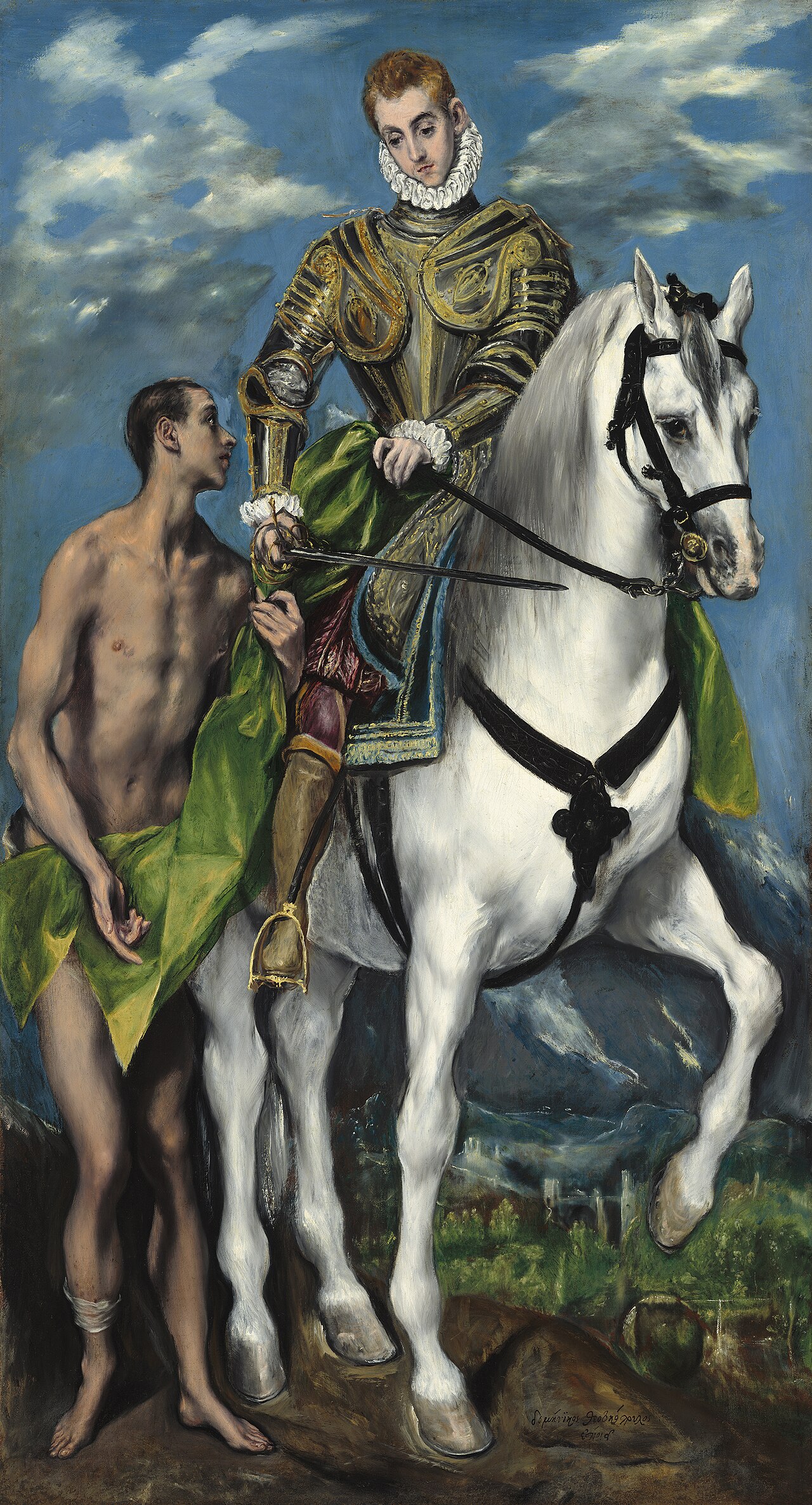
One of the most loved stories in Christian history shows living faith in action. In the winter of around 334, a young Roman soldier named Martin was riding through the gate of the city of Amiens in France when he saw a beggar, almost naked, shivering in the cold. Everyone else passed by. Martin had nothing with him but his weapons and his cloak, so he drew his sword, cut his military cloak in two, and gave half to the beggar. Martin was not yet even baptised, only a catechumen. That night, according to his biographer Sulpicius Severus, he dreamed of Christ wearing the half-cloak and saying to the angels, “Martin, still a catechumen, has clothed me with this garment” (Life of Martin 3). Martin was soon baptised, and later became bishop of Tours.
4. Why good works matter
If salvation is a gift, why do good works matter at all? Because Jesus himself said that people will be judged on how they treated those in need.
In his parable of the last judgement, Jesus describes the Son of Man on his throne, separating the nations like a shepherd separating sheep from goats. To those on his right he says, “I was hungry, and you gave me to eat; I was thirsty, and you gave me to drink; I was a stranger, and you took me in.” When they ask when they did this, he answers: “as long as you did it to one of these my least brethren, you did it to me.” Those who ignored the needy are turned away (Matthew 25:31-46). Jesus does not say faith is unnecessary; he says that real faith will show itself in love.
When a rich young man ran up to Jesus and asked, “Good Master, what shall I do that I may receive life everlasting?”, Jesus pointed him first to the commandments. Then, looking at him with love, he told him to sell what he had and give to the poor, and come and follow him. The young man went away sad, because he had great possessions (Mark 10:17-22).
In 1952, Mother Teresa of Calcutta opened a home for the dying in a former pilgrims’ hostel attached to the Kali temple at Kalighat, in Calcutta. She called it Nirmal Hriday, “Pure Heart”. There her sisters took in people dying on the streets, so that they could die cared for and loved. She explained her work again and again with Jesus’s words from Matthew 25: what we do for the least, we do for him. She did not think her work earned her salvation; she thought she was serving Christ himself.
5. Even our good works are God’s gift
Catholics also believe that good works are themselves God’s gift. Grace always comes first, and our cooperation follows and depends on it. When God rewards us, he is rewarding what he himself has done in us.
St Paul says this in a single passage that Protestants and Catholics both love: “For by grace you are saved through faith, and that not of yourselves, for it is the gift of God; Not of works, that no man may glory. For we are his workmanship, created in Christ Jesus in good works, which God hath prepared that we should walk in them” (Ephesians 2:8-10). Salvation is not by works, but it is for good works, which God himself has prepared.
St Augustine summed this up in a phrase that the Catechism of the Catholic Church still quotes: when God rewards our merits, he is “crowning his own gifts” (Augustine, Letter 194; CCC 2006). Catholics do speak of “merit”, but they mean that God freely chooses to reward the good he enables us to do, as a father delights in rewarding a child for a gift the child bought with the father’s money.
The pattern can be seen in Mary herself. When the angel Gabriel came to her, he greeted her as “full of grace” or “highly favoured” before she had said or done anything (Luke 1:28). God’s favour came first. Only then did Mary respond with her free consent: “Behold the handmaid of the Lord; be it done to me according to thy word” (Luke 1:38). Grace first, then free response: that is the Catholic understanding of salvation.
6. The sixteenth-century quarrel, and its real causes
Catholics and Protestants clashed bitterly over justification in the sixteenth century, and honesty requires admitting that Catholic abuses gave the Protestant protest real force.
In 1517 the Dominican friar Johann Tetzel was preaching an indulgence near Wittenberg, in the town of Jüterbog, to raise money for rebuilding St Peter’s Basilica in Rome. His preaching made grace look as though it could be bought with money. A popular rhyme associated with him ran, “As soon as the coin in the coffer rings, the soul from purgatory springs.” Martin Luther, a friar and professor at Wittenberg, was outraged by what he saw among his own people, and in response he wrote his Ninety-Five Theses.
Luther’s study of St Paul convinced him that sinners are justified by faith alone. When he translated the New Testament into German in 1522, he added the word “alone” (allein) to Romans 3:28, so that it read “a man is justified without the works of the law, by faith alone”. The word “alone” is not in the Greek. Catholic critics protested, and in 1530 Luther defended his choice in his Open Letter on Translating, arguing that it captured Paul’s meaning in good German.
Protestants rightly prize Paul’s great argument. At Antioch, Paul publicly opposed Peter, who had begun to separate from Gentile Christians, and told him: “a man is not justified by the works of the law, but by the faith of Jesus Christ” (Galatians 2:16). Catholics believe this just as firmly. The question was what exactly “works of the law” and “faith” meant.
7. Paul and James do not contradict each other
Many people think that Paul and James contradict each other: Paul says we are justified by faith apart from works, and James says we are justified by works and not by faith alone. Catholics believe they are addressing different questions, and both are true.
Paul excludes any idea of earning God’s favour, especially by the “works of the law”, the observances of the Law of Moses, such as circumcision. James insists that real faith acts. They are attacking different errors. And the same Paul who wrote that we are justified by faith also wrote that God “will render to every man according to his works. To them indeed, who according to patience in good work, seek glory and honour and incorruption, eternal life” (Romans 2:6-7).
Luther found James very hard to square with his reading of Paul. In the preface to his German New Testament in 1522, he called James “an epistle of straw” compared with the letters of Paul and John, because, he said, it had nothing of the nature of the Gospel about it. He kept it in his Bible, but at the back.
Remarkably, Catholic and Protestant theologians nearly reached agreement on this very question in the sixteenth century. In 1541, at the Colloquy of Regensburg in Germany, the Catholic Cardinal Gasparo Contarini and the Lutheran Philip Melanchthon, with others, agreed on a joint text on justification, describing a “double justice”. But both Rome and Luther rejected the agreement, and the opportunity was lost for over four centuries.
8. The agreement of 1999
The breakthrough finally came at the end of the twentieth century. On 31 October 1999, Reformation Day, in the city of Augsburg, Cardinal Edward Cassidy, representing the Vatican, and Bishop Christian Krause, president of the Lutheran World Federation, signed the Joint Declaration on the Doctrine of Justification.
Its central sentence states: “Together we confess: By grace alone, in faith in Christ’s saving work and not because of any merit on our part, we are accepted by God and receive the Holy Spirit, who renews our hearts while equipping and calling us to good works.” The declaration also stated that the mutual condemnations of the sixteenth century do not apply to the teaching of the other side as presented in the document. Differences of emphasis and language remain, but they are no longer seen as dividing the churches on this point.
Other churches soon joined. The World Methodist Council formally associated itself with the declaration on 23 July 2006, in Seoul. The World Communion of Reformed Churches did so on 5 July 2017 in Wittenberg, the town where Luther had posted his theses five hundred years before. The Anglican Communion also welcomed it.
On 31 October 2016, Pope Francis travelled to Lund Cathedral in Sweden to pray with leaders of the Lutheran World Federation, opening the five hundredth anniversary of the Reformation. Together they thanked God for the gifts received through the Reformation, including its rediscovery of the centrality of grace, and asked forgiveness for the wounds of division.
9. Confident hope, not presumption
One real difference remains in emphasis. Many Protestants speak of the “assurance of salvation”: that a true believer can be certain of being saved. Catholics speak instead of confident hope, because they believe a person remains free to turn away from grace.
Catholics point to St Paul’s own words. Long after his conversion, and after years as an apostle, Paul wrote: “I chastise my body, and bring it into subjection: lest perhaps, when I have preached to others, I myself should become a castaway” (1 Corinthians 9:27). Paul did not take his final salvation for granted.
The most famous example of Catholic hope comes from the trial of St Joan of Arc in 1431. On 24 February, her judges tried to trap her with a question: was she in God’s grace? If she said yes, she would be accused of presumption; if she said no, she would be admitting guilt. Joan, a young peasant woman who could not read, answered: “If I am not, may God put me there; and if I am, may God so keep me.” The judges were reportedly astonished. The Catechism quotes her answer as a model of Christian hope (CCC 2005).
The Gospels show how easily even an apostle could fall, and how mercy restores. On the night of the Last Supper, Peter swore that he would never deny Jesus, even if he had to die with him. That same night, he denied knowing him three times (Luke 22:33-34, 54-62). After the Resurrection, Jesus restored him by asking him three times, “Lovest thou me?” (John 21:15-19). Catholics trust in that mercy, while taking seriously the possibility of falling.
10. Where to begin
Anyone who wants to respond to God’s grace can begin where the Church has always begun: ask for grace, trust in Christ, be baptised, and let your faith act in love.
On the day of Pentecost, after Peter’s first sermon, the crowd in Jerusalem were “cut to the heart” and asked, “What shall we do?” Peter answered: “Do penance, and be baptized every one of you in the name of Jesus Christ, for the remission of your sins: and you shall receive the gift of the Holy Ghost.” About three thousand people were baptised that day (Acts 2:37-41).
At Philippi, after an earthquake shook open the prison where Paul and Silas were held, the terrified jailer asked them, “Masters, what must I do, that I may be saved?” They answered, “Believe in the Lord Jesus, and thou shalt be saved, and thy house.” That same hour of the night he washed their wounds, and he and all his household were baptised (Acts 16:30-33). Faith, baptism and an act of love came together in a single night.
In the twentieth century, Dorothy Day, an American journalist who had lived a bohemian life among socialists and anarchists in New York, was drawn to God through the birth of her daughter. On 28 December 1927 she was baptised a Catholic on Staten Island. In 1933, with Peter Maurin, she founded the Catholic Worker movement, opening houses of hospitality for the homeless and destitute that still operate today. She did not see her work as earning salvation, but as living the faith she had received as a gift.
Frequently asked questions
Do Catholics believe in “faith alone”? Catholics avoid the phrase if it means faith without love. But they agree with the Joint Declaration that we are accepted by God by grace alone, through faith in Christ, and not because of any merit.
Then why do Catholics go to confession and do penance? Not to earn forgiveness, which Christ freely gives, but to receive it and to heal the damage sin causes. See Why Do Catholics Confess to a Priest?
Can a Catholic lose salvation? Catholics believe a person can freely turn away from God through grave sin, and be restored through repentance.
What about people who never hear of Christ? See Do Catholics Believe Non-Catholics Can Go to Heaven?
Sources and further reading
- The Bible: Genesis 22:1-18; Matthew 25:31-46; Mark 10:17-22; Luke 1:26-38; 22:31-62; 23:39-43; John 21:15-19; Acts 2:37-41; 16:25-34; Romans 2:6-8; 3:28; 1 Corinthians 9:24-27; Galatians 2:11-16; Ephesians 2:8-10; James 2:14-26.
- Council of Carthage (418); Second Council of Orange (529); Council of Trent, Decree on Justification (1547).
- Catechism of the Catholic Church, 1987-2029.
- Lutheran World Federation and Pontifical Council for Promoting Christian Unity, Joint Declaration on the Doctrine of Justification (1999).
- Benedict XVI, General Audience on St Paul’s teaching on justification (19 November 2008).
- St Augustine, Confessions 10.29; Letter 194; On the Gift of Perseverance 53. Sulpicius Severus, Life of St Martin 3.
- St Thérèse of Lisieux, Act of Oblation to Merciful Love (1895).
- Martin Luther, Preface to the New Testament (1522) and Open Letter on Translating (1530).
- Dorothy Day, The Long Loneliness (1952).
