
Are Weddings in SSPX Chapels Valid? Dates, Delegation and the 2026 Change
Understand SSPX marriage validity, the July 2026 Vatican clarification, earlier permissions and the records to take to your diocesan tribunal.
The answer depends especially on the wedding’s date and the authority under which consent was received. A major Vatican intervention on 2 July 2026 means older explanations of SSPX weddings cannot safely be applied to a wedding planned today. Couples who have already married should ask their diocesan tribunal to examine their actual records rather than conclude from a headline that their marriage is invalid.
This article reflects the official documents available on 26 September 2026. Because the situation can change, anyone planning a wedding should obtain current written guidance from the local Catholic diocese before making arrangements.
What changed in July 2026?
The Dicastery for the Doctrine of the Faith issued a decree dated 2 July 2026 concerning episcopal consecrations carried out without a pontifical mandate. A companion explanatory note addresses the resulting position of SSPX ministers and those who formally adhere to the Society.
For the question in this article, the note’s decisive statement is that Penance administered by SSPX ministers and marriages assisted by them are invalid. The note frames its consequences as applying from that point onwards. It also urges Catholics to refrain from the Society’s celebrations and activities and expresses the Church’s readiness to welcome those returning to full communion.
That is why an answer written several years ago may now be materially incomplete. A couple planning a wedding should not rely on the claim that an arrangement available under the earlier framework still automatically authorises an SSPX priest today.
The original note is in Italian. Readers should consult the linked official text and their diocese for its application, rather than treat a social-media paraphrase as a canonical judgment on their own case.
What was the 2017 arrangement?
A letter of the Pontifical Commission Ecclesia Dei, dated 27 March 2017 and published on 4 April, provided a route for local ordinaries to authorise the celebration of marriages involving SSPX faithful.
It envisaged, where possible, a diocesan or otherwise fully regular priest receiving the couple’s consent, followed by Mass celebrated by an SSPX priest. Where that was not possible, the ordinary could grant the necessary faculties directly to an SSPX priest, with provisions for documentation.
This was not a declaration that every wedding in every SSPX chapel was valid simply because it occurred there. The relevant permission or delegation and the other requirements for marriage still mattered.
Nor should that earlier letter now be quoted without the 2026 documents. Historical guidance can explain a past wedding; it cannot be presumed to supply present authority after a later intervention.
Why does delegation matter for a Catholic wedding?
In Catholic marriage, the spouses exchange the consent that makes the marriage, provided the legal requirements are met. For Catholics bound to canonical form, the Church also ordinarily requires an authorised person to assist and two witnesses. Canons 1057, 1108 and 1111 help explain this structure.
“Assist” has a particular canonical meaning here: receiving the spouses’ consent in the name of the Church. It is not simply being present, preaching a homily or celebrating a Mass nearby.
A priest’s valid ordination and his authority to assist at a particular marriage are therefore distinct questions. A beautiful chapel, a traditional liturgy or the priest’s personal sincerity does not by itself settle the question of canonical authority.
Other issues can also affect validity, including freedom to marry and genuine consent. Conversely, not every procedural mistake makes a marriage invalid. That is why a competent review matters more than a checklist assembled from online arguments.
An illustration: the signature and the seal
This is an original illustrative story.
A couple brought an important document to a respected official. He knew them well and sincerely wanted to help, but the office had not authorised him to certify that particular document. Years later, they discovered an older letter granting a different official authority under specific conditions.
The letter was relevant, but it did not answer their case by itself. They needed to know who had acted, when, and under what authorisation.
A sacramental marriage is much more than paperwork, and this story does not describe every canonical exception. It illustrates why sincerity, appearance and an old general announcement cannot replace examination of the actual authority involved.
Does the 2026 note invalidate every earlier SSPX wedding?
Do not draw that conclusion. A later change in a minister’s situation does not undo a valid marriage already contracted. A past wedding must be examined in light of the law and circumstances that applied when it took place.
Some earlier weddings may have involved a priest properly authorised under the 2017 arrangements. Others may raise questions that need further investigation. The mere phrase “SSPX wedding” does not tell a tribunal enough to decide.
Catholic law also gives marriage the favour of law: in doubt, its validity is upheld until the contrary is proven. See canon 1060 in the marriage canons. This is another reason not to declare yourself unmarried on the basis of an online article.
If your wedding was before 2017, its date does not authorise a simple blanket verdict either. Ask the tribunal to assess the actual case, including any relevant legal provisions and evidence. General internet arguments about supplied jurisdiction or exceptional circumstances are not a substitute for that review.
What documents should a married couple gather?
Begin with what you have. Do not delay asking for help because your file is incomplete.
- The wedding certificate, exact date and place.
- The name of the person who received your consent.
- Any written permission or delegation from the local ordinary or parish.
- Baptismal records and relevant information about previous marriages.
- Correspondence with the chapel or diocese about the ceremony.
Tell the diocese whether a different priest received the consent from the priest who celebrated Mass. That detail can matter under the earlier arrangements.
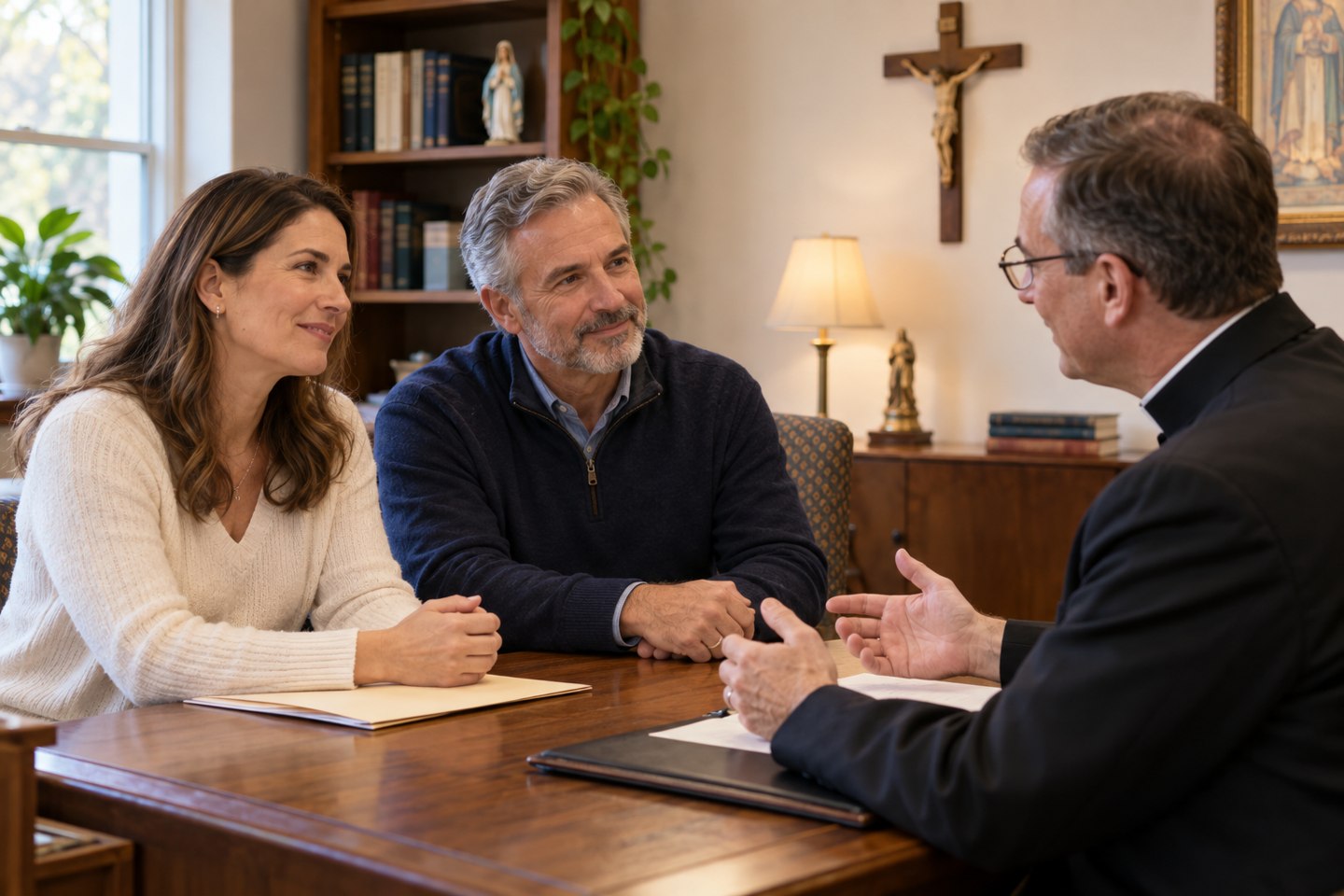
A parish priest can help you contact the tribunal or chancery. Ask for a clear explanation of what is being investigated and what you should do while awaiting an answer. Do not arrange a second ceremony on your own as an improvised “just in case” repair.
What if there really was a defect?
The Church has ways to address some invalid marriages, but the correct remedy depends on the defect and the spouses’ present circumstances. Convalidation or, in suitable cases, radical sanation may be relevant. These are not interchangeable labels for any desired solution.
Our article on becoming Catholic while an annulment question remains explains why previous bonds and freedom to marry require proper attention. Our discussion of marriage and free consent also highlights that external arrangements alone do not establish everything necessary for marriage.
The aim of seeking help is clarity and a secure sacramental life, not public shame. A couple who acted in good faith should be met with patient pastoral care and a careful investigation of facts.
Are lay people automatically excommunicated for ever attending?
Do not turn the 2026 documents into that claim. The explanatory note treats lay formal adherence under specified conditions; it does not say that every person who ever entered an SSPX chapel has automatically incurred the same penalty. Personal canonical questions require competent assessment.
At the same time, the current warning should not be minimised. If you are planning a wedding now, contact a parish and diocese in full communion with the Pope and obtain their guidance. If you are worried about an existing marriage, seek a review of the date, consent and authorisation.
The safest conclusion is neither blanket reassurance nor blanket panic. It is to use the current official documents and have the Church examine the actual case.
Sources and further reading
- DDF: Decree, 2 July 2026 (Italian)
- DDF: Explanatory Note on the SSPX, 2 July 2026 (Italian)
- Ecclesia Dei letter on SSPX marriages, 27 March 2017
- Code of Canon Law: Marriage, canons 1055–1165
Sources checked 26 September 2026. Original illustrative stories are teaching aids, not reported events or quotations from Scripture. This article offers general formation; personal sacramental, legal and health questions require the appropriate qualified adviser.
