
Do Catholics Speak in Tongues? The Charismatic Gifts Explained
Some Catholics do. Here is what the Church teaches about speaking in tongues, its history from Pentecost to the Charismatic Renewal, the fair objections, and what matters more than any gift.
Perhaps you are a Pentecostal or charismatic Christian, and you have wondered whether Catholics have really received the Holy Spirit, or whether they know anything about the gifts of the Spirit. Or perhaps you are a Catholic who went along to a prayer meeting in your parish and were unsettled to hear people around you praying aloud in a language you could not understand. Either way, here is the short answer: yes, some Catholics speak in tongues. The Catholic Church counts the gift of tongues among the charisms, the gifts of the Holy Spirit, though it has never ruled on exactly what the modern practice is. The gift is not required of anyone, it is not a sign of salvation, and it is not the most important gift. This article explains the Catholic Charismatic Renewal, the gift of tongues in the New Testament, St Paul’s guidance, its history in the Church, the stories of missionary saints, Pentecostalism, the Catholic roots of the renewal, the serious objections, the dangers, and the invitation to ask for the Holy Spirit himself.
1. Some Catholics do
Some Catholics do speak in tongues. The Church recognises it as a real gift of the Holy Spirit, but it is not required of anyone, and most Catholics never receive or seek it.
The modern Catholic Charismatic Renewal began on a single weekend. On 17 to 19 February 1967, a group of students and staff from Duquesne University, a Catholic university in Pittsburgh, went on a retreat at a house called The Ark and the Dove, north of the city. They had been reading the Acts of the Apostles and a book about Pentecostal Christians, and they prayed for the Holy Spirit. On the Saturday night, several of them went to pray in the chapel, and experienced what they described as being “baptised in the Holy Spirit”. Some began to pray in tongues. This “Duquesne Weekend” is usually counted as the beginning of the Catholic Charismatic Renewal, which spread rapidly to Notre Dame, Michigan and around the world.
The popes have welcomed the renewal, while also guiding it. On Pentecost Monday, 19 May 1975, Pope Paul VI welcomed some ten thousand charismatic Catholics from around the world to St Peter’s Basilica, at the end of their international conference in Rome. He described the renewal as a chance for the Church and the world, while asking them to remain faithful to the Church’s teaching and to its pastors.
In 2019, Pope Francis set up a single service body for the whole Catholic Charismatic Renewal worldwide, called CHARIS (Catholic Charismatic Renewal International Service). Its statutes came into force at Pentecost, 9 June 2019. Estimates of how many Catholics have taken part in the renewal vary widely, but it is often put at more than a hundred million worldwide.
2. The gift in the New Testament
The gift of tongues appears in the New Testament, first at Pentecost, and then on several occasions as new groups of people come to faith.
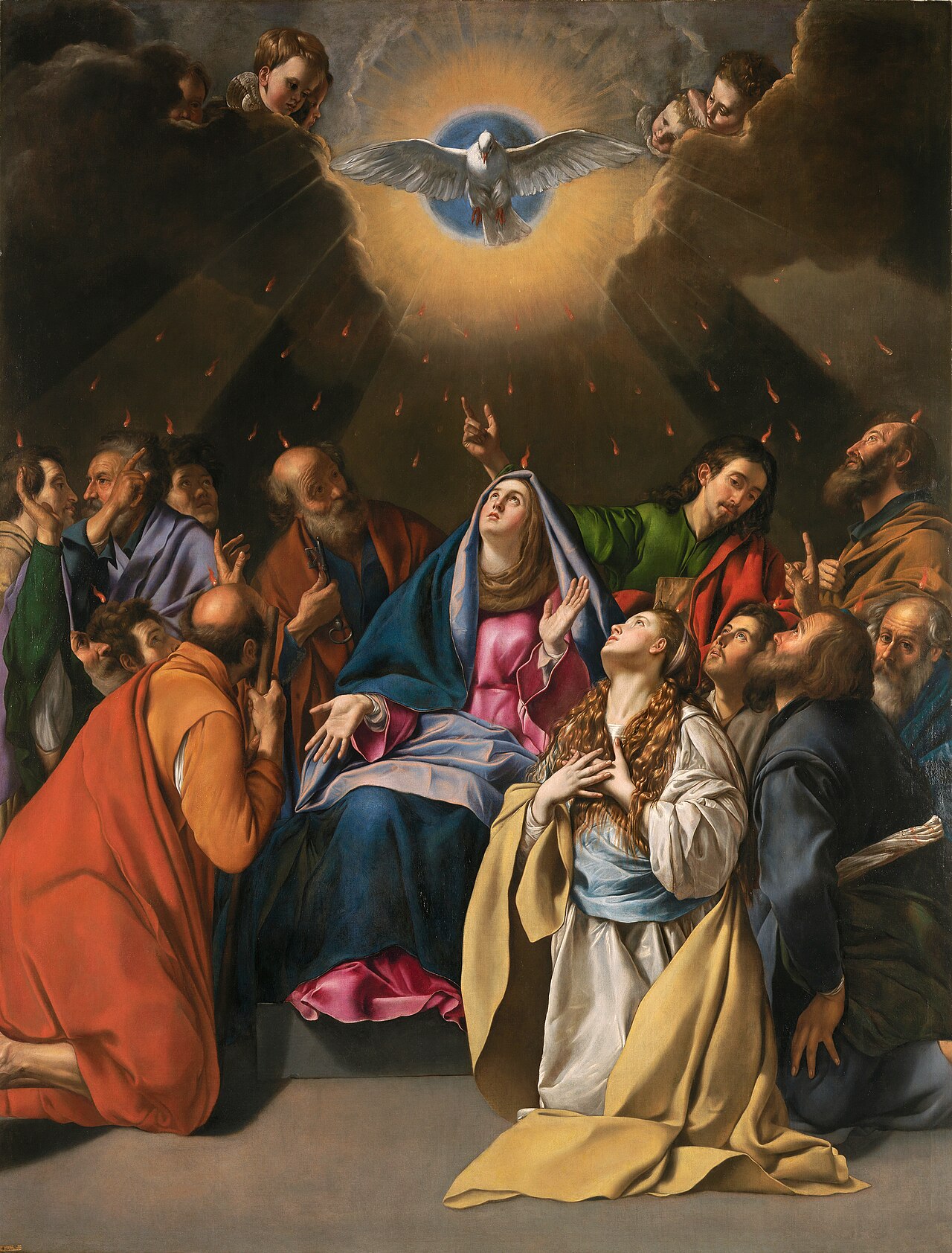
On the feast of Pentecost, fifty days after the resurrection, the apostles were gathered together in Jerusalem. Suddenly “there came a sound from heaven, as of a mighty wind coming”, and “there appeared to them parted tongues as it were of fire, and it sat upon every one of them”. They were all filled with the Holy Spirit, “and they began to speak with divers tongues, according as the Holy Ghost gave them to speak”. Pilgrims in Jerusalem from many nations were amazed, because each heard them speaking in his own native language (Acts 2:1-13).
The gift appeared again when the Gospel first reached the Gentiles. St Peter was sent to the house of Cornelius, a Roman centurion in Caesarea. While Peter was still preaching to Cornelius and his household, “the Holy Ghost fell on all them that heard the word”. Peter’s Jewish companions were astonished, “for they heard them speaking with tongues, and magnifying God”. Peter then had them baptised (Acts 10:44-48).
The gift did not die out with the apostles. Around 180, St Irenaeus, bishop of Lyons in Gaul, wrote that he had heard many brothers in the Church who had prophetic gifts and who spoke through the Spirit in all kinds of languages (Against Heresies 5.6.1).
3. Paul valued tongues but ranked them low
St Paul valued the gift of tongues, but he ranked it low among the gifts, insisted on good order in worship, and put love above every gift.
The church in Corinth was rich in spiritual gifts, but its worship had become chaotic, with people speaking in tongues all at once. Paul wrote to correct them. He said: “I thank my God I speak with all your tongues. But in the church I had rather speak five words with my understanding, that I may instruct others also; than ten thousand words in a tongue” (1 Corinthians 14:18-19). Paul spoke in tongues more than all of them, yet he valued words that build up others more.
Paul laid down rules for public worship. If anyone speaks in a tongue, it should be “by two, or at the most by three, and in course”, that is, one at a time, “and let one interpret”. If there is no interpreter, they should keep silent in the church and speak privately to God. “For God is not the God of dissension, but of peace” (1 Corinthians 14:27-33). And between his two long chapters on the spiritual gifts, Paul placed his famous hymn to love: “If I speak with the tongues of men, and of angels, and have not charity, I am become as sounding brass, or a tinkling cymbal” (1 Corinthians 13:1).
The Church’s teaching today follows Paul. In June 2016, the Congregation for the Doctrine of the Faith published a letter, dated 15 May 2016 and called Iuvenescit Ecclesia (“The Church Rejuvenates”), on the relationship between charismatic gifts and the Church’s hierarchy. It taught that charismatic gifts and the Church’s pastors need each other, and that the gifts must be tested by the pastors, whose task is not to extinguish the Spirit but to test everything and hold fast to what is good (1 Thessalonians 5:19-21).
4. A gift that became rare
After the first centuries, the gift of tongues seems to have become rare, and some of the Church’s leading teachers assumed that it had served its purpose.
Around 390, St John Chrysostom, preaching in Antioch on Paul’s First Letter to the Corinthians, admitted to his congregation that Paul’s whole discussion of spiritual gifts was very obscure to him. The obscurity, he explained, came from our ignorance of the facts: such things used to happen, but no longer did (Homily 29 on 1 Corinthians).
St Augustine, in the early fifth century, taught that speaking in tongues was a sign suited to the Church’s beginning. When the Spirit came at Pentecost, the apostles spoke in all languages, as a sign that the Gospel would spread to all nations. Now that the Church itself spoke the languages of all nations, the sign had passed away (Homilies on the First Letter of John 6.10).
But Augustine also described something that sounds rather like modern tongues. In his commentary on the Psalms, he speaks of “jubilation” (jubilus), when worshippers, overcome with joy, sing wordless sounds because words are not enough. He compares it to workers in the fields or vineyards who, filled with joy, begin to sing songs and then break into sounds without words. “And whom does such jubilation befit, if not the ineffable God?” (Expositions of the Psalms, on Psalm 32/33).
5. Missionary saints and the gift of languages
There are stories of missionary saints who were miraculously given the ability to speak or be understood in foreign languages. The Church treats them with reserve.
St Vincent Ferrer, a Dominican friar from Valencia in Spain, preached across Europe in the late fourteenth and early fifteenth centuries, drawing huge crowds. He died in 1419. At the inquiries held in 1453 and 1454 for his canonisation, witnesses testified that crowds of people from different nations understood him, even though he preached in his native Valencian.
St Francis Xavier, the great Jesuit missionary to India and Japan, is credited with the gift of tongues in the bull of his canonisation (1623). But his own letters, written from India and Japan in the 1540s, describe him struggling to learn languages, memorising translated prayers, and relying heavily on interpreters. This contrast is a good reason to be cautious about such stories.
According to a tradition recorded in the Little Flowers of St Francis, a fourteenth-century collection of stories, St Anthony of Padua once preached before the Pope and cardinals in Rome, where people of many nations were present, and each of them heard him in his own language (Little Flowers 39). The Church does not require Catholics to believe such stories, though it allows them.
6. Pentecostalism and a different view
The modern practice of speaking in tongues began among Protestants in the early twentieth century, and classical Pentecostals understand it differently from Catholics.
On 1 January 1901, at Charles Parham’s Bethel Bible College in Topeka, Kansas, a student named Agnes Ozman asked Parham to lay hands on her and pray that she would receive the Holy Spirit. She began to speak in what was believed to be another language. Pentecostals count this event as the beginning of their movement.
From 1906 to 1909, William J. Seymour, a Black Holiness preacher and the son of former slaves, led a revival at a former stable and warehouse on Azusa Street in Los Angeles. Black and white, rich and poor worshipped together, and many spoke in tongues. The Azusa Street Revival sent Pentecostal missionaries around the world. Today Pentecostal and charismatic Christians are counted in the hundreds of millions.
In 1916, the Assemblies of God, one of the largest Pentecostal denominations, adopted a Statement of Fundamental Truths. It taught that speaking in tongues is the “initial physical sign” of the baptism in the Holy Spirit. In other words, a person who has not spoken in tongues has not yet been baptised in the Spirit. Catholics do not make this claim. The Church teaches that every baptised and confirmed Christian has received the Holy Spirit, whether or not they ever speak in tongues.
7. The Catholic roots of the renewal
The Catholic Charismatic Renewal also has its own roots within the Catholic Church, in popes and a council that asked God for a new Pentecost.
Blessed, now Saint, Elena Guerra was an Italian nun who founded a religious congregation dedicated to the Holy Spirit. Between 1895 and 1903, she wrote twelve letters to Pope Leo XIII, urging him to encourage devotion to the Holy Spirit throughout the Church. In 1897, Leo XIII issued an encyclical on the Holy Spirit, Divinum Illud Munus, and asked the whole Church to pray a novena to the Holy Spirit before Pentecost. Pope Francis canonised Elena Guerra on 20 October 2024.
On 25 December 1961, Pope John XXIII issued Humanae Salutis, formally summoning the Second Vatican Council. He asked the faithful to pray that God would renew his wonders in our time, as by a new Pentecost.
At the Council, on 22 October 1963, Cardinal Léon-Joseph Suenens, Archbishop of Malines-Brussels in Belgium, gave a famous speech. He argued that the charisms, the special gifts of the Holy Spirit, were not just a phenomenon of the early Church, but are given to ordinary believers in every age. His view prevailed. The Council’s constitution on the Church, Lumen Gentium, teaches that the Holy Spirit distributes special graces among the faithful of every rank, “whether they be the more outstanding or the more simple and widely diffused”, and that these gifts “are to be received with thanksgiving and consolation” (Lumen Gentium 12). Suenens later became a leading supporter of the Charismatic Renewal.
8. The serious objection
The serious objection to speaking in tongues is that it is a learned behaviour, not a real language. The Church does not need it to be more than it is.
In the 1960s, the linguist William Samarin, of the University of Toronto, recorded people speaking in tongues in several countries and analysed the recordings. In his book Tongues of Men and Angels (1972), he concluded that glossolalia, as it is technically called, lacks the structure of any real human language. But he also concluded that it is not a sign of mental disorder: it is a normal human ability that anyone can learn.
In 2006, Andrew Newberg, a neuroscientist at the University of Pennsylvania, took brain scans of five women while they were praying in tongues. He found reduced activity in the frontal lobes, the part of the brain associated with deliberate, voluntary control. This matched the women’s own sense that they were not in control of what they were saying. The study was small, and it could not say whether the experience came from God.
Ronald Knox, a Catholic priest and convert from Anglicanism, studied the history of ecstatic religious movements in his book Enthusiasm (1950). He surveyed centuries of groups that had prized visions, prophecies, tongues and other spiritual experiences. He warned how often such movements had ended in division, pride and rebellion against the Church. Many Catholics in the Charismatic Renewal answer these objections by saying that the gift of tongues, whatever exactly it is, is a form of prayer, a way of praising God beyond words, and that it does not need to be a real foreign language to be a real gift. The Church itself has not ruled on what the modern practice is. It teaches that tongues is among the charisms (CCC 2003) and that every charism must be discerned by the Church’s pastors (CCC 799-801).
9. Tongues are no measure of holiness
Speaking in tongues is no measure of holiness. Communities that have prized spiritual gifts over humility and love have sometimes gone badly wrong.
The church in Corinth was rich in spiritual gifts, yet St Paul had to rebuke the Corinthians for splitting into rival parties: “Every one of you saith: I indeed am of Paul; and I am of Apollo; and I of Cephas; and I of Christ” (1 Corinthians 1:12). He reminded them that the body of Christ has many members, with different gifts. “Are all apostles? Are all prophets?… Do all speak with tongues?” (1 Corinthians 12:29-30). The expected answer is no.
Around 170, a man named Montanus began to prophesy in Phrygia, in what is now Turkey, together with two women, Priscilla and Maximilla. They spoke in ecstatic states, claiming that their utterances were a new revelation from the Holy Spirit, going beyond the teaching of the apostles. The bishops of Asia Minor examined the movement and rejected it.
More recently, problems have arisen in some Catholic charismatic communities. In 1991, Bishop Albert Ottenweller of Steubenville, Ohio, conducted a pastoral visitation of the Servants of Christ the King, a charismatic covenant community in his diocese. The diocesan newspaper, the Steubenville Register, published his findings in June 1991. He found that allegations of over-control by the community’s leaders were valid and ordered reforms. Christianity Today reported on the case later that year.
10. Ask for the Holy Spirit himself
The invitation to every Catholic is not to seek a particular gift, but to ask for the Holy Spirit himself, and to leave the choice of gifts to him.
Jesus promised that God will give the Holy Spirit to all who ask. “Ask, and it shall be given you: seek, and you shall find: knock, and it shall be opened to you… If you then, being evil, know how to give good gifts to your children, how much more will your Father from heaven give the good Spirit to them that ask him?” (Luke 11:9-13).
Before Pentecost, the apostles prepared for the coming of the Holy Spirit by praying together. After Jesus ascended into heaven, they returned to Jerusalem and gathered in the upper room. “All these were persevering with one mind in prayer with the women, and Mary the mother of Jesus, and with his brethren” (Acts 1:14). The Church still prays a novena, nine days of prayer, before Pentecost each year, in memory of those nine days.
On 1 June 2014, Pope Francis attended a great gathering of the Catholic Charismatic Renewal at the Olympic Stadium in Rome. Tens of thousands of charismatic Catholics filled the stadium. At one point, the Pope knelt on the stage while the crowd prayed over him, asking the Holy Spirit to fill him. The head of the Catholic Church knelt to receive the prayer of ordinary believers. The gifts of the Spirit, in the end, are for the whole Church. See also Which Sacraments Can I Receive?
Frequently asked questions
Do Catholics speak in tongues? Some do, especially in the Catholic Charismatic Renewal. It is a recognised gift, but not required.
Do you have to speak in tongues to be saved or to have the Holy Spirit? No. Every baptised and confirmed Catholic has received the Holy Spirit.
Is speaking in tongues allowed at Mass? Charismatic prayer is usually kept to prayer meetings. The Mass follows the Church’s liturgical books.
How can I tell if a gift is from God? By its fruits: love, humility, peace and unity with the Church. Pastors have a duty to test the gifts.
You may also like Why Do Catholics Pray the Rosary? and Why Do Catholics Make the Sign of the Cross?
Sources and further reading
- The Bible: Luke 11:9-13; Acts 1:12-14; 2:1-13; 10:44-48; 19:1-7; 1 Corinthians 1:10-13; 12-14; 1 Thessalonians 5:19-21.
- Catechism of the Catholic Church, 799-801, 2003.
- Second Vatican Council, Lumen Gentium 12 (1964).
- Leo XIII, Divinum Illud Munus (1897); John XXIII, Humanae Salutis (1961); Congregation for the Doctrine of the Faith, Iuvenescit Ecclesia (2016).
- St Irenaeus, Against Heresies 5.6.1; St John Chrysostom, Homily 29 on 1 Corinthians; St Augustine, Homilies on 1 John 6.10 and Expositions of the Psalms (on Psalm 32).
- Kevin and Dorothy Ranaghan, Catholic Pentecostals (1969).
- William J. Samarin, Tongues of Men and Angels (1972); Ronald Knox, Enthusiasm (1950).
- Steubenville Register, 21 June 1991, on the Servants of Christ the King.
