
Do Catholics Believe in Predestination? Grace, Free Will and God’s Plan
Yes, Catholics believe in predestination, but not that God predestines anyone to hell. Here is the Catholic teaching on grace and free will, how it differs from Calvinism, and why it brings hope.
Many Reformed and evangelical Christians assume that predestination is a Calvinist doctrine, and that Catholics, by contrast, believe that people earn heaven by their own free will. Some anxious Catholics, meanwhile, lie awake wondering whether God has already decided that they are damned. Both groups may be surprised to learn that the Catholic Church does teach predestination, firmly and on the basis of Scripture. But it teaches it in a very particular way. This article explains what Catholics believe: that God predestines people to glory by grace, but predestines no one to hell; that he wills all people to be saved; that grace always comes first, yet does not override human freedom; how the Church has rejected “double predestination”; how this differs from Calvinism; how Catholics read the hard passages in Romans 9; why some questions remain open; and why the teaching leads to hope rather than fear.
1. Yes, but no one is predestined to hell
The Catholic Church believes in predestination. St Paul teaches it plainly, and the Church accepts his words in full. But the Church also teaches, just as firmly, that God predestines no one to hell.
The key text is in Paul’s Letter to the Romans: “we know that to them that love God, all things work together unto good, to such as, according to his purpose, are called to be saints. For whom he foreknew, he also predestinated to be made conformable to the image of his Son… And whom he predestinated, them he also called. And whom he called, them he also justified. And whom he justified, them he also glorified” (Romans 8:28-30).
Paul says the same in his Letter to the Ephesians, blessing God who “chose us in him before the foundation of the world, that we should be holy and unspotted in his sight in charity. Who hath predestinated us unto the adoption of children through Jesus Christ unto himself” (Ephesians 1:4-5). Salvation, for Paul, begins not with our choice, but with God’s eternal, loving plan.
The Catechism of the Catholic Church affirms this, but adds an important point. “To God, all moments of time are present in their immediacy. When therefore he establishes his eternal plan of ‘predestination’, he includes in it each person’s free response to his grace” (CCC 600). And it states clearly: “God predestines no one to go to hell; for this, a wilful turning away from God (a mortal sin) is necessary, and persistence in it until the end” (CCC 1037).
2. God wants everyone to be saved
The Catholic Church teaches that God sincerely wills every human being to be saved, and that Christ died for all people, not only for a chosen few.
St Paul urged Christians to pray “for all men”, because this “is good and acceptable in the sight of God our Saviour, who will have all men to be saved, and to come to the knowledge of the truth” (1 Timothy 2:1-4). God’s desire for salvation extends to everyone.
The Old Testament says the same. Through the prophet Ezekiel, God swore an oath: “As I live, saith the Lord God, I desire not the death of the wicked, but that the wicked turn from his way, and live. Turn ye, turn ye from your evil ways: and why will you die, O house of Israel?” (Ezekiel 33:11). God takes no pleasure in anyone’s destruction.
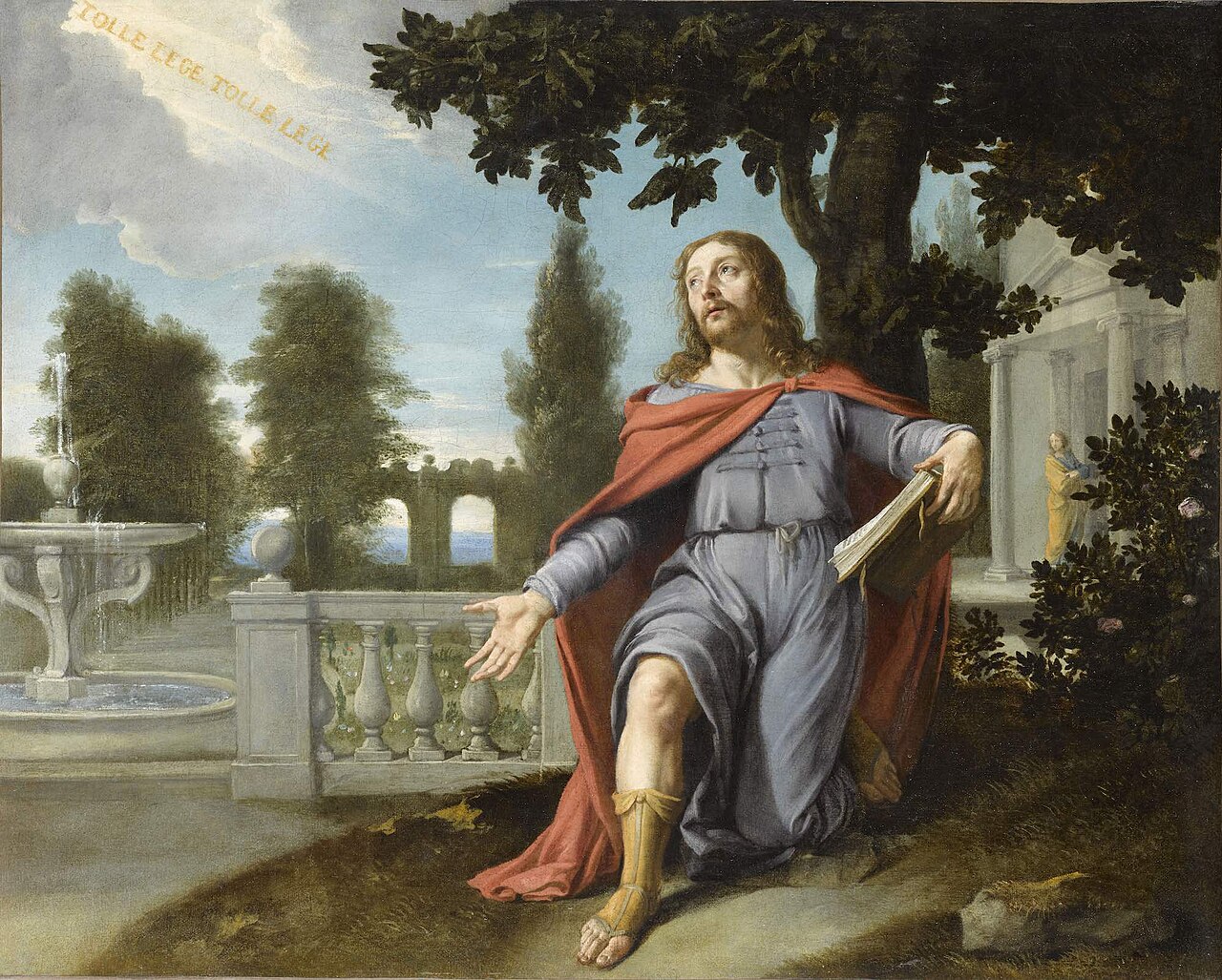
The Church has defended this truth against those who denied it. In the seventeenth century a movement called Jansenism, named after the Dutch bishop Cornelius Jansen, taught a severe version of Augustine’s theology, including the claim that Christ did not die for all people, but only for the elect. On 31 May 1653, Pope Innocent X condemned this and four other Jansenist propositions in the bull Cum occasione, declaring it heretical to say that Christ died or shed his blood only for the predestined. (The painting at the top of this article, by Philippe de Champaigne, hangs in the museum of Port-Royal, the convent that became the centre of Jansenism in France.)
3. Grace always comes first
Catholics believe, as firmly as any Calvinist, that grace comes first. No one can begin to believe, repent or do anything good for salvation unless God moves them first.
Jesus said: “No man can come to me, except the Father, who hath sent me, draw him” (John 6:44). Faith is not something we produce by ourselves; it is a response to God’s drawing.
This truth was defended in the great controversy with Pelagius in the early fifth century. Pelagius, a British monk living in Rome, taught that human beings could keep God’s commandments by their own natural strength. According to St Augustine, what first provoked him was a line from Augustine’s Confessions, a prayer to God: “Give what you command, and command what you will” (Confessions 10.29). When a bishop quoted this in Pelagius’s presence in Rome around 405, Pelagius objected angrily, because it seemed to him to excuse laziness, as if people could do nothing until God gave them the power. The controversy that followed shaped Christian thinking on grace for ever.
The Church took Augustine’s side. In 529 the Second Council of Orange, a council of bishops in southern Gaul, later confirmed by Pope Boniface II, taught that even the very beginning of faith, the first desire to believe, is a gift of grace, not something we achieve by our own effort. If anyone says that the increase of faith or its beginning is in us by nature and not by grace, the council declared, he contradicts the apostles.
4. But grace does not override freedom
Yet the Catholic Church also teaches that grace does not override human freedom. People really consent to God’s grace, and they can really refuse it.
Jesus himself expressed the sorrow of rejected love. Looking out over Jerusalem, he cried: “Jerusalem, Jerusalem, thou that killest the prophets… how often would I have gathered together thy children, as the hen doth gather her chickens under her wings, and thou wouldst not?” (Matthew 23:37). God wanted to save; Jerusalem refused.
St Stephen, the first Christian martyr, told the council in Jerusalem the same thing just before they stoned him: “You stiffnecked and uncircumcised in heart and ears, you always resist the Holy Ghost: as your fathers did, so do you also” (Acts 7:51). It is possible to resist the Holy Spirit.
At the Council of Trent, in its decree on justification of 13 January 1547, the Catholic Church condemned anyone who says that a person’s free will, moved and aroused by God, does not cooperate at all by assenting to God’s call, or “that it cannot refuse its consent if it would”, but is merely passive, like something lifeless (Session 6, canon 4). Grace invites and empowers; it does not compel.
5. No “double predestination”
The Catholic Church has repeatedly rejected what is called “double predestination”: the idea that God not only chooses some people for salvation, but also positively decrees others to sin and damnation.
The same council that so strongly defended the primacy of grace also condemned this idea. The Second Council of Orange in 529 declared: “We not only do not believe that any are foreordained to evil by the power of God, but even state with utter abhorrence that if there are those who want to believe so evil a thing, they are anathema.”
In the ninth century, a Saxon monk named Gottschalk of Orbais taught a strict “twofold” predestination: that God predestines the elect to life and the reprobate to death. His teaching was condemned at the synods of Mainz in 848 and Quierzy in 849. Gottschalk himself was publicly flogged, forced to burn his writings, and confined to a monastery for the rest of his life, where he died around 868 still holding his views. Few today would defend the harshness with which he was treated, whatever one thinks of his theology.
The Council of Trent again condemned anyone who says that “the grace of justification is attained only by those who are predestined unto life; but that all others who are called, are called indeed, but receive not grace, as being, by the divine power, predestined unto evil” (Session 6, canon 17). For Catholics, God’s grace is genuinely offered to all.
6. The Calvinist view, fairly stated
The Reformed (Calvinist) tradition holds that God, by his eternal decree, unconditionally chose some people for salvation and passed over others. Calvinists believe this magnifies the free grace of God and gives believers assurance that their salvation rests on God’s choice, not on their own wavering wills. This view deserves to be stated fairly.
John Calvin defined predestination in his Institutes of the Christian Religion as “God’s eternal decree, by which he determined with himself whatever he wished to happen with regard to every man. All are not created on equal terms, but some are preordained to eternal life, others to eternal damnation” (Institutes 3.21.5, 1559). Calvin himself called this a “dreadful decree”, but believed Scripture taught it.
In the early seventeenth century, a Dutch theologian named Jacobus Arminius and his followers argued that God’s election was based on his foreknowledge of who would freely believe. In 1618-1619, Reformed delegates from the Netherlands, Britain, Switzerland and Germany met at the Synod of Dort and rejected the Arminian view, affirming that God’s election is unconditional, not based on foreseen faith. The “canons of Dort” remain a standard of Reformed belief.
Not all Protestants agree with Calvin. The Lutherans, in the Formula of Concord of 1577, confessed God’s eternal election of his children to salvation, but explicitly refused to teach that God had decreed anyone to damnation. They taught that God’s grace is offered to all, and that those who are lost are lost by their own fault (Formula of Concord, article 11). On this point Lutherans are closer to Catholics than to Calvinists.
7. Romans 9
The strongest biblical text for the Calvinist view is Romans 9. There Paul writes that before Jacob and Esau were born, God chose Jacob, and quotes Scripture: “Jacob I have loved, but Esau I have hated.” He says that God hardened Pharaoh’s heart, and compares God to a potter, who has the right to make from the same clay “one vessel unto honour, and another unto dishonour” (Romans 9:10-21). Catholics take this passage seriously, but read it in its full context.
When Paul quotes “Jacob I have loved, but Esau I have hated”, he is quoting the prophet Malachi (Malachi 1:2-3), who was speaking centuries after the two brothers lived, about the two nations descended from them, Israel and Edom, and their role in history. The passage is about God’s freedom in choosing the people through whom he would work, not about the eternal destiny of every individual.
The Bible’s account of Pharaoh is also more complex than it first appears. Exodus says both that “Pharao… hardened his own heart” (Exodus 8:15) and that “the Lord hardened the heart of Pharao” (Exodus 9:12). Many interpreters, Catholic and Protestant, see God’s hardening as confirming a choice Pharaoh had already freely made.
Catholics also insist on reading Romans 9 together with chapters 10 and 11, which complete Paul’s argument. There Paul concludes: “God hath concluded all in unbelief, that he may have mercy on all” (Romans 11:32). Around 391, St John Chrysostom, preaching on Romans 9, explained that Paul’s image of the potter and clay was meant to silence arrogant questioning of God, and to teach humility, not to deny that human beings are free to respond to God (Homilies on Romans 16).
8. An open question within the Church
How exactly God’s sovereign grace and human freedom fit together is a mystery, and on some details Catholic theologians still legitimately differ.
In the late sixteenth century, a fierce debate broke out between Dominican and Jesuit theologians. The Dominicans, following St Thomas Aquinas as interpreted by the Spanish theologian Domingo Báñez, stressed that God’s grace is effective by its own power. The Jesuits, led by the Spanish theologian Luis de Molina, proposed in his book Concordia (Lisbon, 1588) that God knows what every person would freely choose in every possible situation, and arranges his plan accordingly, so that his providence is certain without overriding human freedom.
The debate grew so heated that each side accused the other of heresy. Rome set up a special commission, the Congregatio de Auxiliis (“Congregation on the Helps of Grace”), which held hearings for nine years, from 1598 to 1607. In the end, Pope Paul V declined to rule on the question. He allowed both views to be taught, and forbade each side to call the other heretical. The question remains open today.
The question can be painful as well as abstract. As a young student in Paris, around 1586-1587, St Francis de Sales, later bishop of Geneva and a Doctor of the Church, became convinced that he was among those predestined to damnation. For weeks he was tormented by despair and fell ill. The crisis ended when he knelt before a statue of Mary in a Paris church and prayed the Memorare, abandoning himself to God’s mercy: whatever God had decided, he would love him in this life. The despair lifted. Francis later became one of the gentlest guides of souls in Christian history.
9. Hope, not certainty or despair
No one can be absolutely certain of being among the predestined, the Church teaches. So Catholics live by hope, avoiding both presumption (assuming they are saved whatever they do) and despair (assuming they are lost).
The Council of Trent taught that “no one, so long as he is in this mortal life, ought so far to presume as regards the secret mystery of divine predestination, as to determine for certain that he is assuredly in the number of the predestinate”, unless God has given a special revelation (Session 6, chapter 12). This is a point of real difference from many Protestants, who teach the assurance of salvation.
But this is not a call to anxiety. St Paul told the Philippians: “with fear and trembling work out your salvation. For it is God who worketh in you, both to will and to accomplish, according to his good will” (Philippians 2:12-13). The fear and trembling are a reverent seriousness; the confidence is that God himself is at work in us.
The perfect expression of Catholic hope came from a young peasant woman on trial for her life. On 24 February 1431, at Rouen, the judges trying St Joan of Arc asked her a trick question: was she in God’s grace? If she said yes, she would be accused of presumption; if no, of admitting guilt. Joan answered: “If I am not, may God put me there; and if I am, may God so keep me.” The Catechism quotes her answer as a model of Christian hope (CCC 2005).
10. Respond to grace today
The practical answer to the question of predestination is simple: respond to God’s grace today. The door stays open until the very last moment.
The clearest proof is the criminal crucified beside Jesus. He had lived a life of crime. Dying on a cross, he turned to Jesus and said: “Lord, remember me when thou shalt come into thy kingdom.” Jesus answered: “Amen I say to thee, this day thou shalt be with me in paradise” (Luke 23:42-43). It was never too late.
Peter too shows that a fall is not final. On the night of Jesus’s arrest, he denied three times that he even knew him, and then, when the cock crowed, “going out, he wept bitterly” (Luke 22:62). After the resurrection, Jesus restored him, asking him three times, “Lovest thou me?”, and entrusting him with his flock (John 21:15-17).
And the greatest theologian of grace was himself a man who had resisted it for years. In the summer of 386, in a garden in Milan, Augustine, torn between his longing for God and his attachment to his old life, threw himself down under a fig tree and wept. He heard a child’s voice from a neighbouring house chanting, “Take up and read, take up and read.” He opened St Paul’s letters and read the first passage his eyes fell on: “put ye on the Lord Jesus Christ, and make not provision for the flesh in its concupiscences” (Romans 13:14). “No further would I read,” he wrote, “nor needed I” (Confessions 8.12). Grace had been at work all along; that day, Augustine said yes.
Frequently asked questions
Do Catholics believe God has already chosen who will be saved? Catholics believe God knows from eternity who will be saved, and that his plan includes each person’s free response. They do not believe God chooses anyone for damnation.
Is this the same as Calvinism? No. Catholics reject the idea that God decrees anyone to damnation, and teach that grace is truly offered to all and can be refused.
Can I know whether I am predestined? Not with absolute certainty, but you can have confident hope by trusting in God’s mercy and responding to his grace.
What if I am afraid I am damned? Talk to a priest. Fear of damnation can be a form of scrupulosity. See How Can Scrupulosity Be Treated? and Do Catholics Believe They Are Saved by Works?
Sources and further reading
- The Bible: Exodus 8:15; 9:12; Ezekiel 33:11; Malachi 1:2-3; Matthew 23:37; Luke 22:54-62; 23:39-43; John 6:44; 21:15-17; Acts 7:51; Romans 8:28-30; 9-11; 13:14; Ephesians 1:4-5; Philippians 2:12-13; 1 Timothy 2:1-4.
- Catechism of the Catholic Church, 600, 1037, 2005.
- Second Council of Orange (529); Synods of Mainz (848) and Quierzy (849); Council of Trent, Session 6 (1547), chapters 12-13 and canons 4, 17; Innocent X, Cum occasione (1653).
- St Augustine, Confessions 8.12 and 10.29; On the Gift of Perseverance; St John Chrysostom, Homilies on Romans 16.
- John Calvin, Institutes of the Christian Religion 3.21-24 (1559); Canons of Dort (1619); Formula of Concord (1577), article 11.
- Luis de Molina, Concordia (1588).
- Réginald Garrigou-Lagrange, Predestination (1936); Michael Pomazansky and others for Orthodox perspectives.
