Why Do Catholics Make the Sign of the Cross, and How Is It Done?
The sign of the cross is a short prayer made with the body: a confession of the Trinity and of Christ’s cross. Here is how to make it, where it comes from, and why it is not a charm.
You have probably seen it: a footballer crossing himself before taking a penalty, a woman touching her forehead and shoulders as she passes a church, a family at a restaurant pausing before a meal. If you are not Catholic, you may wonder what it means. Is it a prayer? A superstition? A lucky charm? Is it in the Bible? This article explains what the sign of the cross is and how to make it, its roots in Scripture, how early Christians used it, its link to baptism, the fair objection that the Bible never commands it, why it is not a charm, how Catholics use it to bless, the courage it has sometimes taken, and why anyone is welcome to make it.
1. A prayer made with the body
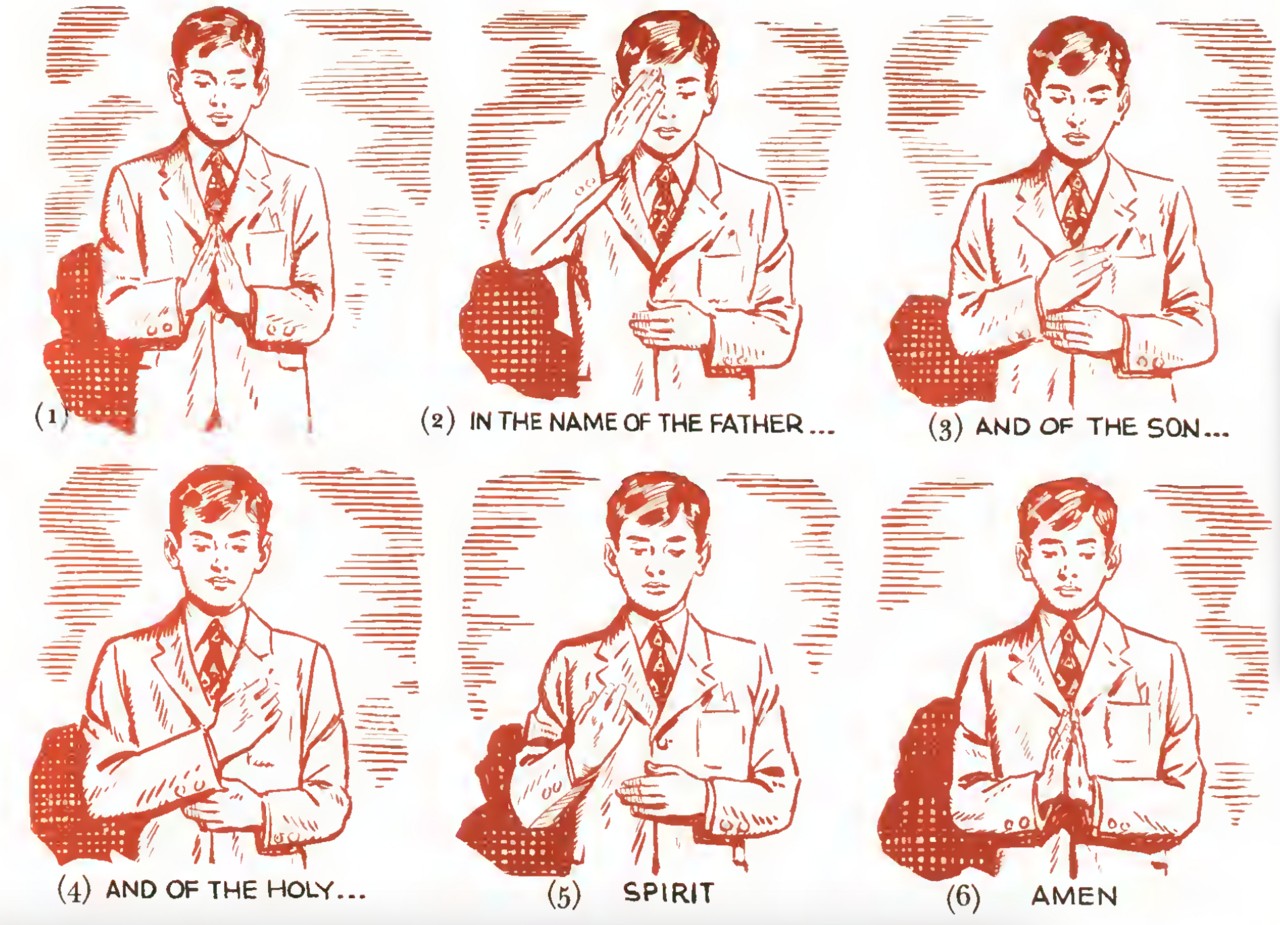
The sign of the cross is a short prayer made with the whole body. A Catholic traces the shape of a cross on himself or herself while saying: “In the name of the Father, and of the Son, and of the Holy Spirit. Amen.” In one small gesture, it confesses the two central mysteries of the Christian faith: who God is (the Trinity) and how he saved us (through the cross of Christ).
The words come directly from Jesus. After his resurrection, he sent his apostles to “teach ye all nations; baptizing them in the name of the Father, and of the Son, and of the Holy Ghost” (Matthew 28:19). Every time Catholics make the sign of the cross, they repeat the words of their baptism.
The gesture itself expresses St Paul’s great boast: “God forbid that I should glory, save in the cross of our Lord Jesus Christ; by whom the world is crucified to me, and I to the world” (Galatians 6:14). The cross was a shameful instrument of execution; Christians mark themselves with it because they believe it became the means of their salvation.
The Catechism of the Catholic Church encourages Christians to begin their day, their prayers and their activities with the sign of the cross, so as to dedicate everything to God, “in the name of the Father and of the Son and of the Holy Spirit”, and to strengthen themselves in temptation and difficulty (CCC 2157).
2. How it is done
In the Latin (Roman) Catholic Church, the sign is made with the right hand, usually with the fingers held together or the hand open. You touch your forehead (“In the name of the Father”), then your breast or stomach (“and of the Son”), then your left shoulder and right shoulder (“and of the Holy Spirit”), and finish by saying “Amen”, often joining the hands.
Eastern Christians, Orthodox and Eastern Catholic alike, make the sign from right shoulder to left, usually with the thumb and first two fingers joined (for the Trinity) and the other two folded into the palm (for the two natures of Christ). In the late twelfth century, Pope Innocent III, in a treatise on the Mass, described the sign being made with three fingers from right to left, as the Eastern Christians still do, and noted that some people in the West had begun to make it from left to right (De sacro altaris mysterio 2.45). Both ways are ancient and legitimate.
Small details can matter deeply to people. In the 1650s and 1660s, Patriarch Nikon of Moscow reformed the Russian liturgy to match Greek practice, including changing the sign of the cross from two fingers to three. Many Russians refused to change the way their ancestors had prayed. These “Old Believers” broke away from the Russian Orthodox Church rather than alter the gesture, and many suffered persecution and exile for it. Their communities still exist today.
Catholics also make an older, smaller form of the sign. At Mass, when the deacon or priest announces the Gospel, everyone traces a small cross with the thumb on the forehead, the lips and the breast (General Instruction of the Roman Missal 134). The meaning is often explained as a silent prayer: may the Gospel be in my mind, on my lips and in my heart.
3. God marks those who belong to him
The sign of the cross grows out of a striking picture in Scripture: God marking the foreheads of those who belong to him.
In a vision, the prophet Ezekiel saw God’s judgement coming upon Jerusalem. Before it fell, God told a man dressed in linen: “Go through the midst of the city… and mark Thau upon the foreheads of the men that sigh, and mourn for all the abominations.” Those who bore the mark were spared (Ezekiel 9:4-6). The mark was the Hebrew letter tav, the last letter of the alphabet, which in the ancient Hebrew script was written as a cross, like an X or a +.
The Book of Revelation returns to this image. John saw an angel crying out, “Hurt not the earth… till we sign the servants of our God in their foreheads.” Later he saw the redeemed standing with the Lamb on Mount Zion, “having his name, and the name of his Father, written on their foreheads” (Revelation 7:3; 14:1).
The early Christians made the connection explicitly. Around 208, the North African writer Tertullian pointed out that the letter tav in Ezekiel’s vision was the shape of a T, a cross, and that the prophet had thus foretold the sign that Christians would bear on their foreheads (Against Marcion 3.22).
4. Christians signed themselves by 200
The sign of the cross is not a medieval invention or the result of a papal decree. Christians were signing themselves by about the year 200.
Around 211, Tertullian described how ordinary Christians used the sign in everyday life: “At every forward step and movement, at every going in and out, when we put on our clothes and shoes, when we bathe, when we sit at table, when we light the lamps, on couch, on seat, in all the ordinary actions of daily life, we trace upon the forehead the sign” (De Corona 3). For early Christians, the sign was woven through the whole day.
Around 350, St Cyril of Jerusalem told adults preparing for baptism not to be ashamed of the cross of Christ. “Let us not then be ashamed to confess the Crucified,” he said. “Be the cross our seal made with boldness by our fingers on our brow, and on everything; over the bread we eat, and the cups we drink; in our comings in, and goings out; before our sleep, when we lie down and when we rise up” (Catechetical Lecture 13.36).
Around 375, St Basil the Great, defending traditions that had been handed down in the Church without being written in Scripture, gave the sign of the cross as his first example. Nobody, he pointed out, had taught in writing that those who hope in Christ should sign themselves with the cross, yet all Christians did so, having received it from the apostles’ tradition (On the Holy Spirit 27.66).
5. First given at baptism
For Catholics, the sign of the cross is first given at baptism, so every time it is repeated, it recalls that the person has been claimed for Christ.
In the Catholic rite of baptism for children, before the baptism itself, the priest welcomes the child and says, “the Christian community welcomes you with great joy. In its name I claim you for Christ our Saviour by the sign of his cross.” Then he traces a cross on the child’s forehead, and invites the parents and godparents to do the same (Rite of Baptism for Children, 1969).
St Augustine remembered receiving this sign as a small boy, long before he was baptised. In his Confessions, he recalled that from his birth his Christian mother had seen to it that he was “signed with the sign of his cross” and seasoned with blessed salt, as a catechumen, a candidate for baptism (Confessions 1.11). He was not baptised until he was thirty-two, but the sign had marked him from childhood.
St Paul explains why the cross marks a Christian’s beginning: “all we, who are baptized in Christ Jesus, are baptized in his death. For we are buried together with him by baptism into death; that as Christ is risen from the dead by the glory of the Father, so we also may walk in newness of life” (Romans 6:3-4).
6. “The Bible never commands it”
The fair objection is that Scripture never commands Christians to make the sign of the cross, and that Jesus warned against empty ritual. The answer is that it is a custom, not a command, and that many Protestant Reformers kept it as fitting.
Jesus did warn against religious gestures that are only outward. Quoting Isaiah, he said: “This people honoureth me with their lips, but their heart is far from me. And in vain do they worship me, teaching doctrines and precepts of men” (Mark 7:6-7). Any Catholic who crosses himself thoughtlessly should take that warning to heart.
But the early Reformers did not reject the sign of the cross. Martin Luther’s Small Catechism of 1529 includes instructions for morning and evening prayers in the home: “In the morning, when you rise, you shall bless yourself with the holy cross and say: In the name of God the Father, Son and Holy Ghost. Amen.” Many Lutherans still make the sign today.
In England, the Puritans wanted to abolish the sign of the cross in baptism, along with other “popish” ceremonies. In 1603 they presented the Millenary Petition to King James I asking for its removal. The Church of England refused. In 1604, its new Canons defended the use of the cross in baptism at length as an ancient and lawful custom, explaining that it is not part of the substance of the sacrament but an honourable sign of dedication to Christ (Canon 30).
7. A prayer, not a charm
The sign of the cross is a prayer, not a charm. Without faith, the movement of the hand does nothing, and the Church says so plainly.
The Acts of the Apostles tells a cautionary story. In Ephesus, seven sons of a Jewish priest named Sceva saw Paul driving out evil spirits in the name of Jesus, and tried to copy him, using the name as a formula: “I conjure you by Jesus, whom Paul preacheth.” The evil spirit answered, “Jesus I know, and Paul I know; but who are you?” The man possessed by it leapt on them and overpowered them, and they fled naked and wounded (Acts 19:13-16). Holy words and signs used without faith have no power.
Around 390, St John Chrysostom warned his congregation in Antioch about this very danger. He urged them to make the sign of the cross not merely with the finger, but first with the will and with great faith. If you trace it on your face in this way, he said, no unclean spirit will be able to stand against you (Homilies on Matthew 54).
The Catechism explains that the sign of the cross belongs to the “sacramentals”, sacred signs instituted by the Church. Unlike the seven sacraments, sacramentals do not confer grace by the power of the rite itself. They prepare people to receive grace and dispose them to cooperate with it, through the prayer of the Church and the faith of the one who uses them (CCC 1670).
8. A blessing for everything
Because it is a sacramental and a custom, not a dogma, the sign of the cross is used to bless people, meals, journeys, homes and the start of prayer.
Every Christian blessing echoes Jesus’s last action on earth. Luke tells us that at the Ascension, Jesus “lifting up his hands, he blessed them. And it came to pass, whilst he blessed them, he departed from them, and was carried up to heaven” (Luke 24:50-51). Priests bless people by making the sign of the cross over them; parents trace it on their children’s foreheads at bedtime.
Christians have long told stories of the sign’s protection. Pope St Gregory the Great, writing around 593, tells of St Benedict, the father of Western monasticism. Some monks who resented his strict discipline put poison in his wine. When the glass was brought to Benedict, he made the sign of the cross over it as he blessed it, and the glass shattered as though struck by a stone. Benedict understood that it had held a drink of death (Dialogues 2.3).
A gentler story comes from Lourdes. On 11 February 1858, fourteen-year-old Bernadette Soubirous saw a beautiful lady in the grotto of Massabielle. Frightened, she took out her rosary and tried to make the sign of the cross, but she could not raise her hand. Only when the lady herself made the sign of the cross could Bernadette do it too. She said afterwards that the lady made the sign so beautifully that she wished she could make it like that.
9. A quiet act of witness
Made in public, the sign of the cross is a quiet act of witness, and in some times and places it has taken courage.
Jesus said: “he that shall be ashamed of me and of my words, of him the Son of man shall be ashamed, when he shall come in his majesty” (Luke 9:26). For many Christians, crossing themselves before a meal in a public restaurant or before a test at school is a small way of not being ashamed of Christ.
The desert monks used the sign against fear. Around 360, St Athanasius wrote the life of St Antony of Egypt, the father of Christian monasticism. Antony taught his monks that when they were frightened by the attacks of demons, they should not be afraid, but should “sign yourselves and your houses” with the cross and pray, and the enemy would vanish (Life of Antony 35).
Even an apostate could not shake off the habit. The Emperor Julian, raised a Christian, abandoned the faith and tried to restore paganism in the Roman Empire. St Gregory of Nazianzus, who had known him as a student, recorded a strange story. During a secret pagan ritual in an underground shrine, Julian was terrified by fearful sights and, out of old habit, made the sign of the cross. The apparitions vanished (Oration 4.55-56). Whatever we make of the story, it shows how deeply the sign was rooted in Christian life.
10. Anyone may make it
Anyone may make the sign of the cross. Many Lutherans and Anglicans do, and a visitor at a Catholic Mass is free to join in, or simply to watch.
Every Catholic Mass begins with the priest and people signing themselves together, as the priest says, “In the name of the Father, and of the Son, and of the Holy Spirit”, and the people answer “Amen” (General Instruction of the Roman Missal 50). It ends with the priest blessing the people in the same form, tracing a cross over them (GIRM 167). The whole Mass is framed by the sign of the cross.
Some Protestant churches have recovered the practice. The Evangelical Lutheran Worship book of the Evangelical Lutheran Church in America (2006) invites the whole congregation to make the sign of the cross at various points of the service, as a reminder of baptism.
Jesus himself praised a man who prayed with a bodily gesture. In his parable of the Pharisee and the tax collector, the tax collector, “standing afar off, would not so much as lift up his eyes towards heaven; but struck his breast, saying: O God, be merciful to me a sinner.” Jesus said that this man, rather than the Pharisee, “went down into his house justified” (Luke 18:13-14). Our bodies can pray too.
Frequently asked questions
Is it wrong for a non-Catholic to make the sign of the cross? No. It is a Christian prayer, and many Protestants, Orthodox and Anglicans make it.
Which way is correct, left to right or right to left? Both are ancient. Latin Catholics go from the left shoulder to the right; Eastern Christians from the right to the left.
Why do athletes cross themselves? For many it is a brief prayer for help or thanksgiving. Used with faith, it is a good prayer; used as a lucky charm, it misses the point.
When do Catholics make the sign of the cross? At the beginning and end of prayers, at Mass, when entering a church with holy water, before meals, and at moments of need. See Why Do Catholics Use Holy Water?
Sources and further reading
- The Bible: Ezekiel 9:4-6; Matthew 28:19; Mark 7:6-8; Luke 9:23-26; 18:13-14; 24:50-51; Acts 19:13-16; Romans 6:3-4; Galatians 6:14; Revelation 7:3; 14:1.
- Catechism of the Catholic Church, 1235, 1668-1671, 2157.
- General Instruction of the Roman Missal 50, 134, 167; Rite of Baptism for Children (1969).
- Tertullian, Against Marcion 3.22 and De Corona 3; St Cyril of Jerusalem, Catechetical Lecture 13.36; St Basil, On the Holy Spirit 27.66; St Athanasius, Life of Antony 35; St Gregory Nazianzen, Oration 4; St John Chrysostom, Homilies on Matthew 54; St Augustine, Confessions 1.11; St Gregory the Great, Dialogues 2.3.
- Innocent III, De sacro altaris mysterio 2.45.
- Martin Luther, Small Catechism (1529); Church of England, Canons of 1604, Canon 30.
- Bert Ghezzi, The Sign of the Cross: Recovering the Power of the Ancient Prayer (2004).
