
Why Don’t Catholics Go by the Bible Alone? Scripture, Tradition and Authority
Catholics believe the Bible is God’s word, but not “the Bible alone”. Here is what Scripture, Tradition and the Church’s teaching office mean, the fair Protestant case, and the Catholic answer.
If you are a Bible-believing Protestant, you may have been taught that the Catholic Church puts human tradition above God’s word, and that Catholics believe whatever the Pope says rather than what the Bible says. If you are a Catholic, you may have been asked, “Where is that in the Bible?” and found yourself unable to explain why the Bible alone is not the Catholic rule of faith. This article tries to help both. It explains what Catholics mean by Scripture, Tradition and the Church’s teaching office; what Protestants mean by sola scriptura, stated fairly; and the main reasons Catholics give for their view: that Jesus founded a Church rather than writing a book, that the Bible does not tell us which books belong in it, that heretics have always quoted Scripture, and that the Bible alone has not produced agreement. It also faces the strongest Protestant objections and the Church’s own failures.
1. What Catholics believe
Catholics believe that the Bible is the inspired word of God, and that it teaches without error the truth God wanted recorded for our salvation. They read it at every Mass and are urged to read it every day. But they believe that God’s word reaches us through two channels, Scripture and Tradition, which together form one “deposit of faith”, interpreted with authority by the Church’s teaching office.
They find this pattern in the New Testament itself. St Paul, writing to the Christians of Thessalonica, said: “stand fast; and hold the traditions, which you have learned, whether by word, or by our epistle” (2 Thessalonians 2:15). Paul put his spoken teaching and his letters side by side, as equally authoritative.
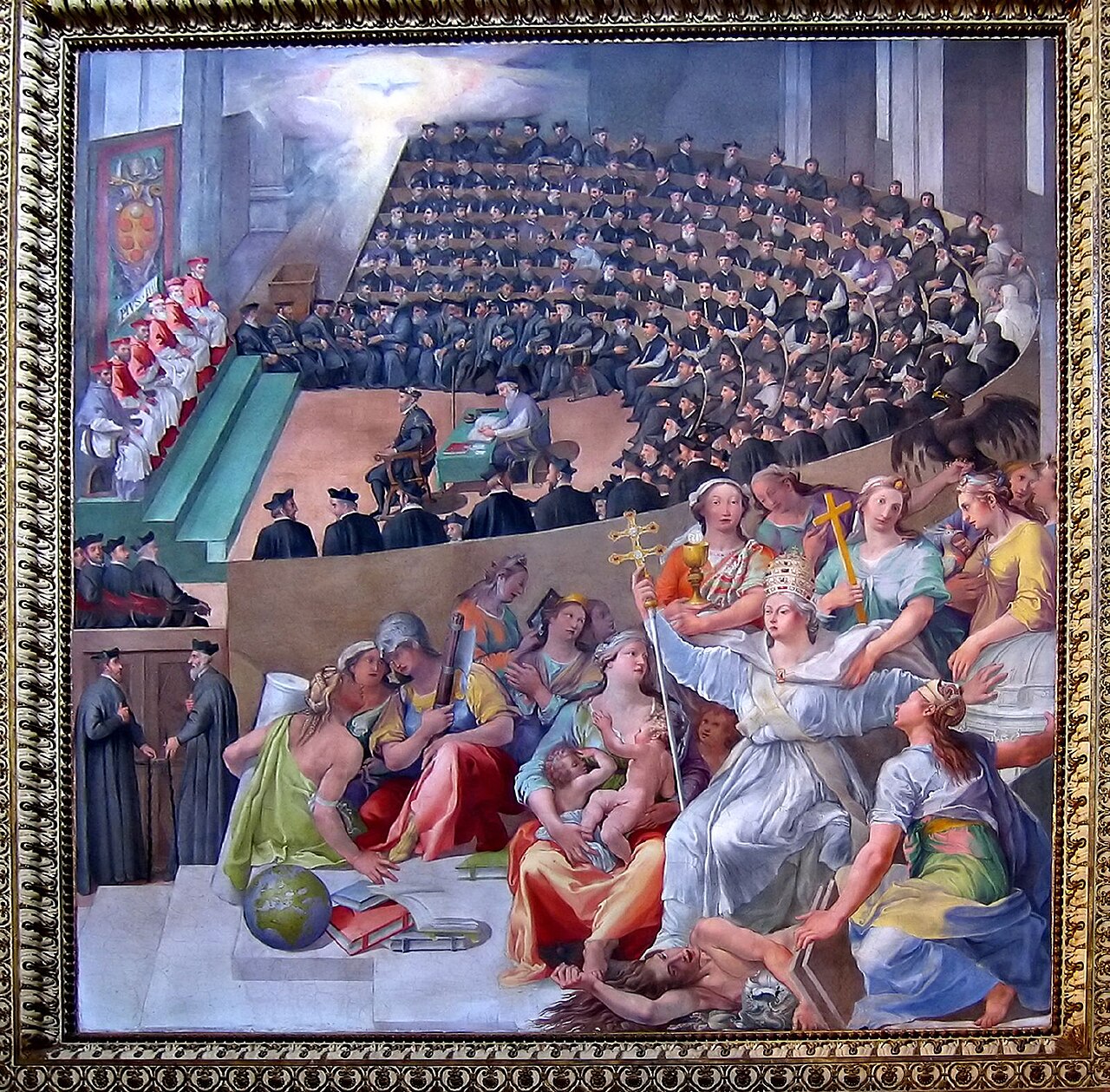
On 8 April 1546, the Council of Trent taught that the truth of the Gospel “is contained in the written books, and the unwritten traditions which, received by the Apostles from the mouth of Christ himself, or from the Apostles themselves, the Holy Ghost dictating, have come down even unto us, transmitted as it were from hand to hand” (Session 4).
The Second Vatican Council explained this with a beautiful image. Sacred Tradition and Sacred Scripture, it said, “flowing from the same divine wellspring, in a certain way merge into a unity and tend toward the same end”. Together they form “one sacred deposit of the word of God, committed to the Church” (Dei Verbum 9-10). They are not two separate sources competing with each other, but two streams from one spring.
2. What “Scripture alone” means, fairly stated
To be fair, sola scriptura (“Scripture alone”) does not mean that Protestants ignore the creeds, Christian teachers or church history. Most Protestant churches value the ancient creeds and learn from the Church Fathers. What sola scriptura means is that the Bible is the only infallible rule of faith, the final court of appeal over every other authority.
The principle was dramatically expressed by Martin Luther on 18 April 1521 at the Diet of Worms, when he was ordered to recant his writings before the Emperor. He refused, saying that unless he was convinced by Scripture or by clear reason, since popes and councils had often erred and contradicted each other, his conscience was “captive to the Word of God”.
Protestants find support in the example of the Jews of Beroea in Greece. When Paul preached to them, Luke says, they “received the word with all eagerness, daily searching the scriptures, whether these things were so” (Acts 17:11). They tested even an apostle’s preaching against the Scriptures, and were praised for it.
The Westminster Confession of Faith of 1646, the classic statement of Presbyterian belief, puts the principle clearly: “The supreme judge by which all controversies of religion are to be determined… can be no other but the Holy Spirit speaking in the Scripture” (1.10). Catholics should understand this view at its best, not as a caricature.
3. Jesus wrote no book
The first Catholic reply is historical: Jesus did not write a book or tell his apostles to write one. He founded a Church and sent his apostles to preach. The Christian faith was believed, lived and celebrated for years before any of the New Testament was written.
When the risen Jesus commissioned his apostles on a mountain in Galilee, he told them: “Going therefore, teach ye all nations; baptizing them… Teaching them to observe all things whatsoever I have commanded you” (Matthew 28:19-20). He gave them authority to teach and baptise. He said nothing about writing.
The earliest book of the New Testament, St Paul’s First Letter to the Thessalonians, was written around AD 50, about twenty years after the resurrection. It was written to a church that already believed, worshipped and lived as Christians, having received the Gospel from Paul’s preaching. The Gospels came later still, probably between about 65 and 100.
Even after the apostles’ writings existed, early Christians valued the living voice of those who had known them. Papias, bishop of Hierapolis in Asia Minor in the early second century, knew people who had heard the apostles. He wrote that whenever anyone came who had been a follower of the elders, he asked what Andrew or Peter or John had said, “for I did not think that what was to be gotten from the books would profit me as much as what came from the living and abiding voice” (quoted in Eusebius, Church History 3.39).
4. Who decided which books are in the Bible?
The second Catholic reply is perhaps the strongest. The Bible contains no inspired list of its own books. Nowhere does Scripture tell us that there should be twenty-seven books in the New Testament, or which ones. Christians know which writings are Scripture because the Church, guided by the Holy Spirit, discerned them over several centuries.
For a long time Christians disagreed about some books. The Muratorian Fragment, an early list of New Testament books probably from Rome around 170-200, accepts most of the books we have, but does not mention Hebrews, James or 1 and 2 Peter. It also mentions an “Apocalypse of Peter”, noting that some do not want it read in church.
The first surviving list with exactly our twenty-seven New Testament books comes from St Athanasius, bishop of Alexandria, in his annual Easter letter of 367 (Festal Letter 39), more than three hundred years after Christ. Councils in North Africa confirmed the same list in the 390s.
Even after that, the question was not entirely closed in everyone’s mind. In his preface to the New Testament of September 1522, Luther questioned four New Testament books: Hebrews, James, Jude and Revelation. He famously called the Letter of James “an epistle of straw” compared with the great letters of Paul, because it seemed to him to teach justification by works. He printed these four books at the end of his New Testament, without numbers. Catholics ask: if the Bible alone is our authority, how do we know which books are the Bible?
5. Heretics have always quoted Scripture
A third Catholic reply is that heretics have always quoted the Bible. When disputes arose in the early Church, the answer was not simply “read the Bible”, but “what have the apostles’ churches always taught?”
Even the devil quoted Scripture. When he tempted Jesus to throw himself down from the pinnacle of the Temple, he quoted Psalm 91: “He hath given his angels charge over thee, and in their hands shall they bear thee up” (Matthew 4:6). Using the Bible’s words does not guarantee using them rightly.
In the second century, Gnostic teachers quoted Scripture constantly, while teaching that the material world was evil and that salvation came through secret knowledge. Around 180, St Irenaeus of Lyons answered them not only with Scripture, but by pointing to the public teaching handed down openly in the churches founded by the apostles, through the succession of their bishops. If the apostles had secret teachings, he argued, they would have handed them to the men they trusted with the churches (Against Heresies 3.3-4).
The same thing happened in the fourth century. Arius, a priest of Alexandria, taught that the Son of God was a created being, and he quoted Bible verses to prove it, such as “the Father is greater than I” (John 14:28). In 325 the bishops at the Council of Nicaea found that every biblical phrase they proposed could be twisted by the Arians. So they used a non-biblical word, homoousios, “consubstantial” or “of one substance”, to protect the Bible’s true meaning: that the Son is God as the Father is God. Nearly all Christians, Protestants included, accept that decision today.
6. The Bible points to a living authority
Catholics also argue that Scripture itself points beyond itself to a living authority in the Church.
St Paul wrote to Timothy that he wanted him to know how to behave “in the house of God, which is the church of the living God, the pillar and ground of the truth” (1 Timothy 3:15). For Paul, the Church is what holds up and supports the truth.
Jesus himself gave the Church authority to settle disputes. Speaking of a brother who sins and will not listen, he told his disciples, “if he will not hear them: tell the church. And if he will not hear the church, let him be to thee as the heathen and publican.” Then he added, “whatsoever you shall bind upon earth, shall be bound also in heaven” (Matthew 18:17-18).
The early Church acted on this. In 451, when bishops gathered at Chalcedon to settle a fierce dispute about how Christ could be both God and man, they heard a letter from Pope Leo the Great explaining that Christ is one person in two natures. When it was read, the bishops cried out, “Peter has spoken through Leo!” The question was settled not by each bishop’s private reading of Scripture, but by the Church, in council, with Peter’s successor.
7. “Scripture is sufficient, and Jesus condemned tradition”
Protestants raise two strong objections. The first is that Jesus condemned tradition. The second is that Scripture is sufficient.
On the first: Jesus did condemn certain traditions. He rebuked the Pharisees for a custom called corban, by which a man could declare his property dedicated to God and so avoid supporting his elderly parents. He accused them of “making void the word of God by your own tradition” (Mark 7:8-13). Catholics agree entirely that any human custom contradicting God’s commands must be rejected. But they distinguish such human traditions from the apostolic Tradition Paul told the Thessalonians to keep.
On the second: Protestants often quote Paul’s words to Timothy: “All scripture, inspired of God, is profitable to teach, to reprove, to correct, to instruct in justice, that the man of God may be perfect” (2 Timothy 3:16-17). Catholics fully agree that all Scripture is inspired and profitable. But they note that Paul was speaking of the Scriptures Timothy had known “from thy infancy” (3:15), the Old Testament, before most of the New Testament was written; and that “profitable” does not mean “the only thing needed”.
Catholics must also admit that Church authorities have sometimes misread Scripture badly. In 1633 the Holy Office condemned Galileo Galilei, partly on the basis of a mistaken literal reading of biblical passages about the sun moving. On 31 October 1992, Pope John Paul II publicly acknowledged that the theologians who condemned Galileo had failed to grasp the difference between the Bible’s purpose and scientific questions.
8. The Bible alone has not produced agreement
A further Catholic argument is practical. If the Bible alone were enough, we might expect sincere, prayerful Christians reading it to agree on its essentials. In fact, they have divided over baptism, the Eucharist and much else, and often violently.
The first great test came only twelve years after Luther’s theses. In October 1529, Luther and the Swiss reformer Huldrych Zwingli met at Marburg. Both held to Scripture alone. Both were learned, sincere and devout. Yet they could not agree on what Jesus meant by “This is my body”, and they parted without unity.
Others read their Bibles and concluded that infants should not be baptised. In Zurich, Felix Manz, a scholar of Hebrew, found no infant baptism in the New Testament and began baptising adult believers. On 5 January 1527 the Reformed city council of Zurich, which also held to Scripture alone, had him bound and drowned in the river Limmat, a cruel mockery of his teaching on baptism.
The problem was not only theological. In the United States, the Methodist Episcopal Church split into northern and southern churches in 1844, and Baptists divided in 1845, with the formation of the Southern Baptist Convention. In both cases, the issue was slavery, and both sides argued passionately from Scripture. Catholics do not claim that Church authority solves every problem; but they argue that Christ did not leave his people with a book and no one authorised to interpret it.
9. What Tradition does not mean
It is important to be clear about what Catholics do not mean by Tradition. Tradition does not mean customs, such as eating fish on Friday or Christmas decorations; the Church calls these “traditions” with a small “t”, and they can change. It does not mean secret teachings added to the Gospel. And it does not mean that popes and bishops can invent new doctrines.
The Church’s leaders are themselves subject to the word of God. Even in the New Testament, an apostle could be corrected. Paul tells how, at Antioch, Peter stopped eating with Gentile Christians for fear of criticism. “I withstood him to the face, because he was to be blamed,” Paul writes, because his conduct was not in line with the truth of the Gospel (Galatians 2:11-14).
The First Vatican Council, which defined papal infallibility in 1870, was careful to state its limits. “The Holy Spirit was promised to the successors of Peter,” it taught, “not so that they might, by his revelation, make known some new doctrine, but that, by his assistance, they might religiously guard and faithfully expound the revelation or deposit of faith transmitted by the apostles” (Pastor Aeternus, chapter 4).
The Second Vatican Council put it even more plainly: “this teaching office is not above the word of God, but serves it, teaching only what has been handed on” (Dei Verbum 10). The Church does not own the word of God; it is its servant.
10. Test it for yourself
The best way to weigh these arguments is to test them: read the Bible alongside the earliest Christian writers, those who lived in the first centuries after the apostles, and see what kind of Church they describe.
After his resurrection, Jesus himself “opened their understanding, that they might understand the scriptures”, explaining that everything written about him in the Law, the Prophets and the Psalms had to be fulfilled. Then he sent them out as witnesses (Luke 24:44-48). From the beginning, Scripture was understood within the community Christ formed.
Many people who have made this test have reached surprising conclusions. In the 1830s and 1840s, John Henry Newman, a brilliant Anglican scholar at Oxford, spent years reading the Church Fathers in order to defend the Church of England. Instead, he became convinced that the Catholic Church was the true heir of the early Church. In 1845 he wrote, in his Essay on the Development of Christian Doctrine: “To be deep in history is to cease to be a Protestant.” He was received into the Catholic Church that year.
A more recent example is Francis Beckwith, a philosopher at Baylor University in Texas. Raised Catholic, he became an evangelical as a young man, and in 2006 was elected president of the Evangelical Theological Society, one of the leading associations of evangelical scholars. Reading the early Church Fathers and Catholic writers, he was drawn back to the Catholic Church. In spring 2007 he was received back into full communion and resigned the presidency, explaining his journey in Return to Rome (2009). Not everyone who makes the test reaches the same conclusion, but it is a test worth making.
Frequently asked questions
Do Catholics believe the Bible is the word of God? Yes. The Church teaches that Scripture is inspired by God and teaches without error the truth God wanted put into the sacred writings for our salvation.
Is Tradition above Scripture? No. Scripture and Tradition together form one deposit of faith, and the Church’s teaching office is the servant of both.
Can the Pope change doctrine? No. He can define and explain what has been handed down from the apostles, but he cannot invent new doctrine.
Where can I read the early Church Fathers? Many are available free online, including the letters of Ignatius of Antioch, the Didache and Irenaeus’s Against Heresies. See also Who Founded the Catholic Church?
You may also like What Bible Do Catholics Use? and Why Did Jesus Call Peter a Rock?
Sources and further reading
- The Bible: Matthew 4:5-7; 18:15-18; 28:18-20; Mark 7:8-13; Luke 24:44-48; John 14:28; Acts 17:10-12; Galatians 2:11-14; 2 Thessalonians 2:15; 1 Timothy 3:15; 2 Timothy 3:14-17.
- Council of Trent, Session 4 (8 April 1546); First Vatican Council, Pastor Aeternus (1870), ch. 4; Second Vatican Council, Dei Verbum (1965), 7-10.
- Catechism of the Catholic Church, 74-100.
- Westminster Confession of Faith (1646), 1.10.
- St Irenaeus, Against Heresies 3.3-4; Eusebius, Church History 3.39 (Papias); St Athanasius, Festal Letter 39; Muratorian Fragment.
- Martin Luther, Preface to the New Testament (1522).
- John Paul II, Address to the Pontifical Academy of Sciences on the Galileo case (31 October 1992).
- John Henry Newman, An Essay on the Development of Christian Doctrine (1845); Francis J. Beckwith, Return to Rome (2009).
- Keith A. Mathison, The Shape of Sola Scriptura (2001), for a careful Protestant account.
