
Do Catholics Read the Bible? What Really Happens at Mass and at Home
Yes, the Church urges every Catholic to read Scripture, and the Mass is full of it. Here is what happens at Mass and at home, the honest history, and how to start reading today.
Many evangelical and other Protestant Christians have had the same puzzling experience: they meet a Catholic friend who goes to Mass every week, but who cannot find John 3:16 or says they have never read the Bible through. Some have also heard that the Catholic Church kept the Bible from its people, chained it up in churches, or burned those who translated it. So do Catholics read the Bible? The honest answer is: the Church strongly urges every Catholic to read Scripture and fills its worship with it, but many Catholics do read it too little on their own. This article explains how much Scripture a Catholic hears at Mass, how the Church’s prayer is built on the Bible, the long history of Catholics copying and translating Scripture, the real failures in that history, recent popes’ calls to read the Bible daily, and how anyone can start.
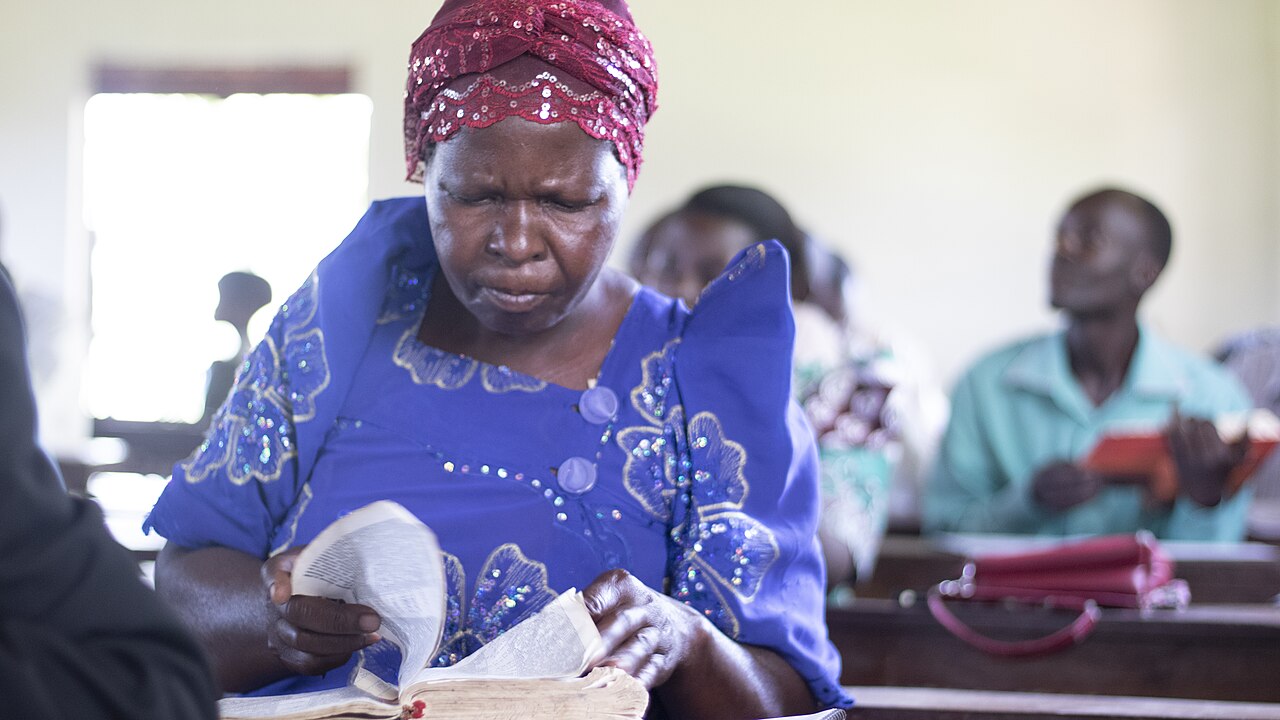
1. Yes, though many Catholics read too little
The Catholic Church officially urges all its members to read the Bible. In 1965 the Second Vatican Council “earnestly and especially” urged all the Christian faithful to learn “the surpassing knowledge of Jesus Christ” by frequent reading of the divine Scriptures. It quoted a famous line from St Jerome, the fourth-century biblical scholar: “Ignorance of the Scriptures is ignorance of Christ” (Dei Verbum 25).
Still, it would be dishonest to pretend that all Catholics live up to this. In 2014 the Pew Research Center’s large Religious Landscape Study in the United States found that about a quarter of Catholics (25 per cent) said they read Scripture at least once a week outside religious services, compared with about six in ten evangelical Protestants (63 per cent). Evangelicals who meet Catholics unfamiliar with the Bible are not imagining things.
Yet the Catholic ideal is clear, and it goes back to Jesus himself. At the synagogue in Nazareth, Luke tells us, Jesus “rose up to read. And the book of Isaias the prophet was delivered unto him.” He unrolled the scroll, read aloud the prophecy of the Spirit anointing one to preach good news to the poor, sat down, and said, “This day is fulfilled this scripture in your ears” (Luke 4:16-21). Jesus read the Scriptures in public worship and explained them. That is what the Church still does at every Mass.
2. A lot of Bible at every Mass
Whatever their private reading habits, Catholics who go to Mass hear a great deal of Scripture. Every Sunday Mass includes a reading from the Old Testament (or, at Easter time, from the Acts of the Apostles), a Psalm sung or said in response, a reading from the New Testament letters, and a reading from one of the Gospels. The homily is meant to explain the readings.
This pattern is ancient. Around 155, St Justin Martyr wrote to the Roman emperor to explain what Christians did on Sundays. “On the day called Sunday,” he wrote, “all who live in cities or in the country gather together to one place, and the memoirs of the apostles or the writings of the prophets are read, as long as time permits.” Then the presider preached, urging people to imitate what they had heard (First Apology 67).
After the Second Vatican Council asked that “the treasures of the Bible are to be opened up more lavishly” (Sacrosanctum Concilium 51, 1963), the Church introduced a new Lectionary in 1969, with readings arranged in a three-year cycle for Sundays and a two-year cycle for weekdays. A Catholic who attends Mass every Sunday for three years hears most of the four Gospels and large parts of the rest of the Bible. Daily Mass-goers hear even more.
The new cycle was so well regarded that many Protestant churches adopted an adapted version of it. The Revised Common Lectionary of 1992, used by many Anglican, Lutheran, Methodist, Presbyterian and other churches, is based directly on the Catholic one. On many Sundays, Catholics and Protestants around the world hear the same Bible readings.
3. The Mass is woven from Scripture
Even beyond the readings, the prayers of the Mass are themselves woven from Scripture. A Catholic who knows the Mass by heart knows more of the Bible than he or she may realise.
Just before Communion, Catholics say together: “Lord, I am not worthy that you should enter under my roof, but only say the word and my soul shall be healed.” These are almost exactly the words of a Roman centurion who asked Jesus to heal his servant: “Lord, I am not worthy that thou shouldst enter under my roof: but only say the word, and my servant shall be healed” (Matthew 8:8).
Before the Eucharistic Prayer, Catholics sing the Sanctus: “Holy, Holy, Holy Lord God of hosts. Heaven and earth are full of your glory.” These are the words the prophet Isaiah heard the seraphim crying to one another in his vision of God’s throne in the Temple (Isaiah 6:3), joined to the crowd’s cry of “Hosanna” as Jesus entered Jerusalem (Matthew 21:9). The Gloria begins with the song of the angels at Bethlehem (Luke 2:14); the Lamb of God echoes John the Baptist (John 1:29).
The American theologian Scott Hahn discovered this in a surprising way. In the mid-1980s he was a Presbyterian minister and a strongly anti-Catholic seminary teacher. Studying the early Church, he grew curious about the Mass and, feeling almost guilty, slipped into the back of a weekday Mass at a Catholic chapel in Milwaukee to observe. He was astonished to recognise Scripture in almost every line of the liturgy, much of it from the Book of Revelation he had been studying. He later became a Catholic and told the story in Rome Sweet Home (1993), written with his wife Kimberly.
4. The Psalms and lectio divina
Outside Mass, the Church’s official daily prayer, the Liturgy of the Hours (also called the Divine Office), is built on the Psalms. Priests, religious and many lay people pray it every day, morning and evening.
The Psalms were Jesus’s own prayer book. As he was dying on the cross, he cried out in Aramaic, “Eloi, Eloi, lamma sabacthani? Which is, being interpreted, My God, my God, why hast thou forsaken me?” (Mark 15:34). These are the opening words of Psalm 22, a psalm that moves from desolation to trust and praise. Even in agony, Jesus prayed the Scriptures.
Around 540, St Benedict wrote a Rule for his monks that shaped Western monasticism for fifteen centuries. He arranged for his monks to chant all 150 psalms every week (chapter 18), remarking that the early monks had prayed them all in a single day. He also set aside several hours a day for lectio divina, “sacred reading” (chapter 48), slow, prayerful reading of Scripture.
In the twelfth century, a Carthusian monk named Guigo II, prior of the Grande Chartreuse in the French Alps, described the method in a short book called The Ladder of Monks. He compared it to a ladder with four rungs: reading (taking in the text), meditation (pondering it), prayer (responding to God from the heart), and contemplation (resting in God). Popes have recommended lectio divina to every Catholic, and many parishes now run groups that pray Scripture this way.
5. A thousand years of copying and translating
For more than a thousand years before printing, Catholic monks and missionaries copied the Bible by hand and translated it for new peoples. Without their labour, the Bible would not have survived.
At the twin monastery of Wearmouth-Jarrow in north-east England, the monks under Abbot Ceolfrith produced three enormous complete Latin Bibles around the year 700, each requiring the skins of hundreds of calves. In 716 Ceolfrith set out for Rome carrying one of them as a gift for the Pope. He died on the way, in France, but the Bible reached Italy. Now called the Codex Amiatinus and kept in Florence, it is the oldest surviving complete Latin Bible.
The most famous monk of Jarrow, St Bede the Venerable, spent his last days translating St John’s Gospel into Old English for ordinary people who knew no Latin. His disciple Cuthbert wrote a moving letter describing Bede’s death in 735. Bede was dictating to a young scribe named Wilbert, who told him there was one sentence left to write. Bede told him to write quickly. When the boy said, “It is finished,” Bede replied, “You have spoken truly, it is finished,” asked to be turned towards the place where he used to pray, sang the Glory Be, and died.
In the ninth century, the brothers Sts Cyril and Methodius, missionaries from Thessalonica, created a new alphabet so that they could translate the Gospels and the liturgy into the language of the Slavs. When German clergy objected, the Pope approved their work in 868. The Slavonic Bible became the foundation of Christian culture across Eastern Europe.
6. The honest failures
The Church’s record is not spotless. In some periods, fearing heresy and the misuse of Scripture, Church authorities restricted vernacular Bibles and punished unauthorised translators. Catholics should acknowledge this honestly.
In England, the followers of John Wyclif, called Lollards, produced English translations of the Bible in the late fourteenth century and used them to attack the Church’s teachings. In response, Archbishop Thomas Arundel of Canterbury issued the Constitutions of Oxford in 1408-1409. They forbade anyone to translate Scripture into English, or to own such a translation, without the approval of a bishop. The effect was to discourage English Bibles for over a century.
The most famous victim was William Tyndale, a brilliant English scholar who translated the New Testament from Greek into English and had it printed abroad in 1526, then smuggled into England. His English is so good that much of it survives in the King James Version and in common phrases today. Tyndale was betrayed in Antwerp, imprisoned near Brussels, and in October 1536 strangled and burned at Vilvoorde as a heretic. His last words, according to John Foxe, were a prayer: “Lord, open the King of England’s eyes.”
After the Council of Trent, the rules attached to the Index of Forbidden Books, issued by Pope Pius IV in 1564, required lay people to obtain written permission from their bishop or inquisitor before reading the Bible in their own language (Rule IV). Restrictions of this kind lasted, in various forms, into the eighteenth century.
7. But the Church never banned the Bible
Yet it is equally untrue that the Catholic Church banned the Bible or kept it hidden. Approved translations into ordinary languages were printed long before Luther, and the famous “chained Bibles” were chained to protect them from thieves, not to hide them.
The printing press made new translations possible. In 1466, the Strasbourg printer Johann Mentelin issued a complete German Bible. It was the first of around eighteen printed editions of the Bible in German that appeared before Luther’s New Testament of 1522, all in Catholic Germany.
In Italy, a Camaldolese monk named Nicolò Malermi translated the whole Bible into Italian, published in Catholic Venice in 1471. It went through many editions. Catholic Bibles were also printed in French, Catalan, Dutch and Czech before the Reformation.
As for chains: in a world before cheap printing, a large Bible could cost as much as a house. Libraries and churches chained their most valuable books to desks or shelves so that they could be read by anyone but carried off by no one. Hereford Cathedral in England, today an Anglican church, still has a famous chained library, fitted out in 1611, where over two hundred medieval books remain chained. The chains kept costly books available to readers, rather than locking them away.
8. Recent popes: read it every day
Since the late nineteenth century, the popes have pressed Catholics ever more urgently to read Scripture personally and every day.
On 18 November 1893 Pope Leo XIII issued Providentissimus Deus, the first modern encyclical on the study of Scripture. A few years later he granted an indulgence to Catholics who spent a quarter of an hour reading the Gospels, a way of encouraging ordinary people to take up the Bible.
Pope Francis took the encouragement to a new level. On 6 April 2014, at the Sunday Angelus in St Peter’s Square, he had volunteers hand out thousands of free pocket-sized Gospels to the crowd. He urged people to carry a small Gospel in a pocket or bag and read a passage every day. “Read the Gospel,” he said again and again.
On 30 September 2019, the feast of St Jerome, Francis issued a short document, Aperuit Illis, establishing the Sunday of the Word of God, to be celebrated every year on the Third Sunday in Ordinary Time (in January). He asked parishes to enthrone the Bible, encourage its reading and study, and help people see that the Bible belongs to the whole people of God, not only to scholars.
9. “Catholics let the Church read for them”
Many Protestants object that Catholics let the Church do their reading for them, accepting the priest’s interpretation rather than searching the Scriptures themselves. Catholics reply that Scripture was always meant to be read together, within the community of faith.
They often point to the story of the Ethiopian official in Acts. Returning from Jerusalem, he was sitting in his chariot reading Isaiah. When Philip asked whether he understood it, he answered, “And how can I, unless some man shew me?” He invited Philip into the chariot, and Philip explained that the prophecy was about Jesus (Acts 8:26-35). Even a devout, educated reader needed a guide.
St Peter himself warned that in Paul’s letters “are certain things hard to be understood, which the unlearned and unstable wrest, as they do also the other scriptures, to their own destruction” (2 Peter 3:16). Private reading is good, Catholics say, but it needs the context of the whole Church.
At the same time, Catholics have something to learn from Protestants here, and the Church has said so. The Second Vatican Council paid tribute to the “love and reverence, almost a cult, of Holy Scripture” among Protestant Christians, which leads them to the constant and diligent study of the sacred text (Unitatis Redintegratio 21). Many Catholics first learned to love the Bible from a Protestant friend.
10. Start today
Whether you are Catholic or not, you can start reading the Bible today. Here are three simple ways. Follow the daily Mass readings, available free online and in apps: it takes about ten minutes a day. Read one Gospel straight through, a chapter a day: Mark takes just over two weeks. Or join a Bible study in your parish.
The Gospels themselves show what can happen. On the evening of the first Easter, two disciples were walking dejectedly from Jerusalem to the village of Emmaus when the risen Jesus joined them, unrecognised. “Beginning at Moses and all the prophets, he expounded to them in all the scriptures, the things that were concerning him.” Later, after they recognised him in the breaking of bread, they said to each other, “Was not our heart burning within us, whilst he spoke in the way, and opened to us the scriptures?” (Luke 24:13-32).
Around 270, in a village in Egypt, a young man named Antony, recently orphaned and left with a large farm, went into church one day as the Gospel was being read. He heard Jesus’s words to the rich young man: “If thou wilt be perfect, go sell what thou hast, and give to the poor” (Matthew 19:21). He felt that the words were spoken directly to him. He went out, gave away his inheritance, and went into the desert to pray. St Antony of the Desert became the father of Christian monasticism (Athanasius, Life of Antony 2).
Something similar happened in our own time. In January 2021 a young American priest, Father Mike Schmitz, launched a daily podcast called The Bible in a Year, reading through the whole Bible in short daily episodes with commentary. To the surprise of everyone, including its publisher, it shot to the top of the Apple Podcasts chart in the United States, ahead of the most popular news and entertainment shows. Millions of Catholics, and many others, have listened through the whole Bible since.
Frequently asked questions
Which Bible should a Catholic read? Any approved Catholic edition. See What Bible Do Catholics Use?
Is it true that Catholics weren’t allowed to read the Bible? No. Some periods saw restrictions on unapproved translations, but the Church never banned the Bible, and today it strongly encourages daily reading.
How much of the Bible is read at Mass? Over a three-year Sunday cycle, most of the four Gospels and large parts of the rest of the Bible are read.
Do Catholics interpret the Bible for themselves? Catholics are encouraged to read and pray with Scripture personally, while reading it within the faith of the Church. See Why Don’t Catholics Go by the Bible Alone?
Sources and further reading
- The Bible: Isaiah 6:1-3; Psalm 22; Matthew 8:5-8; 19:21; Mark 15:34; Luke 4:16-21; 24:13-32; John 1:29; Acts 8:26-35; 2 Peter 3:15-16.
- Second Vatican Council, Dei Verbum 25; Sacrosanctum Concilium 51; Unitatis Redintegratio 21.
- Leo XIII, Providentissimus Deus (1893); Francis, Angelus address (6 April 2014) and Aperuit Illis (30 September 2019).
- Pew Research Center, Religious Landscape Study (2014), frequency of reading scripture by religious tradition.
- St Justin Martyr, First Apology 67; Rule of St Benedict, chs. 18 and 48; Guigo II, The Ladder of Monks; Cuthbert, Letter on the Death of Bede (735); St Athanasius, Life of Antony 2.
- Constitutions of Oxford (1408-1409); Index of Pius IV (1564), Rule IV.
- Scott and Kimberly Hahn, Rome Sweet Home (1993).
- Eamon Duffy, The Stripping of the Altars (1992); David Daniell, William Tyndale: A Biography (1994).
