
Did Mary Have Other Children? The ‘Brothers of Jesus’ and Mary’s Perpetual Virginity
The Gospels mention “brothers” of Jesus. So why do Catholics say Mary had no other children? Here is the evidence from the Bible, early Christians and even the Reformers.
It is one of the first things a careful Bible reader notices: the Gospels mention “brothers” and “sisters” of Jesus, and even give four of the brothers’ names. So how can the Catholic Church say that Mary had no other children and remained a virgin all her life? Isn’t that a flat contradiction of the text? This article sets out what Catholics actually believe, looks honestly at every passage involved, explains what the word “brother” meant in the Bible’s world, and shows something that surprises many people: the early Protestant Reformers, including Luther, Zwingli and later Wesley, all held the same belief as Catholics.
1. What Catholics believe
Catholics believe that Mary had only one child, Jesus, and that she remained a virgin before, during and after his birth. The Church calls this her perpetual virginity, and gives Mary the ancient title “Ever-Virgin”.
This is not a recent or a peculiarly Roman belief. In 553 the Second Council of Constantinople, an ecumenical council accepted by both Catholics and Orthodox, referred in its formal decrees to “the holy and glorious Mother of God and ever-virgin Mary”. The phrase appears as something everyone already took for granted.
A century later, in 649, a synod held in the Lateran Basilica in Rome under Pope St Martin I went further. Its third canon condemned anyone who denied that Mary conceived by the Holy Spirit without seed, gave birth without loss of her virginity, and remained a virgin after the birth. Pope Martin was later arrested on the orders of the Byzantine emperor, dragged to Constantinople and exiled to the Crimea, where he died in 655. He is honoured as the last pope to die a martyr.
The Catechism of the Catholic Church summarises the belief in a single sentence: Christ’s birth “did not diminish his mother’s virginal integrity but sanctified it”, and so the liturgy of the Church celebrates Mary as the “Ever-virgin” (CCC 499).
2. Yes, the New Testament mentions “brothers”
The first thing to say is that the Catholic Church does not hide or deny the passages about Jesus’s brothers. They are real, and they are important. The question is not whether the New Testament speaks of brothers, but what the word means.
The clearest text is in Mark. When Jesus preached in the synagogue at Nazareth, his old neighbours were astonished and said: “Is not this the carpenter, the son of Mary, the brother of James, and Joseph, and Jude, and Simon? are not also his sisters here with us?” (Mark 6:3). Four brothers are named, and sisters are mentioned too.
St Paul, writing in the 50s AD, tells the Galatians that on his first visit to Jerusalem he saw none of the other apostles except Peter and “James the brother of the Lord” (Galatians 1:19). James was clearly a well-known figure, the leader of the Jerusalem church.
Even a non-Christian source mentions him. The Jewish historian Flavius Josephus, writing around AD 93, describes how in AD 62, during a gap between Roman governors, the high priest Ananus had “the brother of Jesus who was called Christ, whose name was James” brought before the Sanhedrin and stoned (Antiquities of the Jews 20.9.1). Josephus’s reference is one of the earliest pieces of evidence outside the New Testament for the existence of Jesus himself.
So the brothers are historical. Now we need to ask who they were.
3. What “brother” meant in the Bible’s world
In modern English, “brother” normally means a son of the same parents. In the Bible it has a much wider range. Hebrew and Aramaic, the languages Jesus and his family spoke, had no common everyday word for “cousin”. Relatives of many kinds were simply called “brothers”.
The Old Testament shows this plainly. Abraham’s nephew Lot was the son of Abraham’s brother Haran (Genesis 11:27). Yet when quarrels broke out between their herdsmen, Abraham said to Lot, “Let there be no quarrel, I beseech thee, between me and thee… for we are brethren” (Genesis 13:8). In the very next chapter, when Lot is captured, the text again calls him Abraham’s “brother” (Genesis 14:14).
The First Book of Chronicles records that the Levite Eleazar died leaving daughters but no sons, “and the sons of Cis their brethren took them” in marriage (1 Chronicles 23:22). Kish was Eleazar’s brother, so his sons were the girls’ first cousins, but the text calls them their “brethren”.
In AD 383 a Roman layman named Helvidius published a pamphlet arguing that Mary and Joseph had normal marital relations after Jesus’s birth and had several children. St Jerome, the greatest biblical scholar of the age, replied with a short, sharp treatise. He pointed out that Scripture uses “brother” in at least four ways: by nature (the same parents), by nation (fellow Israelites), by kinship (relatives of any kind) and by affection (friends and fellow believers). The bare use of the word, Jerome argued, cannot settle the question.
4. Clues in the Gospels themselves
If the word alone cannot settle it, are there other clues? Catholics point to several details in the Gospels which suggest that at least some of the “brothers” had a different mother.
At the crucifixion, Matthew lists the women watching from a distance: “Mary Magdalen, and Mary the mother of James and Joseph, and the mother of the sons of Zebedee” (Matthew 27:56). Mark gives a similar list (Mark 15:40). James and Joseph (or Joses) are two of the four “brothers” named at Nazareth. Yet their mother is here called “Mary the mother of James and Joseph”, a very strange way for an evangelist to describe the mother of Jesus at the moment of his death, if she were the same woman. John’s Gospel mentions a “Mary of Cleophas” standing near the cross (John 19:25), probably the same person.
The second-century Jewish Christian historian Hegesippus, whose work survives in quotations by Eusebius, adds that Clopas (Cleophas) was the brother of Joseph, and that after James was martyred, Clopas’s son Symeon was chosen as the next bishop of Jerusalem, “being a cousin of the Lord” (Eusebius, Church History 3.11; 4.22). If Hegesippus is right, the family of Clopas and his wife Mary were Jesus’s close relatives, and their sons could naturally be called his “brothers”.
Finally, there is the scene at the cross. As he was dying, Jesus entrusted his mother to the beloved disciple, “and from that hour the disciple took her to his own” (John 19:26-27). In Jewish custom, care of a widowed mother fell to her surviving sons. If Mary had other sons, among them James, a respected leader in Jerusalem, it would have been odd and even insulting for Jesus to hand her to someone outside the family. Many early writers saw this as a strong sign that Mary had no other children.
5. An old belief with more than one explanation
The belief that Mary remained a virgin was common in the early Church long before it was defined. Interestingly, early Christians did not all agree on exactly who the brothers were. They offered two main explanations.
The first appears in a popular second-century writing called the Protoevangelium of James, which is not part of the Bible but shows what many Christians believed around the year 150. It presents Joseph as an older widower, with sons from a previous marriage, who was chosen to be Mary’s guardian and husband (Protoevangelium 9). On this view the “brothers” were Jesus’s step-brothers. This is still the usual view among Orthodox Christians, and it would explain why the brothers seem older than Jesus and feel free to give him advice.
Origen of Alexandria, writing around 248, reported this tradition and added that it was fitting that, as Jesus was the first-fruits of male purity, Mary should be the first-fruits of virginity among women (Commentary on Matthew 10.17).
Jerome, in his reply to Helvidius, proposed a different explanation. He thought Joseph too had remained a virgin, and argued that the brothers were Jesus’s cousins, the sons of Mary of Clopas. This became the usual explanation in the Latin West.
The Catholic Church has never defined which explanation is correct. Both are permitted. What the Church holds is that the brothers were not sons of the Virgin Mary.
6. “Until” and “firstborn”: the strongest objections
Two words in the Gospels are usually raised as decisive objections, and they deserve a careful answer.
The first is in Matthew 1:25. Speaking of Joseph and Mary, the evangelist says that Joseph “knew her not till she brought forth her firstborn son”. Doesn’t “till” (or “until”) imply that he knew her afterwards? Not necessarily. In biblical Greek and Hebrew, “until” states what happened up to a certain point without implying anything about what came after. The Second Book of Samuel says that Michal, the daughter of Saul, “had no child unto the day of her death” (2 Samuel 6:23). Nobody concludes that she had children after she died. Matthew’s purpose is to make clear that Jesus was conceived without a human father; he is not commenting on the later marriage.
The second word is “firstborn” (Luke 2:7). In Jewish law the “firstborn” was simply the child who opened the womb, the child to be consecrated to God, whether or not any others followed (Exodus 13:2). A remarkable archaeological find illustrates this. A Jewish tombstone from the cemetery at Tell el-Yahudiya (ancient Leontopolis) in Egypt, dated to 5 BC and catalogued as Corpus Inscriptionum Iudaicarum II 1510, records the death of a young woman named Arsinoe. The epitaph says she died in the pains of giving birth to her “firstborn” child. She had no other children. “Firstborn” was a legal title, not a statement that brothers and sisters came later.
In fairness, these texts have been read the other way by Christians in every age. Helvidius in the fourth century and, it seems, Tertullian before him (Against Marcion 4.19) took the brothers to be Mary’s children by Joseph. The Catholic case does not rest on making these objections disappear. It rests on showing that they do not compel the conclusion drawn from them.
7. What the Reformers believed
Today most Protestants take the “brothers” to be Mary’s younger children, so it often comes as a surprise that the first Reformers held the same belief as Catholics.
Martin Luther defended Mary’s perpetual virginity throughout his life. The Smalcald Articles of 1537, which Luther wrote and which became part of the official Lutheran confessional writings, state in the Latin text that the Son of God was born of the pure, holy and “ever virgin” Mary (Smalcald Articles, Part I, Article 4).
Huldrych Zwingli, the reformer of Zurich, who was far more radical than Luther in removing Catholic customs, published a sermon in 1522 on Mary “the ever pure maid”. In it he insisted that Mary remained a pure virgin before, during and after the birth of her Son.
More than two centuries later, John Wesley, the founder of Methodism, wrote his famous Letter to a Roman Catholic in 1749, setting out what Protestants and Catholics hold in common. In it he wrote that he believed Christ was born of the blessed Virgin Mary, “who, as well after as before she brought Him forth, continued a pure and unspotted virgin.” The belief was abandoned by most Protestants only later, largely in the eighteenth and nineteenth centuries.
8. It does not belittle marriage
Some people suspect that the doctrine reflects a negative view of sex or marriage, as if the Church were embarrassed that Mary was married. The Church rejects that idea firmly.
Mary and Joseph were truly married. The angel told Joseph in a dream, “fear not to take unto thee Mary thy wife”, and Matthew tells us that Joseph “took unto him his wife” (Matthew 1:20-24). Their marriage was real and holy, and Joseph was a real husband and father to Jesus in every way except biology.
The early Church even had to restrain its own enthusiasts. Around 393, St Jerome wrote a treatise against a monk named Jovinian, who had argued that virginity was no better than marriage. Jerome’s reply praised virginity in such extravagant terms, and spoke of marriage so harshly, that his own friend Pammachius, a Roman senator, tried to buy up and withdraw the copies circulating in Rome. Jerome had to write a further letter defending himself (Jerome, Letters 48-49). The Church has never adopted his harsher statements.
In modern times the Second Vatican Council spoke of married love in the warmest terms. It called it eminently human, noble and worthy, and taught that Christ the Lord “has abundantly blessed this love” (Gaudium et Spes 48-49). Mary’s virginity is honoured as a unique vocation tied to her unique role, not as a criticism of the married life most people are called to.
9. What the belief says about Jesus
Like all Catholic teaching about Mary, the doctrine of her perpetual virginity is ultimately about her Son. The early Christians saw her as entirely dedicated to God’s plan, a woman whose whole life was given over to Christ.
Some found a clue in Mary’s question to the angel. When Gabriel announced that she would conceive and bear a son, she asked, “How shall this be done, because I know not man?” (Luke 1:34). She was already betrothed to Joseph. If she expected an ordinary marriage, the question would be odd: she would simply have assumed the child would come in the usual way. St Augustine and others read her words as showing that she had already resolved to remain a virgin (On Holy Virginity 4). Not every modern scholar agrees, but it is an old and serious reading.
Around 392, St Ambrose of Milan applied a striking image from the prophet Ezekiel to Mary. Ezekiel saw a gate of the Temple that was to remain shut, “because the Lord the God of Israel hath entered in by it” (Ezekiel 44:2). Ambrose saw Mary as that gate: the Lord had entered the world through her, and the gate remained closed to everyone else.
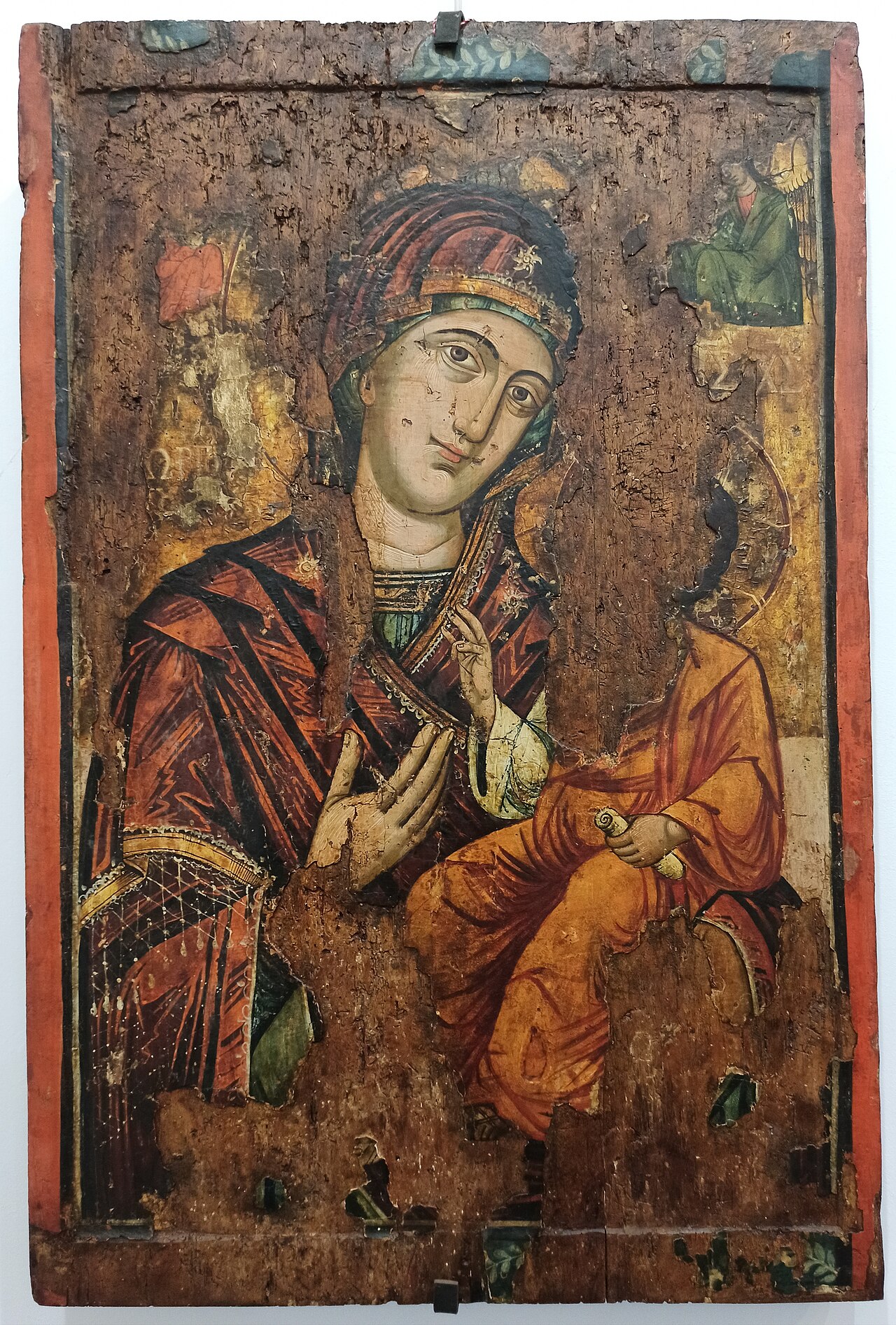
Christian art kept the belief alive in its own way. In Byzantine icons of the Mother of God, like the one at the top of this page, Mary’s veil is traditionally marked with three stars, one on her forehead and one on each shoulder. They are a silent sign of her virginity before, during and after the birth of Christ.
10. Follow the brothers’ story
The most moving part of this subject is not the argument but the story of the “brothers” themselves: relatives who began as sceptics and ended as leaders and martyrs.
John’s Gospel is honest about the family’s doubts. At one point, he says, “neither did his brethren believe in him” (John 7:5). Mark records that his relatives once set out to seize him, saying he was out of his mind (Mark 3:21). Yet after the Resurrection, Luke places “his brethren” in the upper room with Mary and the apostles, praying as they waited for the Holy Spirit (Acts 1:14). Something had changed them.
St Paul tells us what it was, at least for one of them. Listing the appearances of the risen Christ, he writes, “after that, he was seen by James” (1 Corinthians 15:7). James went on to lead the church of Jerusalem, speaking the decisive word at the council of Acts 15, and was eventually stoned to death for his faith, as Josephus reports.
Hegesippus preserves another touching story. Towards the end of the first century, the Emperor Domitian, nervous about anyone descended from King David, had two grandsons of Jude, one of the Lord’s “brothers”, brought before him. He asked about their property. They told him they owned only a small farm, which they worked with their own hands, and showed him their calloused palms. When he asked about Christ’s kingdom, they said it was not of this world but heavenly. Domitian dismissed them as harmless (Eusebius, Church History 3.20). Whatever their exact relationship to Jesus, the family of Nazareth produced faithful witnesses to the end.
Frequently asked questions
Does the Bible say Mary had other children? The Bible mentions “brothers” and “sisters” of Jesus, but never calls them children of Mary. In biblical usage “brother” can mean cousin, step-brother or other relative.
Who were the brothers of Jesus, then? The two traditional explanations are that they were Joseph’s sons from an earlier marriage, or that they were cousins. The Church allows either view.
Do Orthodox Christians believe in Mary’s perpetual virginity? Yes. The Orthodox, like Catholics, call Mary “Ever-Virgin” in their liturgy, and most of them follow the step-brother explanation.
Did Martin Luther believe Mary was always a virgin? Yes. Luther, Zwingli and other early Reformers held the belief, and it appears in the Lutheran confessional writings.
You may also like Why Do Catholics Believe Mary Was Sinless? and What Does Simeon’s Sword Prophecy About Mary Mean?
Sources and further reading
- The Bible: Genesis 11:27; 13:8; 14:14; Exodus 13:2; 2 Samuel 6:23; 1 Chronicles 23:21-22; Ezekiel 44:2; Matthew 1:18-25; 27:56; Mark 3:21; 6:3; 15:40; Luke 1:34; 2:7; John 7:5; 19:25-27; Acts 1:14; 15:13-21; 1 Corinthians 15:7; Galatians 1:19.
- Catechism of the Catholic Church, 496-501.
- Second Council of Constantinople (553); Lateran Synod (649), canon 3.
- Flavius Josephus, Antiquities of the Jews 20.9.1.
- Eusebius, Church History 3.11, 3.20, 4.22 (quoting Hegesippus).
- Protoevangelium of James (c. 150).
- Origen, Commentary on Matthew 10.17; St Jerome, Against Helvidius (383) and Letters 48-49; St Augustine, On Holy Virginity 4; St Ambrose, On the Instruction of a Virgin.
- Corpus Inscriptionum Iudaicarum II 1510 (epitaph of Arsinoe, Tell el-Yahudiya, 5 BC).
- Smalcald Articles (1537), Part I, Article 4; Huldrych Zwingli, sermon on Mary (1522); John Wesley, Letter to a Roman Catholic (1749).
- Second Vatican Council, Gaudium et Spes (1965), 48-49.
