
Does the Catholic Church Limit the Age Gap Between Spouses?
Does an age gap prevent a Catholic marriage? A clear guide to Church law, free consent, local requirements and the conversations couples should have.
No universal Catholic rule says that spouses must be within a fixed number of years of each other. A large age gap does not, by itself, make a marriage invalid. But a wedding still requires genuine freedom, the capacity to undertake marriage, compliance with the applicable Church and civil requirements, and careful preparation for a shared life.
Perhaps you are engaged to someone considerably older or younger. Your family may have questions. A friend may have said that “the Church will never allow it,” while someone else insists that “age is only a number.” Neither slogan is enough.
The Church asks a deeper question: can these two people freely give themselves to one another in a faithful, lifelong marriage? An age difference can bring practical concerns that deserve an honest conversation. It cannot answer that question on its own.
This article explains the universal Latin Church framework and offers questions for adult couples. It is not a determination that a particular couple is free to marry. Eastern Catholics should ask their own parish about the law and preparation that apply to them.
What does canon law actually require?
The Code of Canon Law contains no universal numerical age-gap impediment. Canon 1083 sets minimum ages for validity: 16 for a man and 14 for a woman. It also permits bishops’ conferences to set higher ages for lawful celebration.
These canonical thresholds are not recommended marriage ages, an endorsement of child marriage, or permission to disregard civil law. Canon 1072 tells pastors to discourage marriage before the age at which people ordinarily marry in their region. Local Church rules, safeguarding responsibilities and civil requirements must be addressed.
Canon 1095 concerns capacity for matrimonial consent; canon 1103 addresses force or grave externally imposed fear. A prior marriage bond also matters under canon 1085. Those are different questions from the number of years between two birthdays.
Ask your parish to identify any applicable requirement precisely. “We need further preparation” and “there is an impediment” do not mean the same thing.
Valid, lawful and wise are different questions
Validity asks whether a real marriage comes into existence. Lawfulness, sometimes called liceity, asks whether the celebration follows the applicable rules. Prudence asks whether the couple has honestly faced the life they intend to share.
Imagine someone asking whether a journey is possible. “The road is open” is useful information. It does not tell you whether the driver is rested, whether the vehicle is ready, or whether both passengers agree on the destination.
Similarly, the absence of a numerical age-gap prohibition is not the end of marriage preparation. It is the beginning of a more meaningful discussion. A priest may raise concerns without claiming that every couple with the same age difference is prohibited from marrying.
A little parable: two people planting a garden
This is an original illustrative story, not a biblical account.
Two neighbours decided to plant a garden together. One was older and had tended gardens for many years. The other was younger and brought new ideas. Everyone argued about whether their different ages would make the garden succeed.
At last, an experienced gardener asked them different questions. “Who will water it when one of you is tired? What will you plant? How will you decide when you disagree? Have you both agreed to care for it through the difficult seasons?”
The questions did not make their ages irrelevant. They put those ages into the larger reality of a shared responsibility.
A marriage is far more than a garden, but the lesson is useful: do not spend every conversation defending the relationship from outsiders while avoiding the conversations that will help you live it.
What is the couple actually promising?
Catechism 1601 describes marriage as a partnership of the whole of life, directed towards the good of the spouses and the procreation and education of children. Between baptised persons, this covenant is a sacrament.
That is why the conversation must go beyond compatibility in the present. Being happy together now is a precious beginning. It is not the whole promise.
Ask yourselves what a shared life will mean when work changes, parents need care, health becomes uncertain or family responsibilities increase. No couple can predict everything. Every couple can practise discussing difficult possibilities without treating questions as an attack.
Freedom matters more than appearances
Catechism 1625–1628 places free consent at the centre of marriage. Neither family pressure nor another person’s authority can substitute for the consent of the spouses.
An older partner is not automatically controlling. A younger partner is not automatically helpless. Nevertheless, differences in money, experience, employment, immigration circumstances or social influence can make it harder for one person to speak freely. These issues deserve attention whenever they exist, including between people of the same age.
A useful personal question is: “Could I ask to postpone the wedding without being threatened, humiliated or punished?” Another is: “Can I speak privately to the priest or counsellor?”
If you are frightened to answer honestly in front of your partner, request a private meeting. If there are threats, abuse or coercion, seek appropriate local help. A wedding date is never a reason to silence a concern about someone’s safety.
Six conversations to have before booking the wedding
1. Children and parenthood
Discuss what each of you hopes for, existing children, responsibilities to former households and the possibility that circumstances may differ from your hopes. Do not rely on hints or assume that silence means agreement.
Ask how you would approach the practical work of parenting: interrupted nights, school years, discipline, time with children and support from relatives. Where age raises fertility or health questions, seek qualified medical advice rather than relying on assurances from friends. The parish can help you discuss the moral and sacramental questions.
2. Work, retirement and daily life
One spouse may still be building a career when the other wants to retire. Neither preference is automatically selfish. The difficulty comes when both imagine a future that has never been discussed.
Talk about where you would live, travel, working hours and how you would share ordinary household tasks. A calendar and a realistic budget can reveal assumptions that romance has left unspoken.
3. Money and independence
Be honest about debts, financial commitments and dependants. Discuss how decisions will be made and whether both people will have meaningful access to information. Generosity is not the same as giving one person complete control.
Where there are complicated assets or inheritance questions, obtain qualified advice in your jurisdiction. Do not expect a general religious article to settle civil legal rights.
4. Health and caregiving
Age does not tell you exactly who will become ill first. Still, significant differences in life stage may affect likely caregiving responsibilities. Speak about what support might be needed and who could help.
The purpose is not to demand a guarantee of health. It is to discover whether you can discuss vulnerability with tenderness and realism.
5. Family relationships
Listen to concerns from trusted people, but ask them to describe actual behaviour rather than repeat a stereotype. “You are being isolated from your friends” is different from “People will talk.”
Existing children may need time to express complicated feelings. They should not be expected to celebrate instantly or be drawn into adult disputes. Consider professional family support where relationships are strained.
6. Faith and conflict
How will you pray, attend church, raise children in faith and respond when one person struggles? How do you apologise? Can you disagree without threats, ridicule or days of punishment?
In Amoris Laetitia 209–210, Pope Francis encourages engaged couples to discuss expectations and recognise risks before marriage. Mutual attraction does not remove the need for deeper discernment.
What should we ask the priest?
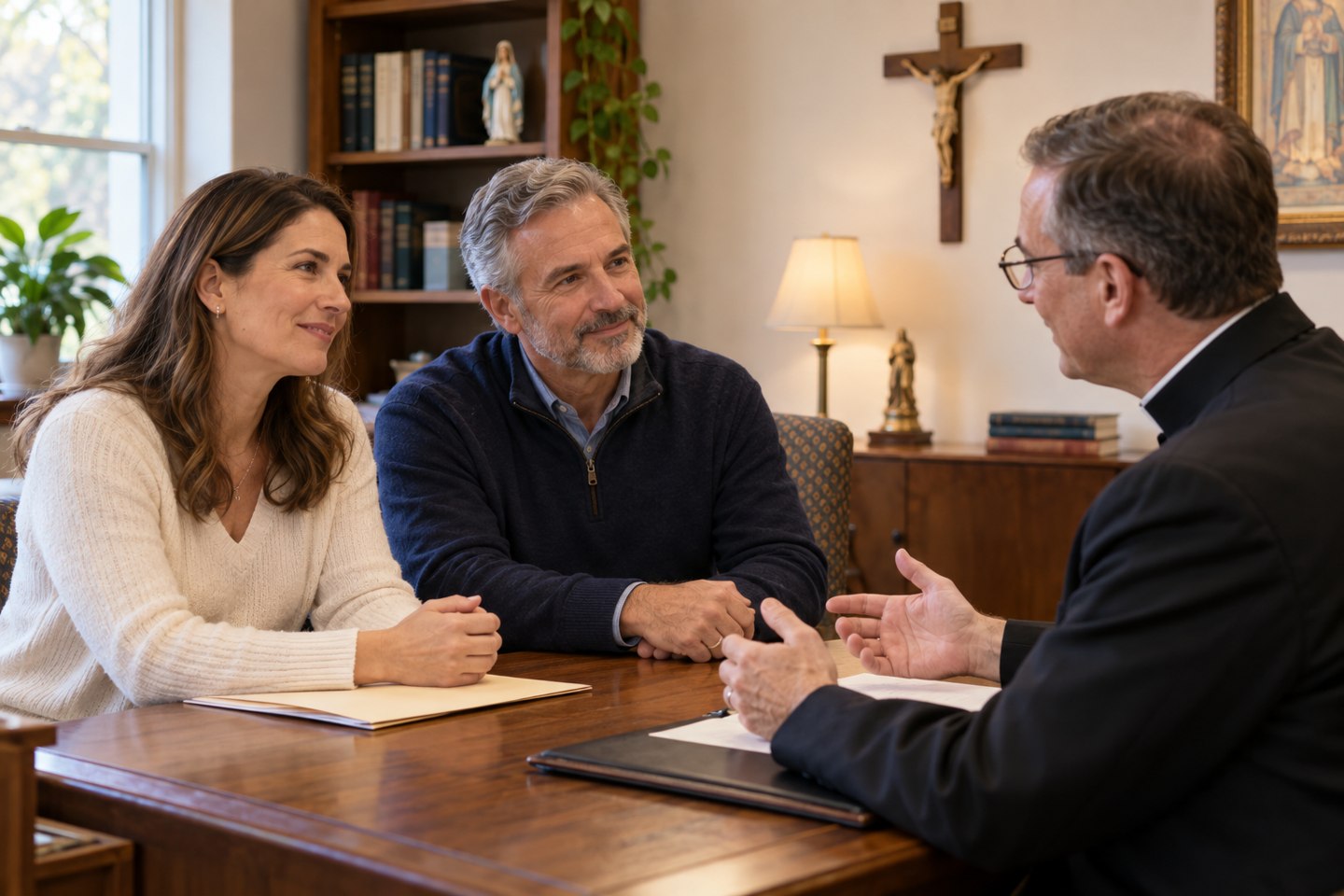
Arrange the conversation early, before non-refundable plans create pressure. Tell the priest both ages, baptismal backgrounds and any previous marriages. Ask:
- Which Church and civil requirements apply to us?
- Is your concern a legal requirement, a preparation issue or a pastoral judgment?
- What further preparation would help us?
- May each of us have a private conversation if needed?
- Who can clarify a difficult question: the parish, diocesan office or tribunal?
Marriage preparation is intended to help a couple discern and prepare, not merely obtain a booking. The Pontifical Council for the Family’s guidance on preparation for marriage treats formation as a serious part of the vocation.
If a previous marriage is involved, read our guide to becoming Catholic while waiting for an annulment. A discussion about age cannot resolve a separate question about an existing bond. The US bishops’ annulment overview explains why previous marriages require proper assessment.
Frequently asked questions
Is a ten-, twenty- or thirty-year difference automatically forbidden?
No universal numerical rule makes those gaps automatic impediments. That is not an individual clearance to marry. The couple’s actual circumstances still need to be assessed.
Can a parish invent an age-gap rule that makes every such marriage invalid?
Establishing an impediment and giving pastoral advice are different acts. Canon 1075 reserves the establishment of other impediments for the baptised to the Church’s supreme authority. If a restriction is mentioned, ask the diocesan office to identify its source and precise effect.
Does family disapproval prove that the marriage is wrong?
No. Family members can misunderstand a relationship, and they can also notice genuine dangers. Listen for concrete concerns, seek independent advice, and avoid making either parental approval or parental opposition your only test.
Should we stop preparation if serious doubts emerge?
It can be wise to pause. Asking for time is not a failure of love. An honest postponement can protect both people from making a promise they are not ready to make.
A prayer for discernment
Lord, help us love one another truthfully. Give us the courage to ask difficult questions, the freedom to speak honestly, and the humility to accept wise guidance. Lead us towards a commitment that honours you and protects the good of each person. Amen.
Sources and scope
References include the Code of Canon Law, canons 1072, 1075, 1083, 1085, 1095 and 1103; Catechism 1601 and 1625–1632; Amoris Laetitia 209–210; and the Church documents linked above. The practical questions and garden story are original pastoral illustrations. Local requirements and individual eligibility must be confirmed by the appropriate parish or diocesan authority.
