
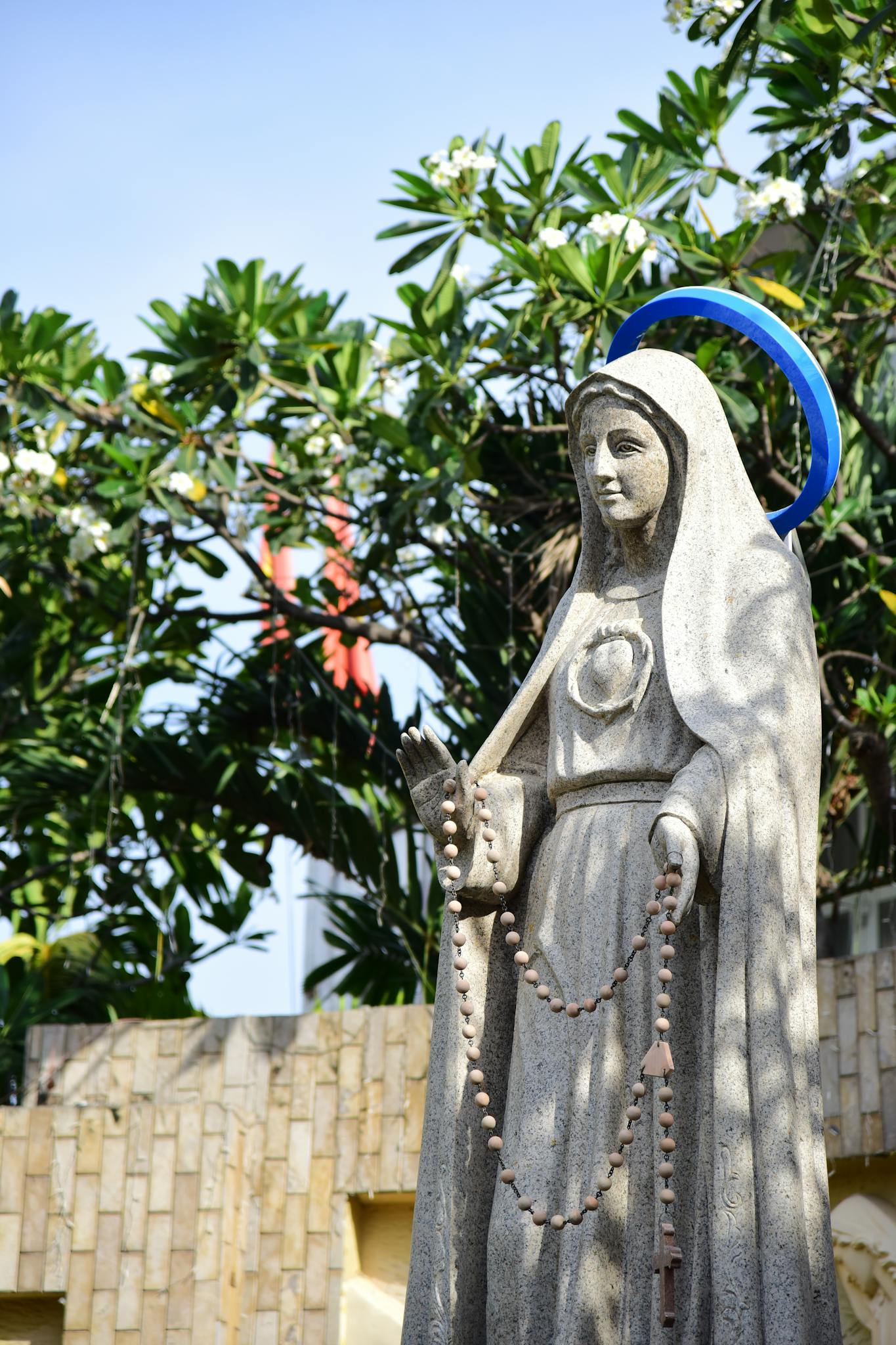
Akita and Catholic Devotion
Apparition Discernment
The reported events at a Japanese convent, Bishop Ito’s 1984 declaration, and how Catholics should weigh a case the Holy See has never separately ruled on.
Between 1973 and 1981, a deaf religious sister named Agnes Sasagawa at a small convent in Akita, Japan, reported messages and repeated weeping from a statue of Mary, events witnessed at times by others and once filmed by a television crew. In 1984 the local bishop, John Shojiro Ito, formally recognized their supernatural character and authorized veneration, a comparatively strong form of diocesan approval, though the Holy See itself has never issued its own separate ruling on the case. Catholics remain free, but never obligated, to hold devotion to Akita, always as a private matter subordinate to the Church’s public teaching.
A Convent, a Deaf Sister, and a Wooden Statue
The events associated with Our Lady of Akita center on Sister Agnes Katsuko Sasagawa, a deaf member of the Handmaids of the Holy Eucharist, a small religious community living at a convent in Yuzawadai, in the city of Akita, Japan. Sister Sasagawa entered the convent on 12 May 1973. Within weeks, the reported phenomena began.
A first reported message came on 6 July 1973, accompanied by an account of the convent’s wooden statue of Mary appearing illuminated. The most severe of the reported messages followed on 13 October 1973, warning of societal catastrophe, corruption within the Church, and scandal among priests and religious, and urging the daily recitation of the rosary. In translation, that message included the line, “Fire will fall from the sky and will wipe out a great part of humanity, sparing neither priests nor faithful.” Between 4 January 1975 and 15 September 1981, the statue was reported to have wept on 101 separate occasions, witnessed at various times by others present at the convent, and on one occasion in December 1978, captured on film by a Japanese television crew. Sister Sasagawa also reported an unexplained wound resembling a cross on the palm of her hand, and experienced periods of deafness that were later reported to have resolved.
It bears stating plainly that the content of the 1973 message should be read descriptively, as part of the historical record of what was reported, rather than as a prophecy whose fulfillment can be read off of later world events. Treating any later war, disaster, or Church scandal as automatic confirmation of a decades-old private message goes well beyond what the Church’s own process claims, and beyond what careful devotion to Akita should claim either.
Bishop Ito’s Investigation and 1984 Declaration
Responsibility for investigating the reports fell to Bishop John Shojiro Ito of the Diocese of Niigata, within which Akita lies. Bishop Ito began looking into the case from 1975, consulting the Vatican’s Congregation for the Doctrine of the Faith, the predecessor body to today’s Dicastery for the Doctrine of the Faith, and convening his own diocesan commission of inquiry. That commission concluded, around 1976, that it was not in a position to prove the events were supernatural, a cautious and inconclusive result. In 1981 the Congregation responded that it did not intend to open its own examination, and described itself as unfavorable to the events. Bishop Ito continued gathering evidence over the following years and submitted further material to the Congregation in 1982.
On 22 April 1984, Bishop Ito issued a formal diocesan declaration. He stated that he recognized the supernatural character of the series of mysterious events connected with the statue at the Akita convent, and he authorized veneration of the image within his diocese. He was careful, at the same time, to clarify that these were private revelations, not required for the salvation of the faithful and not binding on anyone’s belief. This choice of language, a bishop affirmatively recognizing supernatural character, is notably stronger than the more common “worthy of belief” formula used for other approved twentieth-century cases, such as Beauraing and Banneux. Even so, Bishop Ito’s declaration remains, like those cases, an act of the local diocesan bishop rather than a declaration issued by the Holy See itself.
The 1988 Meeting With Cardinal Ratzinger
In June 1988, by then retired, Bishop Ito met with Cardinal Joseph Ratzinger, at that time Prefect of the Congregation for the Doctrine of the Faith and later elected Pope Benedict XVI. According to accounts of that meeting, Cardinal Ratzinger gave verbal approval to the substance of Bishop Ito’s 1984 declaration, while declining to render his own personal judgment on the credibility of the events. It is important to state this precisely: this was a private meeting, related afterward through personal accounts, and no formal Vatican document on Akita was ever published as a result of it. The exchange is real and often cited, but it does not carry the weight of a Roman decree.
A Genuine Difference of Opinion Within the Japanese Hierarchy
The Akita case has not been received with unanimous confidence, even among Japanese Church leaders. In 1990, Archbishop Peter Shirayanagi of Tokyo, a senior figure among the Japanese bishops who was later made a cardinal, and who led a different diocese than Niigata, told an Italian publication that the events of Akita were, in his words, no longer to be taken seriously. This should be understood honestly, as a genuine internal difference of opinion among Church leaders in Japan, not as any later official reversal of Bishop Ito’s declaration. That declaration itself has never been revoked by his successors as Bishop of Niigata.
A Case the Holy See Has Never Separately Ruled On
To date, the Holy See has never issued its own independent, separate declaration on Akita, whether under the 1978 norms, the current 2024 norms, or through any other formal process. The only formal ecclesiastical act concerning Akita remains Bishop Ito’s 1984 diocesan declaration, standing on its own and unreversed. Readers wanting the full picture of how such cases are normally handled today, including the six verdicts a bishop can now reach in agreement with the Dicastery, should see our overview of how the Church judges Marian apparitions, and our companion explainer on what it would mean, and specifically would not mean, if a case like Akita ever received a modern Nihil obstat verdict.
Sister Agnes Sasagawa died on 15 August 2024, the feast of the Assumption, at the age of ninety-three. The current Bishop of Niigata, Paul Daisuke Narui, made no additional substantive statement about the Akita events at the time of her death, leaving Bishop Ito’s 1984 declaration as it has stood for four decades. There is no universal Church feast day for Our Lady of Akita; devotion centers instead on the convent and shrine of the Handmaids of the Holy Eucharist in Akita, and on the rosary-centered message associated with the reports.
Weighing Akita Against the Church’s Own Criteria
It is instructive to read the Akita case against the positive and negative indicators the Dicastery’s own norms now use to weigh cases like it, described in full on our page on how the Church judges Marian apparitions. On the positive side, Bishop Ito’s own multi-year investigation found Sister Sasagawa cooperative with Church authority rather than resistant to it, the reported weeping was witnessed by others on many separate occasions and once captured on film, and the message’s central call was to ordinary Catholic practice, the daily rosary, rather than to anything doctrinally novel or divisive. On the more cautious side, the case shows real friction points that any honest account has to hold onto: the Congregation for the Doctrine of the Faith’s own 1981 assessment was unfavorable rather than encouraging, a senior archbishop publicly voiced doubt about the events just six years after Bishop Ito’s declaration, and, most importantly, the Holy See has simply never chosen to issue its own ruling in either direction, despite decades in which it could have done so. None of this makes Akita a settled case in the way that a formally closed nineteenth-century shrine is settled. It makes it a genuine example of the kind of mixed, still-open evidence the Church’s discernment process is built to handle with patience rather than forcing to a premature conclusion.
How a Catholic Should Personally Relate to Akita
Akita illustrates, better than most cases, why the Church’s careful vocabulary around private revelation matters in practice. Bishop Ito’s 1984 wording is genuinely stronger than the language used for many comparable cases, and it has stood, unreversed, for four decades, including an informal nod of approval from a future pope. At the same time, it remains the judgment of a single diocesan bishop rather than the Holy See, it has drawn open disagreement from at least one senior Japanese archbishop, and Rome itself has never chosen to weigh in with a ruling of its own, positive or negative.
That combination calls for a measured response rather than either enthusiastic certainty or dismissive suspicion. A Catholic is entirely free to hold personal devotion to Our Lady of Akita, to value its call to the rosary, and to find spiritual benefit in it, precisely because Bishop Ito’s declaration remains a legitimate, standing act of Church authority. No Catholic, however, is obligated to accept the events as historically factual, and the message associated with Akita, like every private revelation, adds nothing to and can never revise the Church’s public and definitive deposit of faith. For the broader principle behind that last point, see our page on public revelation versus private revelation. Held with that discipline, freely, prudently, and always subordinate to what the Church teaches with certainty, devotion to Akita can take its place alongside the Church’s other approved private revelations without overstating what any of them, including this one, actually claims.