Can I Become Catholic While Waiting for an Annulment? Questions to Ask in OCIA
You can continue exploring the Catholic faith and attending Mass while a marriage case is being considered. Whether you can receive the…
You can continue exploring the Catholic faith and attending Mass while a marriage case is being considered. Whether you can receive the sacraments of initiation before the case ends depends on your baptismal status, previous marriages, present relationship and the Church's requirements in your circumstances. Ask your parish priest and diocesan tribunal for a specific plan.
A previous divorce does not automatically mean that every person must postpone becoming Catholic. A current civil marriage following a previous marriage raises different questions from being divorced and living single. Your current spouse's earlier marriages may matter too. The US bishops' annulment guide explains why a civilly divorced and remarried person seeking to become Catholic needs the marriage situation addressed.
If you are in OCIA, the Order of Christian Initiation of Adults, arrange a private conversation early. You may also hear the older term RCIA. You do not need to explain your personal history to the whole group, and you should not have to guess what happens next.
First, find out which question actually needs answering
People often use “I need an annulment” to describe several different situations. Before gathering a large file of documents, ask the parish to identify the issue in your case.
You might be divorced and not in another relationship. You might be civilly remarried. You might be engaged to someone who has a previous marriage. Or you might have been told that a Catholic wedding did not follow the required Church form.
Those facts can affect the process. The word “divorced” alone does not supply enough information for someone online to decide what you need or when you can receive the sacraments.
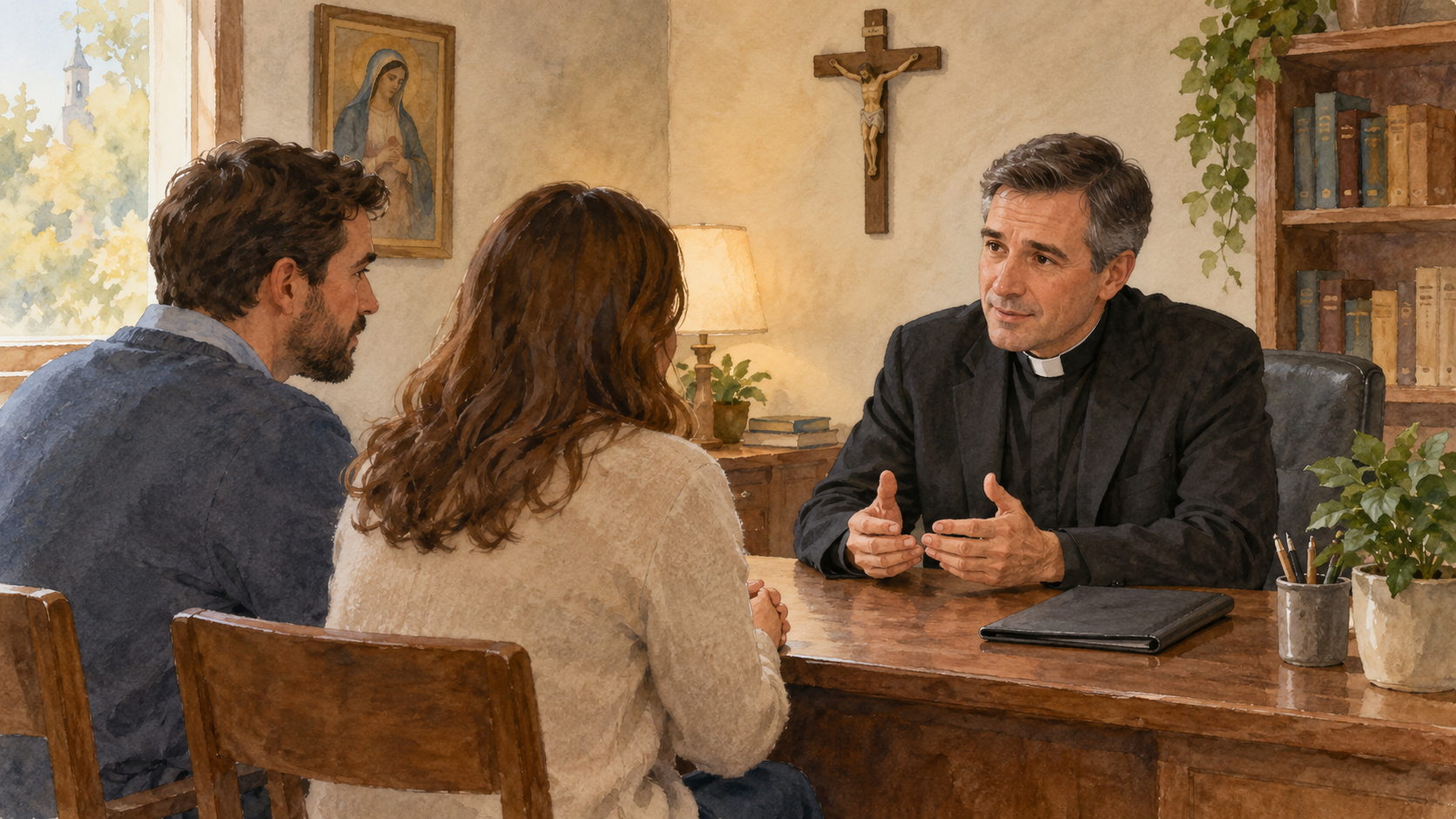
At your first meeting, ask: “What exactly needs to be established, and which Church office will establish it?” Write down the answer in plain language. If someone uses a technical term, ask what it means for the next practical step.
A clear description of the problem will make later conversations less confusing. It can also prevent you from spending weeks collecting material for a process that does not apply to you.
What is an annulment in the Catholic Church?
What people commonly call an annulment is a declaration of nullity. A Church tribunal examines whether an essential requirement for a valid marriage was missing when consent was exchanged. It does not decide simply whether the relationship later became unhappy. The US bishops explain this distinction.
The Church takes the marriage bond seriously. Canons 1060 and 1085 establish the presumption of validity and the obstacle created by an existing prior bond. A civil divorce does not, by itself, establish freedom to marry in the Church.
This can be difficult to hear when a relationship ended painfully years ago. You may feel that you have already answered every question anyone could ask about it. It is reasonable to tell the priest that reopening the subject is hard.
Ask him to explain the purpose of the process without assuming that you already understand Catholic marriage teaching. You can take the teaching seriously while needing time and patient explanation.
Does every previous marriage require the same process?
No. Do not assume that someone else's experience will be a timetable for yours. A tribunal may need to consider the religious status of the parties, how the wedding took place and other relevant facts.
A case involving an alleged lack of required Catholic form can differ from an investigation of marital consent. Certain limited situations may involve a dissolution process rather than a declaration of nullity. The Code of Canon Law's marriage provisions, including canons 1108 and 1141–1143, show why these distinctions matter.
You do not need to choose the legal route yourself. Give accurate information and ask the tribunal which process, if any, applies. Avoid describing a case as “obvious” because you have read a brief explanation online.
Also mention every previous marriage when asked, including marriages outside a Catholic church. The Church recognises that non-Catholics can enter valid marriages; a different wedding setting does not automatically settle the question. See the US bishops' explanation of non-Catholic marriages.
What should I bring to the first parish meeting?
Prepare a simple timeline. Include any known baptism, each marriage, separation, civil divorce and present relationship. Note approximate dates where you are unsure, rather than presenting a guess as a confirmed fact.
Bring documents you already have, but ask for the official list before ordering replacements. Depending on the case, the parish or tribunal may request records relating to baptism, marriage, divorce or a former spouse's death.
Ask whether copies are sufficient, whether recently issued certificates are required and how documents should be submitted securely. Keep your own copies and a record of what you send.
Write down the names of the people or offices already involved. If you have received a case number or letter, bring it. That can help the parish understand what has already happened and prevent duplicate work.
You can also bring your questions on one page. When a conversation is emotional, it is easy to forget the practical issue you most wanted to raise.
If you are uncertain about a fact, say so. “I do not know whether my former spouse was baptised” is useful information. The right next step is to ask how that uncertainty should be investigated.
Ask who is responsible for each part of the process
Your OCIA coordinator can support formation, but may not be the person who decides a marriage case or advises on every sacramental question. Ask who your main contacts should be.
You need to know whom to ask about documents, whom to contact for a case update and whom to approach about prayer, family life and preparation for the sacraments. Sometimes one person will connect you with the others.
Before the meeting ends, ask: “What do I need to do next, who is waiting for it, and when should I follow up?” Write down the answer while it is fresh.
If an instruction is unclear, repeat it back in your own words. “So I should request this record first, then send it to that office?” This gives the person a chance to correct a misunderstanding immediately.
Keep messages brief and factual. Include your case reference if the office has asked you to use one. Avoid sending sensitive personal history to several parish volunteers when one designated contact can direct you appropriately.
Can I stay in OCIA while the case is pending?
Ask for an ongoing formation plan. You can keep learning, praying and attending Mass while the parish clarifies the timing of sacramental steps. A delay in one part of the process does not mean that all spiritual growth must stop.
The US bishops' adult initiation overview distinguishes the preparation of unbaptised people from that of already baptised Christians. Make sure the team understands your background instead of treating everyone in the group as having the same path.
If you are told that a sacrament must wait, ask which one and why. Then ask what you should continue doing in the meantime. You deserve an explanation that connects the decision to your actual circumstances.
Discuss what happens if the group's formal meetings finish before your case does. Could you continue with a sponsor, attend another suitable formation group or arrange regular conversations? Make that plan before you suddenly find yourself without contact.
You may feel disappointed when others celebrate a step you cannot yet take. Tell someone you trust. You can be happy for them and still need support with your own sadness.
What about Communion and my present relationship?
Do not make this decision from a general article or a stranger's comment. Ask the priest to explain the Church's teaching and the pastoral guidance that applies to you.
The Catechism, paragraphs 1649–1651, distinguishes separation from a new union and explains the sacramental difficulty when a valid prior marriage remains. It also calls the Church to care for people in these circumstances and support their participation in Christian life.
In Amoris Laetitia, paragraph 300, Pope Francis calls for responsible personal and pastoral discernment, with priests accompanying people according to Church teaching and the bishop's guidance. That is a reason to seek a careful conversation about the real situation.
If you are living with a civil spouse, ask what this means for your way of life during the process, including sexual relations, responsibilities towards children and preparation for the sacraments. These questions deserve clear guidance. Do not assume that a private intention automatically resolves every issue.
If advice from different people appears to conflict, ask the priest to clarify it with the relevant diocesan office. You should not have to assemble a personal ruling from fragments of unrelated online discussions.
Will my former spouse have to be involved?
In a declaration of nullity process, the former spouse normally has a right to be notified and participate. A refusal to participate does not necessarily stop the case. The US bishops' process overview explains these rights.
Ask the tribunal how contact is handled in your case. Do not assume that you must personally reopen communication or persuade your former spouse to agree with you.
If there has been abuse, intimidation or a protective order, tell the tribunal at the beginning. Ask how safe contact and information handling will work. Seek appropriate specialist help if you are at risk.
A tribunal case is not sacramental Confession. Ask who may see testimony and what privacy protections or limits apply before sharing sensitive records. Do not rely on a general promise that “everything at church is confidential.”
Give honest information without trying to punish your former spouse through the process. If you need emotional support while describing painful events, arrange that support alongside the case.
How should I approach written testimony?
Follow the tribunal's questions and instructions. Answer in your own words, describing what you know and what you remember. If you do not remember something, say so.
Separate events you witnessed from things you learned later. Avoid trying to diagnose another person or using a label as a substitute for describing behaviour. Concrete information is easier to understand and assess.
Do not shape your account around a story someone says will guarantee a favourable decision. Your role is to tell the truth. The tribunal's role is to evaluate the case.
Break the work into manageable periods if it is emotionally difficult. Ask your contact what to do if you need more time or find a question confusing. A request for clarification is better than quietly leaving the form unfinished for months.
If witnesses are requested, ask what kind of knowledge would be relevant. Let witnesses give their own accounts rather than coaching them to repeat yours.
How long will it take, and what happens afterwards?
Ask the tribunal for a current estimate based on your case. Neither a parish calendar nor a friend's experience can guarantee the completion date. The outcome is not guaranteed either.
Before making wedding plans, wait for the decision to be final and ask whether any restrictions or further steps remain. If you are already civilly married, ask whether convalidation or another step is needed; a favourable decision about a prior marriage does not by itself answer every question about the present union. See canons 1156–1165 on convalidation.
Also ask about fees and financial assistance at the start. Get the local office's information instead of relying on figures from another country or diocese.
While waiting, agree on a sensible follow-up pattern. You can check that requested documents have arrived without contacting the office every day. Keep a simple record of submissions and replies so that the next action remains clear.
Related questions about annulments and becoming Catholic
Does an annulment mean my children are illegitimate?
No. A declaration of nullity does not remove your children's legitimacy or your responsibilities towards them. Canon 1137 addresses children born of a valid or putative marriage. Ask the parish to explain unfamiliar language in a way your family can understand.
Does Baptism make my previous marriage disappear?
No. Do not treat Baptism as a way to bypass the marriage question. Tell the priest the full history and ask which process applies. The Church's provisions for particular marriage cases require proper assessment; they are not a general rule that conversion cancels an earlier bond.
What if I am divorced but have not remarried?
Make that clear at the first meeting. Do not assume that advice written for someone in a new civil union applies to you. Ask whether any marriage case is needed for your present circumstances and how your sacramental preparation should proceed.
What if the decision is not in favour of nullity?
Ask the tribunal to explain the decision and any available next steps or appeal rights. Discuss your spiritual and family situation with the priest. A difficult outcome needs a real conversation and a continuing pastoral plan, rather than a conclusion that you should simply disappear from parish life.
What should I ask before leaving my next meeting?
Ask: “What is my next step, who is my contact, and how will I continue preparing for the faith while this is being resolved?” Those three questions can turn a confusing wait into a clearer path. You may not receive every answer immediately, but you should know how to obtain the answers you still need.