
Saint Francis of Assisi
Saints
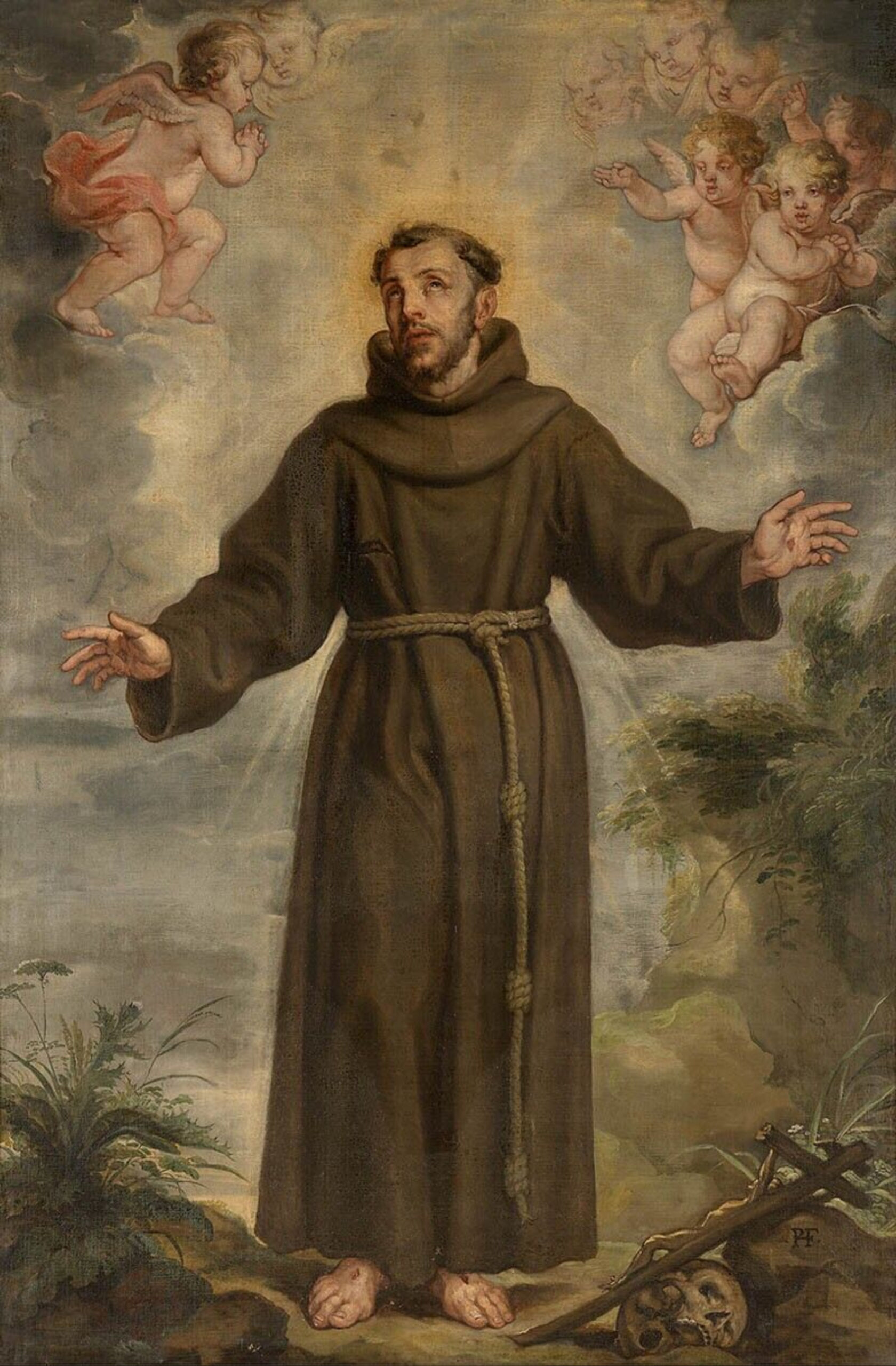
The wealthy merchant’s son who embraced radical poverty, founded the Franciscan order, preached to the poor and to nature alike, and bore the wounds of Christ.
Saint Francis of Assisi (c. 1181–1226) was an Italian friar, deacon, and mystic who abandoned a life of wealth and worldly ambition to embrace absolute poverty in imitation of Christ. Around 1209 he gathered a small band of followers and founded the Order of Friars Minor, whose simple, itinerant, preaching way of life spread across Europe within his lifetime. With Saint Clare of Assisi he helped establish the Poor Clares, and he later inspired a lay Third Order for men and women living in the world. Known for his love of creation, his peacemaking mission to the Sultan of Egypt during the Fifth Crusade, and his composition of the Canticle of the Creatures, Francis received the stigmata, the wounds of the crucified Christ, at La Verna in 1224. He died in Assisi on October 3, 1226, and remains one of the most beloved and widely venerated saints in Christian history.
Quick Facts
- Born: c. 1181–1182, Assisi, in the Duchy of Spoleto, Italy
- Died: October 3, 1226, Assisi, Italy, at about 44 years old
- Feast Day: October 4
- Canonized: July 16, 1228, by Pope Gregory IX, less than two years after his death
- Patron of: animals, ecology and the environment, merchants, and Italy
Who Was Saint Francis of Assisi?
Francis was born Giovanni di Pietro di Bernardone, the son of a prosperous cloth merchant in the hill town of Assisi, and he spent his youth pursuing the pleasures and ambitions typical of a wealthy young man of his class, including a brief attempt at knighthood that ended in imprisonment and illness after a local war with the neighboring city of Perugia. A series of profound religious experiences, traditionally including a vision of Christ speaking to him from the crucifix at the ruined chapel of San Damiano and telling him to ‘rebuild my church,’ turned him away from his father’s business and social expectations entirely. He renounced his inheritance publicly before the bishop of Assisi, stripping off his fine clothes, and began living as a penitent, repairing chapels with his own hands and caring for lepers, whom he had once found repulsive. Other men were drawn to his radical simplicity, and around 1209 Pope Innocent III gave informal approval to the way of life Francis and his companions had begun to follow, a rule grounded in absolute poverty, itinerant preaching, and manual labor. The movement grew with extraordinary speed into the Order of Friars Minor. Francis also collaborated closely with a young noblewoman of Assisi, Clare, in establishing what became the Poor Clares, and he encouraged a Third Order for laypeople who wished to live his spirit of penance and charity without leaving ordinary life. In 1219 he traveled to Egypt during the Fifth Crusade and sought a peaceful audience with the Sultan al-Kamil, preaching the Gospel to him directly rather than joining the fighting. In his final years, weakened by illness and largely blind, he composed the Canticle of the Creatures, a hymn praising God through the elements of creation, and in 1224, at the mountain retreat of La Verna, he is recorded to have received the stigmata, the wounds of Christ’s crucifixion, on his own body. He died on October 3, 1226, singing psalms, at the small chapel of the Porziuncola near Assisi.
Historical Setting
Francis lived during a period of rapid commercial growth and social change in central Italy, as merchant families like his own gained wealth and status rivaling the old feudal nobility, while the wider Church wrestled with how to respond to widespread poverty, urban unrest, and various movements that questioned clerical wealth and authority, some of which slid into heresy. His decision to embrace poverty as a positive spiritual ideal, rather than simply enduring it, resonated powerfully with a society uneasy about the growing gap between Gospel simplicity and ecclesiastical opulence, and his willingness to work within the structure of the Church, seeking papal approval rather than operating outside it, distinguished his movement from more oppositional reform groups of the era.
Why the Church Venerates Saint Francis of Assisi
Francis is venerated above all as a living icon of Gospel poverty and radical discipleship, a man who took Christ’s call to ‘sell what you have and give to the poor’ with startling literalness and in doing so renewed the Church’s sense of its own mission at a critical moment. His stigmata, understood by the tradition as a physical conformity to the crucified Christ, became a lasting symbol of his total identification with the suffering and love of Jesus. He is honored as well for his reverence toward all creation, a vision that has made him a natural patron for ecological concern in the modern era, and for the humility and joy that made his poverty attractive rather than merely austere, a quality captured in the enduring nickname ‘il Poverello,’ the little poor man of Assisi.
Canonization and Feast Day
Francis’s canonization was remarkably swift by medieval standards: Pope Gregory IX, who had known him personally and supported his order, canonized him in Assisi on July 16, 1228, not quite two years after his death, and laid the cornerstone of the great basilica built in Francis’s honor the very next day. His liturgical feast is kept on October 4, one day after the anniversary of his death, since October 3 falls within the vigil observed by the Franciscan tradition itself.
What Catholics Can Learn Today
Francis’s life continues to challenge believers to ask how much of ordinary comfort and security stands between them and the freedom of the Gospel, and his example suggests that joy, rather than grim self-denial, is the true fruit of letting go of what one does not need. His care for the poor, the sick, and the natural world together offers a single, integrated vision of holiness that speaks directly to contemporary concerns about human dignity and the environment, reminding modern readers that love of God, love of neighbor, and care for creation were never, for Francis, three separate commitments but one undivided way of following Christ.
A Prayer to Saint Francis of Assisi
Saint Francis, little poor man of Assisi, who let go of every comfort to hold fast to Christ alone, teach me to see the wealth I cling to and the freedom I am missing. You who called the sun brother and the moon sister, open my eyes to the goodness of creation and my hands to its care. You who embraced the leper others turned away from, give me courage to love where love is hardest. Pray that I may seek not to be understood but to understand, not to be consoled but to console, and that in giving of myself I may find, as you found, the joy of the Gospel. Amen.
Sources
- the Catholic Encyclopedia (New Advent)
- Vatican.va, biography of Saint Francis of Assisi
- Encyclopaedia Britannica
- the Franciscan tradition’s early biographies (Thomas of Celano, Bonaventure)