Saint Daniele Comboni
Saints
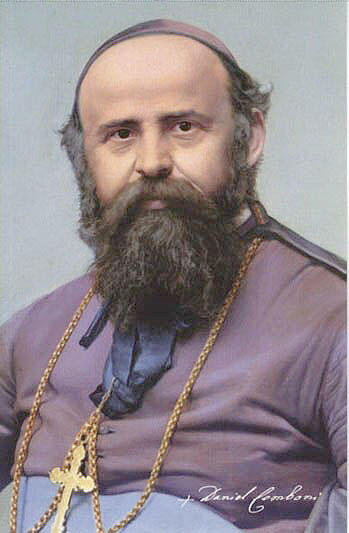
An Italian missionary bishop who devoted his life to evangelizing central Africa, founding missionary institutes and dying at his post in Khartoum after decades of hardship and loss.
Saint Daniele Comboni, born in 1831 near Lake Garda in Italy, was ordained for missionary work in Africa and, after early expeditions exposed him to the ravages of disease and the slave trade in the region, developed a bold strategy summarized as ‘Save Africa through Africa’ — training African clergy and catechists rather than relying indefinitely on European missionaries. He founded institutes for missionary priests and sisters, was named the first bishop of Central Africa in 1877, and died at his post in Khartoum in 1881, having buried many of his own companions to disease. Canonized by John Paul II in 2003, Comboni is remembered for a missionary vision built on local leadership and for his unwavering opposition to the slave trade. His feast is kept on October 10.
Quick Facts
- Born: March 15, 1831, Limone sul Garda, Italy
- Died: October 10, 1881, Khartoum, Sudan
- Feast Day: October 10
- Canonized: 2003 by Pope John Paul II
- Patron of: missionaries to Africa; invoked by those working against poverty and disease in central Africa
Who Was Saint Daniele Comboni?
Daniele Comboni was born in 1831 in Limone sul Garda, a village on Lake Garda in northern Italy, to a poor family, and was educated at a missionary institute in Verona founded to train priests for work in Africa. Ordained in 1854, he joined an expedition to central Africa three years later, in 1857, an assignment that quickly exposed him to the brutal realities of the region: a punishing climate, tropical disease that killed several of his companions within months, and the ongoing devastation of the Arab and East African slave trade, which he came to see as the central obstacle to any lasting evangelization or human flourishing there. Rather than retreat to safer missionary strategies, he developed and published, in 1864, a bold plan he called ‘Save Africa through Africa,’ arguing that lasting mission work required training African clergy and catechists rather than relying indefinitely on European missionaries in a climate that killed them at alarming rates. He founded two missionary institutes, for men and women, to carry this plan out, and was appointed the first Vicar Apostolic and later bishop of Central Africa in 1877. He died at his mission post in Khartoum in 1881, worn down by decades of illness and loss, having buried a large share of his own missionaries.
Historical Setting
Comboni’s mission unfolded during the height of European exploration and colonial expansion into the African interior, and against the entrenched, devastating Arab slave-trading networks that moved captives from the upper Nile region toward markets in North Africa and the Middle East. The Catholic Church’s missionary efforts in this period were only beginning to grapple seriously with the question of how evangelization could avoid becoming entangled with, or dependent upon, European colonial structures, and Comboni’s insistence on forming African clergy and leaders reflected an unusually forward-looking response to that tension for his era, even as his own expeditions still depended heavily on European personnel and funding.
Why the Church Venerates Saint Daniele Comboni
The Church venerates Comboni for a missionary vision that was both spiritually and practically ahead of its time: his conviction that Africa’s evangelization had to be carried forward by Africans themselves, trained and ordained rather than perpetually dependent on foreign missionaries, anticipated a principle the Church would only fully embrace as standard missionary policy in the twentieth century. He is also honored for his outspoken, sustained opposition to the slave trade at a time when that trade still moved largely unchallenged through the regions where he worked, and for a personal endurance that saw him return to Africa again and again despite losing friends, colleagues, and his own health to disease.
Canonization and Feast Day
Comboni was beatified by Pope John Paul II in 1996 and canonized by the same pope on October 5, 2003, following the Vatican’s recognition of miracles attributed to his intercession. His feast is kept on October 10, the anniversary of his death in Khartoum in 1881.
What Catholics Can Learn Today
Comboni’s life challenges any temptation to treat mission work, or any demanding calling, as something to be managed cautiously from a safe distance. He returned repeatedly to a climate and a set of circumstances that he knew, from bitter experience, could kill him, because he judged the work worth the risk. His insistence on empowering local leadership rather than perpetuating dependence also offers a lasting lesson for any form of service today: that genuine help aims, eventually, to make itself unnecessary by building up the capacity of the people it serves.
A Prayer to Saint Daniele Comboni
Saint Daniele Comboni, who gave your whole life and buried so many companions in the service of Africa, teach me your patient courage in the face of loss. You believed that Africa would be saved through Africa, trusting the people you served to carry the work forward; help me trust others as you did, and to serve without needing to be indispensable. Pray for missionaries far from home, for the sick, and for all who labor where the cost is high and the reward is not seen in their own lifetime. Amen.
Sources
- Vatican.va
- Encyclopaedia Britannica
- the Catholic Encyclopedia tradition continued by New Advent
- the historical records of the Comboni Missionaries (Missionaries of the Sacred Heart of Jesus)