
Saint Bernard de Menthon
Saints
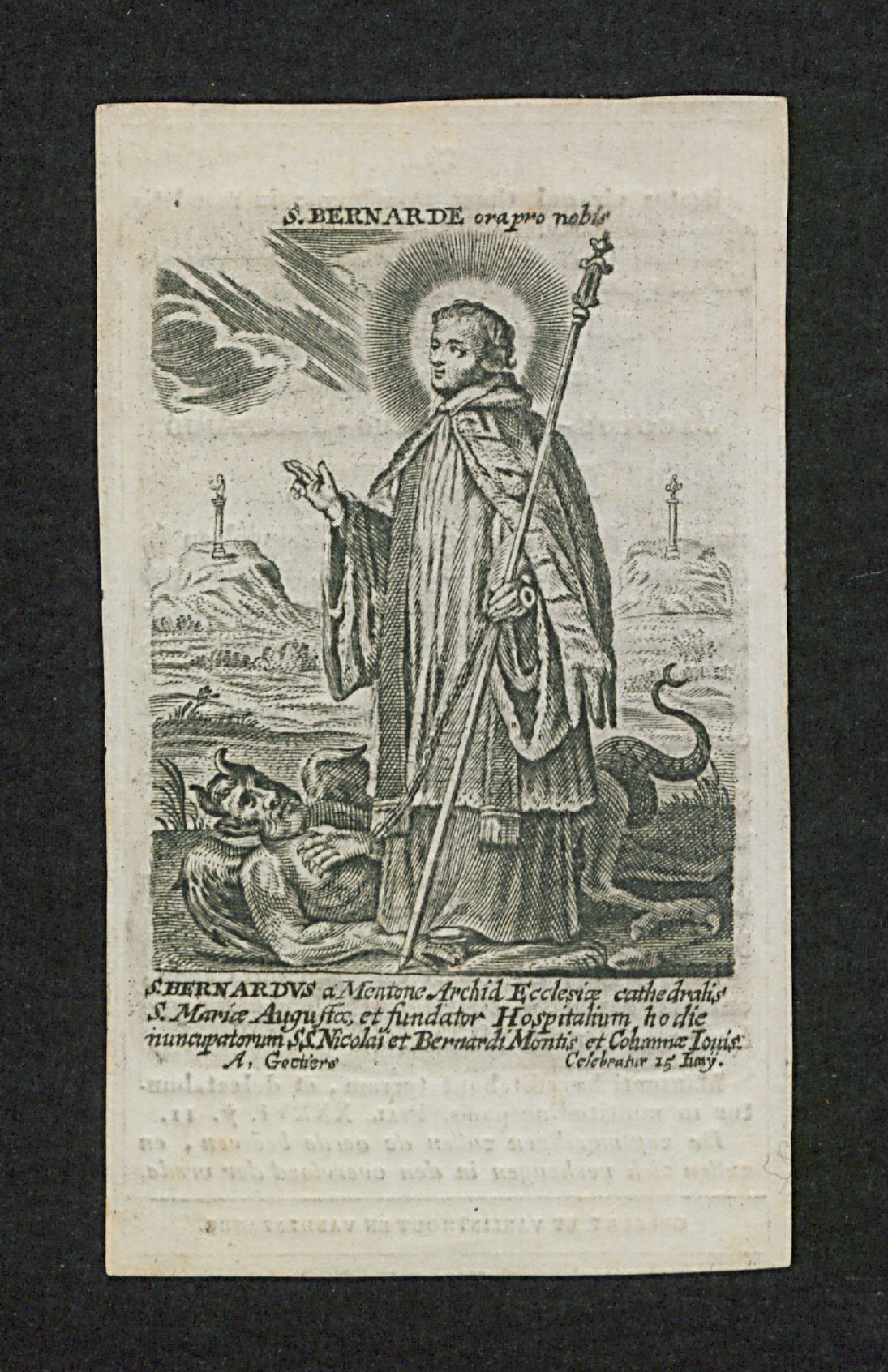
An eleventh-century Alpine priest who founded hospices for travelers on the treacherous mountain passes now named after him, becoming patron of mountaineers.
Saint Bernard de Menthon (c. 1020-1081), also known as Bernard of Montjoux, was a priest from a noble family near Annecy who devoted his ministry to serving travelers crossing the dangerous Alpine passes between Italy and what is now Switzerland and France. According to tradition, after ordination he turned down family expectations of an advantageous marriage and instead became archdeacon of Aosta, where he witnessed firsthand the perils faced by pilgrims, merchants, and soldiers crossing the mountains, including robbers and deadly weather. Around 1050 he founded a hospice at the pass later named the Great Saint Bernard, and another at the Little Saint Bernard Pass, staffed by canons regular who rescued and sheltered travelers, a mission carried on for centuries afterward by the famous Saint Bernard dogs bred at the hospice. He died at Novara in 1081 and is venerated as the patron of Alpine travelers and mountaineers.
Quick Facts
- Born: c. 1020, Menthon, near Annecy, Savoy (modern-day France)
- Died: June 12, 1081, Novara, Italy (age approximately 60)
- Founder of the Canons Regular of the Hospitaller Congregation of Great Saint Bernard, c. 1050
- Feast Day: June 15 (traditionally; May 28 in some regional calendars)
- Declared patron of mountaineers and Alpine dwellers by Pope Pius XI in 1923
- Patronage: mountaineers, skiers, hikers, and the Alps region
Who Was Saint Bernard de Menthon?
Born into a noble family in Savoy, Bernard is traditionally said to have resisted his father’s plans for a suitable marriage and instead escaped to pursue priestly formation, eventually becoming archdeacon of Aosta in the Italian Alps. In that role he took on responsibility for preaching throughout the region and became deeply concerned for the travelers, pilgrims, and merchants who had to cross high mountain passes exposed to avalanches, bandits, and brutal weather. Rather than merely preaching about the danger, he acted on it directly, establishing hospices staffed by canons regular whose mission was to house, feed, and if necessary rescue anyone attempting the crossing, regardless of their background or faith.
Historical Setting
Eleventh-century Europe saw growing traffic across the Alps as pilgrimage to Rome, trade between Italy and northern Europe, and military campaigns all required crossing high mountain passes with no reliable shelter or protection. These routes were notoriously dangerous, plagued by robbers as well as natural hazards, and travelers who lost their way in sudden storms often died of exposure within sight of safety. Bernard’s hospices addressed a very concrete social need of his era, filling a gap that neither secular authorities nor existing religious houses had adequately met, and his foundations became essential waypoints on some of medieval Europe’s busiest travel corridors.
Why the Church Venerates Saint Bernard de Menthon
The Church honors Bernard for a ministry defined by direct, sustained charity toward strangers in physical danger, a concrete expression of the Gospel command to shelter the traveler and rescue those in peril. His hospices operated for centuries after his death, continuing to rescue travelers well into the modern era and giving rise to the celebrated Saint Bernard dogs used in mountain rescue work. His willingness to establish a permanent institution rather than offer only occasional aid reflects a practical, far-sighted charity that the Church has long recognized as a hallmark of genuine holiness.
Canonization and Feast Day
Bernard was venerated locally for centuries before being formally recognized, and Pope Pius XI declared him patron of mountaineers, climbers, and Alpine dwellers in 1923, cementing a connection between his ministry and the modern sport of mountaineering that had grown up around the very passes he once served. His feast is generally kept on June 15, near the anniversary of his death, and he remains especially honored throughout the Alpine regions of France, Switzerland, and Italy.
What Catholics Can Learn Today
Saint Bernard’s life shows how a specific, local danger, faced honestly and addressed with practical, lasting institutions, can become a model of charity for the whole Church. He did not simply express concern for travelers in peril; he built something durable to meet that need, one that continued saving lives long after his own death. His example invites modern Catholics to consider what concrete dangers or unmet needs exist in their own communities and to respond not only with sympathy but with sustained, organized action.
A Prayer to Saint Bernard de Menthon
Saint Bernard de Menthon, protector of travelers on dangerous paths, watch over all who journey through peril, whether on mountain heights or through the hard passes of life. Give us your practical charity, your courage in the face of danger, and your steady care for strangers in need of shelter. Guide us safely home, as you guided so many through the treacherous Alps. Amen.
Sources
- Catholic Encyclopedia (New Advent), entry on Bernard of Menthon
- Butler’s Lives of the Saints, revised edition
- Congregation of Canons Regular of Great Saint Bernard, historical records of the hospice
- Roman Martyrology, June entries