Saint Bede the Venerable
Saints
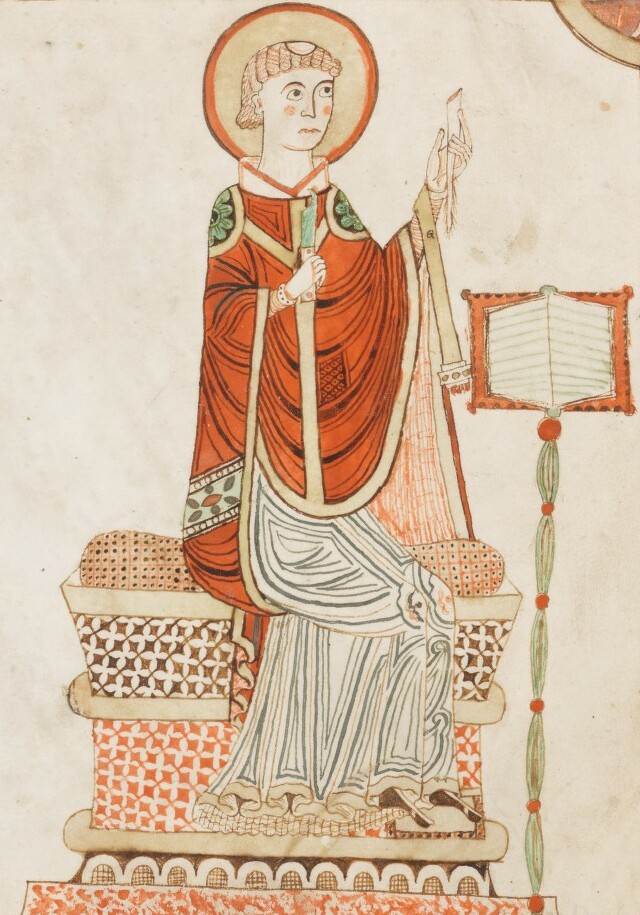
An English Benedictine monk and Doctor of the Church whose Ecclesiastical History of the English People made him the father of English historical writing.
Saint Bede the Venerable (c. 673-735) was an English Benedictine monk who spent almost his entire life at the twin monastery of Monkwearmouth-Jarrow in Northumbria, devoted to study, teaching, and writing. He produced dozens of works on scripture, chronology, natural science, and history, most famously the Ecclesiastical History of the English People, which remains the primary source for early Anglo-Saxon Christianity and earned him the title “Father of English History.” A careful scholar within a well-stocked monastic library built up by his abbots, Bede also helped popularize the dating of events from the birth of Christ, the anno Domini system still used worldwide. He died at Jarrow in 735 while dictating a final translation, reportedly finishing his work moments before death. In 1899 he was declared a Doctor of the Church, the only native of England to hold that title.
Quick Facts
- Born: c. 673, near Monkwearmouth, Northumbria, England
- Died: May 26, 735, Jarrow, England (age approximately 61)
- Benedictine monk and priest at Monkwearmouth-Jarrow
- Feast Day: May 25
- Declared a Doctor of the Church in 1899 by Pope Leo XIII
- Patronage: historians, scholars, and lectors
Who Was Saint Bede the Venerable?
Bede was given as a child, around age seven, to the monastery of Saint Peter at Monkwearmouth, and later moved to its sister house at Jarrow, both founded by Saint Benedict Biscop. He spent the rest of his life there, ordained deacon at nineteen and priest at thirty, rarely traveling beyond the monastery’s walls. Within that stability he became one of the most learned men of his age, writing biblical commentaries, works on grammar and computus (the calculation of dates, especially for Easter), scientific treatises, saints’ lives, and above all his Ecclesiastical History of the English People, completed around 731, which traced the spread of Christianity in Britain from Roman times through his own day.
Historical Setting
Bede lived during the golden age of Northumbrian monastic culture, a period when English monasteries maintained close ties to Rome and built substantial libraries through journeys undertaken by founders like Benedict Biscop. This was still a missionary age for parts of Britain, with Christianity only recently and unevenly established among Anglo-Saxon kingdoms, and Bede’s history preserved crucial details about figures such as Augustine of Canterbury, the Synod of Whitby, and the conversion of various English kings. His monastery’s twin-house structure and its rich collection of manuscripts gave him access to sources most contemporaries could never have consulted.
Why the Church Venerates Saint Bede the Venerable
The Church honors Bede for the extraordinary breadth and rigor of his scholarship placed entirely at the service of faith. His scriptural commentaries shaped medieval biblical interpretation for centuries, and his historical writing preserved the memory of the English Church’s founding saints and structures with unusual care for named sources and eyewitness testimony. His personal holiness, marked by humility, ceaseless work, and a peaceful death spent dictating scripture, made him a model of the scholar-monk whose intellectual labor is itself a form of prayer and service to the wider Church.
Canonization and Feast Day
Bede was venerated as a saint from soon after his death, with the title “Venerable” attached to his name by the ninth century, well before formal canonization processes existed in their later form. Pope Leo XIII declared him a Doctor of the Church in 1899, recognizing centuries of veneration and the enduring value of his writings. His feast is celebrated on May 25, the date closest to his actual death on May 26, since that latter date is already assigned to Saint Philip Neri on the general calendar (Pope Gregory VII in fact shares the May 25 date with Bede as an optional memorial).
What Catholics Can Learn Today
Bede’s life shows that a hidden, stable existence within one small community can still produce work of lasting significance for the whole Church and even for secular scholarship. He never sought fame or traveled widely, yet his careful attention to sources, his intellectual honesty, and his discipline of daily study and prayer left a legacy that shaped how English-speaking Christians understand their own religious history. His example encourages Catholics today to take seriously the quiet, patient work of learning and teaching as a genuine vocation, not a lesser substitute for more visibly dramatic forms of holiness.
A Prayer to Saint Bede the Venerable
Saint Bede the Venerable, faithful monk and tireless scholar, you spent your life within monastery walls yet illuminated the history of a whole nation’s faith. Obtain for us your love of sacred scripture, your patience in study, and your devotion to truth carefully sought and honestly recorded. Help us to find holiness in the quiet, daily work entrusted to us, and to finish our labors, as you finished yours, in peace with God. Amen.
Sources
- Bede, Ecclesiastical History of the English People
- Catholic Encyclopedia (New Advent), entry on Venerable Bede
- Butler’s Lives of the Saints, revised edition
- Roman Martyrology, May 25/26 entries