
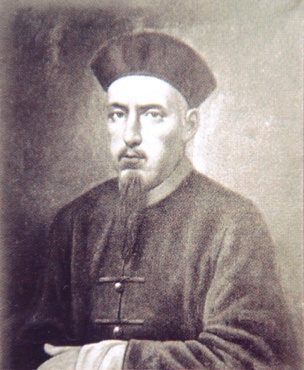
Saint Auguste Chapdelaine
Saints
A French missionary priest whose brutal death in a remote Chinese county in 1856 became both a Catholic martyrdom and, controversially, a pretext for foreign war.
Saint Auguste Chapdelaine (1814-1856) was a French priest of the Paris Foreign Missions Society martyred in Guangxi province, China, in 1856. Ordained in 1843, he served first as a parish priest in France before volunteering for the demanding China mission, entering the country covertly at a time when Christian missionary activity was still restricted under Qing law. Ministering to a small Catholic community in the remote district of Xilin, he was arrested by local authorities, tortured, and executed, an event that came to be known as the Xilin case. His death, along with the mistreatment of other foreigners, was later cited by France and Britain as one of the justifications for launching the Second Opium War against China. Beatified in 1900, he was canonized in 2000 among a large group of martyrs of China, remembered for the pastoral zeal that led him deep into hostile territory to serve a hidden flock.
Quick Facts
- Born: January 6, 1814, in La Rochelle, Coutances, France
- Died: February 29, 1856, at Xilin, Guangxi, China, at age forty-two
- Feast Day: July 9, with the Martyr Saints of China
- Canonized: October 1, 2000, by Pope John Paul II
- Patron of: Missionaries to China, honored among the Martyr Saints of China
Who Was Saint Auguste Chapdelaine?
Auguste Chapdelaine was born in 1814 into a farming family in Normandy, France, and felt drawn to the priesthood relatively late, entering seminary after some years working the family land. Ordained in 1843, he served as a parish priest for several years before seeking permission to join the Paris Foreign Missions Society, a congregation dedicated to sending priests to Asia, and departed for China in 1852. At the time, Christian missionary work remained tightly restricted under imperial Chinese law, and Chapdelaine traveled and ministered largely in secret, adopting local dress and customs to reach small, isolated communities of Catholic converts. He settled in the remote and mountainous district of Xilin in Guangxi province, one of the more dangerous postings available to a foreign priest, where he continued to say Mass, catechize converts, and administer the sacraments despite the constant risk of discovery. In February 1856, local officials arrested him along with several Chinese Catholics on charges connected to his forbidden missionary activity. He was tortured in custody and executed, reportedly beheaded, becoming one of the more widely reported cases of anti-Christian persecution in China during this period.
Historical Setting
Chapdelaine’s mission took place during a tense period in China’s relations with Western powers, as European nations pressed for greater trading and missionary access under treaties China’s government resented and resisted. His execution in 1856 occurred against this backdrop of mutual suspicion, and the incident became internationally significant when the French government cited it, alongside British grievances, as a pretext for launching the Second Opium War against China later that year, entangling a local act of religious persecution with the broader politics of European imperial expansion in East Asia.
Why the Church Venerates Saint Auguste Chapdelaine
The Church venerates Chapdelaine for his willingness to accept extreme personal risk to serve a small, vulnerable Catholic community in a remote corner of China where discovery meant near-certain death. His death is honored strictly as a martyrdom for the faith rather than for any political cause, and the Church has been careful in official reflection to distinguish his religious witness from the diplomatic and military consequences that followed his death, which he neither sought nor could have foreseen.
Canonization and Feast Day
Auguste Chapdelaine was beatified on May 27, 1900, by Pope Leo XIII, among the first large group of China’s nineteenth-century martyrs to be so honored, and canonized on October 1, 2000, by Pope John Paul II as one of 120 Martyrs of China. His individual date of death, February 29, falls on a leap-year day and is rarely available for annual commemoration; the group of China’s martyrs is instead honored together on July 9 each year.
What Catholics Can Learn Today
Chapdelaine’s willingness to serve believers who had almost no access to the sacraments, at the cost of his own safety, challenges Catholics today to consider how far they would go to bring Christ to people the world has largely forgotten. His story is also a sober reminder that acts of martyrdom can become entangled in history’s larger and messier events, and that honoring a martyr’s faith does not require endorsing everything done afterward in his name.
A Prayer to Saint Auguste Chapdelaine
Saint Auguste Chapdelaine, who crossed the world in secret to bring the sacraments to a hidden flock, pray for missionaries who serve today in places where the faith is still forbidden or dangerous to profess. Give us your courage to seek out the isolated and the overlooked, and your steadfastness under threat. Intercede for the Church in China, for the descendants of the Catholics you served, and for peace between nations too easily drawn into conflict. Help us serve Christ’s people wherever they may be found, whatever the risk. Amen.
Sources
- Vatican.va, Holy See canonization records
- the Catholic Encyclopedia (New Advent)
- Paris Foreign Missions Society (Missions Étrangères de Paris), historical archives
- Encyclopaedia Britannica