
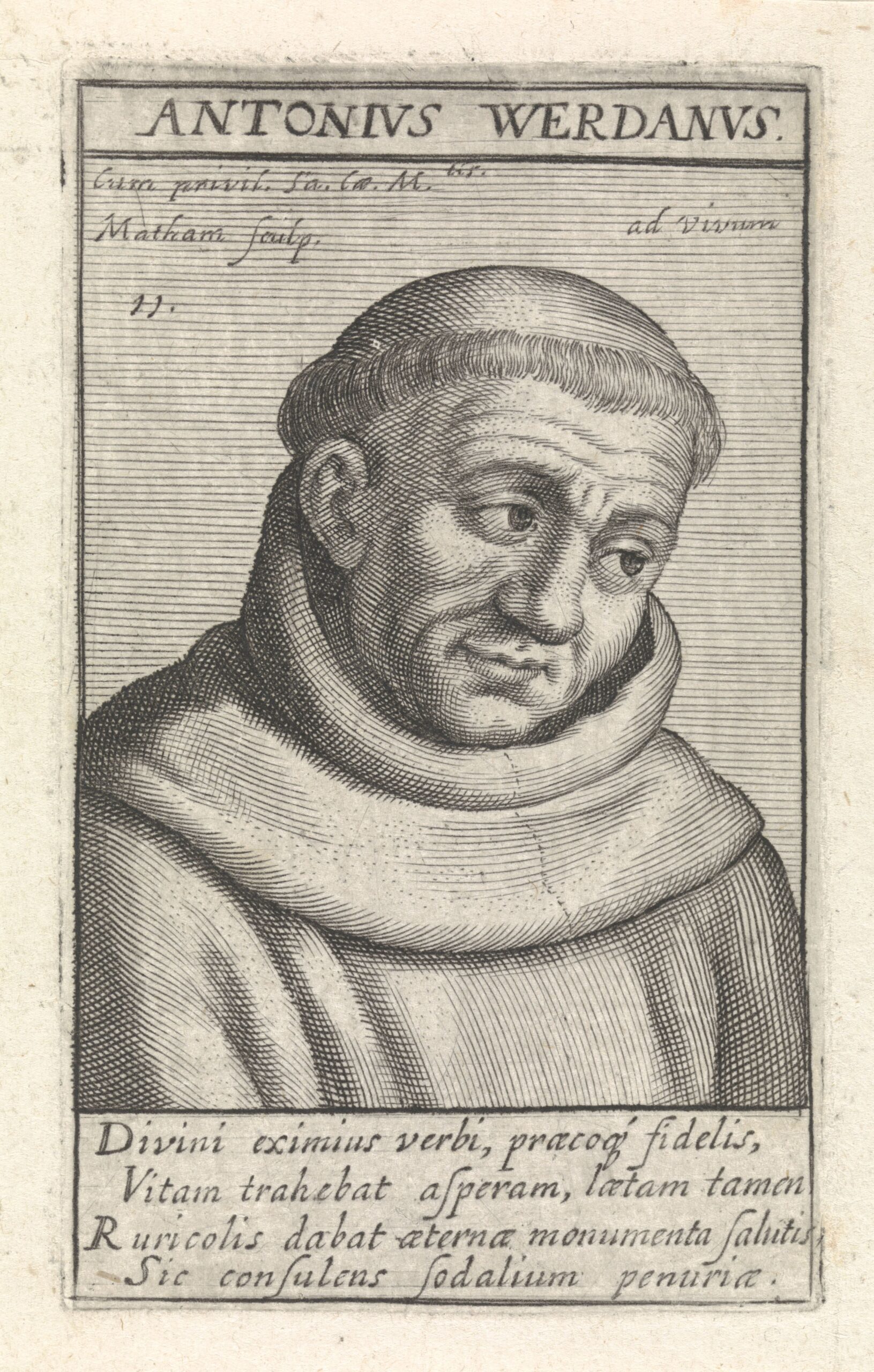
Saint Antonius van Weert
Saints
A forty-eight-year-old Dutch Franciscan friar hanged at Brielle in 1572 with eighteen companions, the Martyrs of Gorkum, for defending papal authority and the Eucharist.
Saint Antonius van Weert was a Franciscan friar of the Observant community at Gorkum, in the Netherlands, born in 1523 in the town of Weert, martyred on July 9, 1572, at forty-eight years old. He was among the group of friars and diocesan priests seized from Gorkum by the Calvinist Sea Beggars during the early Dutch Revolt against Spanish rule, then held captive at Brielle and pressed to publicly deny papal authority and the Catholic teaching on the Real Presence of Christ in the Eucharist. When he and his companions refused, they were hanged together in a peat shed near Brielle on the night of July 9, 1572. Antonius van Weert is venerated as one of the nineteen Martyrs of Gorkum, canonized in 1867 by Pope Pius IX, remembered for their firm doctrinal witness amid the violent religious conflicts of the early Dutch Reformation.
Quick Facts
- Born: 1523, in Weert, Limburg, Netherlands
- Died: July 9, 1572, in Brielle, Zuid-Holland, Netherlands, at age 48
- Feast Day: July 9, with the Martyrs of Gorkum
- Beatified: November 14, 1675, by Pope Clement X
- Canonized: June 29, 1867, by Pope Pius IX
- Patron of: venerated with the Martyrs of Gorkum, honored throughout the Catholic Church in the Netherlands
Who Was Saint Antonius van Weert?
Antonius van Weert was born in 1523 in the town of Weert, in the Duchy of Limburg, and took the religious habit as a friar of the Order of Observant Friars Minor, eventually residing at the Franciscan friary in Gorkum, in the county of Holland. By 1572 he had lived nearly half a century, most of it as a friar, and would have witnessed the growing religious tension in the Low Countries as Calvinist reform movements gained ground against the Catholic and Spanish-aligned authorities. In late June 1572, rebel Calvinist forces known as the Sea Beggars captured Gorkum and arrested the Franciscan community along with several diocesan priests found there. The prisoners, including Antonius van Weert, were transported first to Dordrecht and then to Brielle, where their captors offered them freedom in exchange for a public denial of the pope’s authority over the Church and of the Catholic doctrine that Christ is truly present in the Eucharist. Van Weert, along with his companions, refused these demands, and on the night of July 9, 1572, at forty-eight years old, he was hanged with eighteen others in a makeshift gallows set up in a peat shed outside the town.
Historical Setting
Van Weert’s death occurred in the opening phase of the Dutch Revolt against Spanish Habsburg rule, a conflict that combined a political struggle for autonomy in the Low Countries with sharp religious division between an increasingly Calvinist rebel movement and a Catholic establishment aligned with Spain. The Sea Beggars who seized Gorkum in 1572 were both military combatants and religious partisans, and their treatment of the captured friars, offering release only in exchange for a specific doctrinal denial, reflects how thoroughly theological conflict and armed rebellion were intertwined in this founding period of what would become the Dutch Republic.
Why the Church Venerates Saint Antonius van Weert
Antonius van Weert is venerated for the same reason as his eighteen companions: he was offered a clear escape from death on the sole condition of denying specific Catholic doctrines, and he chose death instead. Having lived nearly fifty years as a friar before his martyrdom, his witness carries the weight of a long, settled religious commitment rather than a decision made in the impulse of youth, and the Church honors that mature, deliberate constancy alongside the shared courage of the whole Gorkum community.
Canonization and Feast Day
Antonius van Weert was beatified with his companions on November 14, 1675, by Pope Clement X, and canonized on June 29, 1867, by Pope Pius IX, as one of the Martyrs of Gorkum, following the Church’s recognition of their deaths as martyrdom for the Catholic faith. Their shared feast is observed on July 9, the anniversary of the executions at Brielle.
What Catholics Can Learn Today
Van Weert’s decades of quiet religious life before his sudden, violent death are a reminder that the constancy required in a moment of crisis is usually the fruit of years of ordinary faithfulness that no one notices at the time. His example suggests that preparing to stand firm, should the moment ever come, is less about a single decisive act than about a whole life of steady practice beforehand. It is also, like the story of his companions, an invitation to remember the cost of division among Christians and to work, without compromising truth, toward the reconciliation later generations have sought.
A Prayer to Saint Antonius van Weert
Saint Antonius van Weert, friar who spent nearly fifty years in quiet religious life before you were called to give it entirely, you met your final test with the same constancy you had practiced for decades. Obtain for us the patience to build, day by day, the kind of faith that does not waver when finally tested. Pray for friars and religious everywhere who live hidden, faithful lives, and for reconciliation among the Christian communities still divided by the conflicts of your era. Amen.
Sources
- the Catholic Encyclopedia (New Advent), entry on the Martyrs of Gorkum
- Vatican.va
- EWTN
- the historical archive of the Order of Friars Minor