

Saint Abraham Kidunaia
Saints
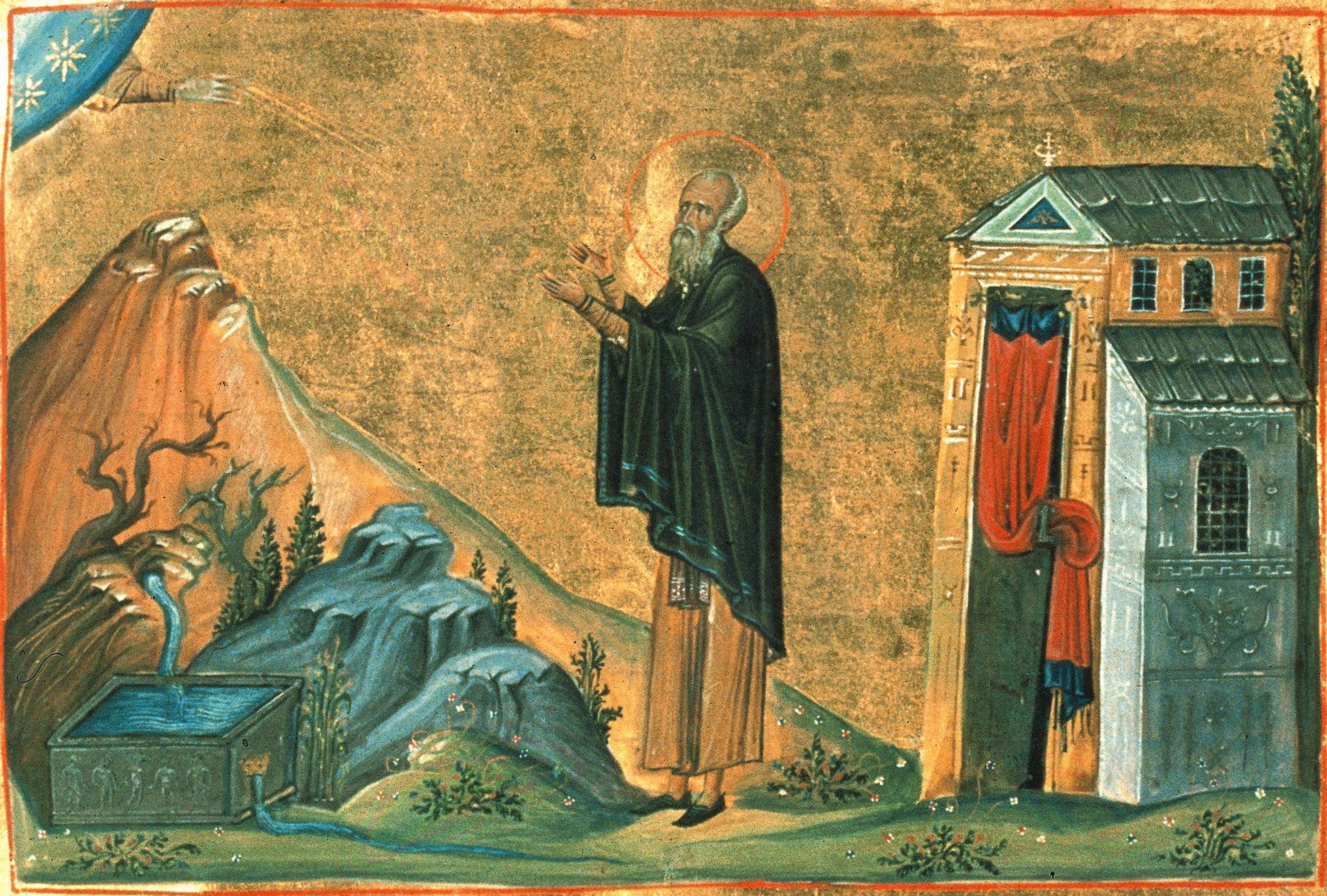
A Syriac hermit-priest near Edessa remembered for years of solitary prayer and for gently bringing his wayward niece Mary back from despair.
Abraham of Qidun, often called Abraham Kidunaia, was a hermit and priest who lived near Edessa in Syria, probably in the fourth century. Born into a prosperous family, he is said to have abandoned an arranged marriage on his wedding day in order to give himself entirely to solitude and prayer, living for years walled into a small cell. Ordained a priest against his own wishes, he was sent to evangelize a resistant pagan village, where tradition says he endured hostility patiently until the community converted, after which he returned gladly to his hermitage. He is best remembered for the story of his niece Mary, who, after being seduced and abandoning her own ascetic life in shame, was sought out by Abraham in disguise and gently persuaded to return to God without condemnation. Because these details come through later hagiographical writing, they should be read as treasured spiritual tradition rather than verified biography.
Quick Facts
- Born: date unknown; traditionally fourth century, near Edessa
- Died: traditionally fourth century, near Edessa
- Feast Day: March 16 (Roman Martyrology); other dates observed in Eastern traditions
- Canonization: none; recognized through ancient cult
- Patron of: no formal patronage assigned
Who Was Saint Abraham Kidunaia?
According to his Life, Abraham was born to a wealthy family in the region around Edessa in Syria and was expected to marry well and take his place in ordinary society. On the day of his wedding, or shortly after, he is said to have left his bride and his household behind to embrace a life of solitude, walling himself into a small cell attached to his family home and later moving to more remote seclusion, where he devoted himself to fasting, prayer, and manual work over many years. His reputation for holiness eventually reached local church authorities, who ordained him a priest, reportedly against his strong personal preference for a hidden life, and sent him to a village that had resisted every previous attempt at evangelization. The tradition describes Abraham enduring rejection, hostility, and even physical abuse from the villagers with patience, refusing to abandon them until a Christian community had genuinely taken hold there, after which he returned to his hermitage. The most beloved episode of his Life concerns his orphaned niece, Mary, whom he had raised and trained in ascetic discipline from childhood, only for her to be seduced by a man who visited her cell and then, in despair and shame, to abandon her vocation entirely for a life of sin in a nearby town. Abraham is said to have disguised himself as a traveler, tracked her down, and won her back through patient love and mercy rather than reproach, restoring her to the religious life she had left.
Historical Setting
Abraham Kidunaia belonged to the world of early Syriac Christian monasticism, a movement that flourished in the region around Edessa and across Mesopotamia from the fourth century onward, developing its own distinctive practices, often more austere than the roughly contemporary Egyptian desert tradition, including forms of solitary enclosure in small cells rather than life in organized monastic communities. This was also an era of active missionary effort in the villages surrounding cities like Edessa, where Christianity was well established in urban centers but had not always penetrated the surrounding countryside, requiring dedicated ministers willing to face suspicion and hostility from populations still attached to older religious practices. The Syriac Christian world of this period produced a rich body of ascetic and hagiographical literature, of which Abraham’s Life is one notable example.
Why the Church Venerates Saint Abraham Kidunaia
Abraham is venerated for combining two forms of holiness that do not always appear together: an intense, self-effacing life of solitary prayer, and a willingness to leave that solitude behind when obedience and pastoral need required it. His patient evangelization of a hostile village models perseverance in ministry that yields fruit only slowly and without recognition. Above all, his search for his niece Mary has made him beloved as an image of God’s own mercy, seeking out the person who has fallen away not with condemnation but with patient, disguised, persistent love, a story that has shaped Christian understanding of repentance and forgiveness for over a thousand years, regardless of how much of its detail is historically verifiable.
Canonization and Feast Day
Abraham Kidunaia’s cult predates the modern papal canonization process by many centuries. He is commemorated in the Roman Martyrology on March 16, and various Eastern Christian traditions honor him on other dates according to their own calendars. There is no beatification or canonization decree to cite for Abraham; his recognition as a saint rests on ancient and continuous liturgical memory in both the Syriac Christian tradition where his story originated and the wider Church that later received his Life. A page presenting Abraham should describe him as commemorated through this ancient reception rather than assign him a fabricated formal process.
What Catholics Can Learn Today
Abraham’s story of seeking out his niece Mary offers one of Christian tradition’s most tender pictures of how mercy should be extended to someone who feels too ashamed to return on their own. Rather than waiting for Mary to come back and confess, Abraham went looking for her, met her without judgment, and drew her home through patience rather than pressure. For Catholics today, his example is a model for how to approach anyone, a family member, a friend, who has drifted from faith through failure or shame: not with condemnation, but with the same disguised, humble persistence Abraham showed, trusting that love can still reach someone who believes they are beyond it.
A Prayer to Saint Abraham Kidunaia
Saint Abraham Kidunaia, hermit of Edessa, you left comfort for solitude, and solitude for a hostile village, and finally your solitude again to find one lost soul. Teach us to seek out those who feel too ashamed to come home, meeting them with patience rather than judgment. Give us your endurance in quiet, unseen prayer, and your courage to leave that quiet when love requires it. Pray for every family with someone who has wandered far from God, that they may be found as gently as you found Mary. Amen.
Sources
- the Roman Martyrology
- the Catholic Encyclopedia (New Advent), entry on Abraham of Qidun
- Butler’s Lives of the Saints
- the Syriac hagiographical tradition of Edessa, as preserved by the Bollandists