Saint Thomas Aquinas
Saints
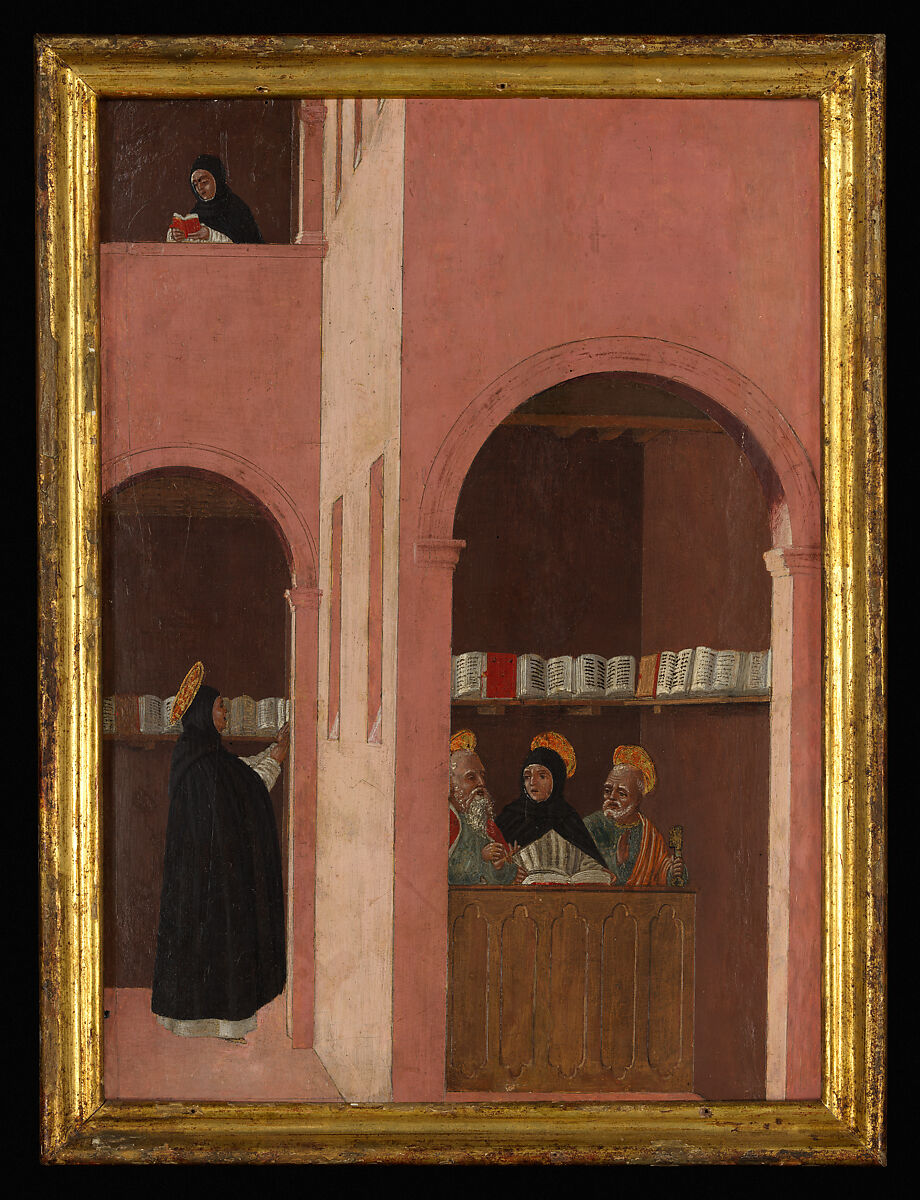
A thirteenth-century Dominican friar whose Summa Theologiae fused Christian faith with Aristotelian philosophy, shaping Catholic theology so profoundly that he is honored as the Church’s ‘Angelic Doctor.’
Saint Thomas Aquinas (c. 1225-1274) was an Italian Dominican friar and theologian whose writings became the single most influential body of work in the history of Catholic theology. Born into a noble family near Aquino in the Kingdom of Sicily, he joined the newly founded Dominican Order against his family’s fierce objections, reportedly enduring nearly a year of confinement by his own relatives as they tried to dissuade him. He studied under Saint Albert the Great in Cologne and later taught at the University of Paris and at papal courts in Italy, producing an enormous body of work that included the massive, unfinished ‘Summa Theologiae’ and the ‘Summa Contra Gentiles,’ both landmark efforts to reconcile Christian revelation with the philosophy of Aristotle, then newly reintroduced to Western Europe. He died in 1274 while traveling to the Second Council of Lyon, was canonized in 1323, and was declared a Doctor of the Church in 1567, earning the traditional title Doctor Angelicus, the Angelic Doctor.
Quick Facts
- Born: c. 1225, Roccasecca, near Aquino, Kingdom of Sicily (Italy)
- Died: March 7, 1274, Fossanova Abbey, Italy
- Feast Day: January 28
- Canonized: July 18, 1323, by Pope John XXII
- Declared Doctor of the Church: 1567, by Pope Pius V (‘Doctor Angelicus,’ the Angelic Doctor)
- Patron of: Catholic schools, universities, theologians, and students
Who Was Saint Thomas Aquinas?
Thomas Aquinas was born around 1225 at his family’s castle in Roccasecca, near Aquino, in the Kingdom of Sicily, to a family of minor nobility with connections to the Holy Roman imperial house. Sent as a child oblate to the great Benedictine abbey of Monte Cassino, he later studied at the University of Naples, where he first encountered both the newly founded Dominican Order and the works of Aristotle, then being reintroduced to Western Europe largely through Arabic and Jewish scholarly commentary. Around 1244 he resolved to join the Dominicans, a decision his family fiercely opposed; according to tradition, his brothers physically intercepted him and held him confined at the family castle for close to a year in an unsuccessful attempt to break his resolve. Once free, Thomas pursued rigorous theological studies under Saint Albert the Great, first in Paris and then in Cologne, before beginning his own long teaching career at the University of Paris and at various Dominican and papal centers of study in Italy, including Orvieto, Rome, and Naples. Over roughly two decades he produced an extraordinary body of writing, commentaries on Aristotle and Scripture, disputed questions, hymns composed for the newly established feast of Corpus Christi, and above all his two great theological syntheses, the ‘Summa Contra Gentiles’ and the vast, ultimately unfinished ‘Summa Theologiae,’ which systematically addressed nearly every major question of Christian doctrine using the philosophical tools of Aristotelian logic and metaphysics. In 1274, while traveling to attend the Second Council of Lyon at the pope’s summons, he fell ill and died at the Cistercian abbey of Fossanova.
Historical Setting
Aquinas lived during the High Middle Ages, a period of remarkable intellectual ferment marked by the rise of universities as new centers of formal learning and by the reintroduction into Western Christendom of Aristotle’s philosophical works, which had been largely lost to Latin Europe but preserved and extensively commented upon by Islamic and Jewish scholars. This influx of Aristotelian thought posed real challenges to Christian theology, since some of its conclusions seemed to conflict with revealed doctrine, and Aquinas’s life work was substantially devoted to demonstrating that faith and reason, properly understood, were not opposed but complementary. His era also saw tension between the newly founded mendicant orders, the Dominicans and Franciscans, and more established secular clergy at the University of Paris, who resented the mendicants’ growing academic influence.
Why the Church Venerates Saint Thomas Aquinas
The Church honors Thomas Aquinas as perhaps its most influential theologian, whose systematic integration of faith and philosophical reason shaped Catholic doctrine on subjects ranging from the nature of God and the sacraments to natural law and moral virtue, an influence that persists in seminary education and official Church teaching to this day. He is also remembered for a personal holiness inseparable from his intellectual labor, famously described by his own principle that the fruits of contemplation should be handed on to others, and for a humility that led fellow students to nickname him the ‘Dumb Ox,’ a jest to which his teacher Albert the Great reportedly replied that this ox’s bellow would one day be heard throughout the world.
Canonization and Feast Day
Thomas Aquinas was canonized on July 18, 1323, by Pope John XXII, less than fifty years after his death. In 1567, Pope Pius V declared him a Doctor of the Church, honoring him with the traditional title Doctor Angelicus, the Angelic Doctor. His feast day, originally observed on March 7, the date of his death, was later moved in the Church’s calendar reform to January 28, the date associated with the translation of his relics, since March 7 regularly falls during Lent.
What Catholics Can Learn Today
Aquinas’s confidence that genuine reason and genuine faith cannot ultimately contradict one another remains a valuable resource for believers navigating tensions between scientific inquiry, philosophy, and religious belief today. His personal discipline, ordering an immense intellectual output toward prayer and the service of others rather than mere academic achievement, also offers a model for anyone seeking to integrate demanding study or work with a serious spiritual life.
A Prayer to Saint Thomas Aquinas
Saint Thomas Aquinas, patron of scholars and seekers of truth, you devoted your great mind entirely to the service of God. Grant us your love of learning joined to humility, your patience in difficult study, and your confidence that faith and reason are friends, not enemies. Help us to seek truth wherever it may be found, and to offer what we learn back to God and to those we serve. Amen.
Sources
- Vatican.va, biographical materials on Thomas Aquinas
- the Dominican Order (Order of Preachers), historical records
- the Catholic Encyclopedia (New Advent)
- Encyclopaedia Britannica