
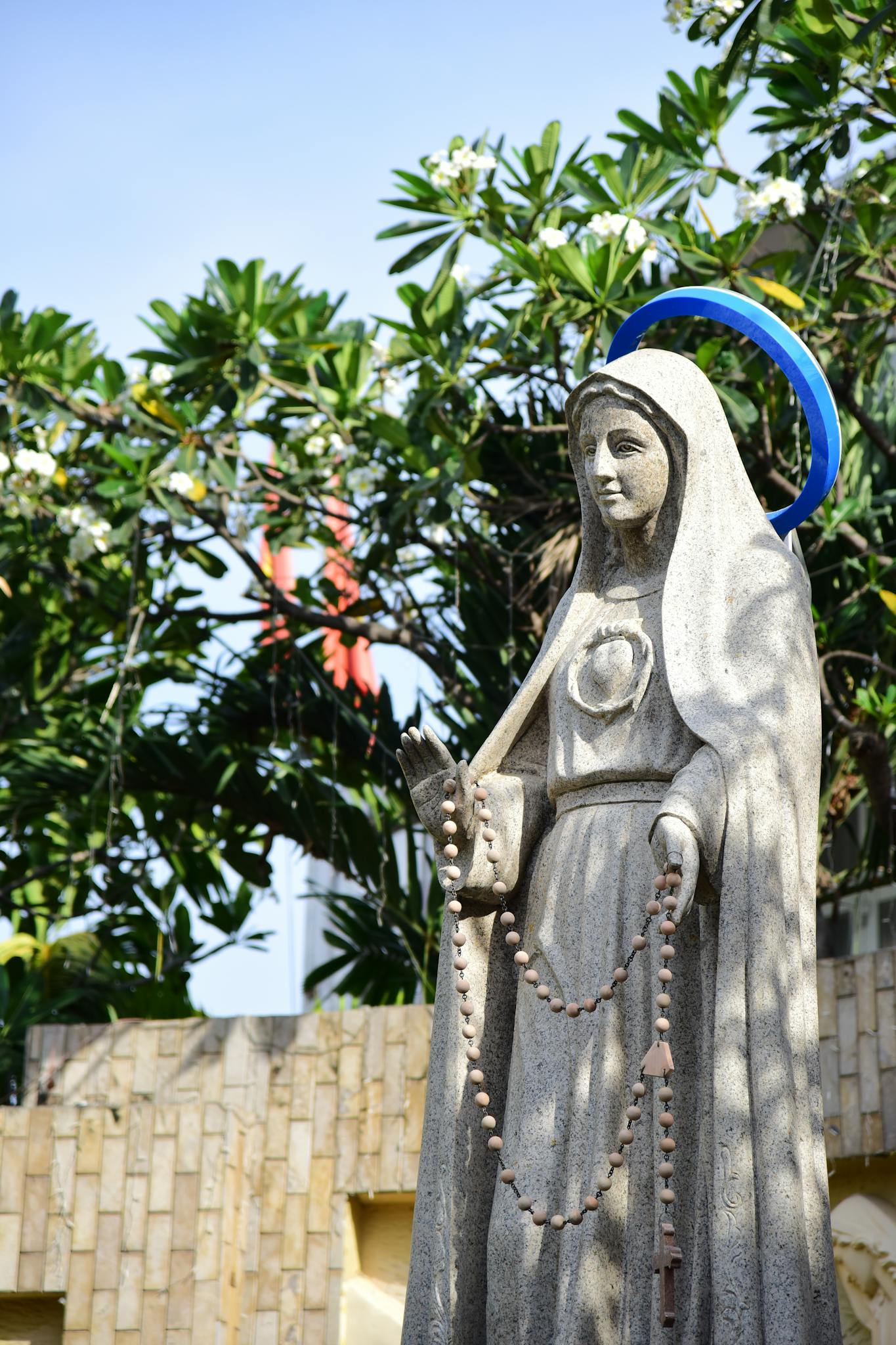
Our Lady of Walsingham
Devotions
England’s medieval Marian pilgrimage shrine, destroyed at the Reformation and rebuilt in separate Catholic and Anglican forms since the 1890s.
Our Lady of Walsingham is a Marian title tied to a medieval English shrine in Norfolk, traditionally founded after a noblewoman named Richeldis de Faverches reported a vision instructing her to build a replica of the Holy House of Nazareth. Destroyed under Henry VIII in 1538, the shrine was revived separately by Catholics and Anglicans beginning in the 1890s and 1920s, and today both a Catholic National Shrine and an Anglican shrine stand in the village, each keeping the ancient title alive in its own tradition.
Quick Facts
- Category: Marian Apparitions and Shrines — Major International Devotions
- Origin: A medieval English shrine, traditionally founded after a vision reported by Richeldis de Faverches around 1061; historians debate the exact founding date
- Feast: September 24 (England; local calendar)
- Church status: An ecclesially recognized shrine and pilgrimage tradition; the Catholic shrine holds Minor Basilica status
- Private revelation: Not necessary to the devotion as a matter of faith; the 1061 founding vision is centuries-old shrine tradition, first recorded long after the fact, rather than a case examined under the Church’s modern private-revelation procedures
What Is This Devotion?
Devotion to Our Lady of Walsingham centers on a specific place rather than a specific reported message: an English village that, according to founding tradition, became home to a physical replica of Mary’s own house in Nazareth, built so that pilgrims who could not travel to the Holy Land might still walk, in imagination, through the rooms where the Annunciation was believed to have taken place. For nearly five centuries it stood among the most important pilgrimage sites in Christian Europe, before Reformation-era destruction and a more recent, twentieth-century double revival, Catholic and Anglican, that continues today.
Origin and History
According to a tradition first recorded in the fifteenth-century Pynson Ballad, Richeldis de Faverches, a noblewoman of Walsingham, experienced a vision around the year 1061 in which Mary showed her the house of the Annunciation in Nazareth and asked her to build an exact replica in Walsingham as a perpetual memorial. Modern historians have questioned this precise dating; the scholar J.C. Dickinson argued in 1959 that the shrine more likely originated between 1130 and 1153, closer to when Richeldis’s son, Geoffrey de Faverches, is documented as having formally established Walsingham Priory for Augustinian canons, while other historians continue to defend the traditional eleventh-century date. What is not in dispute is the shrine’s subsequent importance: by the later Middle Ages, Walsingham ranked among England’s principal pilgrimage destinations, visited by a long line of English monarchs from Henry III through Henry VIII himself, who made his own pilgrimage there early in his reign, traditionally dated to 1511, decades before he later ordered the shrine’s destruction.
The Reformation ended medieval Walsingham abruptly: the priory was suppressed in 1538 under Henry VIII, its statue of Mary removed to London, and the buildings largely demolished, leaving only fragments such as the priory’s gatehouse and a ruined arch standing amid farmland for more than three centuries. Catholic devotion returned only in the late nineteenth century, when Charlotte Boyd purchased the medieval Slipper Chapel, the last surviving wayside chapel on the old pilgrim route, in 1896; Pope Leo XIII issued a decree the following year blessing a new statue for a restored Holy House at King’s Lynn, and organized Catholic pilgrimage resumed for the first time since the Reformation. The shrine transferred to the restored Slipper Chapel itself in 1934, received a canonical coronation from Pope Pius XII in 1954, and was raised to Minor Basilica status by Pope Francis in 2015. A separate Anglican revival began when Fr. Alfred Hope Patten, appointed vicar of Walsingham in 1921, placed a new statue of Our Lady of Walsingham in the parish church the following year; a dedicated Anglican shrine chapel opened in 1931 and was expanded in 1938, and it continues today alongside, but institutionally distinct from, the Catholic National Shrine.
Catholic Theology
Whatever the precise date of its founding, the devotional logic of Walsingham has always centered on the mystery of the Incarnation: a physical space built to help pilgrims meditate concretely on the moment God became man in Mary’s womb, much as the Holy House shrine at Loreto does in Italy. Visiting or venerating an image at Walsingham is, theologically, an act of the same kind as any pilgrimage — a physical journey meant to deepen an interior one, directing the pilgrim’s prayer through Mary toward her Son, not toward the shrine or the statue as ends in themselves.
How to Practice It
- Make a pilgrimage to the Catholic National Shrine or the Anglican Shrine of Our Lady of Walsingham in Norfolk, England.
- Meditate on the mystery of the Annunciation, the event the original Holy House replica was built to commemorate.
- Learn the documented history of the shrine’s medieval founding, Reformation-era destruction, and modern restoration, distinguishing each from the eleventh-century legend that began it.
- Pray for Christian unity, since Walsingham today is unusually marked by parallel Catholic and Anglican devotion to the same title.
Associated Prayers
When It’s Observed
September 24 is kept as the feast of Our Lady of Walsingham on local and national calendars in England; it is not on the General Roman Calendar for the universal Church.
Church Status
Walsingham holds solid, long-recognized status as a place of Catholic pilgrimage: the medieval shrine’s importance is thoroughly documented, its Reformation-era destruction is a matter of historical record, and its modern Catholic revival carries the Holy See’s own direct approval, expressed through Leo XIII’s 1897 decree, Pius XII’s 1954 coronation, and Pope Francis’s 2015 elevation of the shrine to Minor Basilica. The precise circumstances of its eleventh-century founding remain a matter of historical debate rather than settled fact, which the Church’s own approvals have never required resolving.
Common Misconceptions
“The Catholic and Anglican shrines at Walsingham are the same institution.”
They are not. Following separate twentieth-century revivals, two distinct shrines exist in the village today: the Catholic National Shrine, centered on the restored Slipper Chapel and holding Minor Basilica status, and a separate Anglican shrine built around Fr. Hope Patten’s 1922 restoration. Both honor the same medieval title and often cooperate, but they are governed and maintained independently.
Frequently Asked Questions
Did Mary actually appear to Richeldis de Faverches in 1061?
That is the shrine’s own founding tradition, first written down centuries later in the fifteenth-century Pynson Ballad. Historians disagree about the exact date the shrine was founded, with some placing it as much as a century later, and the Church has never required belief in the specific 1061 date or vision as a condition of the devotion.
What happened to the original shrine?
It was suppressed in 1538 under Henry VIII during the dissolution of the monasteries, its statue removed and the buildings largely demolished, leaving the site in ruins for more than three hundred years until Catholic, and later Anglican, restoration began in the late nineteenth and early twentieth centuries.
Why are there two separate Walsingham shrines today?
Catholic and Anglican devotion to Walsingham were revived independently, decades apart and by different people — Charlotte Boyd and the Catholic hierarchy beginning in the 1890s, and Fr. Alfred Hope Patten within the Church of England beginning in the 1920s — resulting in two shrines that stand near each other but remain institutionally separate.
Is Walsingham connected to the Holy House of Loreto in Italy?
They share the same devotional idea — a physical replica of Mary’s house at Nazareth built for pilgrims — though the two shrines developed independently, Walsingham in eleventh or twelfth-century England and Loreto in thirteenth-century Italy, each with its own separate history.
Sources
- Directory on Popular Piety and the Liturgy: Principles and Guidelines (2001)
- General Roman Calendar
- Catholic National Shrine of Our Lady of Walsingham — official website